Here is my verdict up front: there is no perfect sampling rate for receiving inspection. There is only the right rate for this shipment, from this supplier. Sample too much, and you choke the dock — trucks queue up outside while your team is still opening cartons. Sample too little, and a batch of defective goods walks into your warehouse, and the trouble comes later. Warehouse receiving inspection sampling is not really about the table. It is about how much risk this shipment carries.
I have seen too many warehouses go to extremes on this. Once I visited a home-goods warehouse where the receiving lead was venting to me: quality control demanded a full inspection on a new shipment, six thousand units, two people, a whole day. Three trucks were queued at the gate and the drivers were complaining in the group chat. Another warehouse was the opposite — receiving was basically a glance at the pallet. A batch of shelving connectors with the wrong holes got in, and nobody found out until the racks were being assembled at the customer's site. Two weeks of returns and rework. Put plainly, sampling has two sides: inspection is money spent on certainty, and skipping it is money saved on a gamble. First figure out what losing that gamble would cost you.
The proper way to set a sampling rate borrows from AQL — the acceptance quality limit, under ISO 2859-1, with ANSI/ASQ Z1.4 as the American equivalent. The logic is simple: look up the sample size from the lot size, then accept or reject the whole lot based on the number of defects found. General Inspection Level II is the default, and most day-to-day receiving uses it. Here are the numbers from the standard's tables: for a lot of 281 to 500 units at General Level II, you pull 50 units, and at AQL 2.5 for major defects you accept up to 3 and reject at 4. For 501 to 1,200 units, you pull 80, accept up to 5, reject at 6. For 1,201 to 3,200 units, you pull 125, accept up to 7, reject at 8. Critical defects usually carry an AQL of 0 — one critical defect fails the lot. These numbers come from the ISO 2859-1 and ANSI/ASQ Z1.4 tables, not from my head.
But the table is a starting point, not the answer. The same 50-unit sample means something very different for a new supplier than for an old one. For a new supplier's first three lots, my advice is to tighten up: either move to General Inspection Level III for a bigger sample, or tighten the AQL by one step. It is not that you distrust them — it is that you know nothing yet about their process, their packaging, or their labeling habits. The first three lots are tuition. An established supplier is the opposite: ten clean lots in a row, and you can drop to General Inspection Level I, or use reduced inspection, and give the saved time back to the dock. The principle is simple: the sampling rate should follow the supplier's track record, not a single fixed rule.
When the Warehouse Receiving Inspection Sample Fails, What Happens to the Whole Lot
The real test of inspection is not how much you sample. It is what you do when the sample fails. I have seen too many warehouses fall apart at this step: quality says there is a problem, receiving says let it in and sort it out later, sales is pushing for the stock, the three sides argue, and the bad goods slide into the warehouse anyway.
My approach is: a failed sample freezes the whole lot first, then three steps. Step one, isolate it. The questionable goods go to a separate area, locked in the system, and nobody ships from them on the quiet. Step two, expand the sample. Double the sample size and find out whether the problem is a few stray units or the whole batch. If the expanded sample is still past the acceptance number, the lot is decided. Step three, disposition by situation: return it if you can, and if you cannot, negotiate rework, replacement, or acceptance at a discount. A discounted acceptance needs a written record — who approved it, how much was discounted, who owns it if problems show up later. A discounted acceptance with no written record is just an open invitation to a future argument.
I learned this one the hard way, watching it happen. A warehouse received a batch of small appliances. Inspection found a high rate of damaged outer cartons, but the products inside looked fine, so the receiving manager let it through. The return rate on that batch came in well above normal, and when they investigated, they found the same transit knocks that damaged the cartons had caused hidden damage inside the products. After that, the warehouse set a rule: if outer-carton damage exceeds the agreed rate, the lot fails, no matter how good the inside looks. Put plainly, sampling is not theater. When it flags something, somebody has to take it seriously.
A Warehouse Receiving Inspection Sampling Framework: Three Tiers Are Enough
I do not like making simple things complicated. For warehouse receiving inspection sampling, three tiers are enough.
The tightened tier: a new supplier's first three lots, goods from a changed line or process, categories with complaint history, or high-value or safety-related items. Use General Inspection Level III, or tighten the AQL by one step. A failed sample freezes the lot, the sample expands, and only then do you decide.
The normal tier: stable suppliers, routine categories, clean history. Use General Inspection Level II, with AQL set by defect class — 0 for critical, 2.5 for major, 4.0 for minor. That is a common convention in consumer goods, not a number written into the standard, so put it in the contract explicitly.
The reduced tier: long-standing suppliers with many consecutive clean lots, low-value, low-risk consumables. Use General Inspection Level I, or the reduced-inspection rules in ISO 2859-1 — with one tripwire: two problem lots in a row, and you go straight back to the normal tier. Earn your way back down.
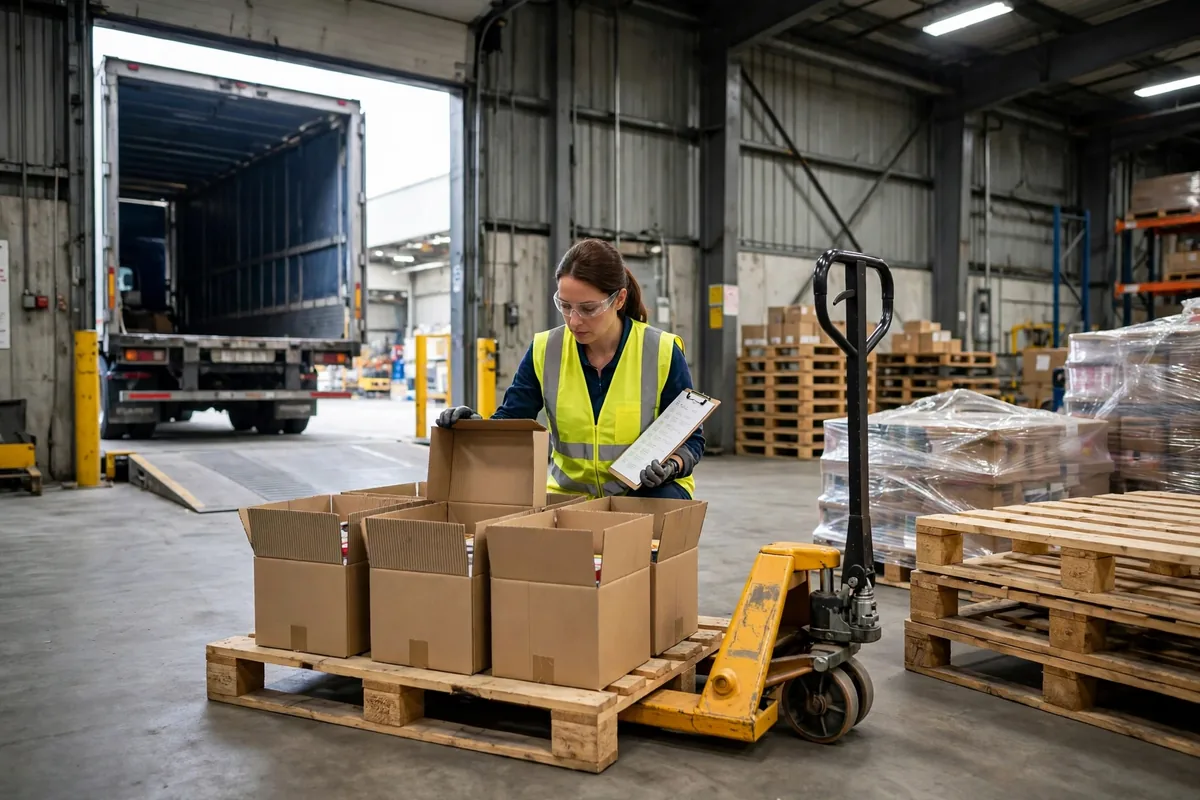
How you move between these tiers belongs in the receiving work instruction, not in the receiving lead's mood that day. Moods change; rules do not. And one thing many people miss: do not only sample the top layer. The most common shortcut on the dock is opening the top few cartons and never touching the bottom. Random sampling sounds easy and is hard to do. My low-tech fix: decide before receiving which pallets and which cartons to pull, write it on the slip, and have the inspector sample from the slip and sign it. The slip is evidence, and it is also a constraint.
Is the Time Spent on Sampling Worth It
This has two sides. Yes, sampling slows the dock. Half an hour extra per lot, ten lots a day, that is five hours. But think about it the other way: the defective goods that slip through get found at picking, at returns, or when a customer complains. What does that cost? Rework labor, a second shipment, a customer claim — every one of those costs more than pulling a few extra units at receiving.
I have seen too many people fail this math, because the cost of receiving is visible and the trouble after putaway is invisible. My suggestion is to run the numbers once a quarter: how many labor hours went into inspection, how many problem lots were stopped, how many returns and complaints were avoided. Put the numbers on the table, and the next time someone complains that inspection is slow, you will have an answer.
Warehouse receiving inspection sampling comes down to one question: how much will it cost you if this lot goes wrong? Once you know that number, the sampling rate picks itself. So tell me — is the rate you sample at today set by risk, or by habit?
By Lao Mi, Supply Chain Veteran (20 yrs)