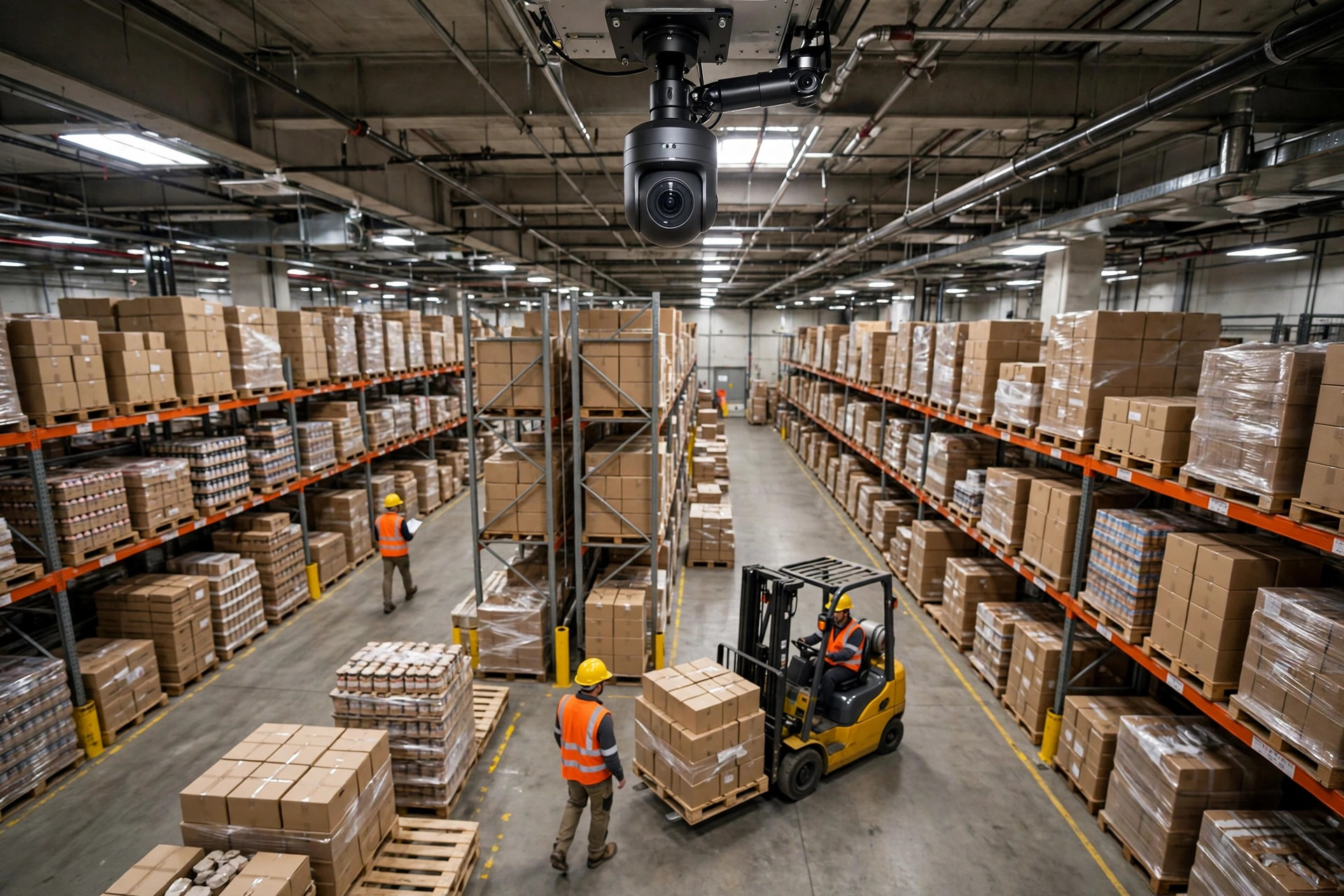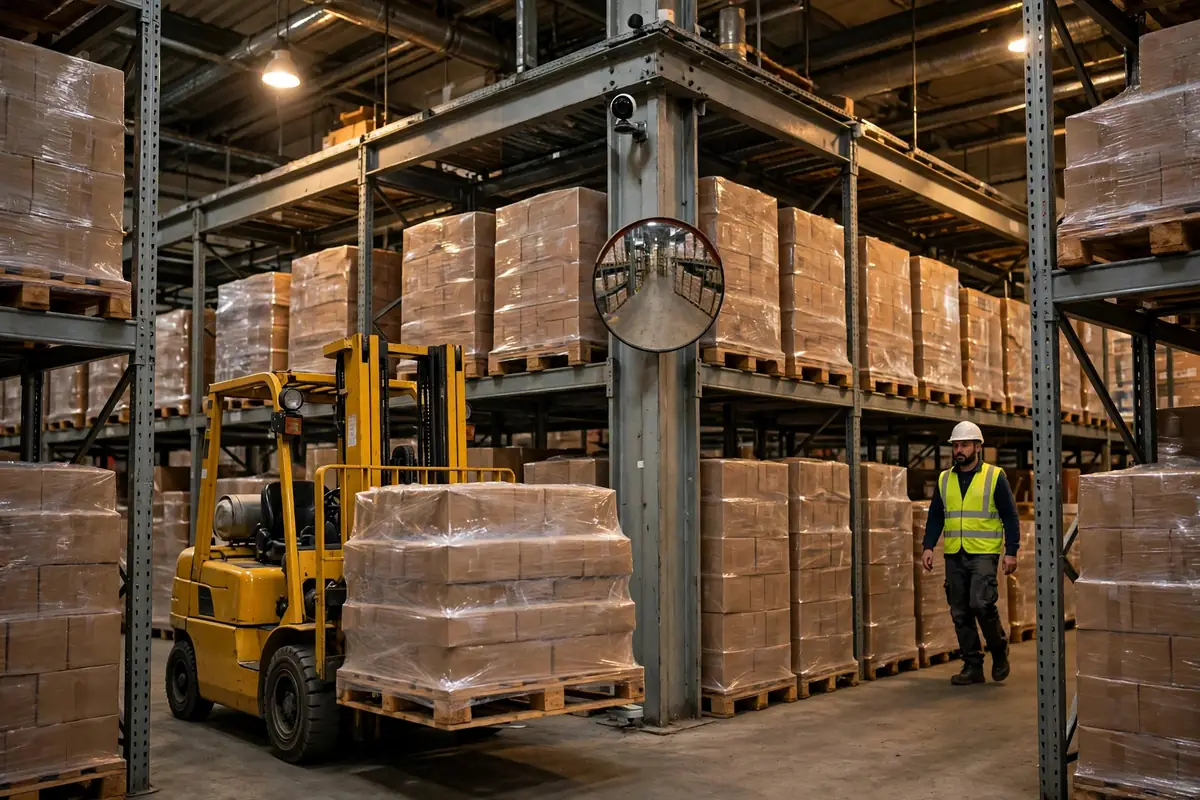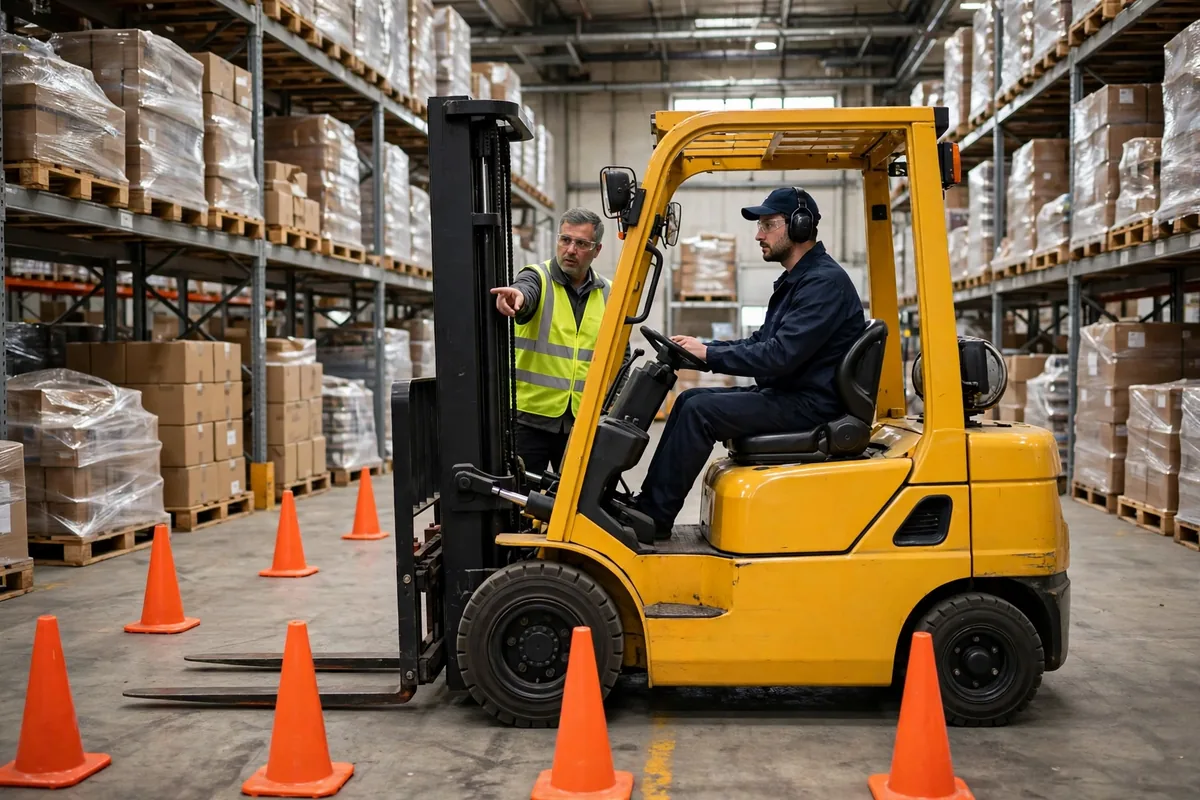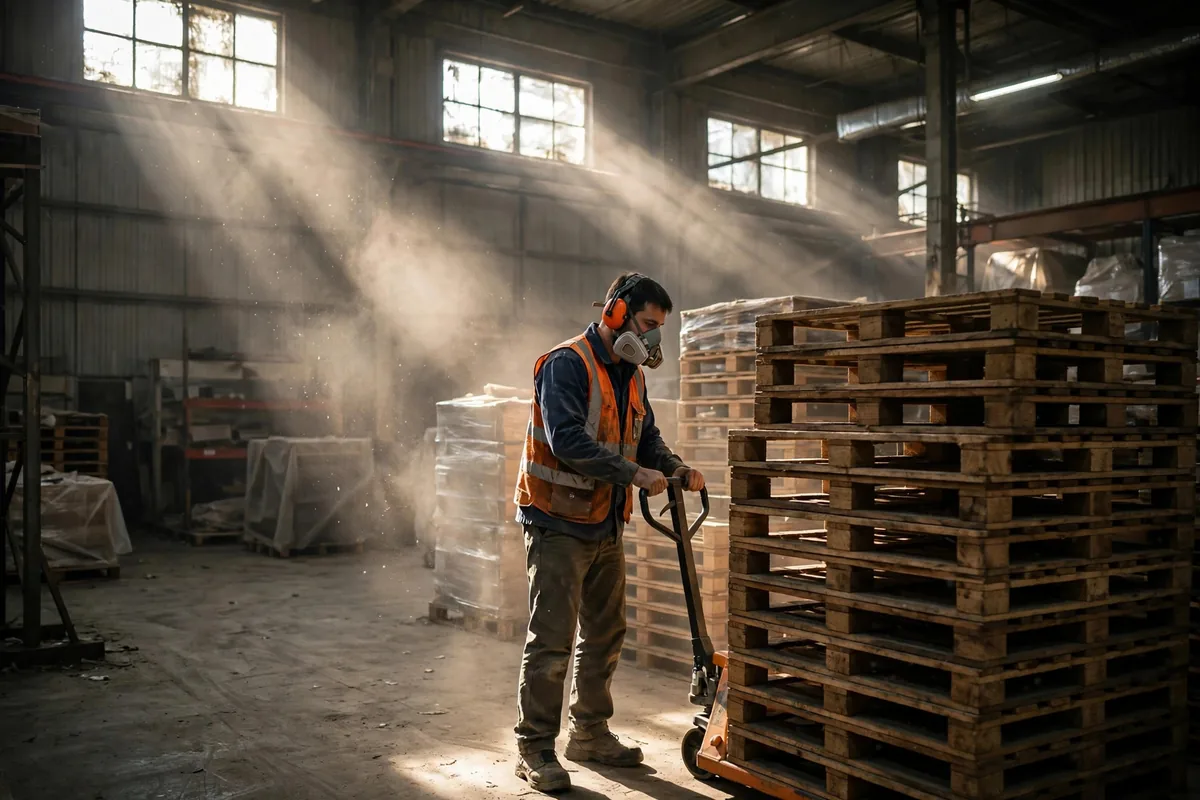
OSHA warehouse inspection violations are not bad luck. Most warehouse managers only learn the day a citation lands that the United States has no single safety standard written for warehouses, and that gap is where most of them come from. An inspector walks in with a checklist stitched together from several general standards: forklifts, material storage, walking surfaces, exit routes, hazard communication. Think of it as a combined exam of five or six general subjects. The exam is not hard. The hard part is that nobody ever graded themselves against it.
Think of it like a medical checkup: the places that never hurt are the places that surprise you, and inspectors look exactly there, because the evidence is easiest to collect. Flip a certificate, take a photo, match a record, and the citation stands.
OSHA Warehouse Inspection Violations Start With a Fixed Four-Step Visit
An OSHA warehouse inspection runs in four fixed steps. Step one, the opening conference: the inspector shows credentials, explains the scope and reason, and asks for records. Injury and illness logs must be produced within four business hours; failing to produce them is itself a problem. Step two, the walkaround: the inspector photographs conditions, takes measurements, checks equipment, and interviews employees one on one. Workers have the right to speak privately, with no manager listening in. Step three, the closing conference: the inspector describes the apparent violations, but no citation is handed out on site. Step four, the citation by mail: the area director reviews the findings and mails the citation within six months of the inspection. From receipt, the employer has 15 working days to contest it or request an informal conference.
Inspections come from three routes: an employee complaint, a reported injury or fatality, or a programmed inspection under an emphasis program. In July 2023, OSHA launched a National Emphasis Program for warehousing and distribution centers, so a warehouse is no longer safe just because nobody complained.
Federal OSHA data for warehousing and storage, October 2024 through September 2025, records 342 inspections, 904 citations, and $3,174,267 in penalties. The five most-cited items were powered industrial trucks at 228 citations, hazard communication at 76, wiring methods at 35, lockout/tagout at 32, and materials handling and storage at 28. Forklift citations alone carried $845,599 in penalties. Inspectors aim at the hazards that kill and injure the most people.
Penalty levels first, because every manager asks. OSHA confirmed in a memorandum dated May 21, 2026 that there was no inflation adjustment for 2026, so 2025 amounts carry over: a serious or other-than-serious violation carries a maximum of $16,550 per violation; a willful or repeated violation carries a maximum of $165,514 per violation, with a $11,823 minimum for willful violations; failure to abate adds up to $16,550 per day. Those are maximums, not standard prices: the actual proposal depends on severity, size, and history, and state-plan states may set higher levels, so check the latest official policy.
OSHA Warehouse Inspection Violations: The Five Citations That Show Up Most
Citation one, forklifts, 29 CFR 1910.178. At 228 citations it leads the list, and it is the first thing an inspector checks. Three failure points dominate: operators without a valid certificate, or with an evaluation that expired — the standard requires a refresher evaluation every three years; pre-shift inspections skipped or unrecorded, so a truck with bad brakes stays in service; and overloading, blocked sight lines, and pedestrians sharing the aisle. The forklift is the heaviest moving object in the building. Lose control of it and nothing else matters. Think of driving with an expired license and squealing brakes: the officer pulls you over.
Citation two, materials handling and storage, 29 CFR 1910.176. At 28 citations the count looks small, but the damage is not: stacks too high, loads not blocked and interlocked, pallets overhanging the beam, heavy freight crushing light freight. Most managers miss this: OSHA has no standard written specifically for pallet racking. Bent uprights, deformed beams, and overloaded levels get cited under 1910.176 and the General Duty Clause instead. No dedicated standard means more inspector discretion, not less.
Citation three, walking-working surfaces, 29 CFR 1910.22 and 1910.28. Oil on the floor that nobody cleaned, clutter in the aisle, an unguarded dock edge, a stairway missing a handrail. Managers call it housekeeping. Inspectors call it the source of slips, trips, and falls. That puddle of hydraulic fluid nobody has owned for three months is a cleaning miss to you and a citation already written to the inspector.
Citation four, exit routes and fire safety, 29 CFR 1910.36 and 1910.37. Exit routes must be kept free and unobstructed, and a workplace must have at least two exit routes. A real case: a warehouse in Exton, Pennsylvania, where a wooden pallet loaded with boxes was left inside an emergency exit route around May 4, 2023. The inspector cited 29 CFR 1910.37(a)(3) as a serious violation, with an initial penalty of $3,036 and a current penalty of $1,833.33. Moving the pallet takes two minutes. Contesting the citation takes two months. Exit routes die two ways: peak-season freight "temporarily" placed in the aisle becomes permanent, and a fire extinguisher gets blocked by stock while its monthly inspection tag sits three months out of date.
Citation five, hazard communication, 29 CFR 1910.1200. At 76 citations it ranks second. The failures cluster in three places: containers with missing or unreadable labels, safety data sheets locked where floor staff cannot reach them, and new hires never trained on the chemicals they handle. Cleaners, batteries, and aerosol cans all count as chemicals. The inspector opens the cleaning cabinet, picks up an unlabeled spray bottle, and the citation exists.
| Citation | Standard | What the inspector looks at | Fixable the same day |
|---|---|---|---|
| Forklifts | 1910.178 | Certificates, evaluation dates, pre-shift check sheets | Stop uncertified operators, restore check records |
| Storage | 1910.176 | Stack height, interlocking, bent racking | Lower stacks, tag damaged uprights out of service |
| Walking surfaces | 1910.22 / 1910.28 | Oil, clutter, dock edges, stair rails | Clean spills, mark pedestrian lanes |
| Exit routes and fire | 1910.36 / 1910.37 | Blocked routes, blocked extinguishers, exit signs | Clear aisles, sign off extinguisher checks |
| Hazard communication | 1910.1200 | Labels, data sheets, training records | Replace labels, move data sheets to the work area |
Here is the counterintuitive part: the most-cited hazards are usually not the hardest technical problems. They are the most visible and the easiest to prove. Training records, exit aisles, and chemical labels need no deep engineering. An inspector can judge them from the doorway. Deep problems, rack load calculations or forklift-pedestrian traffic design, rank lower because they are harder to prove. So flip the logic: clear every visible problem first, then work on the invisible ones. Spending money where the inspector looks is the highest-return compliance spending there is.
One illustrative example, with made-up numbers, not real prices: 40 forklift operators, a full refresher plus digitized pre-shift checks, about 80 labor-hours in total. Compare that with one serious citation capped at $16,550, and a repeat violation jumping to the $165,514 tier. The gap between prevention and penalty is not a rounding error. It is an order of magnitude.
OSHA Warehouse Inspection Violations: Run This Self-Check Before They Do
Run the self-check at three rhythms: weekly, monthly, and quarterly. Weekly covers what moves: check sheets signed today, exit aisles clear, no fresh oil or clutter. Monthly covers what expires: evaluation dates, extinguisher tags, data sheet revisions, label condition. Quarterly covers what loosens: rack impact marks, guardrail bolts, tire and brake wear.
The pitfalls concentrate in the records. Four recur everywhere. Training happened, but the record is a paper sign-in sheet that takes twenty minutes to find. Pre-shift sheets are photocopied blanks, and drivers tick boxes faster than they inspect. The extinguisher tag was signed last month and forgotten this month. The data sheets sit in a locked office cabinet. The inspector applies one test: producible, dated correctly, signed by someone present. Fail any of the three and the work counts as undone.
One blunt point about a pseudo-need vendors love to sell: compliance software with a long feature list and a beautiful dashboard. Buy it, and the pre-shift check is still a driver ticking boxes on paper. The software is not wrong. The mistake is believing that buying software equals being compliant. Compliance lives in daily operations and records. Software is only the box holding them. A pretty box with nothing inside fools nobody, least of all an inspector.
So the whole piece comes down to one number: $16,550, the maximum for a single serious violation. One hour a week on the self-check is a little over 50 hours a year, and that would not buy a single citation. Whether the money is worth it comes down to that one number.
By Da Liu, Automation Engineer