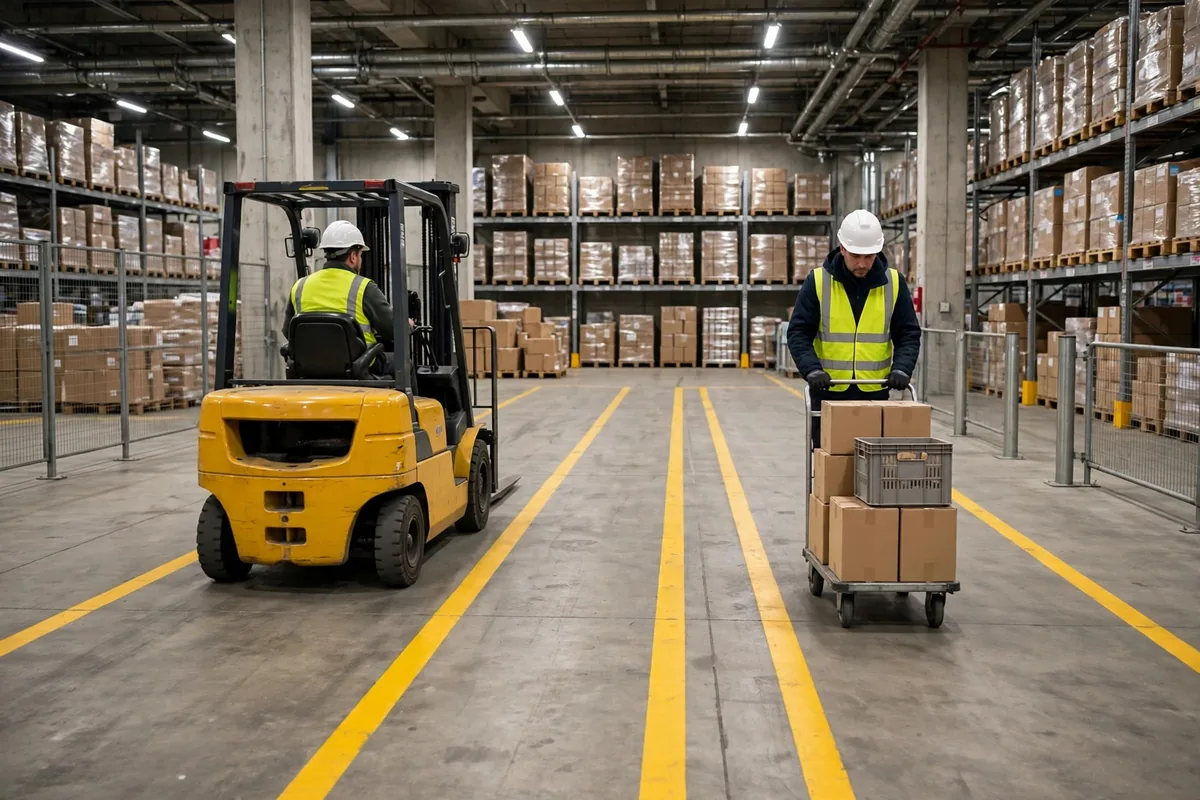
It was 11:40 p.m. on November 10, peak season, and I was standing at the mouth of aisle 3 with a radio in my hand and my voice gone. Twelve forklifts were running the main aisle, forty-odd pickers pushing carts between the racks, orders still coming. Traffic separation between forklifts and pickers was something I thought I had handled. We had painted yellow lines. That night taught me that yellow paint does not stop people who are in a hurry.
The night in question came down to about a meter. Lao Wang, one of our drivers, was backing a forklift out of a slot in zone B. He checked the mirror. Clear. At the same moment Xiao Li, a picker, cut across between two rack rows with a carton in his arms, eyes down. Wang slammed the brake. The truck stopped less than a meter from Li. Two cartons slid off the pallet and burst on the floor. Nobody was hurt. I stood there with weak legs. That night I could not sleep. All I could see was that one meter.
To be honest, we had tried before that night. We painted pedestrian lanes, put up signs, talked about it in meetings. Then peak season arrived and it all fell apart. Pickers cut straight across the forklift lane to save a few steps. Drivers cut through the pick area to save a trip. The lines were still on the floor. Nobody was walking inside them. Separation that depends on everybody behaving breaks on the first day of peak.
The next morning I called Wang and Li into the morning meeting. I did not yell. I asked one question: if it happens again, who here can promise the brake will hold in time? Nobody spoke. Wang has driven for nine years. He was honest. When you reverse, the back is a blind spot. The mirror cannot see it, and a picker wearing earbuds cannot hear the horn anyway. Li said the pick list was pressing on him, so who remembers to look at a line? That day I set the rule: we stop relying on good behavior. We rely on a timetable and on walls you can see.
Traffic separation by the clock: give forklifts and pickers different hours
The first thing we tried was splitting time. Replenishment runs in three windows only: 6:00 to 8:00 in the morning, 1:00 to 2:00 in the afternoon, and 10:00 to 11:00 at night. When a window opens, pickers stay out of the high-bay pick area. When it closes, forklifts leave the pick area for the main aisle and the dock. The first three days, everybody complained. The pick lead came to me and said the morning orders could not wait, and at 8:00 the shelves were still empty.
I did not back down. I changed one thing: the night window moved from 10:00 to 9:30, because night pick volume drops off after 9:30. That one change cut the complaints in half. After a week, our floor log showed pickers getting cut off by forklifts inside the racks fell from more than 40 a day to fewer than 5 (in-house log, illustrative example). Stand at an aisle mouth for one morning. Quiet ears are quiet ears.
Splitting time had a second benefit I only saw later. When replenishment and picking ran together, the driver dodged people and rushed at the same time, and the more he dodged, the slower he went. Inside a window with no pickers around, he does not look left and right all day. One trip does the work of two. Splitting the clock gave both sides room to breathe.
Traffic separation by space: one one-way loop, no U-turns, no jaywalking
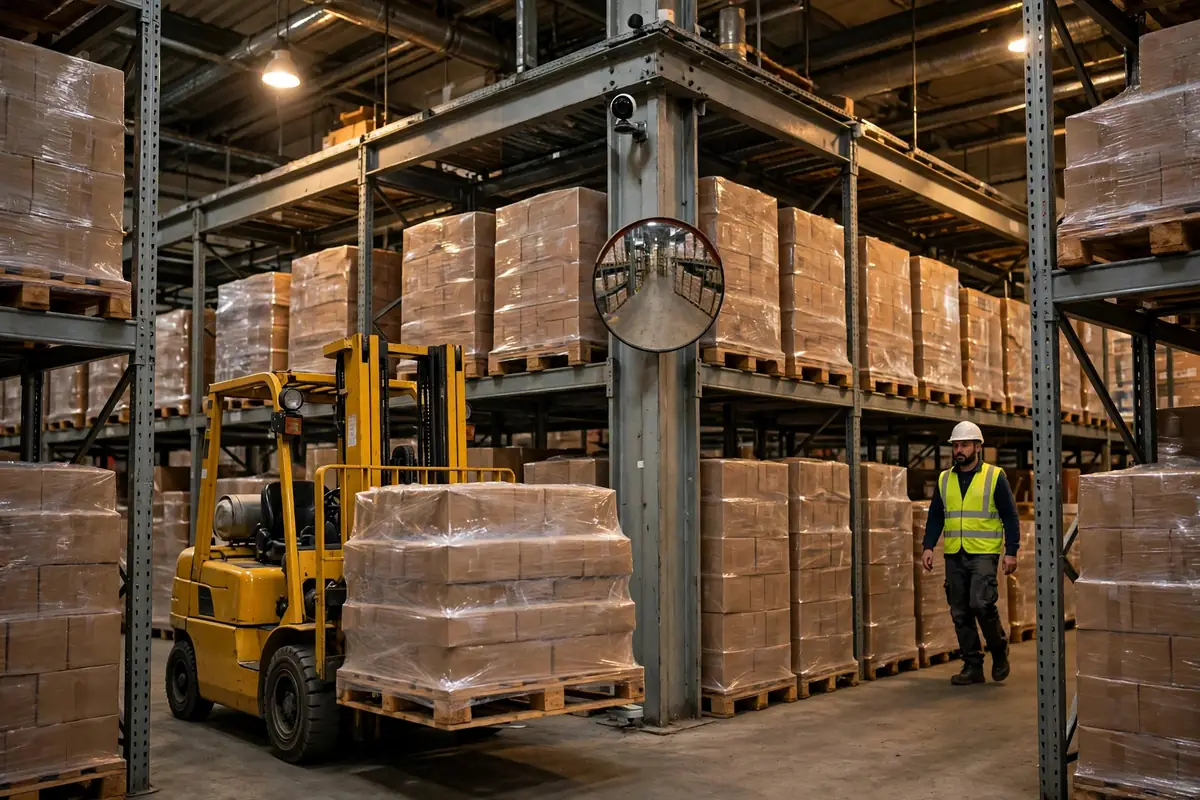
Time fixed most of it. The crossings were still dangerous: where the main aisle meets aisles 3 and 5, forklifts turned around, pickers crossed, and the racks blocked everybody's view. Two convex mirrors, a speed bump, and a stop line helped a little. What really worked was changing one road. The main aisle became a one-way loop. Forklifts go clockwise only. No U-turns, no driving against the flow. Pickers cross only at two marked crossings. Everywhere else, we blocked the gap with barriers.
Old Zhou, a driver with more than ten years behind the wheel, objected first. The loop made him drive an extra half circle, and he told the whole shift I was making trouble for nothing. I did not argue. I asked him to ride along for one morning and count his hard stops. At noon he came back: the hard stops were down, but he was burning more fuel on the detour. I said I would take the fuel bill, and asked what a hard stop avoided was worth. He said nothing. A month later he was explaining the loop to new drivers. Veterans are like that. Let them drive one lap. One lap beats ten meetings.
Here is the part that surprised me. Once forklifts were out of the pick area, replenishment trips got more frequent and each load got smaller, yet pickers waited less for stock. Before, a forklift came in fully loaded and pickers queued behind it, waiting ten minutes or more. Now the truck comes often with a smaller load, and the shelves rarely run dry. Separation looked like a constraint on the truck. In practice it moved the waiting off the picker. The truck drives more miles. The picker never stops. Total orders went up. The constraint sits on the machine, and the speed shows up in the people. I did not see that trade coming.
Do the math: what separation costs against what one accident costs
| Approach | Up-front cost | Extra time per day | Near misses and hard stops |
|---|---|---|---|
| Painted lines only | Paint and labor, a few thousand dollars | None | Peak season chaos, barely changed |
| Time windows | A timetable and a lead watching it, almost free | Pickers wait about half an hour a day | Cut-offs fell by more than half |
| Time windows plus zones plus a one-way loop | Barriers, mirrors, a speed bump, markings, tens of thousands of dollars | Forklifts drive about an hour extra a day | Crossing incidents close to zero |
The table is an illustrative example, scaled to a 200-person warehouse. Do not take it to finance as a real quote. The point is simple: separation costs small money you can see, and an accident costs big money you cannot. The U.S. Occupational Safety and Health Administration's long-standing estimate puts forklift accidents at about 85 deaths and 34,900 serious injuries a year in the United States. The Bureau of Labor Statistics count for 2024, compiled by the National Safety Council, was 84 deaths. Pedestrians struck by forklifts account for about 36% of fatal forklift incidents. Those numbers feel far away. That one meter felt very close. OSHA's own forklift guidance says it plainly: separate forklift traffic from pedestrians wherever possible. The rule behind it is 29 CFR 1910.178, the powered industrial truck standard.
What we do now, every day, without exception
Our fixed routine is written on the wall and taught on a new hire's first day. Four items. The window timetable is posted at every aisle mouth. When the time comes, the lead blows a whistle and clears the area. The pick area takes carts and people only. No forklifts, and the barriers do not move except for stock counts. The main aisle is a one-way loop. Drive against it once and you are off the truck for half a day, then retrained. Every shift starts with a five-minute stand-up, and we name one risky moment from yesterday. No lectures. Just who, where, and how close it came.
One more rule came out of a shouting match. The drivers said pickers wearing earbuds could not hear the horn. The pickers said the horn sounded like somebody yelling. We settled it: in the pick area, one earbud only, the other ear listening. A forklift entering a crossing sounds the horn first, then slows down. The horn is not a scolding. It is a position report. After that argument, both sides calmed down. A rule people argued over sticks better than a rule handed down.
Look, there is no high technology in any of this. Two rulers, time and space. Split the hours, split the floor, and write the routine into the five minutes before every shift. The yellow lines are still on the floor. Now there are barriers outside the lines, a timetable outside the barriers, and a person watching the timetable. If forklifts and pickers are still fighting over the same aisle in your building, do not wait for that one meter to become zero. Start with one window and one loop, try it for a week, and count the hard stops. The count will give you your answer.
By Chen Feng, Warehouse Operations Manager