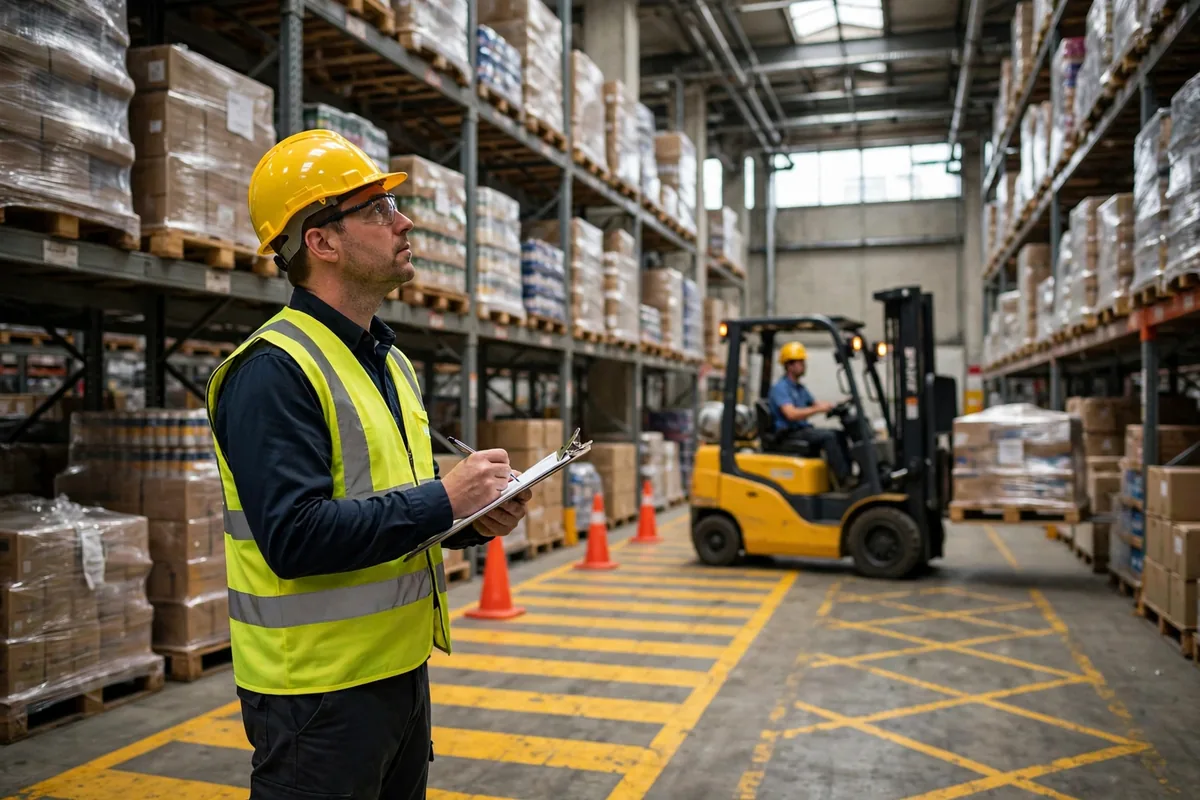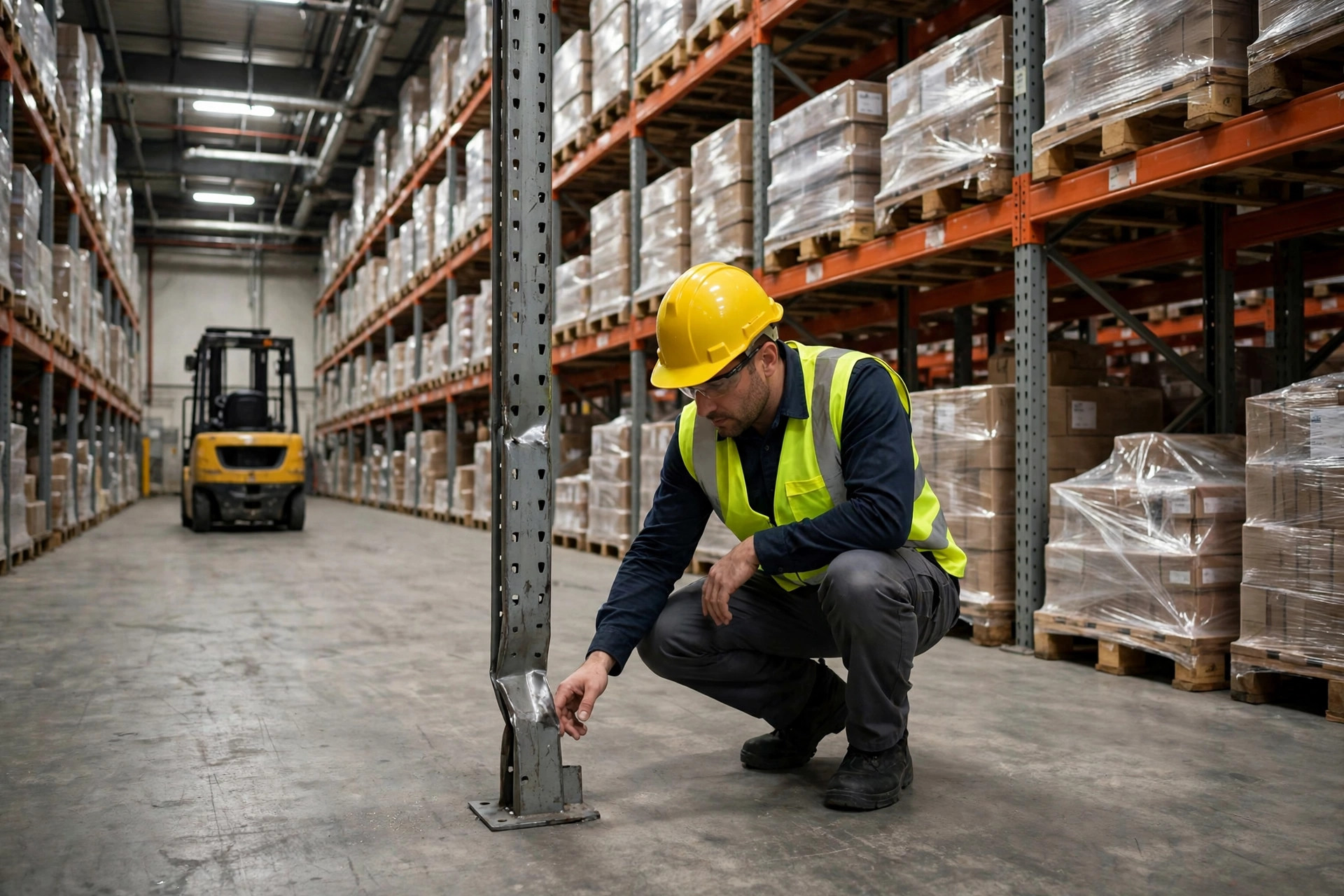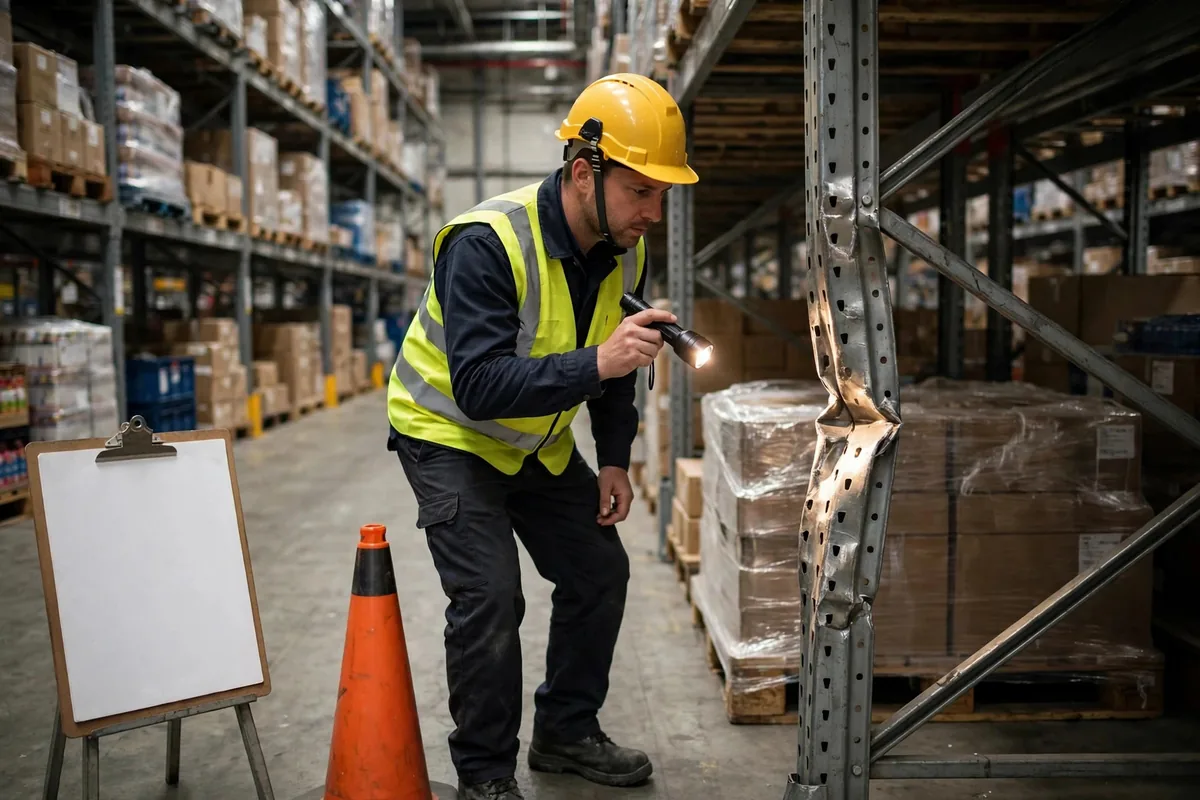
Right after the night shift handed over one morning, I was drinking water at the end of an aisle when I saw it: the outermost upright on row three was wrong, dented inward at the base, paint scraped off. That is what warehouse rack upright damage inspection is really about every single day. It is not paperwork. It is keeping people alive. That one post had several levels of freight stacked above it, and if it ever gave way, what came down would not land on boxes. It would land on somebody.
Let me be straight with you: uprights getting hit happens in every warehouse. A forklift's turning radius is what it is, and in peak season a driver's eyes are on the order, not the post. He backs up, the rear swings, and the base of an upright takes the hit. Sometimes it is just paint. Sometimes the steel folds in. The hit is not what scares me. What scares me is a hit nobody reports, and the next shift stacks heavier freight on top, until one day the post leans far enough that you can see it with the naked eye.
We learned that lesson the hard way. Peak season, 2022 — a worked example from our own floor: a temp clipped an upright on nights, panicked about a fine, said nothing, and hid the damage behind a carton. The day shift kept loading. Three days later our senior inspector found the upright badly deformed, and we unloaded that whole bay on the spot. In the review I was furious — not at the temp. At us. We had never built a rule that made a man feel safe reporting a hit.
Warehouse Rack Upright Damage Inspection: How We Schedule It
Inspection cannot sit on one person's shoulders. We run three layers. Layer one is the drivers: passing an aisle, glance at the upright bases — fresh damage is bright where the paint tore, old damage is dull. Photograph it, drop it in the crew chat. Layer two is the shift lead, who walks the main aisles at every handover and checks the spots hit most: corners, aisle ends, near the dock. Layer three is a formal weekly inspection, flashlight and tape in hand, bay by bay, written down: which upright, which face, how deep the deformation runs.
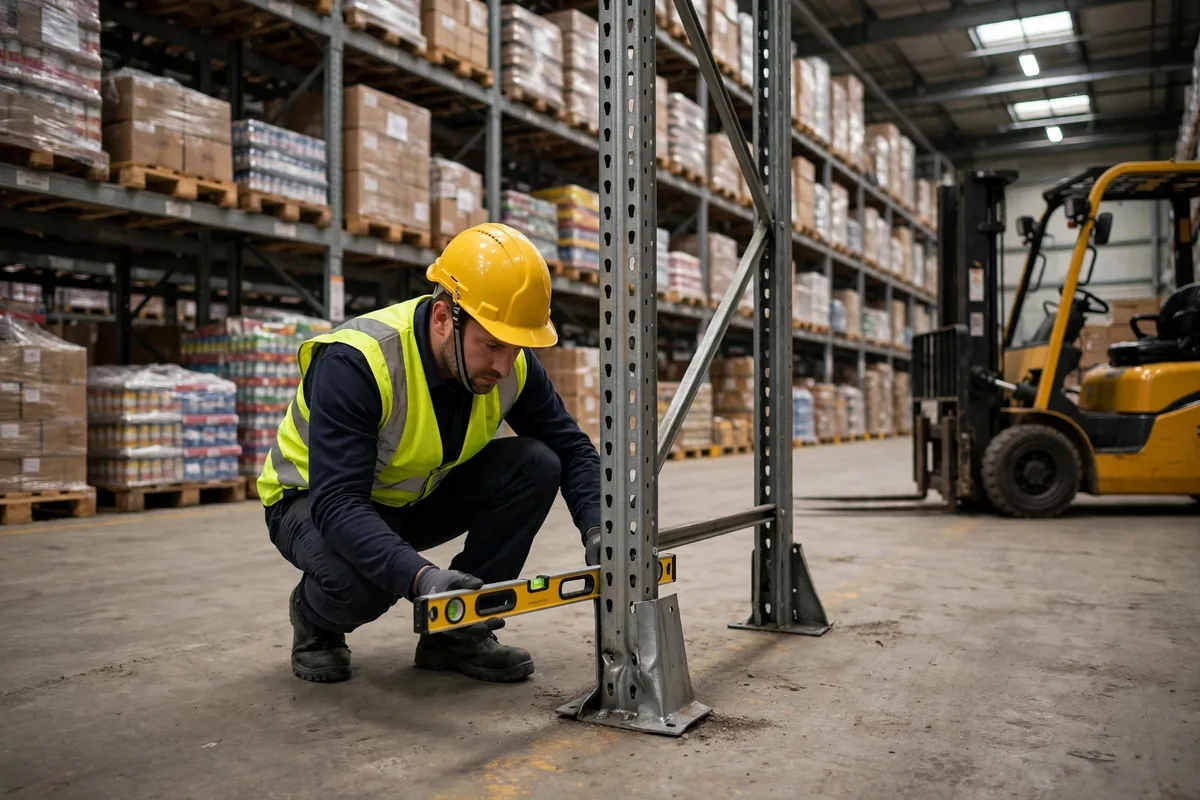
The flashlight sounds small. It is not. Ceiling lights never reach the shadowed base of a post, but a light held flat along the steel makes a dent throw a hard shadow. Our kit is three things: flashlight, tape, phone. The photo must include a reference — the tape, a water bottle — or a week later nobody can tell how big the bend is.
Frequency follows workload. When peak volume doubles, hits roughly double with it, so in peak we inspect formally twice a week and add a fast night-shift sweep of the aisle ends. In the slow season we relax a little, but corner uprights stay on the list forever. Brothers, hear me: the more complicated your form is, the faster people stop filling it in honestly. Ours has a handful of columns — who checked, which post, any deformation, photo taken. Thirty seconds. That is why it survives.
Warehouse Rack Upright Damage Inspection: The Three-Level Response
The common approach in the industry is to grade upright damage green, yellow, red, and we use it too. But let me say this up front: the actual deformation limits and measurement methods follow your rack manufacturer and qualified assessors. What I am describing is the floor procedure, not a standard you should quote back at me. A tape-measure estimate is fine for triage. The moment you are not sure which level you are looking at, you call the manufacturer or a professional. You do not make that call yourself.
Green is minor: paint loss, a small knock, the post still straight. No shutdown — log it, photograph it, re-check it next round. Yellow means visible deformation, or the same upright hit again and again. That bay gets de-rated: heavy freight comes off the upper levels, a tag goes on, a professional assessment gets booked, and nobody loads it full until the assessment says so. Red is the one that matters: post clearly bent, cracked, base plate lifted, bolts loose, frame shifted. No discussion. Unload it and isolate it. Now.
Our red procedure is written on the wall. Whoever finds it pulls a barrier across that bay and the aisle entrance — no forklift goes near it. The duty manager gets called, the freight comes down into a spare area, and nobody stands directly under the rack while it is being unloaded. Then a red tag, photos, a report upward, and we wait for the repair plan. Until assessment and repair are done, that bay does not exist — and the matching locations get locked in the system too, or a night-shift operator who knows nothing about it will happily put freight back up there and the isolation was theater.
We had a red in 2024: morning inspection found an upright near the dock with its base plate bent up off the floor. The shift lead did not hesitate — aisle closed, freight down, half a day gone in peak, and dispatch was cursing. I told him, curse all you want. Freight a day late can be recovered. A rack on the floor cannot. After that, "secure the scene first, report second" became the rule, and whoever protects the scene first carries no blame.
Replace One Upright, or the Whole Bay?
Once the assessment lands, you decide the repair. If only one upright is damaged and the beams and frame are sound, the standard job is an upright swap: unload the bay, shore the beams, remove the damaged post, fit a new one of the same specification, re-torque and re-level. That work goes to the manufacturer or a qualified crew. Your own maintenance man may be brilliant, but he does not touch structural rack — a badly repaired post is worse than a damaged one.
When do you replace the whole bay? When deformation has traveled into the beam connections, when the same bay has been hit repeatedly and its base and anchors are loosened, when spares are discontinued and a new post will not marry the old frame — or when the bend sits in the middle or upper section of the post. And one red line I repeat to every lead: a bent upright never gets hammered straight and put back to work. Steel that has folded once is not the same steel. Straightened, it looks fine. It is the most dangerous post in your building.
Here is an illustrative calculation — a worked example; the numbers only show the decision logic. Say a single upright swap costs 1 unit and a full bay replacement costs 3. On that line alone, everyone picks the swap. But the real bill includes downtime — a swap closes one bay for a day, a replacement closes two bays for two days — and recurrence: if the aisle layout itself causes the hits, three swaps a year plus three rounds of downtime can cost more than one replacement plus protection. We compare three years of expected total cost, not the first repair quote.
| Situation | Standard response | On the floor |
|---|---|---|
| One upright, minor damage, rest sound | Log and monitor | Photo with reference, re-check |
| One upright deformed, beams sound | De-rate, professional assessment, likely swap | Tag it, lock the locations |
| Upright clearly bent or cracked | Unload and isolate immediately | Barrier up, nobody under the rack |
| Beam connections or base also damaged | Assess full bay replacement | Check neighboring bays too |
| Same spot hit repeatedly | Repair plus protection plus aisle fix | Fix the aisle, not just the rack |
Protection belongs in the same job, or you will repair the same post forever. Upright guards, guardrail at aisle corners, painted travel lines — none of it is expensive. Our worst corner took a guardrail and has not hurt a post in six months. Repairing the rack treats the symptom; fixing the aisle treats the cause.
Finding Who Hit It — Without Teaching People to Hide It
The last part is the hardest. Punish reporting and everyone hides damage; ask nothing and driving gets sloppy. Our rule splits the two acts cleanly: reporting is never punished; concealing always is. Report a hit immediately — veteran or temp — and it is a log entry, a review, retraining if needed, no fine. Hide it or let someone else discover it, and that is a different offense: you traded the crew's safety for your own convenience. In the first month under that rule, voluntary reports multiplied. That told me how much had been hidden before.
Tracing does not mean interrogating people. It means matching records to time: a fresh mark appears, you check who worked that zone in that window — roster, task list, truck log — and the field narrows fast. Cameras help only if they cover the base of the posts; a wide shot of the aisle is useless. The driver whose shift and truck it was owns up, and it goes through the reporting process. No theater. Turn warehouse rack upright damage inspection into a rule the whole crew guards together, not one safety officer's lonely job, and your racks actually get safer.
A word to fellow managers: on uprights, take ten false alarms over one lucky escape. See deformation, close it and unload it first, and argue about the bill later. A bill can be settled. A person cannot. That is how we run it in our warehouse. Not fancy. It works.
By Chen Feng, Warehouse Operations Manager