Forklift charging station safety is the first thing I check every morning, at half past six, the moment I walk through the warehouse door. Let me be straight with you: one morning the charging area smelled sour, and I knew right away something was wrong. Somebody on the night shift had charged a lead-acid battery with its caps open all night, and the fan was off. That corner looks quiet in daylight. Trouble there arrives in a second, without warning. I have run big warehouses for years, and I have watched too many people treat charging as plugging in and walking away. That attitude is how good warehouses end up with a bad day.
One night shift in October 2024 taught me the lesson all over again. A forklift sat on charge, and beside it someone had stacked three pallets of cardboard boxes. The night-shift kid wanted to save a walk, so he ran the charging cable straight over the boxes. The charger alarm light was on. He never looked at it. By morning the edge of one box was scorched black. Nobody got hurt. We got lucky, and luck is not a safety plan. A charging area is not a parking lot. It is a live corner of the building, with its own temper.
Forklift Charging Station Safety Starts With Telling Lead-Acid From Lithium
Lead-acid and lithium batteries behave nothing alike on charge, and managing them the same way is asking for trouble. A lead-acid battery gives off hydrogen while it charges. Hydrogen is lighter than air, so it climbs and gathers near the ceiling. At around 4% concentration in air it can form an explosive mixture, so day-to-day management keeps levels far below that mark, for example below 1%, with the exact figure to follow the latest official policy. The United States Occupational Safety and Health Administration standard 29 CFR 1910.178(g) requires charging in a designated area, with adequate ventilation to disperse gases from gassing batteries, plus facilities to flush and neutralize spilled electrolyte, fire protection, and protection of charging apparatus from damage by trucks. That is a hard rule, not a suggestion.
Lithium looks clean. No acid smell, no gas you can see. Its fear is heat. When a battery management system fails, or someone uses a charger that does not match the pack, cell temperature climbs, and thermal runaway can follow. It comes fast, with thick smoke and fierce fire, and an ordinary extinguisher will struggle to hold it. So a lithium charging area needs temperature checks and a close eye on the charging curve. Charger and battery must match. Mixing them is a hard no.
My rule is simple now. Lead-acid and lithium charge in separate zones, with a clear aisle between them, and each zone carries its own job card. The lead-acid zone holds an eyewash station, neutralizing agent, acid-resistant gloves, and a face shield. The lithium zone holds a temperature log and the right fire equipment. Each chemistry has its own written steps, and whoever charges follows the card for that battery. Nobody works from memory.
| Item | Lead-acid battery | Lithium battery |
|---|---|---|
| Main charging risk | Hydrogen gas, acid splash | Overheating, thermal runaway |
| Ventilation need | Mechanical ventilation, hydrogen exhausted high | Normal ventilation, focus on cooling |
| Protective gear | Acid gloves, face shield, eyewash | Insulated gloves, temperature checks |
| Hard no | Open-cap charging, open flame nearby | Mismatched charger, damaged pack in use |
Forklift Charging Station Safety Lives or Dies on Ventilation and Hydrogen
Hydrogen is the part people underestimate, because you cannot see it or smell it. It gathers quietly. My warehouse charging area sits at the west end of the building, with 12 charging bays. In the hottest weeks of summer 2023, the old exhaust fan lost speed, and the air under the roof turned heavy enough to feel. I had an electrician measure it. Airflow at the outlet had dropped by nearly half since the start of the year. That same day I shut down 4 bays, redrew the charging schedule, and had a new fan motor fitted overnight. Somebody called it an overreaction. Hydrogen never sends a warning first.
Ventilation in my building now follows three fixed rules. Exhaust vents sit high, because hydrogen rises, so we pull it out from the top. Fresh-air inlets sit low, so clean air comes in underneath and the room breathes in a loop. The fan links to a hydrogen detector, so a rising reading speeds the fan up and sounds an alarm on its own. Every morning the shift lead checks two things before work starts: the detector reading, and whether the fan is actually turning. Those two glances are not optional. An open door is not ventilation. Low, closed corners are where hydrogen gathers, so no charging bay ever goes into a low, dead corner.
A counterintuitive point is worth saying plainly: a charging area that feels cool and smells clean can still be dangerous. Hydrogen has no smell. A room can feel fine at floor level while gas gathers a few metres above your head. That is why the detector sits high and the exhaust sits high, and why we never judge the air by standing in it and sniffing.
Charging Schedules, Separation, and the Daily Checklist
A charging schedule in chaos makes the whole area chaotic. In peak season, 20 forklifts chase 12 bays, everybody wants to charge first, cables end up across the floor, chargers run hot, and batteries get pulled off before they are full. My schedule hangs on the charging area door, one box per shift: which trucks charge, until what time, and who pulls the plug. The night shift charges fixed truck numbers only. No walk-in additions. A battery pulled off half-charged pays for it in a shorter life, and the next morning pays for it in missed shipments.
Here is the arithmetic, as an illustrative example: 20 forklifts, 12 bays, 8 hours for a full charge. A day holds roughly 36 charging slots if every bay runs around the clock, so the schedule has to choose. We charge the 8 trucks the morning shift needs before the day shift ends, then the rest overnight, and we keep 2 bays spare for trucks that come back early. That board has carried us through two peak seasons without cables on the floor or chargers running hot. Another surprise: more bays are not automatically safer. Extra bays make people lazy about the schedule, plugging in anywhere, and discipline slips. Enough bays, plus a strict schedule, beats a room full of bays with no plan.
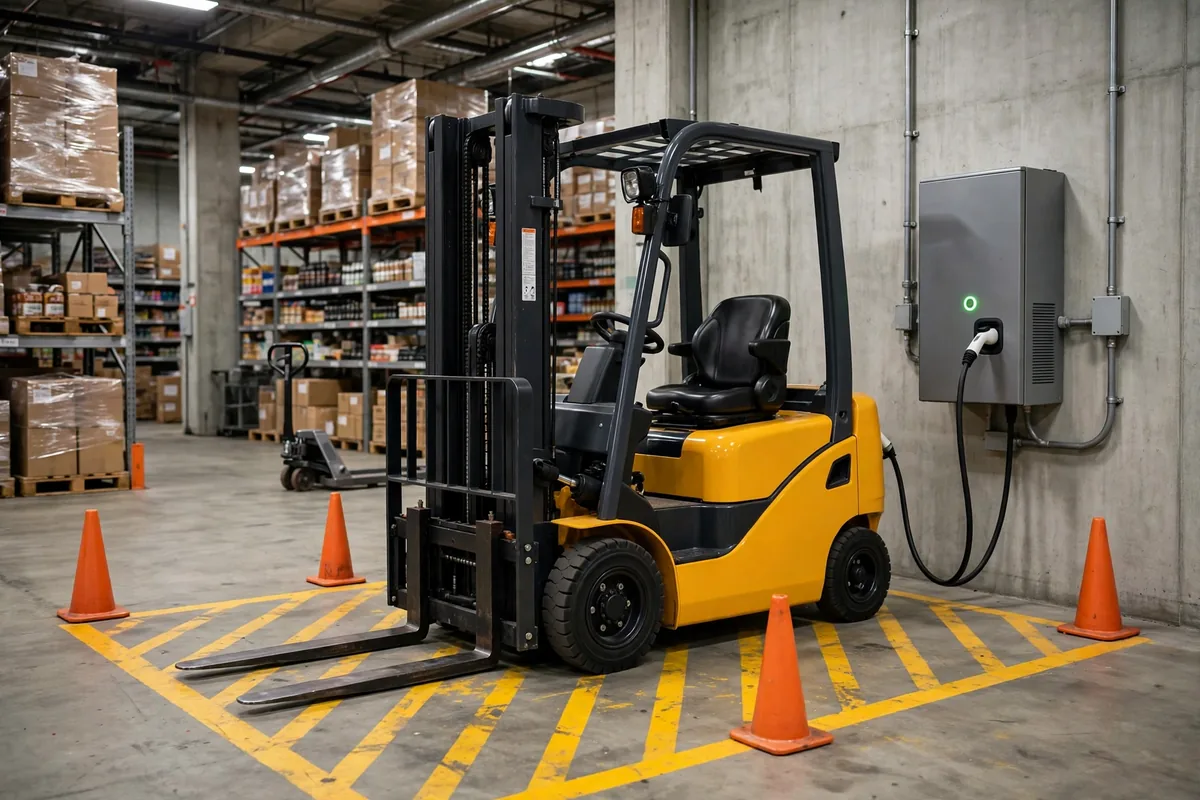
Fire separation is the next line of defence. No cardboard, pallets, or wrapping film stack up around the charging area. Yellow lines mark the floor, and inside the lines sit charging equipment and batteries only. Chargers and batteries keep their distance from each other, so one fire does not take the next unit with it. Extinguishers sit within easy reach, and every month we weigh them and check the pressure gauge, replacing any that have expired. In March 2025 I found one gauge sitting in the red during a walk-around, and it was replaced that same day. When you need an extinguisher, one breath of pressure is the difference between a scare and a disaster.
The daily checklist hangs at the entrance, and the shift lead ticks it off every day:
- Charging cables: any bare wire, any plug that smells burnt
- Chargers: fan turning, alarm light clear
- Batteries: any swelling, leaking, or strange smell
- Eyewash: water running, neutralizing agent in place
- Floor: any acid marks, any vent blocked by goods
That list looks fussy. It catches nine out of ten small problems before they grow. Checks are not for the inspector. They are so the night shift knows the morning found a problem and fixed it, instead of leaving it for the next person to trip over.
Let me be straight with you: forklift charging station safety does not come from one big rebuild. It comes from somebody looking, somebody managing, and somebody willing to argue about a fan motor at midnight. Every new starter gets the same first lesson from me: a walk around the charging area, a smell of the air, a feel of the cables, a look at where the eyewash sits. Equipment can be replaced in a week. Habits take far longer. If you run a charging area too, go and look at it tonight: is the fan turning, are the cables tidy, is anything stacked beside a bay that should not be there? That look takes five minutes. It may save you a very bad morning.
By Chen Feng, Warehouse Operations Manager