Start with the money, because warehouse SDS safety data sheet management is where the fine lives or dies. OSHA's 2026 penalty schedule puts a serious violation at up to about $16,550 per item, and a willful or repeated violation at up to about $165,514 per item — check OSHA's official site for the latest figures. One fine can burn a mid-size warehouse's entire compliance budget two or three times over. For a 200-person warehouse, an illustrative estimate puts a full year of building the files, training staff, and keeping everything current at roughly $8,000 to $12,000. That is not a close call. The real waste is spending the money and still getting fined — a cabinet of paper nobody on the floor can use when the inspector asks.
Here is a scenario, illustrative but close to how it really happens. Autumn 2024, an auto-parts distributor in the American Midwest, 3,200 SKUs on the shelves: cleaners, lubricants, spray paint, batteries, aerosols, the lot. The owner treated compliance as a shopping trip — buy a binder, print whatever the suppliers sent, file it away, done. The inspector picked five SKUs at random: two sheets were three years out of date after a formula change, one SKU had no sheet at all, and a picker asked about a spill said he would go and ask his supervisor. The inspector's conclusion was blunt: a sheet your floor staff cannot reach during their shift is the same as no sheet. I do not know what that warehouse paid in the end, but it was certainly more than doing the job right the first time would have cost.
A second scenario, same street, different ending. A household-goods distributor with fewer than 900 SKUs started by cutting the scope. Products used the way a consumer would use them — hand soap, ordinary tape — are exempt from the SDS requirement, so they never entered the system. Nine hundred SKUs narrowed to a little over 140 that genuinely needed sheets. Training had a focus at last: staff needed to recognize 140 SKUs, know which rack they sat on, and know the first step if one leaked.
Warehouse SDS Safety Data Sheet Management: Which SKUs Actually Need a Sheet
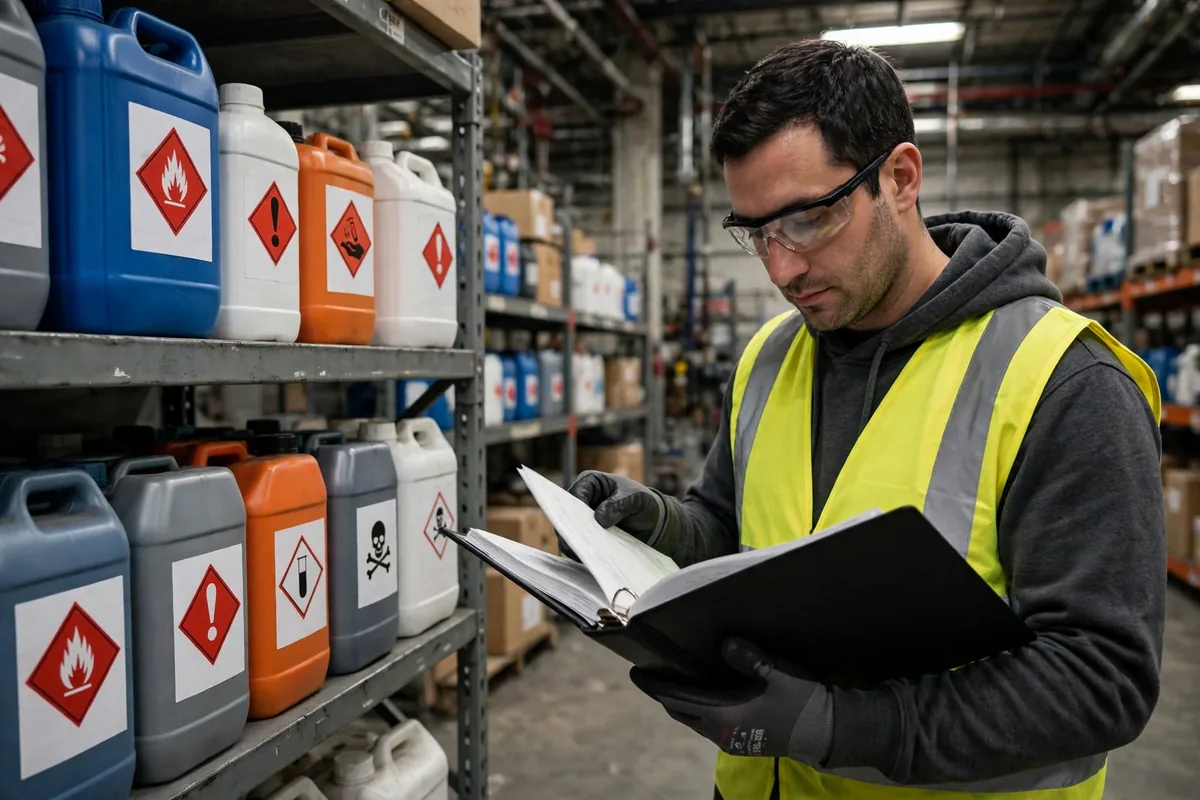
There is one test: is the SKU a hazardous chemical? Look for a GHS pictogram and a signal word on the label. Flame, exclamation mark, corrosion, skull and crossbones; the words "Danger" or "Warning." If those are there, you almost certainly need a sheet. If the label is clean and the product is used the way a consumer would use it, it is usually exempt. The exemption has a condition, though — the use has to be consumer use. Scope before paperwork: that is the first decision in warehouse SDS safety data sheet management. The same cleaner sold to a household for wiping a table is a consumer product; the same cleaner used in a warehouse, diluted by the drum and sprayed all day, is a different exposure, and the exemption stops holding.
The trap is the SKU that looks harmless. Aerosols are the classic case: they look like household goods, but the propellant and solvents inside mean they nearly always need a sheet. Lithium batteries are another — a damaged, swollen, or overheated battery is a different story, and the handling steps live in the SDS. Then there is the supplier change: same SKU, new formula, old sheet dead on arrival. That is how most binders go stale.
Reading a 16-Section Sheet: the Sections That Earn Their Keep
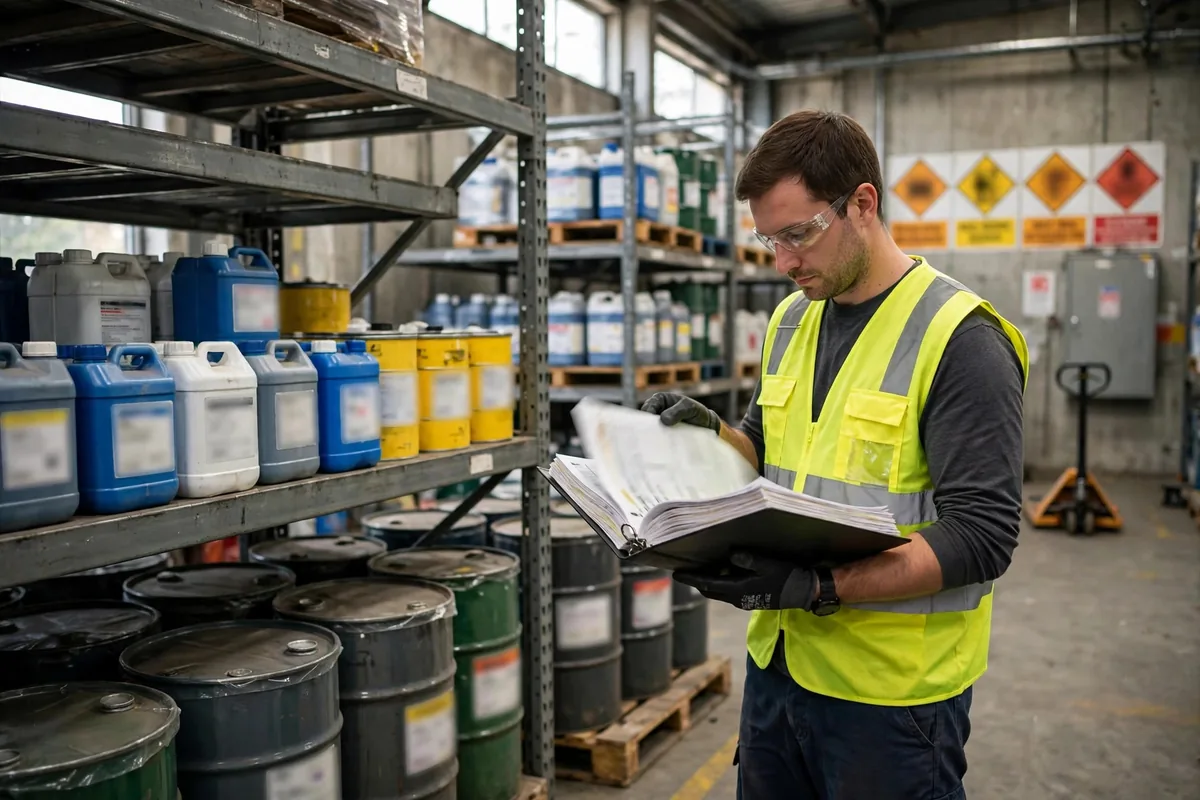
An SDS follows the 16-section GHS format, and all 16 sections are required, but only a handful matter on a normal working day. Section 1 identifies the product and supplier, Section 2 covers hazard identification, Section 4 is first aid, Section 5 firefighting, Section 6 accidental release, Section 7 handling and storage, Section 8 exposure controls and protection, Section 14 transport. Floor staff do not need to memorize all 16. They need to know where the answers live: does this hurt people, what if it catches fire, what if it spills, which gloves, which rack.
Sections 9 and 11 are for management and emergency responders, not pickers. Section 3 has one practical use: when a supplier changes a formula, comparing it tells you in seconds whether anything moved. My advice is a one-page summary card per SKU: product name, pictograms, signal word, three lines of first aid, three steps for a spill, storage location. Pin the card to the end of the rack and keep the full sheet where it can be reached at any time. The inspector reads the original; the staff use the card.
Warehouse SDS Safety Data Sheet Management: Where to Keep the Sheets
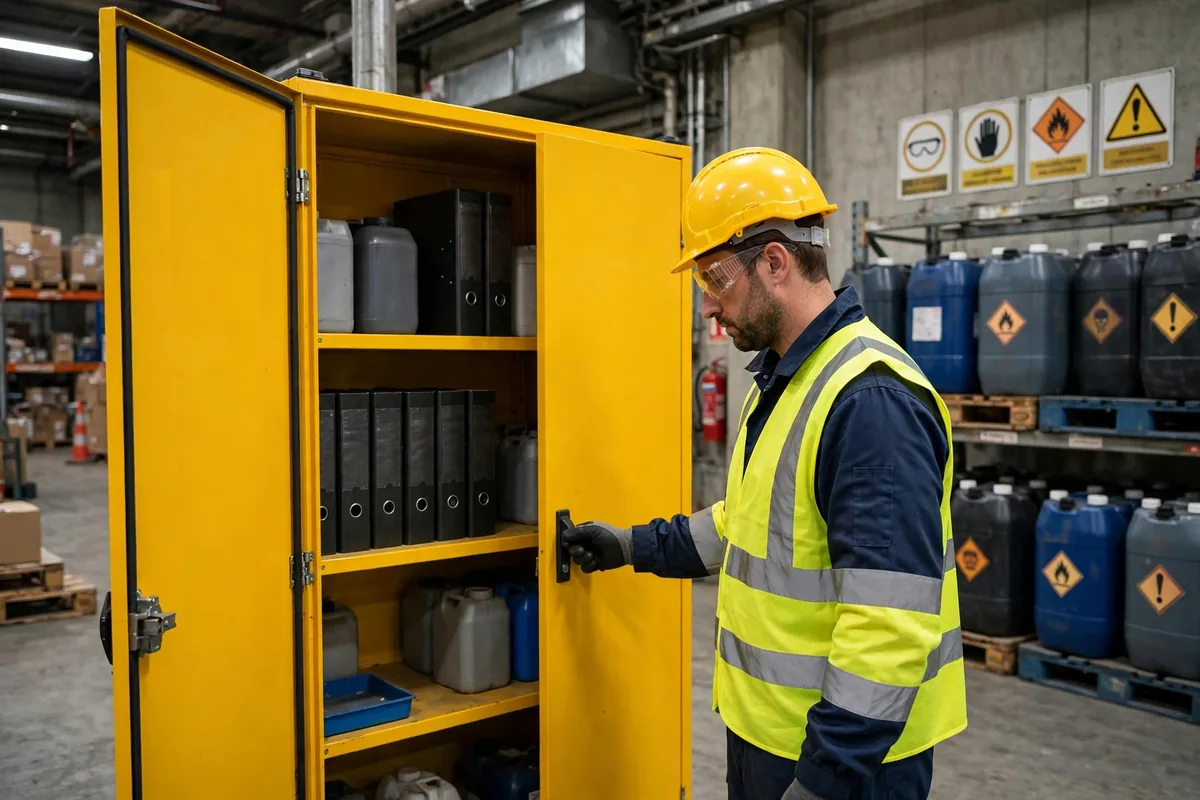
OSHA's Hazard Communication Standard, 29 CFR 1910.1200, is clear: SDS sheets must be readily accessible to employees during their shift, without a supervisor's permission, without a trip to the office to find someone with a key. A paper binder in a locked cabinet, key in the supervisor's pocket, is the same as no binder. An electronic copy is no better if it needs a login, a permission, or a network connection that drops when you need it.
Three tests decide it. Can an employee get the sheet within 30 seconds? Does it need nobody's approval? Does a new hire know where the sheets are before the first shift ends? Most warehouses pick one format; I run both. Paper binders in the work area, filed by rack zone, and an electronic copy on a tablet or workstation for searching. Both must carry the same content and be updated together, always to the supplier's latest version. That dual setup is what warehouse SDS safety data sheet management looks like when it is built for the floor, not the filing cabinet. The paper costs almost nothing: an illustrative estimate for a 150-SKU warehouse puts annual printing and binder upkeep at roughly $600 to $900. That is two orders of magnitude cheaper than one fine.
What Compliance Actually Costs, Line by Line
| Cost item | Illustrative estimate (200-person warehouse, per year) | Note |
|---|---|---|
| Building and organizing the files | $2,000–$3,000 | One-off in year one, incremental after |
| Employee training | $3,000–$4,000 | Onboarding plus annual refresher |
| Paper and electronic upkeep | $1,000–$1,500 | Printing, binders, system subscription |
| Supplier follow-up and updates | $1,000–$2,000 | Formula or supplier changes |
| Annual self-audit | $1,000–$1,500 | Spot-check SKUs and quiz staff |
| Total | $8,000–$12,000 | About 60% of one serious-violation fine |
Now the other side. A serious violation runs up to about $16,550 per item; willful or repeated, up to about $165,514, exact figures per OSHA's official site. One serious fine already exceeds the top of the annual compliance range; a willful finding costs more than a decade of doing it right. That is before downtime, higher insurance, and a customer audit that costs you the account — losses that usually run larger than the fine itself. Saving this money just funds a future penalty.
The two update triggers everyone misses.
The first is onboarding. Training cannot be a slide that says "we have SDS sheets." A new hire should open the sheets for the SKUs near their station and find the spill section with their own hands. When an inspector quizzes a new hire at random and gets a blank answer, the whole training record loses credibility. My rule: SDS questions go into the probation review, and a wrong answer blocks the pass.
The second trigger is a supplier change. A new supplier, a new formula, a new package — any of the three should trigger an SDS check. The rule is one sentence: no new stock goes into the racks until the new sheet is in hand and the old one is archived. Most stale binders exist because receiving never had this step; the goods arrived, and someone remembered the sheet three months later. Pinning the check to receiving is far cheaper than catching it in an audit.
Here is the counterintuitive part: the warehouses that manage SDS best are often the ones with the fewest SKUs, not the most. Big-SKU warehouses know they cannot wing it, so they assign someone. Small-SKU warehouses think "only a few dozen, why build a system?" — and then one aerosol brings the fine. The fixed cost of building the system spreads across 100 SKUs almost as thinly as across 1,000. Small scale is not a reason to skip it. It is the cheapest time to do it.
A calculable conclusion: count the SKUs in your warehouse that carry a GHS pictogram, multiply by roughly $50 to $80 of maintenance per SKU per year — an illustrative estimate — and that is your annual cost of doing this properly. Put that number next to $16,550. If the first is smaller than the second, the money is well spent. If it comes out larger, your process is wasting effort: cut the scope and the duplicated work first, never the compliance itself.
By Lao Zhou, Logistics Cost Analyst