The pitch for ai ppe detection is simple: the cameras are already on the walls, so adding a model that watches for hard hats and hi-vis vests turns sunk hardware into a safety system that never blinks. It is an appealing story, and like most appealing stories in warehouse technology, it is true in the narrow sense and misleading after a month of live use.
The phenomenon is easy to document. According to the Bureau of Labor Statistics Survey of Occupational Injuries and Illnesses for 2024, warehousing and storage recorded 4.8 recordable cases per 100 full-time workers, with 32 fatalities, a rate that placed the subsector ninth-highest among those measured. Under OSHA 29 CFR 1910.132(d), the employer must first assess workplace hazards and decide what protection each job requires, hard hats are covered specifically by 1910.135, and PPE sits at the bottom of the hierarchy of controls, below engineering and administrative controls, as the last layer rather than the first. A system that only watches PPE therefore covers, by design, only the final layer of the safety chain.
What AI PPE Detection Actually Sees in a Warehouse
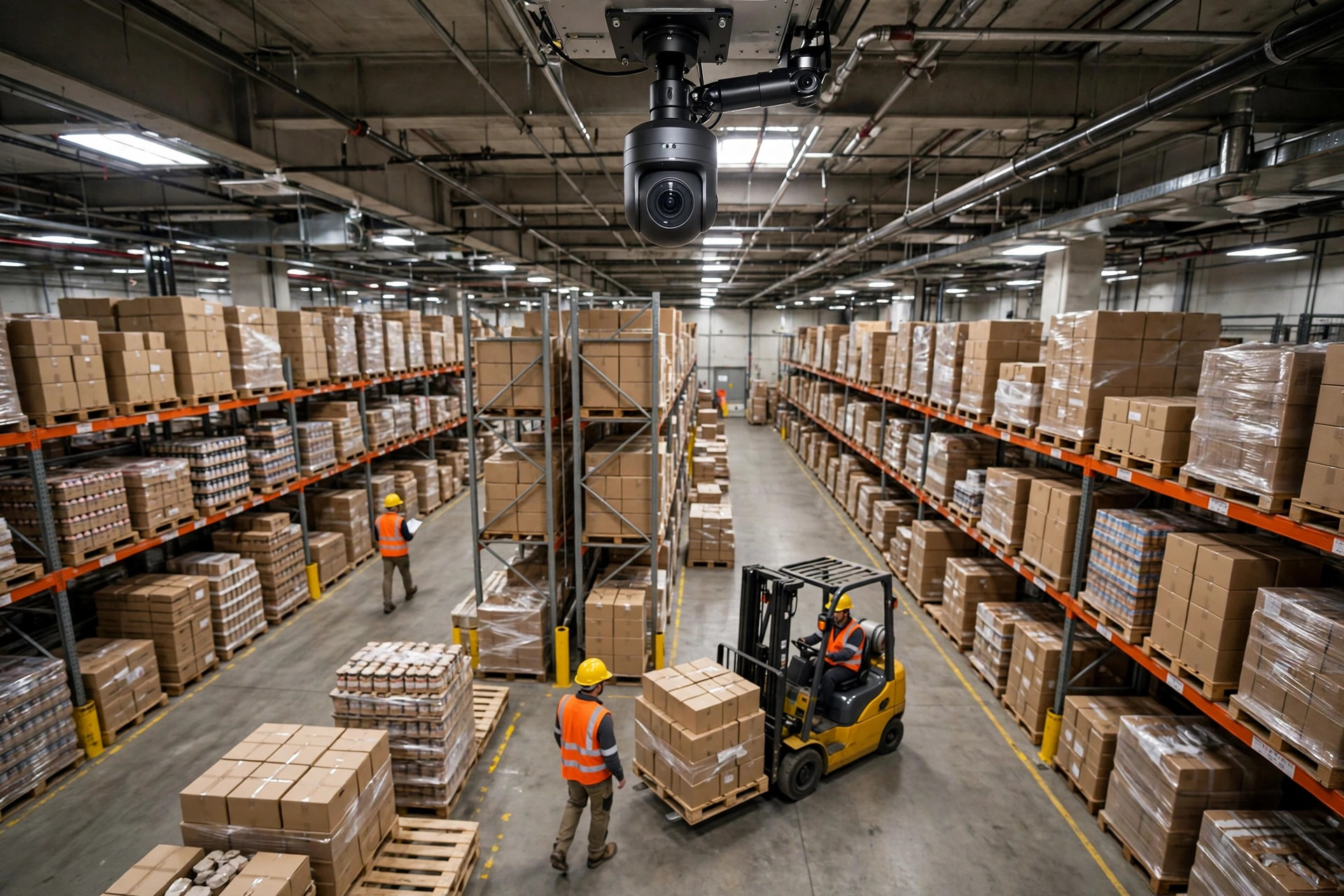
The mechanism is less mysterious than the marketing suggests. The system takes the feed from cameras already installed, runs an object-detection model over each frame to find people and then the equipment on them — a hard hat on the head, a hi-vis vest on the torso — and raises an alert when the expected item is absent. Most run inference locally on an edge device, not in the cloud. One open-source implementation measured the full pipeline, including hard-hat detection, hi-vis detection, and identity recognition, at 113 milliseconds per frame on 640 by 480 video, and classified all 63 of its hard-hat test samples correctly. A small controlled test, not a night-shift promise.
The published research reports higher numbers still, and the gap between research and vendor figures is itself informative. A study using YOLOv11 reported a peak detection rate of 98.6 percent across the environments it tested, a figure the paper itself presents as preliminary, while an earlier study based on YOLOv3 reported an F1 score of 0.96. The Sieora vendor page puts real-world accuracy for common PPE at roughly 90 to 95 percent, and a Tensorbot vendor case study reports 99.4 percent accuracy on a 40-acre site, with 100 times the coverage of manual inspection and alert latency under one second. Accuracy is not a fixed property of the model. It moves with the scene: camera angle, light at the dock door, whether the worker faces the lens, and whether a vest is covered by a jacket or a hard hat is hidden behind a rack beam.
Where Helmet Detection Breaks Down on the Warehouse Floor
False positives arrive first. A white baseball cap, a head of white hair, or a bright light fitting reflected above a worker's head can all be read as a hard hat by a model judging a small patch of pixels at a distance, while a hi-vis vest dulled by dust can be read as an ordinary jacket under the yellowish light of a loading dock at night. The open-source system above requires eight consecutive frames of violation before it alerts, trading speed for reliability, but a walker passes a camera in two or three seconds.
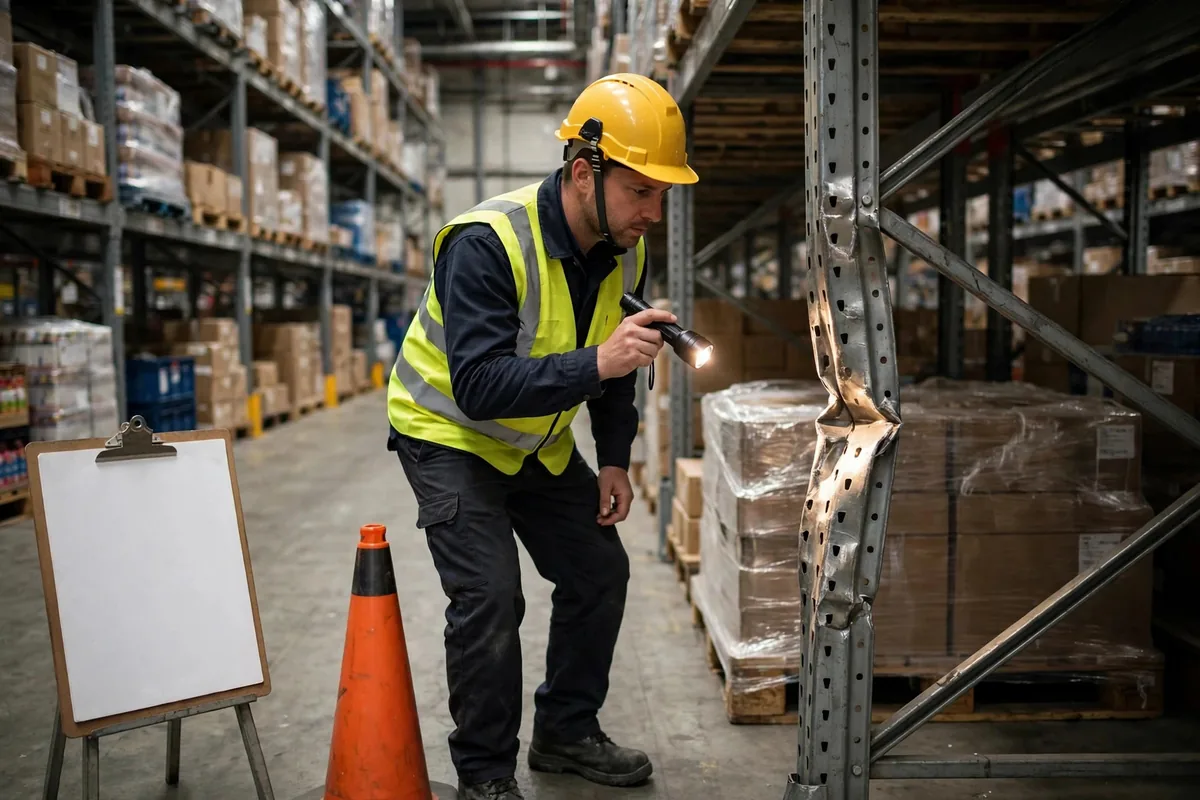
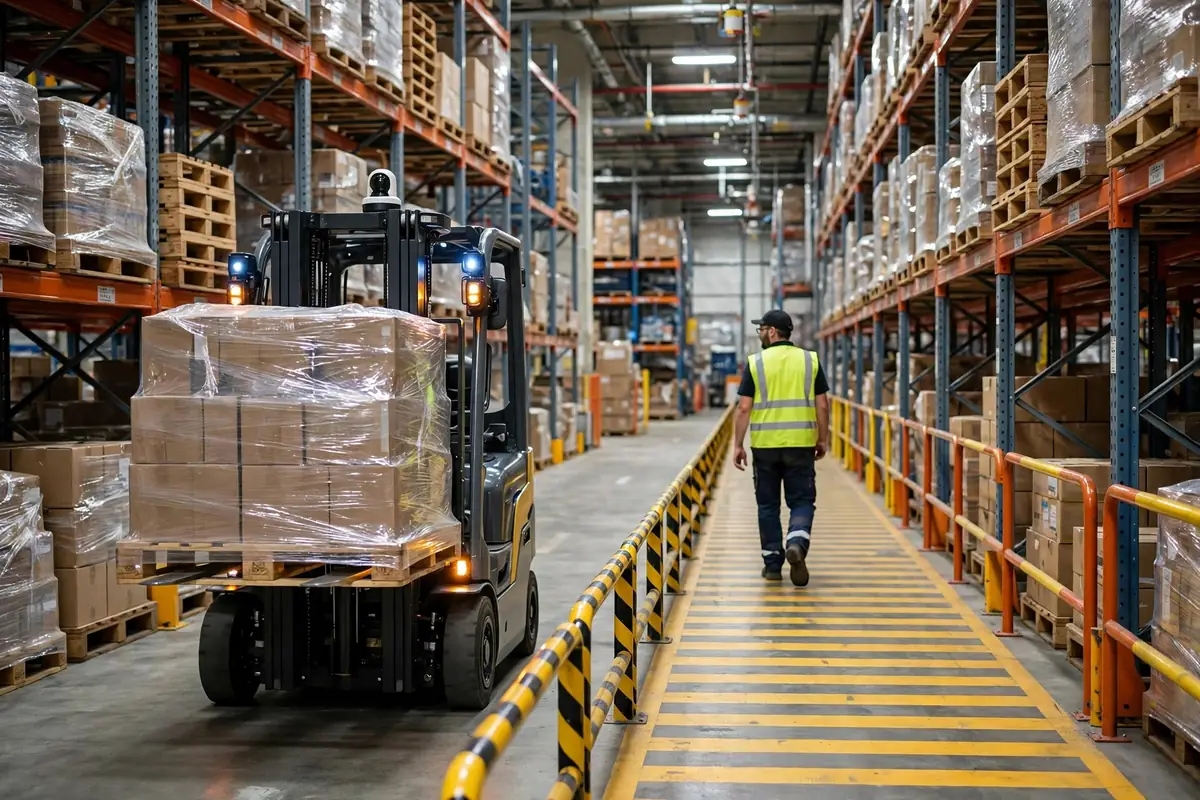
Missed detections follow the ordinary shape of warehouse work. A forklift driver seated in the cab has most of the torso hidden behind the steering wheel and the body of the truck, so a vest plainly visible when the driver is standing becomes a partial, occluded shape when the driver is working. A picker reaching into the lowest level of racking has the hard hat hidden behind a horizontal beam, and a night shift in a poorly lit zone degrades colour judgement directly, because hi-vis detection depends heavily on colour and contrast. Papers test people standing still, facing the camera, in even light.
There is a subtler gap no improvement in detection rate will close: the system judges presence, not compliance. A hard hat worn backwards, a chin strap left unfastened, a hi-vis vest worn open, or safety glasses pushed up onto the forehead all register as present, and the model passes them. Under 1910.132, PPE must fit, be maintained, and be worn as trained, so presence and compliance are different things, and the distance between them is the step a camera cannot currently take.
The arithmetic of alert fatigue is where ai ppe detection usually fails as a management tool, not as a model. Consider the following hypothetical example, with assumed figures used only to illustrate the scale: a 200-person warehouse in which each worker passes a detection zone four times a day produces 800 judgements a day, and even at a true accuracy of 98 percent, that leaves 16 errors a day, or more than 300 in a month. A supervisor will check every alert in the first week, skim the subject lines in the third week, and silence the notifications by the fifth.
| Location | Detection in practice | What to do with it |
|---|---|---|
| Entrance gate, face-on, good light | Most reliable detection | Install here first |
| Dock and aisle, backlit, fast movement | False alarms and misses both rise | Record only for two weeks |
| Forklift cab and low rack levels | Occlusion severe, judgement unreliable | Do not assess individuals here |
| Gloves, eye protection, safety shoes | Small targets, current models struggle | Do not pay extra yet |
The Record, Not the Catch: What the Cameras Are Really For
Here is the judgement that runs against the sales pitch for ai ppe detection. The most durable value of a PPE detection system may not be the violations it catches in the moment, but the record it leaves behind: which aisle, which shift, and which type of violation recurs, and whether the pattern points at training, rostering, or the layout of the traffic routes. The Tensorbot case study on its 40-acre site reports 100 times the coverage of manual inspection and alerts reaching a supervisor in under one second, and the coverage claim is plausible, but the case study does not say whether the injury rate fell. Coverage and injury rate are two different things, and a camera that sees everything and changes nothing has improved observation, not safety.
Privacy must be settled before installation, not after a complaint. State rules differ: California Penal Code section 632 requires all-party consent for audio recording, and restrooms and changing rooms are off limits for cameras, while New York's 2021 electronic monitoring law requires employers to give written notice that monitoring exists. Two California laws signed on 2026-09-30, AB 1883 and AB 1331, take effect on 2027-01-01: AB 1883 restricts the use of AI to infer employee emotions, with an exception for safety tools, and AB 1331 prohibits monitoring inside restrooms, with penalties of up to 500 dollars per violation. PPE detection itself is not prohibited, but a system that adds facial recognition or emotion analysis changes character entirely. Set three policy rules first: work areas only, PPE only, fixed retention.
If a warehouse proceeds, the acceptance method matters more than the vendor. Run the system in shadow mode for two weeks, recording without alerting, and judge it on three figures: the false alarm rate, the missed detection rate, and the rate at which supervisors actually respond to alerts. Start at the entrance gate only. Keep the rule as record only, not discipline, until false alarms fall to a level supervisors can live with, and put acceptance thresholds and an exit clause in the contract, so a system that does not meet them can be stopped.
Over the next two to three years, PPE detection will likely move from whether equipment is present toward whether it is worn correctly, and from hard hats and hi-vis vests toward gloves and eye protection. PPE stays the last layer. The open question I keep returning to is narrow: when the detection rate climbs another two percentage points and false alarms halve, will supervisors still silence the notifications, or will the habit of ignoring them outlast the technical reason for it? The numbers can be made better, and probably will be, but whether the daily habit of the people receiving the alerts keeps pace is not something a benchmark can answer yet.
By Dr. Chen, Supply Chain Researcher