Warehouse dust and noise cause the kind of occupational health problem that hides. The short answer: measure first, name the exposed people second, and talk about earplugs and respirators last. I implement WMS systems. Occupational health is not my home turf, and that is why I keep tripping over the same failure: managers treat "it does not feel loud" and "the floor looks clean" as conclusions.
In November 2024, I was on a go-live at a 3PL warehouse in California's Inland Empire: about 60,000 square feet, 42 pickers across two shifts. The client insisted noise was fine because "everyone is used to it." We borrowed a sound level meter and spent a morning beside the sort line. Readings bounced between 86 and 89 dBA. That range matters more than it looks: it sits below OSHA's 90 dBA limit, yet above the 85 dBA action level. Under 29 CFR 1910.95, an 8-hour average of 85 dBA triggers a hearing conservation program — monitoring, audiometric testing, free hearing protectors, and annual training. The client had done none of it, not from indifference but because nobody had told them 85 existed. The fix cost three extra weeks of monitoring and baseline hearing tests, and nearly slipped the go-live date. I have seen this trap three times: nobody measures, nobody knows they have crossed a line.
Warehouse Dust and Noise Limits: Two Sets of Numbers, Kept Apart
Noise and dust each carry their own numbers, and mixing them up is how programs go wrong. For noise, OSHA's 8-hour permissible exposure limit (PEL) is 90 dBA, the action level is 85 dBA, and the exchange rate is 5 dB — every 5 dB above the limit halves the allowed time. NIOSH recommends a stricter line: 85 dBA over 8 hours, with a 3 dB exchange rate. OSHA's 90 is an enforcement line. NIOSH's 85 is a health recommendation. A warehouse that only aims at 90 has confused "legal" with "not damaging hearing," and those two are not the same thing.
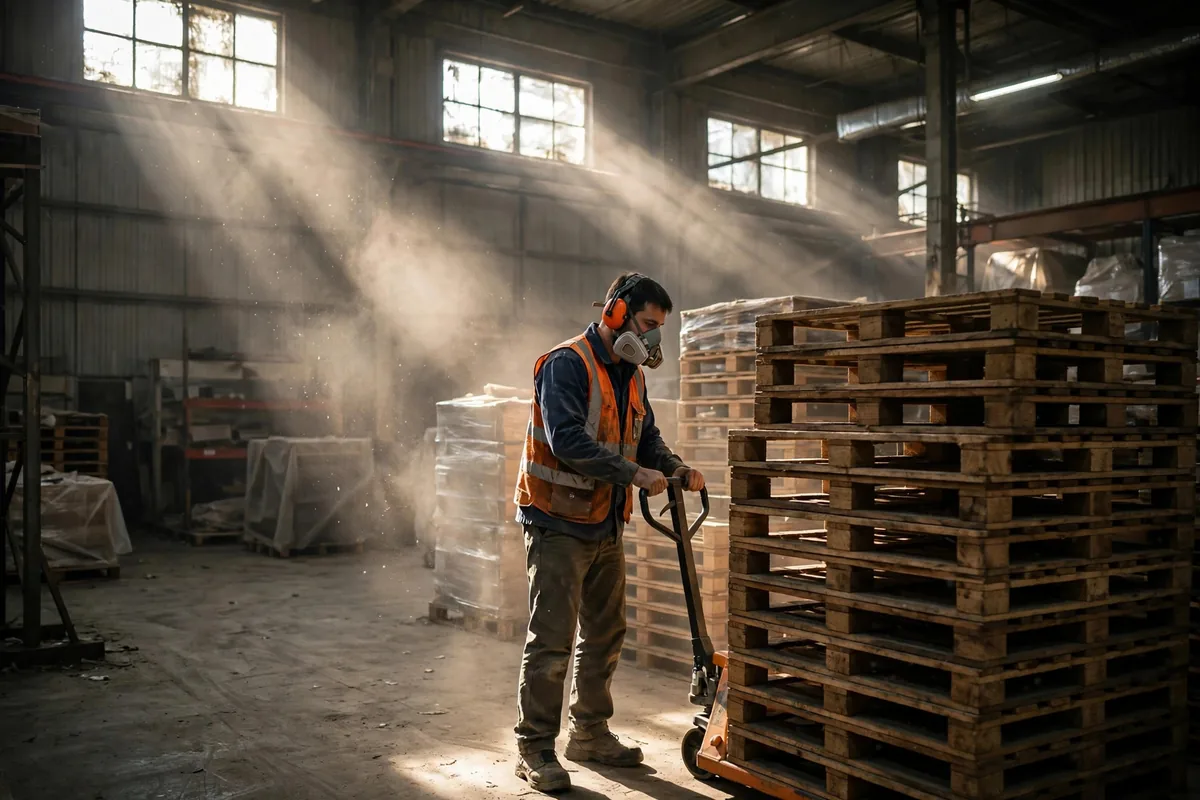
For dust, the general limits under 29 CFR 1910.1000, Table Z-1, cover particulates not otherwise regulated: total dust at 15 mg/m3 and respirable dust at 5 mg/m3, both as 8-hour averages. Respirable crystalline silica is far tighter: a PEL of 50 micrograms per cubic meter and an action level of 25, under 29 CFR 1910.1053. Most warehouse dust — cardboard fiber, pallet wood, floor sweepings — falls under the general limits. Once a site cuts stone, grinds concrete, or handles silica-bearing material, the general numbers no longer apply. Checking the material safety data first is a step I have watched too many teams skip, and the sampling report is where they pay for it.
| Exposure | OSHA enforcement line | Line that triggers action | Note |
|---|---|---|---|
| Noise, 8-hour average | 90 dBA PEL | 85 dBA action level starts a hearing conservation program | 5 dB exchange rate; NIOSH recommends 85 dBA with a 3 dB rate |
| General dust, 8-hour average | Total dust 15 mg/m3; respirable dust 5 mg/m3 | Any exceedance needs correction, confirmed by sampling | 29 CFR 1910.1000, Table Z-1 |
| Respirable crystalline silica, 8-hour average | 50 µg/m3 PEL | 25 µg/m3 action level | 29 CFR 1910.1053 |
How to Run the Occupational Health Inspection, Step by Step
Step 1: draw an exposure map. Split the warehouse by job: receiving, putaway, picking, packing, loading, returns. For each zone, write down headcount, shifts, noise sources, and dust points — tape machines, forklift alarms, conveyor rollers, and the tasks that raise dust: opening cartons, breaking down pallets, sweeping, repacking.
Step 2: measure noise properly. Use a sound level meter for area surveys and a dosimeter worn by the worker for a full shift. Area readings alone mislead, because people move. Cover the loudest shift and roles, and record date, location, shift, and equipment state: a conveyor at full load versus idle can differ by 3 to 5 dBA, and a report without equipment state cannot be rechecked.
Step 3: measure dust. Hire a qualified sampling firm, fit personal sampling pumps to workers in the target roles, and sample across the shift for an 8-hour average. Do not stage sampling day: no deep clean, no shutdown of dusty work. Keep the original lab report. In WMS, I file the report number, sampling date, and location against the work zone.
Step 4: establish baselines for people. For noise, workers at or above the action level need a baseline audiogram within 6 months of first exposure, then an annual audiogram, with at least 14 hours away from workplace noise before each test. For dust, flag anyone with respiratory symptoms or a history of lung disease for an occupational health physician to assess. I am not a doctor, and that judgment is not mine to make. My job is to hand the physician a complete file — names, roles, exposure data — instead of a blank form.
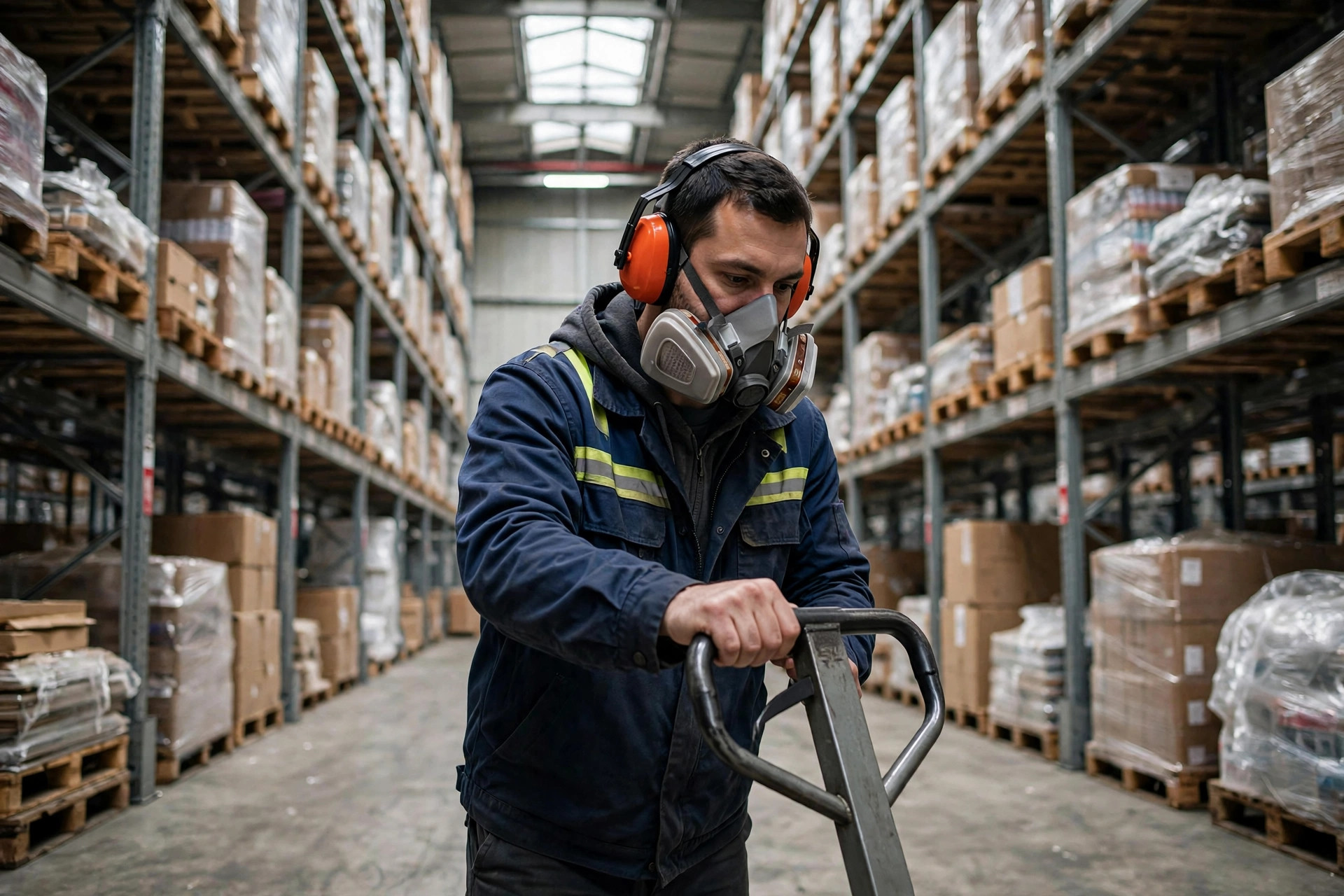
Step 5: rank controls in the right order: engineering first, administrative second, protective equipment last. An enclosure on a conveyor, a quieter fan, local extraction at a dust point — these cost once and keep working. Job rotation is the administrative control I reach for most: split continuous time in high-noise roles. Earplugs and respirators are the last line, not the first. Reverse the order and an inspector spots it at a glance.
Step 6: fold the program into daily operations. Monitoring cycles, retest triggers, training records, and protector issue logs all go onto one checklist, with owner, deadline, and reviewer. On a go-live night I run down a list like that item by item and refuse to call the site ready with a single box unticked. A plan that never enters daily routine collapses the week after the inspection, and the next one starts from zero.
Where Warehouses Most Often Fail
The first failure is cleaning with compressed air. In March 2025, a home-goods warehouse wanted to look clean before an inspection, so workers blew dust off rack tops and beams with compressed air. The airborne concentration spiked in minutes. Combustible dust is exactly what that move creates: settled dust turned into a cloud, one ignition source away from an incident. The correct method is a vacuum with high-efficiency filtration.
The second failure is issuing earplugs without teaching anyone to wear them. An earplug rolled too loosely or seated too shallow can lose half its real-world attenuation or more. Issue day has to include a live demo and a fit check for every worker.
The third failure is sampling only the cleanest day. Some sites pick a half-shutdown morning, freshly mopped, and produce a beautiful report while daily dust levels stay high. One retest exposes it.
The fourth failure is letting the baseline audiogram slip past 6 months. The longer the delay, the harder it is to tell whether hearing loss predates the job. That window sits in 29 CFR 1910.95, and a late test cannot rebuild the timeline.
The fifth failure is scattering records across five people: monitoring reports on the safety manager's laptop, hearing results at the clinic, sign-in sheets in a supervisor's drawer. An inspector asks for one continuous chain, and the site cannot assemble it. I have lost the same battle on WMS go-lives: data in five places is data that does not exist. File centrally, retrievable by person and by role.
The money argument is straightforward. Illustrative example: a 60-person warehouse with 32 people exposed above 85 dBA. Baseline and annual audiometric testing, at hypothetical figures of $120 per person per year, comes to about $3,840 a year. One round of noise and dust sampling, at hypothetical figures of $4,500, brings the total under $9,000. Set that against the other side: a single hearing-loss claim, a round of rework, or one shutdown inspection each clears that figure easily. The numbers here are hypothetical figures for scale, not quotes. Prevention money is small money. Incident money is large money.
Here is the counterintuitive judgment I would leave with any warehouse manager: the quieter the warehouse, the more carefully you should watch dust. Loud sites announce themselves; everyone feels the noise, and management funds the fix. Dust is invisible. The floor can be swept spotless while dust sits on the beams overhead and nobody looks up. Its damage is slow, measured in years. My habit runs the other way round: noise gets judged by numbers, dust gets judged by looking up. Once a month, take a flashlight to the beams, ductwork, and rack tops. See dust, log it, clear it, record it.
An occupational health inspection is not an exam to pass once. It is four habits made routine: measure, name the exposed people, control the source, and keep the evidence. Build those four habits into daily WMS operations, and the inspection stops being a scramble, because you are already doing the work every day.
By Lin Xiao, WMS Implementation Consultant