Blocked Fire Lane, Five-Figure Fine: Warehouse Fire Exit Management That Actually Works
It was a Tuesday morning last November, 8:40 a.m. I was in the office of our Ontario warehouse — 120,000 square feet, about 180 people on the roster — going through the night shift report.
The fire inspector walked in unannounced — another fire-lane check — and headed straight for the emergency exit in Zone B.
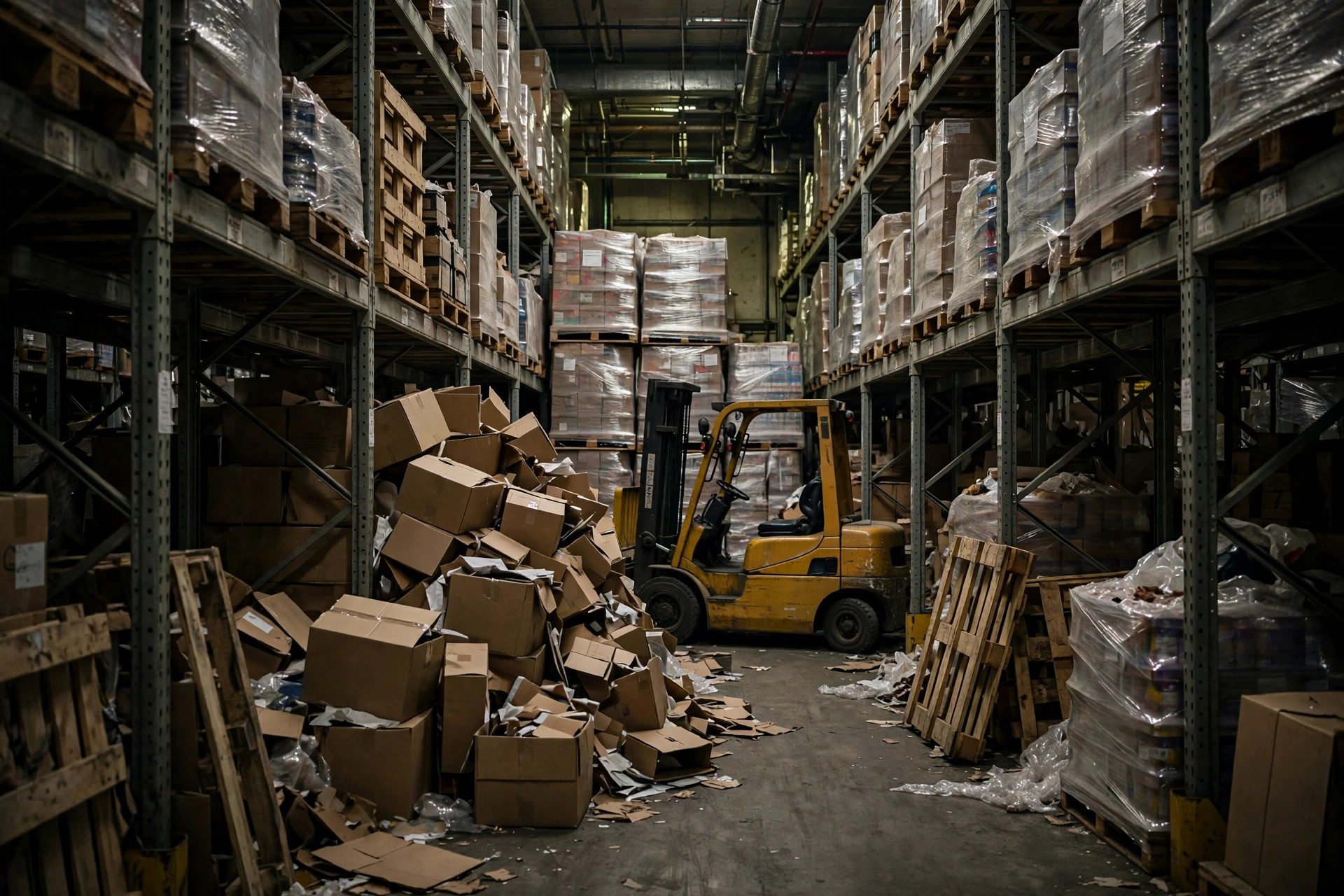
My stomach dropped: three meters in front of that door sat two pallets of returns, "temporarily" staged by night shift six days earlier. The inspector said nothing. He took out his phone. Click. Then he walked the whole building: product stacked within a foot of the ceiling under the sprinklers, a forklift parked diagonally across the fire lane by the north gate, engine still running.
Two weeks later the notice arrived — four violations, each with an abatement deadline. Let me be straight with you: a blocked fire lane in a warehouse starts at five figures once the citations land. Here's how we climbed out of that hole, and how we manage fire lanes now.
What a Blocked Fire Lane Actually Costs
Let's start with OSHA's side of the math, because those numbers are public and verifiable.
OSHA's 2026 maximum penalties (adjusted annually for inflation):
- Serious violation: up to $16,550 per violation
- Willful or repeat violation: up to $165,514 per violation
- Failure to abate: $16,550 per day, compounding until fixed
A blocked exit route falls under 29 CFR 1910.37(a)(3) — exit routes must be kept free and unobstructed, and OSHA treats it as serious almost by default: in a fire, people who can't get out is a life-safety issue.
Do the arithmetic: two blocked exits, one over-stacked sprinkler area, one obstructed fire lane — four serious items at the maximum is $16,550 × 4 = $66,200. That excludes the local fire marshal's citations — penalties vary by jurisdiction, so check your local fire department's current fine schedule. The two agencies fine independently.
Don't assume the maximum is theoretical. OSHA's public citation records: a Brooklyn retail stockroom with its emergency exit blocked by boxes — classified repeat — initial penalty $96,390, settled at $65,000; a warehouse company cited serious for an obstructed path to the exit, initial $13,653, settled at $6,963; a New Jersey truck terminal with empty pallets blocking egress, serious, settled at $1,400 — small money, but the citation sits in the public record.
See the pattern? First offense might be a few thousand. Second or third time it's a repeat violation and you're staring at five or six figures. And a citation comes with an abatement deadline — miss it and failure-to-abate accrues at $16,550 per day. It's not "pay and forget." It's pay, fix by the deadline, and keep paying if you don't.
How Fire Lanes Get Blocked: The Same Scenes, Every Time
After all these years, I've learned a blocked fire lane is never really a space problem — it's almost always a people problem. The top scenarios:
Peak season overflow. After the holidays, returns flood back in. Slots are full, receiving is buried — "we'll just stage it by the aisle for now." That "for now" routinely becomes next month. The two pallets that got us cited? Exactly this.
"Temporary" staging. The two most dangerous words in any warehouse. It's 2 a.m., the load is unloaded, the forklift driver thinks "I'll move it before sunrise." Then shift change gets busy, and everybody forgets. My blood pressure spikes every time I hear "just leave it here for now."
Forklifts parked wherever. Driver hops off for a bathroom break or lunch, parks right there — in front of an emergency exit. Somebody parks by a hydrant cabinet because "it's just five minutes." Five minutes is plenty for ten photos.
Stacking too high under sprinklers. The one everybody overlooks. NFPA 13 requires at least 18 inches of clearance below sprinkler heads. Product creeps up until it's inches from the deflector — in a fire, the water hits the boxes instead of the flames, which means you effectively have no sprinklers. Inspectors check this everywhere they walk.
Three Years of Trial and Error
I'll be honest: our building learned this the expensive way too. Phase one: yellow "no staging" floor lines. Week one people walked around them; week three whole pallets sat on top. Phase two was "$50 every time we catch it" — but we could never catch who did it. Night shift staged it, day shift found it, everybody pointed fingers. A fine that can't be pinned on a specific person is just paper.
The turning point was that inspection. My boss said one sentence: "If this happens again, don't bother coming back." When your back is against the wall, solutions appear. What we do now boils down to four words: one throat to choke. Not "everybody be careful" — but "this lane belongs to this person, checked at this time, and this person answers for it," written into the shift roster in black and white.
What We Do Now — Steal This
Here's our actual inspection sheet. Take it:
| Time | Check | Owner | Standard |
|---|---|---|---|
| 9:00 a.m. | 3-meter clear zone in front of all 6 emergency exits | Shift lead | No product, no equipment, no parked forklifts |
| 1:00 p.m. | Fire lane, fire hydrant access | Receiving lead | No vehicles, no staged pallets |
| 10:00 p.m. | All exit routes + sprinkler clearance | Night supervisor | 18-inch clearance below sprinklers |
| Every Friday | Extinguisher and hydrant signage visibility | Safety coordinator | Signs not hidden by racks or product |
| 1st of month | Emergency lighting, exit sign test | Facilities | 30-second power-cut test |
A few details that make it work:
Every check gets a photo. The shift lead finishes the 9 a.m. walk, snaps a timestamped photo, posts it in the shift group chat. This kills the "yeah, I checked" problem — verbal confirmations evaporate when something goes wrong.
"Temporary" staging over 4 hours counts as a violation. Anything near a lane or exit gets moved within 4 hours, or it goes on the shift supervisor's record. Four hours is what we converged on — shorter isn't realistic, longer and "temporary" becomes permanent.
Forklift key control. Driver steps away for more than 10 minutes, the key goes on the board. People hated this — "I have to hand in my key to use the bathroom?" Two months in, random parking dropped about 80%.
New hires walk every exit on day one. Not a PowerPoint — they physically walk it, pushing open each emergency exit door with their own hands. Our veteran shift leads teach one thing before anything about picking: "Nothing ever goes in front of these doors." That rule came from a shift lead with 12 years on the floor — the best rule in the building.
If You Get Cited Anyway — The Playbook
If a citation lands despite all this, don't panic. Work the process:
- Read the classification. Serious, willful, or repeat — repeat is the worst, and it changes your negotiating room completely.
- Note the abatement date. Fix it before the deadline or request an extension. Failure to abate accrues daily.
- You have 15 working days to contest. Your statutory right under the OSH Act — no contest, and the citation becomes final.
- Fix immediately and document everything. Before-and-after photos and new inspection logs go to the informal conference — that's how penalties get negotiated down.
- Add what got you to the checklist. A citation is the best training material you'll ever get — our "sprinkler clearance" line came from the inspector.
One Thing for Fellow Managers
Last thing, and I'll keep it real.
A lot of people treat the fire lane as "the fire department's problem" or "the safety guy's problem." Wrong. In OSHA's logic, exit access is an operations problem — the manager's problem. The citation names the company, but on inspection day, the person standing next to the inspector is you.
Here's the counterintuitive part: the most expensive part of fire lane management isn't paint, signage, or checklists — a few thousand dollars total. The most expensive part is discipline on the day you're bursting at the seams. When there's nowhere to put the freight, everybody wants to use the lane. Holding the line in peak season comes down to whether you, the manager, will say no to the throughput metric.
Those two pallets of returns — if somebody had said "you can't put that there" that night, none of the rest would have happened. Before you leave today, walk your building. Look at the three meters in front of every emergency exit — don't wait for an inspector to check it for you.
By Chen Feng, Warehouse Operations Manager