Two winters ago I was commissioning equipment at a new distribution center when the owner called me on site a week before final inspection. The fire marshal had just left with a simple verdict: the fire compartmentation failed, so the whole building couldn't open. It was a 250,000-square-foot facility — lease signed, racking up, equipment in. And the entire project was stuck on something nobody had taken seriously.
First, the principle: compartmentation turns one big fire into several small ones
Think of a warehouse as a ship, and fire compartmentation as watertight bulkheads. The hull takes a hit, water floods in, and the bulkheads keep it to one compartment so the ship doesn't sink. A warehouse fire works the same way: compartmentation isn't there to put the fire out — that's the sprinklers' and the fire department's job. Its job is to contain the fire inside one compartment, buying time for people to get out and for firefighters to get in.
Technically, it comes down to two things: fire walls and fire-rated shutters or doors. Walls seal things off permanently. Shutters and doors stay open for daily traffic and slam shut when there's a fire — like the lid on a wok when the oil catches.
In the US, all of this lives in the IBC and the NFPA code family. There's a side benefit a lot of owners never realize: once you divide a building with fire walls, the code lets you calculate allowable building area as if they were separate buildings (always confirm with your local AHJ). That's why nearly every mega-warehouse gets sliced into chunks — not over-engineering, just how the building gets permitted.
Let me get one rant out of the way early. Somebody always asks: "We have full sprinkler coverage, do we really still need compartmentation?" I'll be blunt: sprinklers extinguish; compartmentation confines. Expecting one layer of protection to do two jobs isn't design, it's gambling. Fires that sprinklers can't reach — deep inside high-bay racking, dead corners with no coverage — can still be locked inside one compartment. "We have sprinklers" is not an excuse the fire marshal will accept.
The dividing line: wall or shutter? One line, drawn on the floor
The selection rule is a single line you can draw on the floor plan: does anything — people or forklifts — pass through this opening in daily operations?
- No traffic: build a fire wall. Clean and done. Every pipe, cable tray, and duct that penetrates it gets firestopped, once, properly.
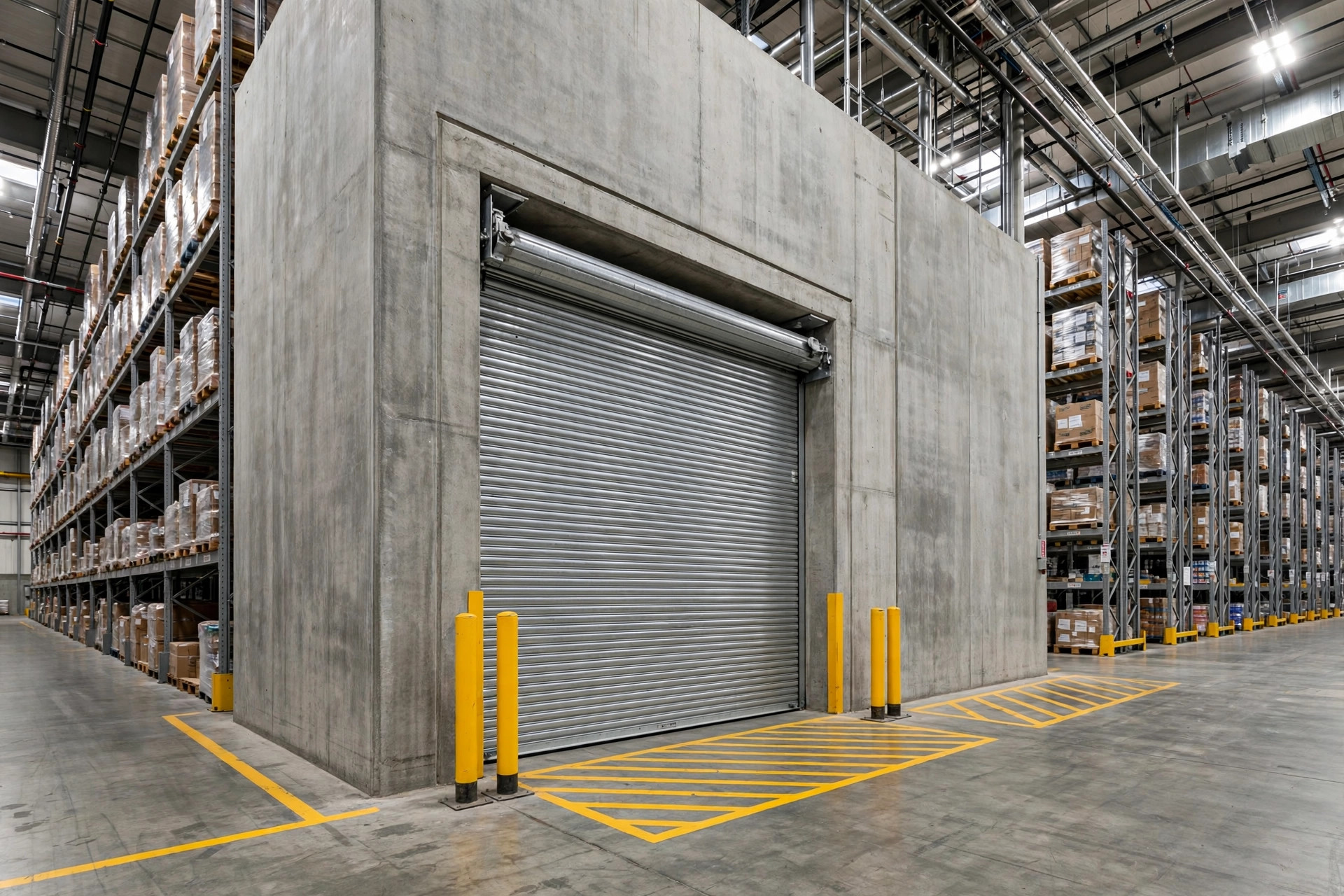
- Traffic needed: install a rolling fire shutter or a fire door. Open all day so it never blocks operations, drops shut automatically when the alarm sounds. Think of it like an elevator's safety gear — you never notice it exists until the one moment it has to work.
On the numbers, here are the ones I can stand behind. IBC Table 716.1(2) maps wall ratings to opening protectives: a 3-hour fire wall needs 3-hour rated shutters or doors in its openings; a 2-hour fire barrier takes 1.5-hour protectives. The short version: the opening can't be dramatically weaker than the wall. Look up the exact table yourself, and let your AHJ have the final word — don't guess.
Three ways to trigger a shutter: tie it to the fire alarm panel, use a fusible link that melts at a set temperature, or power-failure release — if the power dies, the door still has to come down. That's the baseline.
NFPA 80 is explicit: rolling fire doors get a full drop test at least once a year, and every test gets written down and kept for the AHJ (some manufacturers recommend keeping records at least three years). Translation: this door is not a safe you buy once — it's equipment with an annual inspection.
One more rant, on pseudo-needs number two: "Can we just use cheap regular doors? The inspector won't notice." Blunt answer: they will notice — listed fire doors and shutters carry a UL or FM label, and no label means it's scrap paper. In a real fire a regular door is gone in minutes and the fire walks through. If you want to save that money, delete the compartmentation from the drawings entirely. (Then you'll never pass inspection.)
The 5 things inspectors flag most at final inspection
This is the meat of the article. When the fire marshal walks the compartmentation scope, they check the same five things every time — and eight out of ten projects trip on at least one.
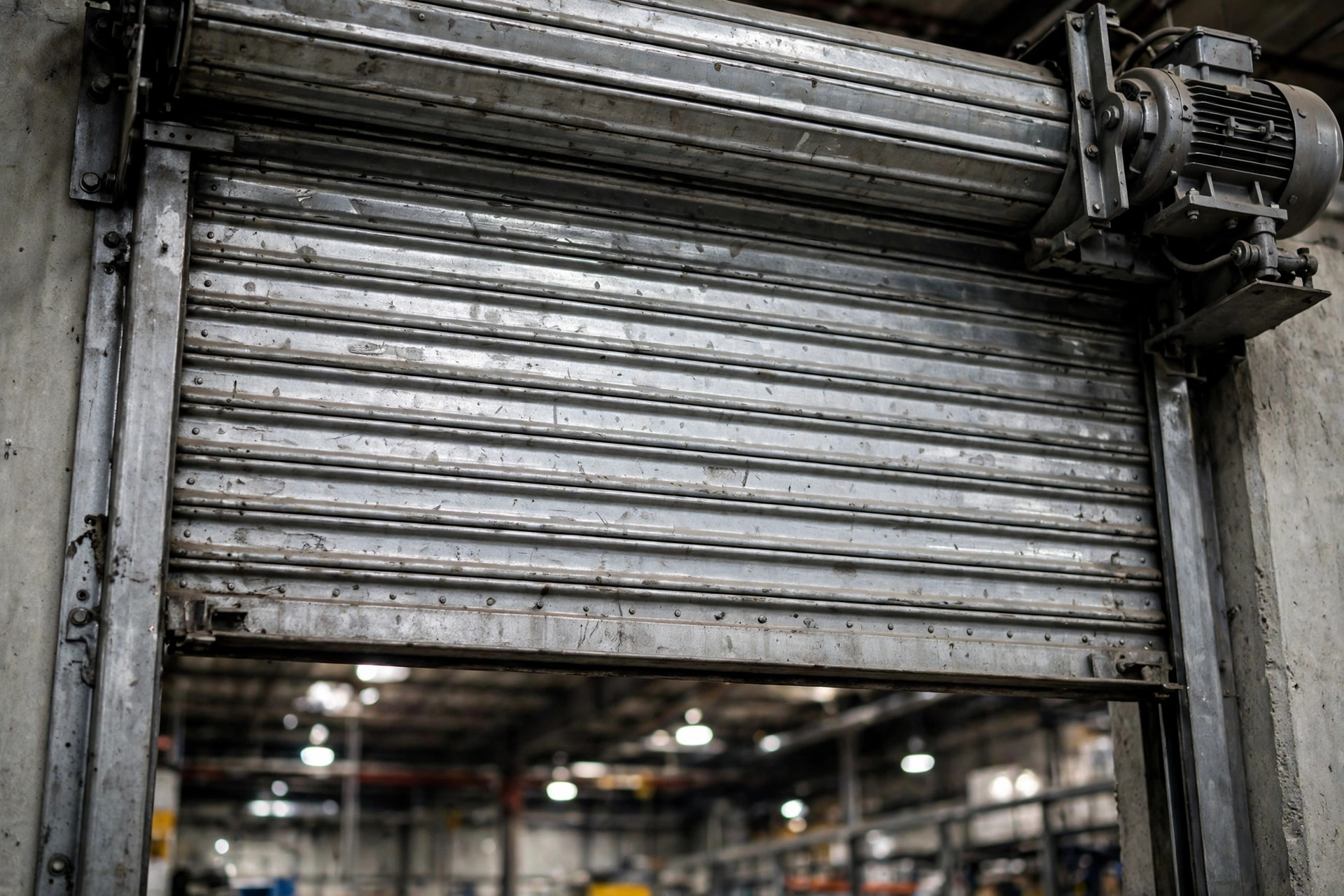
1. The drop test fails: the alarm sounds, and the door doesn't come down — or jams halfway.
This is the number-one killer. At final inspection, the marshal will demand a live test: trigger the alarm, and every shutter must descend fully and seal. The usual suspects: an overtight motor brake, debris in the guide rails, miswired controls, a backup power supply that was never connected.
Case one (figures below are from the actual project): a new 250,000-square-foot DC in California — two out of four shutters failed the drop test on inspection day. Rework, retest, rebook the inspection: two full weeks lost. The lease clock was already running, racking installed, crews standing by. That's real money burning.
2. Unsealed penetrations: pipes, cable trays, and ducts punched through the wall with no firestopping.
You can build the finest fire wall on earth, then the electrician runs a conduit through it and the HVAC guy runs a duct through it, and nobody seals the holes. Congratulations, you've built a chimney. Inspectors bring flashlights specifically for this. The root cause is always the same: every trade assumes someone else seals it. The fix: a penetration permit from day one — one hole, one ticket, the cutter owns the seal, photos on file. That piece of paper saves projects at inspection.
3. Dead closers — or doors wedged open.
A fire door has exactly one job: stay closed in daily life, hold back fire when it counts. Closers are consumables; after a couple of years they lose their muscle and the door won't latch. Worse is when operations wedges the door open with a pallet "because it's more convenient." Which brings me to the counterintuitive take: the biggest enemy of fire compartmentation isn't fire — it's daily operations cutting corners. A great deadbolt means nothing if you leave the door unlocked every day.
4. Compartment area exceeded.
The design had the compartment areas all calculated correctly, then construction changed something, operations added a partition, and the actual area blew past the limit. The rule (confirm with your local fire department): allowable area is tied to construction type and sprinkler protection — change one variable and the limit changes. This is the most expensive failure, because the fix usually means adding walls and doors.
Case two: a retrofit of an older warehouse where the owner widened two openings in a fire wall to fit more racking. The area recalculation failed at inspection, and they had to add two rolling fire shutters to pass. The shutters were the cheap part; the downtime was the expensive part. And one more detail: those shutters had never had their annual NFPA 80 drop test — the chains had rusted and seized, and the door wouldn't descend at all. They replaced the entire release mechanism. Same disease in both cases: installed and then ignored, until inspection day revealed they were decorative.
5. Product stacked under the shutter.
The inspector's favorite glance: is there anything — pallets, totes — sitting directly under the rolling shutter? The door comes down on top of the freight, can't seal, and smoke and flame walk right through the gap. This one is pure habit. The fix costs almost nothing: paint a yellow no-stacking zone on the floor, cover it in forklift training, walk it weekly.
Run the numbers: rework vs. doing it right the first time
My habit: no numbers, no talking. Using case one's figures (actual project costs, rounded):
- Doing it right the first time: spec shutters from a reputable manufacturer with the alarm-interface module, run two full drop tests during installation, get every penetration sealed and signed off on the first pass. The premium is roughly 5–8% of the total compartmentation package.
- Rework: labor to fix, re-inspection fees, two weeks of rent burned while the building sat idle. Total: 8–10x the premium you "saved."
8 to 10 times. That's the one number I promised.
And the counterintuitive take, one more time: the biggest enemy of fire compartmentation isn't fire — it's daily operations cutting corners. A fire happens maybe once. But "leave the door open, it's easier" and "stack it here, we'll move it tomorrow" get said every single day. Compartmentation is a "train for a thousand days" system. Maintaining it costs a little, constantly, in boring ways. The one time it saves you, it pays for everything.
So is the money worth it? Look at that one number: 8–10x. Every dollar you spend doing it right and keeping it maintained today saves eight to ten dollars of rework and downtime later. Even the finance team can do that math.
By Da Liu, Automation Engineer