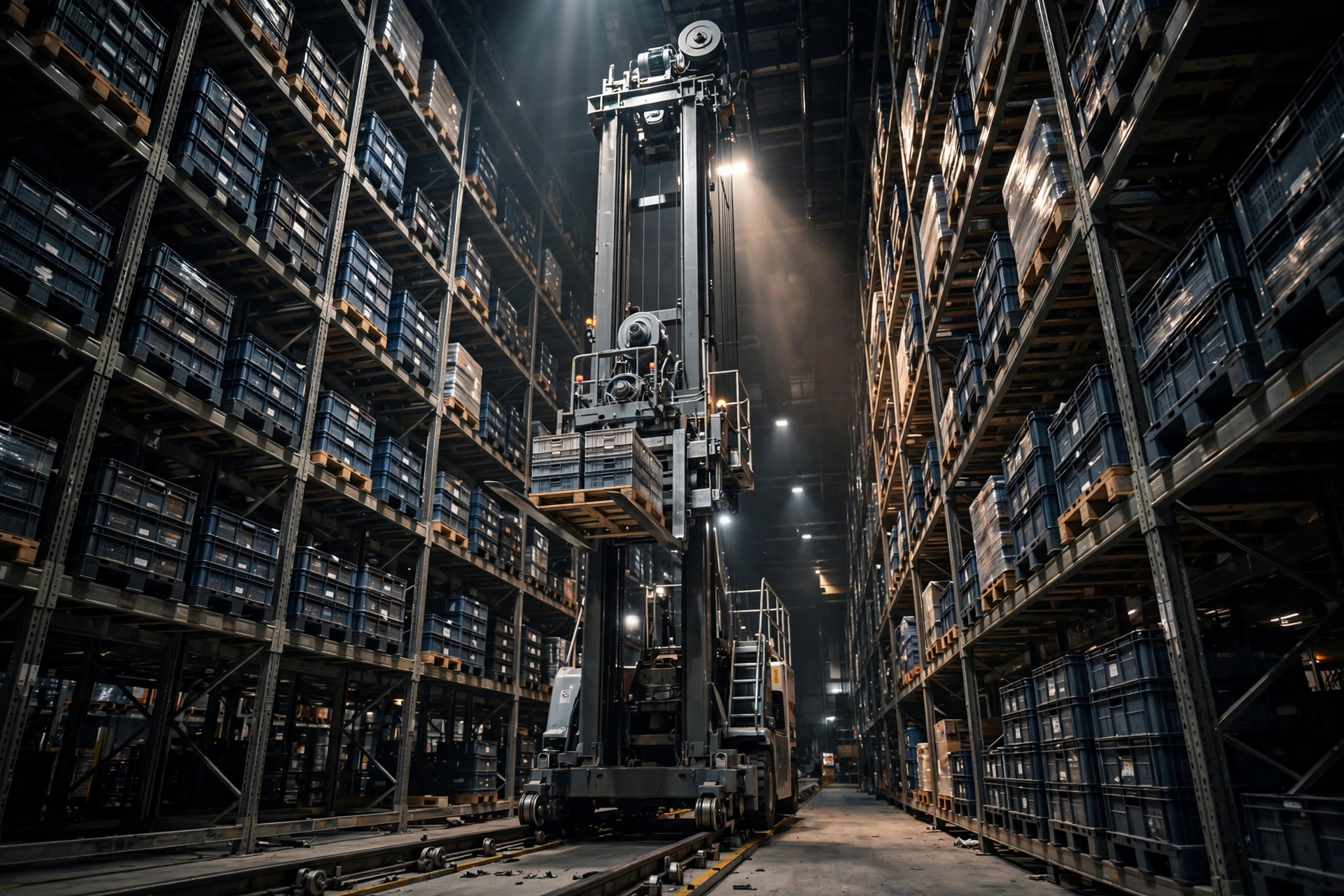
Full disclosure first: our warehouse is 3,000 square meters, 7 meters of clear height, and the floor was poured a decade ago. An AS/RS — the automated storage and retrieval system with those towering stacker cranes — is something I'll probably only ever admire at trade shows. But people keep asking me: "Hey Ma, can an old warehouse be retrofitted with an AS/RS?" Fine. Today I'll measure the three hard thresholds for you, and once you've measured them, you'll know whether you should keep dreaming.
Hurdle One: Floor Loading — Don't Judge an AS/RS by Forklift Standards
An AS/RS presses its weight into the floor at single points: rack legs, stacker-crane rail foundations, each one carrying concentrated loads in the tens to hundreds of kilonewtons. It's like asking Yao Ming to stand on your living room floor in high heels — all the pressure lands on those few heel points.
Most older warehouse floors were designed for forklift traffic, with design live loads in the tens of kPa. Drop AS/RS legs on that, and local pressure multiplies several times over. What happens when the floor can't take it? Differential settlement, leaning racks, deformed crane rails — and fixing that costs more than building new.
How to self-check: dig up the original structural drawings and look at the design live load. If the drawings are gone (they are, in nine out of ten old warehouses), hire a structural engineer to run the numbers — don't guess. And if reinforcement is needed — slab replacement, piling, grouting — civil work easily starts in the seven figures (RMB). That line item is usually missing from the integrator's quote, where it just says "civil conditions by owner."
Here's a hidden trap: many old warehouses have a second pour on top of the original slab — uneven thickness, sometimes hollow underneath. The drawings look fine, but core samples tell a different story. A fellow warehouse owner I know leased an old building in Jiaxing in 2023, planning high-bay racking; core tests showed the concrete at only 70% of design strength, and the project died on the spot — along with every yuan of consulting fees already spent.
Hurdle Two: Clear Height — Too Short, Don't Bother
AS/RS economics scale directly with height: taller stacker cranes and more rack levels are what drive the cost per pallet down. As a rule of thumb, you want well over ten meters of clear height for it to pencil out (exact numbers depend on the equipment).
Plenty of old warehouses sit at 6 to 8 meters. Subtract the beams, sprinklers, and lighting, and you're left with barely 5 meters of clear space for 4 to 5 rack levels — at which point a narrow-aisle rack plus reach truck beats the AS/RS on cost-effectiveness without breaking a sweat. Do the space math honestly: indoor clear height − rack height − crane rail plus top safety clearance − sprinkler/lighting take-up = what's actually usable. Most owners only count the first term, then go pale when the other three get subtracted.
Hurdle Three: Fire Protection — Often Costs More Than the Equipment
This is the most underestimated hurdle of all. An old warehouse's sprinkler system was designed for flat, low racks. Stand up a ten-plus-meter AS/RS and the fire load and spread paths change completely, so fire protection has to be redone: ESFR sprinklers (early suppression, fast response), in-rack sprinklers, upsized supply pipes, added fire pumps, new fire compartmentation — all subject to your local fire code and approval authority.
Here's the counterintuitive part: in many retrofit projects, fire protection plus civil work costs more than the AS/RS equipment itself. In 2023, an e-commerce warehouse in East China got a quote of several million RMB for the AS/RS — and then fire protection added nearly half again on top. The owner went pale when the second quote landed. Integrators love talking equipment; the fire protection part gets a passing mention or a cheerful "to be handled by the owner" — which translates to "get your wallet ready."
There's also the time cost: fire protection retrofits aren't just about money. Design, filing, and inspection take months, minimum. Meanwhile your equipment sits outside gathering dust while the rent keeps ticking. The worst case I saw: equipment arrived in April, fire approval didn't come through until October — six months of rent burned for nothing, which stung more than the depreciation.
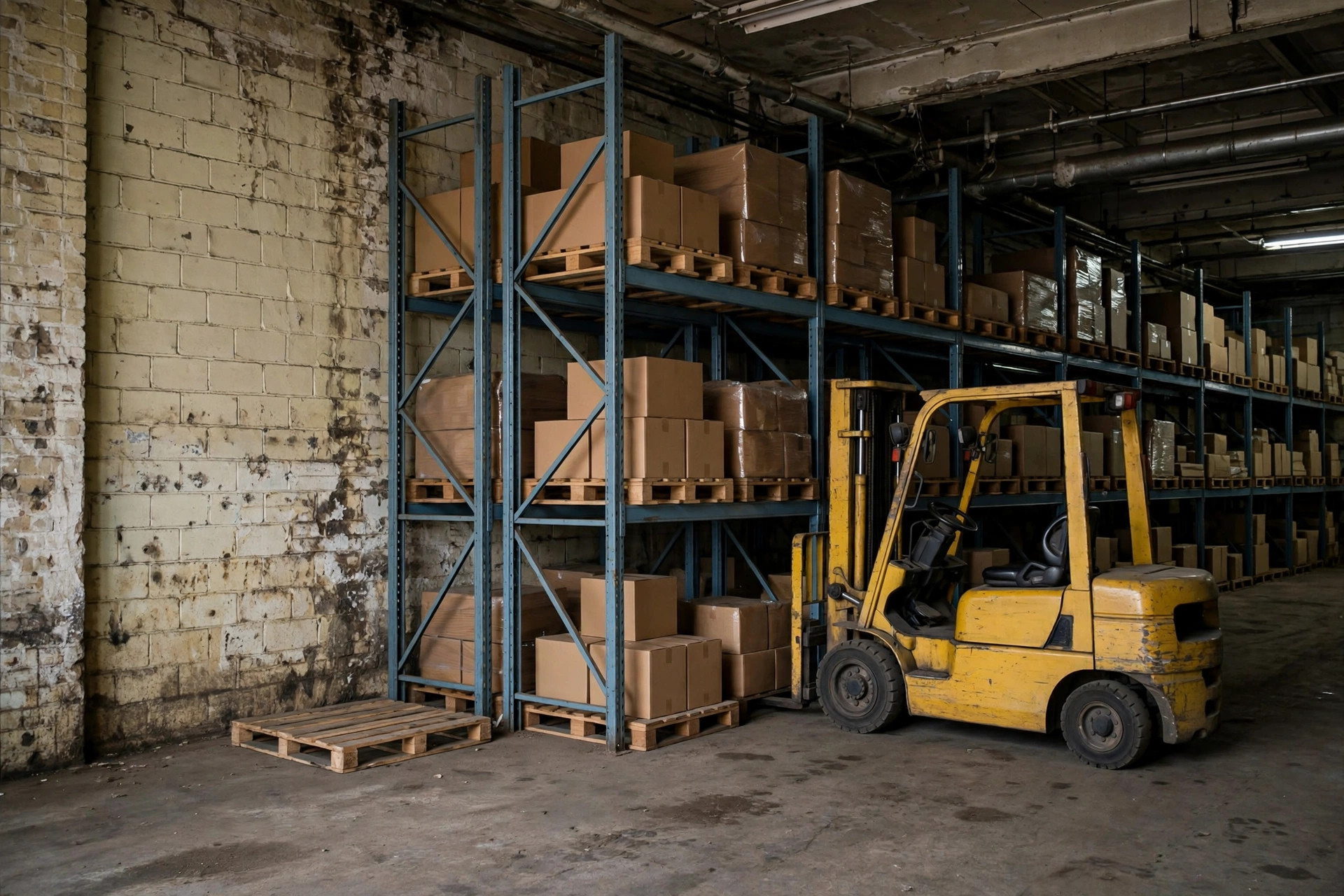
The Three-Minute Self-Check: Three Numbers, Three Questions
Not sure your building qualifies? Spend three minutes filling this out:
| Check item | How to measure/ask | Rough pass line |
|---|---|---|
| Floor design live load | Check structural drawings, or hire an engineer | Must take hundred-kN-class point loads |
| Indoor clear height | Measure under the lowest beam | Well over ten meters to be worth it |
| Existing sprinkler type | Ask the landlord: is it ESFR? | Non-ESFR likely means a full redo |
Three questions for the landlord: ① What's the floor's design load? ② What standard and year was the fire system approved under? ③ Any settlement, cracking, or patching on the floor in the last five years?
If two of the three numbers miss the mark — stop dreaming for now, and read the next section.
Can't Afford an AS/RS? How Our Little Warehouse Survives
Our building is 7 meters tall, so AS/RS is out. But we've been doing just fine. Three scrappy moves that actually worked:
First, the "AS/RS lite." Narrow-aisle racking plus a reach truck: five levels under 7 meters, far denser than standard selective rack, at a fraction of AS/RS cost. For a small warehouse like ours, that's plenty.
Second, pay back the debt you owe to management. In 2022 we did a full slotting overhaul by ABC classification and effectively gained over ten percent more capacity — at zero cost. A lot of warehouses crying "we're out of space" don't have an equipment problem; they have a slotting-management mess.
Third, if you want a taste of automation, start light: conveyors, scan verification, pick-to-light. Barely any civil or fire work involved, small investment, fast payback. We put in a secondhand conveyor line in 2023 for under 100,000 RMB and cut verification labor in half. The beauty of it: installed today, running tomorrow — no waiting on fire approvals. The big-company playbook of "go straight to AS/RS" isn't something we small warehouses can copy — and we don't need to.
AS/RS is great stuff, but it's built for "new building + big budget + high throughput." For an old warehouse, measure the three hurdles first: if you still qualify, go talk to an integrator. If you don't — congratulations, you just saved yourself a small fortune in tuition. Small warehouses have their own way of surviving.
By Xiao Ma, Small Warehouse Owner