December 9, 2022. 6:40 in the morning, still dark outside.
I had just parked in front of the office when my safety lead Lao Zhao called: "Feng, the fire marshal is already at the east gate. He wants to see the outdoor hydrants."
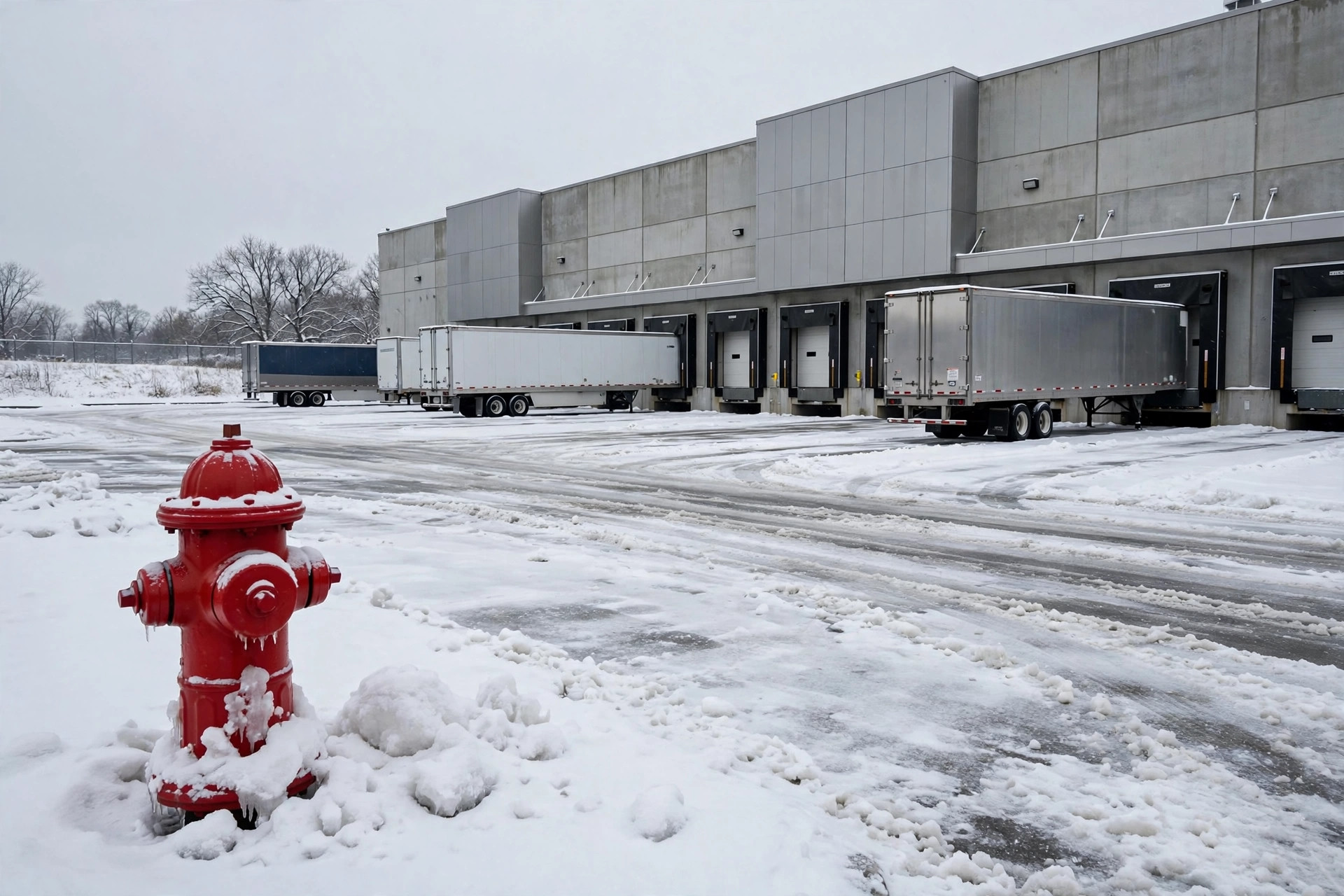
It was the coldest week of the Chicago winter so far. Minus 16 at night, barely minus 10 during the day. The parking lot snow had been packed into an ice crust. My stomach dropped — nobody ever looks at the outdoor hydrants, until winter, when they pick the worst possible moment to fail.
So let's talk about them. Outdoor hydrant spacing, the violations fire inspectors love to write up, and how to keep them from freezing. My warehouse paid tuition twice on this. Both times in real money.
Two expensive lessons: a cracked hydrant, and the inspector's tape measure
Lesson one. January 2021, a 180,000-square-foot warehouse I ran in New Jersey. Six outdoor hydrants on the property.
On the night of January 27, a night-shift driver came back from moving a trailer in the east lot and said, "Feng, something's wrong with hydrant number 3. The cap is pushed up. Looks like there's ice inside the barrel."
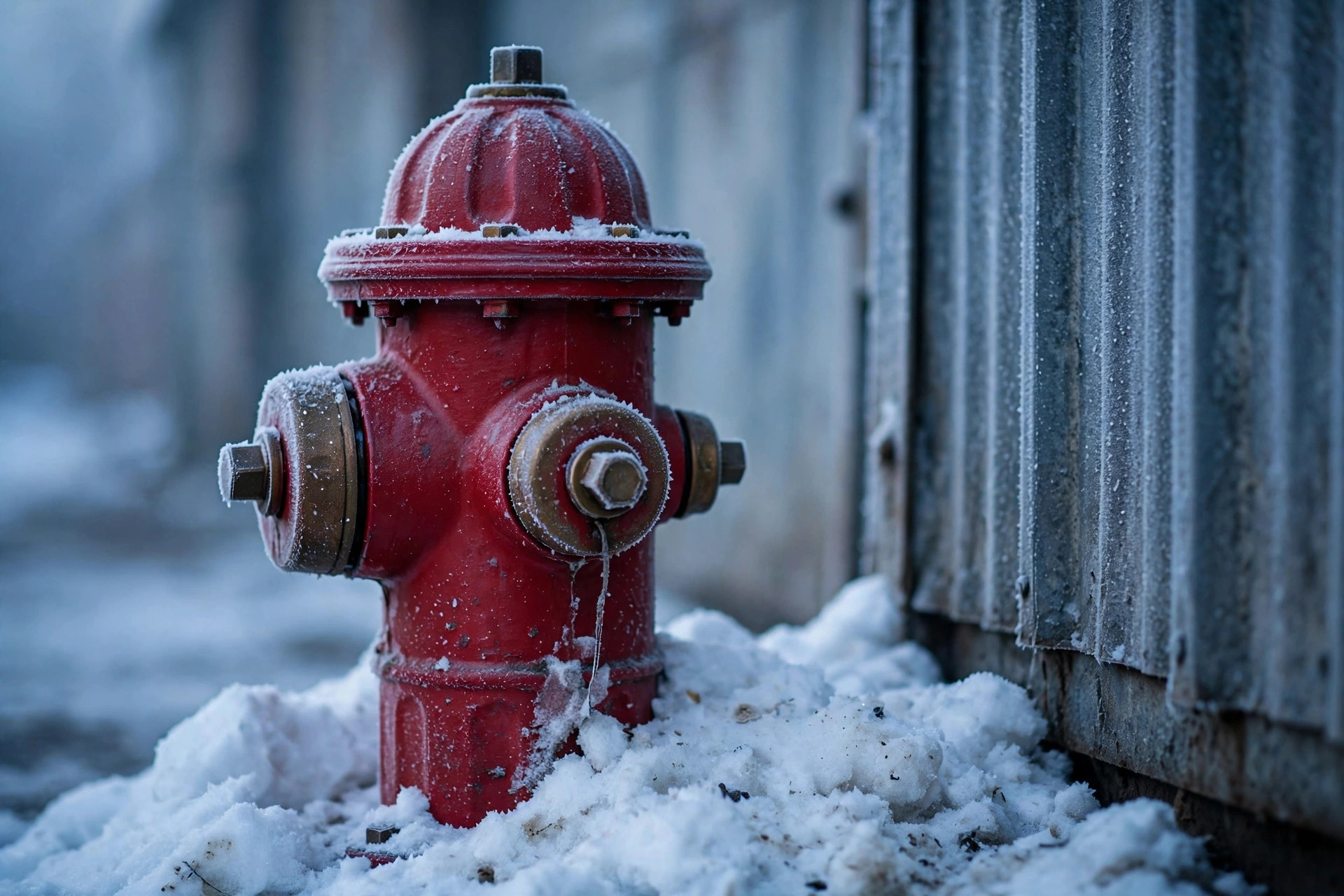
I went to look and my blood ran cold. The top cap had been forced open a crack, and inside the barrel stood a solid column of ice. The lower barrel had already split open from the expansion.
The fire-protection contractor came out, pulled it apart, and the verdict was simple: the drain valve — the weep hole at the bottom — was clogged with silt.
Honestly, until that day I had assumed hydrants "drain themselves" and couldn't freeze. The contractor's veteran tech, Old Wang, set me straight. In the northern US we use dry-barrel hydrants: the main valve sits below the frost line, and when you close the hydrant, the water left in the barrel drains out through the weep holes into a gravel bed. An empty barrel can't freeze. But once those weep holes clog, water sits in the barrel, a cold snap hits, ice expands, and even a steel barrel cracks.
Digging it out and replacing it cost several thousand dollars. Worse: at the spring annual inspection, the fire marshal saw the replacement record and made us verify the drainage function of all six hydrants, one by one. Two more weeks of disruption.
Lesson two takes us back to that December morning. New Chicago facility, 120,000 square feet, about to get its certificate of occupancy.
The inspector was a quiet man in his fifties. Tape measure in hand, he walked the whole perimeter, stopped at the far southeast corner, and measured from the building wall along the fire apparatus road to the nearest hydrant: over 480 feet.
"Too far." Two words. Then a violation notice.
I tried to argue — the whole building had automatic sprinklers, doesn't the code give us a break? He flipped the code book open for me. IFC 507.5.1: no point of the building can be more than 400 feet (about 122 meters) from a hydrant, measured along an approved route. Fully sprinklered buildings get 600 feet. But our southeast corner was a later-added canopy dock area the sprinklers didn't cover. The 400-foot rule applied, and we were dead.
The fix: add a hydrant, run new pipe. Design, permits, construction — two months. Opening delayed six weeks.
That day I also learned the inspector's two other favorite write-ups, free of charge for my fellow operators:
First, a 3-foot clear space must be maintained around every hydrant (IFC 507.5.5). Parked trailers, pallets, snow piles — all violations. We had a trailer habitually parked in front of one hydrant. The inspector just pointed: "How does the engine get close when there's a fire?"
Second, buildings with a standpipe system need a hydrant within 100 feet of the fire department connection (FDC). Most warehouse managers have never heard of this one — until the inspector cites it.
How a dry-barrel hydrant actually survives winter
After paying tuition, I brought Old Wang into the building and had him walk my maintenance crew through all six hydrants, piece by piece, until everyone understood.
It comes down to one sentence: a dry-barrel hydrant doesn't fight the cold — it fights standing water in the barrel.
- The main valve lives underground, below the frost line. The barrel above it is normally empty.
- The instant you close the hydrant, the drain valve at the base opens automatically and dumps residual water into the gravel bed.
- NFPA 25 requires the barrel to drain fully after operation, within 60 minutes. If it can't drain, you plug the drain, pump the barrel out by hand, and tag it: "must be pumped after use."
So in winter, what you're really watching is not whether the paint is red and pretty. It's whether the weep holes are open and whether water is standing in the barrel. Both are underground. Both are invisible from the surface. That's why 90 percent of freeze-cracked hydrants looked "perfectly fine" right up until they split.
Here's the contrarian take, and I'll say it plainly: more hydrants is not better. Every extra hydrant is one more freeze risk and one more inspection responsibility each winter. Enough hydrants, all working — that's the goal. Some owners think "two extra for insurance," then can't keep up with maintenance, and hand the inspector two extra violations.
What we do now: one pre-winter check, one monthly walk
At our Chicago building, two things happen like clockwork.
First: a full drainage inspection every late October, before winter.
The contractor goes hydrant by hydrant:
- Pop the cap, check for standing water in the barrel. Water present? Pump it out, find out why the weep holes are blocked.
- Cycle the valve once — full open, full close. Half-open is the killer: the drain never seals, and the barrel never fully empties.
- Weep holes permanently clogged? Tag it: "this hydrant must be pumped out after use," and note it in the log.
Six hydrants, a few hundred dollars for the visit. Pocket change next to a cracked barrel.
Second: a monthly walk, November through March, fifteen minutes.
Maintenance takes a checklist and circles the property:
- Buried in snow? After a big storm it gets cleared within 24 hours — no snow piles inside the 3-foot zone.
- Caps in place? Lose one cap and winter snow becomes a barrel of ice water by spring.
- 3-foot zone clear? Trailers, pallets, temporary staging — all moved out.
- Markings visible? On a snowy night, the engine driver needs to spot it at a glance.
And the logbook stays current: every hydrant numbered, a site map, every inspection recorded. IFC 507.5.2 requires maintenance records on file, and inspectors really do ask. Don't underestimate that logbook — in 2023, when we renewed our fire certificate, the inspector flipped through it and signed off without another word.
The math: what freeze protection costs vs. what a freeze costs
| Item | Cost |
|---|---|
| Pre-winter drainage inspection (contractor visit) | A few hundred dollars, once a year |
| Monthly 15-minute winter walk | Labor, essentially free |
| Hydrant wrench + hand pump | Tens of dollars, one-time |
| Replacing one freeze-cracked hydrant | Several thousand dollars, plus downtime |
| Failed inspection, delayed opening | Rent keeps running, orders keep slipping, fines per local rules |
You can do that math yourself.
One last reminder for fellow operators: the hydrant is the most invisible piece of equipment on your property — until the day of a fire, when it's the only faucet that matters. Don't skip the October drainage check. On a minus-16 night, you'll thank the version of you from October.
By Chen Feng, Warehouse Operations Manager