Last month, during our annual fire inspection, the inspector stood in front of my electrical panel for three full minutes. Tape measure out. Thirty-six inches. A shake of the head. Then the little notebook came out. That's when it hit me: the guy knew warehouse electrical panel clearance requirements better than I did — and I own the place.
Full disclosure: this isn't a legal explainer. It's a confession. I almost got that ticket myself. The only reason I didn't is that my neighbor got his three days earlier, and his story scared me straight enough to move the two pallets of returns I'd parked in front of my panel.
What Warehouse Electrical Panel Clearance Actually Requires: 30, 36, 78
Let me get the rule out of the way first, so you don't have to learn it the way I did — with your stomach dropping.
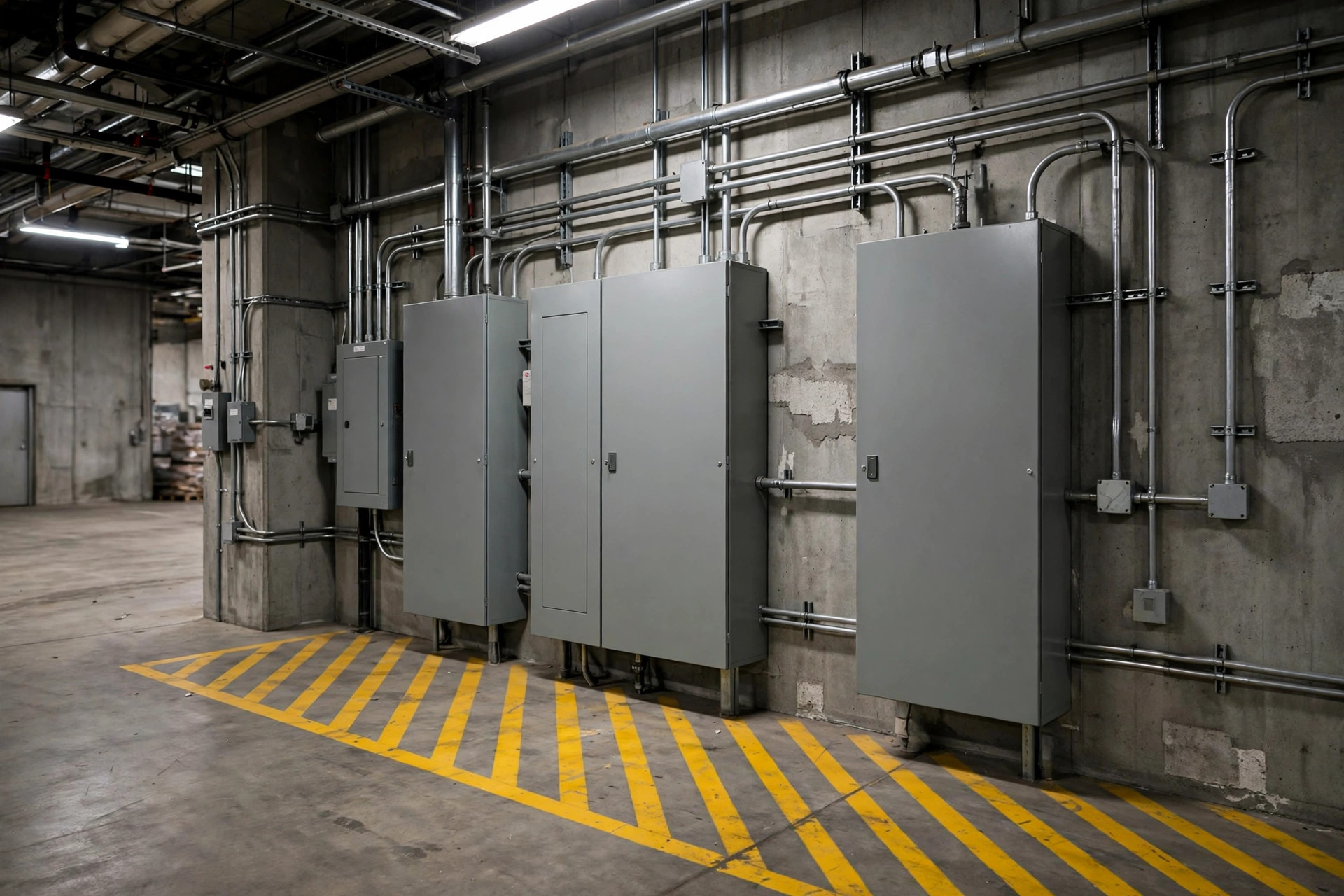
Three different authorities say the same thing. NEC Article 110.26 sets the baseline, OSHA 1910.303 references it, and the fire code (IFC 605.3) enforces the same numbers. In front of every electrical panel, you need a clear working space: 30 inches wide (or the width of the equipment, whichever is greater), 36 inches deep, and 78 inches high — that's six and a half feet. And nothing gets stored in that box. Not pallets, not cartons, not "just for tonight."
How big is 36 inches? About 91 centimeters. Roughly the depth of a desk. Go look at your panel right now — is there 36 inches of clear floor in front of it? If not, an inspector with a tape measure is already on the way.
Here's what the big companies do about this: they have EHS departments, thermal imaging surveys, software that draws "electrical safety zones" on floor plans. We small warehouse folks can't afford that kind of money — I only learned what EHS stands for last year. But the rule doesn't care how big your warehouse is. And for inspectors, this is the easiest ticket they'll write all day: easy to measure, easy to photograph, impossible to argue with.
The Ticket Next Door
October last year, right before peak season, the annual fire inspection rolled through our industrial street. My neighbor Lao Zhang runs a warehouse about my size — roughly 32,000 square feet. Returns were piling up before the holidays, his receiving area was bursting, and a few pallets of returns ended up in front of the electrical panel. "Just for two days, until the forklift's free," he said. Two days turned into three weeks.
The inspector walked straight to the panel, pulled the tape, and found the 36 inches blocked solid by five pallets. Citation on the spot. Fine amounts vary by jurisdiction, so check your local code — but the fine wasn't the worst part. Zhang got a correction deadline, and on reinspection day he had to keep half his crew standing around waiting for the inspector to show up. When he did the math later, he told me the disruption during the busiest weeks of the year hurt worse than the ticket itself.
The 2 A.M. Service Call
My own lesson came the summer before last, in August, at two in the morning. A breaker tripped. The AC and the charging station went dark. I dragged our electrician out of bed, and he showed up at 3 A.M. — only to find three pallets of dead stock blocking the panel. Receiving had overflowed that afternoon and somebody "temporarily" parked them there.
Me and two night-shift guys spent nearly 40 minutes hauling pallets by hand before the electrician could even open the panel door. The emergency call-out fee didn't get any smaller because we were slow. Worse, we restarted more than an hour late, and the whole night's outbound wave slid into the morning.
Lesson learned: stacking freight in front of your panel doesn't save space. It just schedules a future disaster.

Doing the Math: Fifty Bucks of Tape vs. One Citation
We're small warehouse owners. Before we do anything, we ask: how much? Fine. Here's the math.
What does compliance cost? You already own a tape measure. Two rolls of yellow-black caution tape: about a dozen dollars online. A printed, laminated sign — "No storage within 36 inches of electrical panel" — a few dollars. One slow afternoon: measure 36 inches out from the panel door, lay down a tape box on the floor, hang the sign on the wall. My warehouse did the whole thing in an afternoon for under fifty dollars, labor included (the labor was me).
What does non-compliance cost? I won't quote you a fine amount — it varies by jurisdiction, so check your local code. But do the other two lines yourself: first, the reinspection visits and the labor hours burned on corrections; second, the real nightmare scenario — a short, a trip, an actual fire — with the electrician or the firefighters unable to reach the panel, and downtime billed by the hour. In peak season, a single lost day of outbound is a number you already know by heart.
Fifty dollars for peace of mind. A fifth-grader could do this math. The hard part isn't the money — it's admitting you've got stuff stacked in front of your panel.
Electrical Panel Clearance Isn't About Knowing the Code
Here's the counterintuitive truth, and it might offend half the small warehouse owners reading this: most people who block their panels aren't ignorant of the code. They're just out of space.
A 32,000-square-foot warehouse sounds big until you actually run one. Receiving, shipping, returns, packaging, the charging area — plus the mystery freight that appears out of nowhere every peak season. Every square foot is spoken for. That 36-inch strip in front of the panel looks like idle space, and sooner or later somebody's hand gets itchy. The big distribution centers have dedicated electrical rooms with locked doors — problem solved by architecture. My panel is bolted to the wall of an active work area, right next to a traffic lane. Not stacking things there takes actual discipline.
But citations don't care about your square footage. The inspector doesn't measure your problems; he measures the 36 inches. That's the small-warehouse condition in a nutshell: held to big-facility standards, without big-facility space.
So stop arguing with the code. Accept reality, and go low-tech. Below is our small-warehouse version of a warehouse electrical panel clearance playbook — embarrassingly low-tech, but it works.
Paint the box and don't let it fade. Measure a real 36 inches with a real tape measure and lay down yellow-black tape. Don't use chalk — one forklift pass and it's gone. Refresh the tape every few months as part of the regular walkthrough.
Make the sign funny. Ours reads: "No freight within 36 inches of this panel — violators buy boba for the whole shift." A joke gets remembered. "Per NEC 110.26" does not.
Let the fire equipment guard the zone. We hung two fire extinguishers beside the taped box and added a fire-exit-style marker. Once people read the area as "fire zone," they stop stacking things there on pure reflex. Psychology beats policy sometimes.
Put it on the opening checklist. Every morning, the shift lead walks the floor and snaps a photo of the panel area into the group chat. Thirty seconds. But "someone is watching" and "nobody is watching" are two different universes.
The result? At the last two annual inspections, the inspector spent under a minute at my panel, nodded, and moved on. Last month the electrician came to swap a breaker and said, "This little place is better organized than warehouses five times the size." I almost laughed — organized? No. Just scared straight by a ticket.
So here's my advice to fellow small-warehouse owners: first, grab a tape measure right now and check whether you've actually got 36 inches. Second, get the tape and the sign up before the end of this week — not next month. Third, don't argue with the inspector. Fix it first; argue later.
Small warehouses have their own way of surviving: no budget for EHS software, but we own tape measures; can't afford a safety consultant, but we can afford boba. Thirty-six inches. Measure it, mark it, guard it — and the ticket is someone else's problem.
By Xiao Ma, Small Warehouse Owner