Here's my verdict up front: when it comes to forklift overhead guard requirements, OSHA watches far more closely than most warehouse managers think. Drivers hate how the guard blocks their visibility. Somebody always suggests cutting it open or taking it off. And here's the trade-off nobody prices correctly — on one side, a little daily convenience; on the other, a citation, a shutdown, and an accident. I've seen too many people do this math wrong. They save a few hundred bucks and end up paying tens of thousands — or worse.
If you Googled "forklift overhead guard requirements" looking for a checklist you can actually use, this is it. Three hard rules, each one less negotiable than the last.
The Time I Watched Two Overhead Guards Get "Opened Up"
Ontario, California, 2019. A 3PL warehouse running 22 forklifts. That summer, a group of veteran drivers petitioned their supervisor: the middle bars of the overhead guard sat right in their line of sight, and pulling from high bays meant craning their necks sideways all day.
The maintenance lead — a practical guy — made a practical decision: "Cut them out." Two workhorse trucks had their center bars removed with an angle grinder. Visibility improved overnight. The drivers were happy for three months.
Then OSHA showed up for a routine visit. Not about the guards — just a walkthrough. The inspector circled those two trucks twice, ran a finger along the cut edge, and asked one question: "Where's the manufacturer's written approval?"
Silence.
What followed came in three parts. One: both trucks were tagged out on the spot. Two: all 22 trucks were pulled for an overhead-guard inspection blitz, and the pick lines sat idle for two full days. Three: a serious citation. And the part nobody had budgeted for — the insurer heard about it, and the next year's premium went up.
The maintenance lead told me later: "I thought cutting two bars was no big deal." No big deal? It's a violation. That's lesson one.
OSHA's Three Hard Rules on Forklift Overhead Guards
The controlling standard is 29 CFR 1910.178 — Powered Industrial Trucks. Here's the plain-English version of the forklift overhead guard requirements. (For exact regulatory language, always check OSHA's current published text.)
Rule one: if there's a falling-object hazard, the guard goes on.
High-lift rider trucks must be fitted with an overhead guard built to the ANSI B56.1 design standard, "unless operating conditions do not permit." Read that exception carefully — it's for genuinely unusual situations, like extremely low-clearance areas, not for "my drivers don't like it." If your trucks work in racked aisles full of boxes, the falling-object hazard is obvious, and "no guard" is simply not an option.
Bottom line: in a normal warehouse, the overhead guard is standard equipment, not optional.
Rule two: the openings can't be big enough to let small cargo through.
This is the most misunderstood of the forklift overhead guard requirements. Most people think the guard exists to stop a full pallet from falling on the driver. Wrong. A full pallet dropping from height will crush right through it — the guard was never designed for that.
What the guard actually stops is the small stuff falling from racking: a carton, a bag of parts, a wrench. Sounds harmless — until you consider a 15-pound box dropping from a 20-foot beam. The grid openings must be small enough that the smallest items you handle can't slip through and strike the operator. The factory design is compliant when it leaves the manufacturer. Your job is simple: don't touch it.
Rule three: any modification needs the manufacturer's written approval. No letter, no mod.
This is the citation magnet. 29 CFR 1910.178(a)(4) is blunt: modifications and additions affecting capacity and safe operation "shall not be performed by the customer or user without manufacturers prior written approval."
What counts as a modification? More than people think. I've seen every one of these turn into a citation:
- Drilling the guard to mount a fan, a camera, or a work light — modification.
- Cutting bars out to "open up" visibility — modification.
- Welding on a reinforcement of your own design — modification.
- Hammering a bent guard "back into shape" and running it — a gray area, and inspectors don't grade on a curve.
The iron rule: before anyone touches that guard, get written approval from the manufacturer or dealer. A verbal "yeah, that's fine" doesn't count. An email saying "should be okay" doesn't count. OSHA wants it in writing.
One more, attached to all three: a damaged guard means the truck is parked until it's fixed. The standard requires any truck found unsafe to be removed from service until restored to safe operating condition. Cracked welds, bent frames, separated joints — all of that counts as unsafe. Running it anyway doesn't just multiply your citation exposure; if someone gets hurt, the liability is entirely yours.
A Real Citation: The Tire Company in Georgia, 2018
This one isn't a story — it's on OSHA's public record. In 2018, Southern Tire Mart in Covington, Georgia, was cited under 1910.178(a)(4), classified serious.
The violation? They had shortened the overhead guard on a Komatsu forklift — so it could fit under a monorail and racking system in the retread area. No written approval from the manufacturer. The citation record states employees were exposed to fall and struck-by hazards. The initial penalty was $12,934 — under 2018 penalty levels, which have since been adjusted; check OSHA's current schedule for today's figures.
Read that again: they weren't being reckless. They just wanted the truck to fit somewhere. The price was a serious citation plus facility-wide abatement. Same movie I watched in Ontario in 2019, different theater.
Do the Math: What You Save vs. What You Risk
Every decision has two sides. Here's both, side by side:
| Option | Upfront cost | What you get | Risk exposure |
|---|---|---|---|
| Modify or remove the guard yourself | $0 | Slightly better visibility | Serious OSHA citation + shutdown for abatement + full accident liability + insurance hike |
| Replace with a factory guard | A few hundred to ~$2,000 depending on make and model | Compliance and peace of mind | Near zero |
| Get a manufacturer-approved mod | An email and possibly an engineering review fee | Compliance and the visibility fix | Just the time the process takes |
See it now? An unauthorized mod saves you a few hundred dollars at most. It gambles a citation as the opening bid. And if someone actually gets hurt — a driver struck by a falling object — you're looking at the citation, workers' comp, legal fees, and downtime. Each of those starts in the six figures.
Here's my counterintuitive take: a bent, unrepaired guard is more dangerous than no guard at all. With no guard, the driver knows his head is exposed and drives accordingly — carefully. With a deformed guard still bolted on, the driver believes he's protected and drives boldly. But the structure is already compromised; when something falls, it won't hold. False confidence is the most expensive thing on a warehouse floor.
Three Things to Do Starting Tomorrow
Enough theory. Three actions, implementable this week, that keep you inside the forklift overhead guard requirements:
One: add the guard to the daily inspection. Thirty seconds: check welds for cracks, the frame for bends, bolts for looseness. Find a crack or a bend? Tag the truck out on the spot. Not "after the shift" — now.
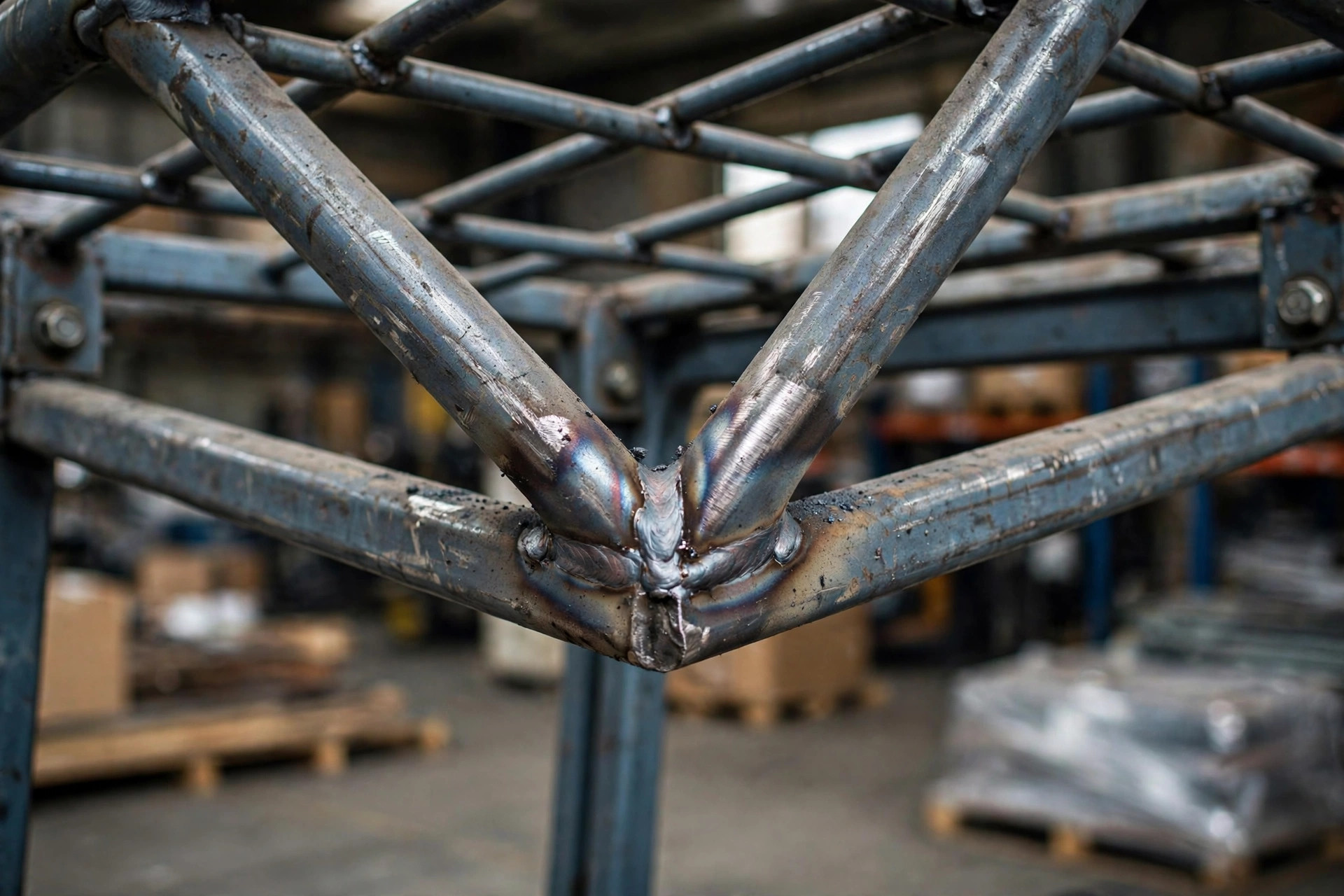
Two: repair it by the book. Tag out, report, repair with factory parts or a manufacturer-endorsed method, and keep the paperwork. Don't let someone "tack-weld it real quick." An inspector can tell a backyard weld from a factory weld at a glance.
Three: if you want it changed, go through the process. Bad visibility is a real problem — I won't pretend it isn't. But the legitimate path runs through the manufacturer or dealer: describe your operation, ask whether there's a compliant modification or a better-visibility option, and get the written approval before anyone picks up a tool. No approval? Change the approach instead — adjust the racking layout, or add compliant visibility aids (after confirming they don't count as unauthorized mods). There are always more options than there are citations.
One last piece of advice: the next time someone tells you "just take the guard off, you'll see better and work faster," ask them one question — is that convenience worth a citation?
By Lao Mi, Supply Chain Veteran (20 yrs)