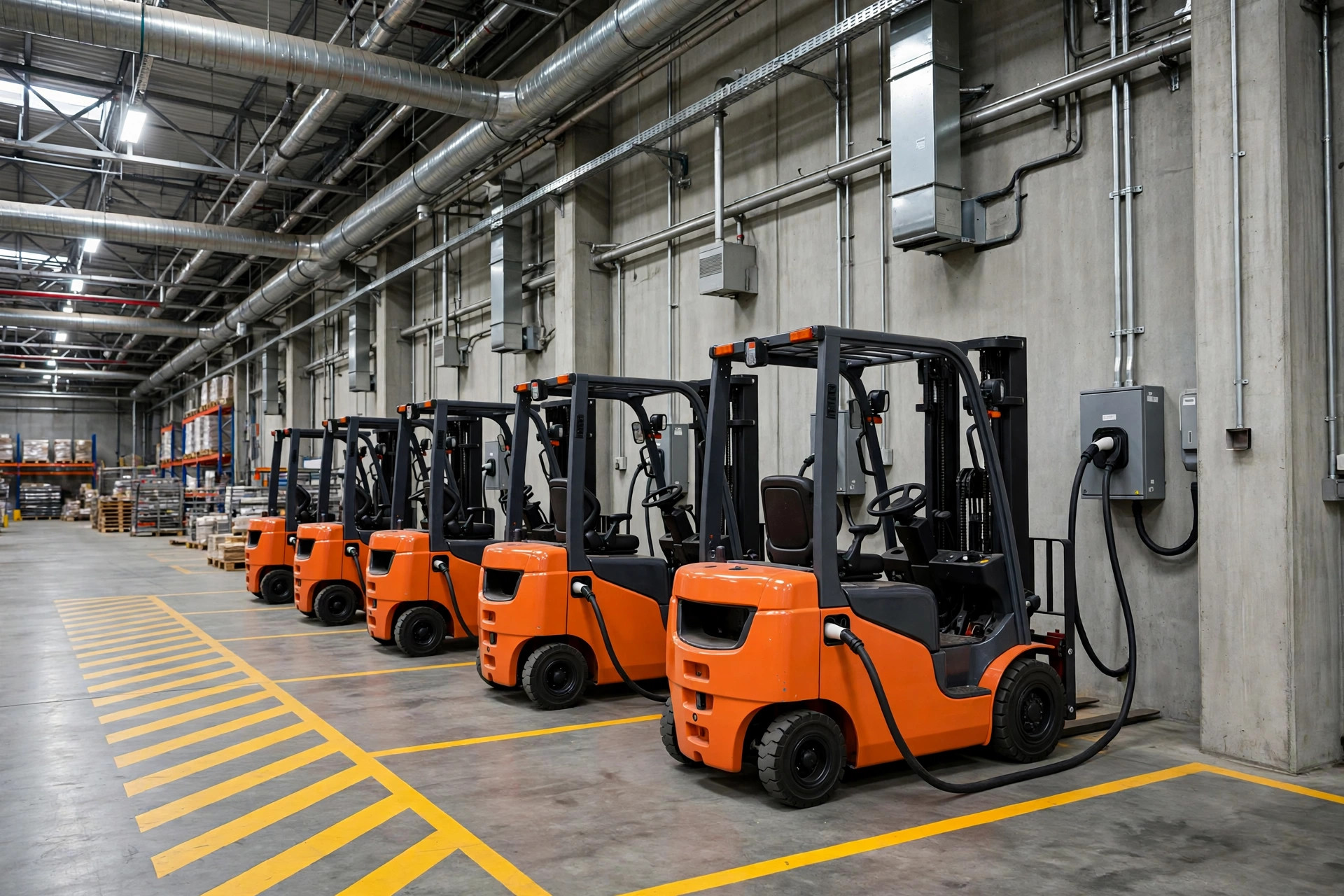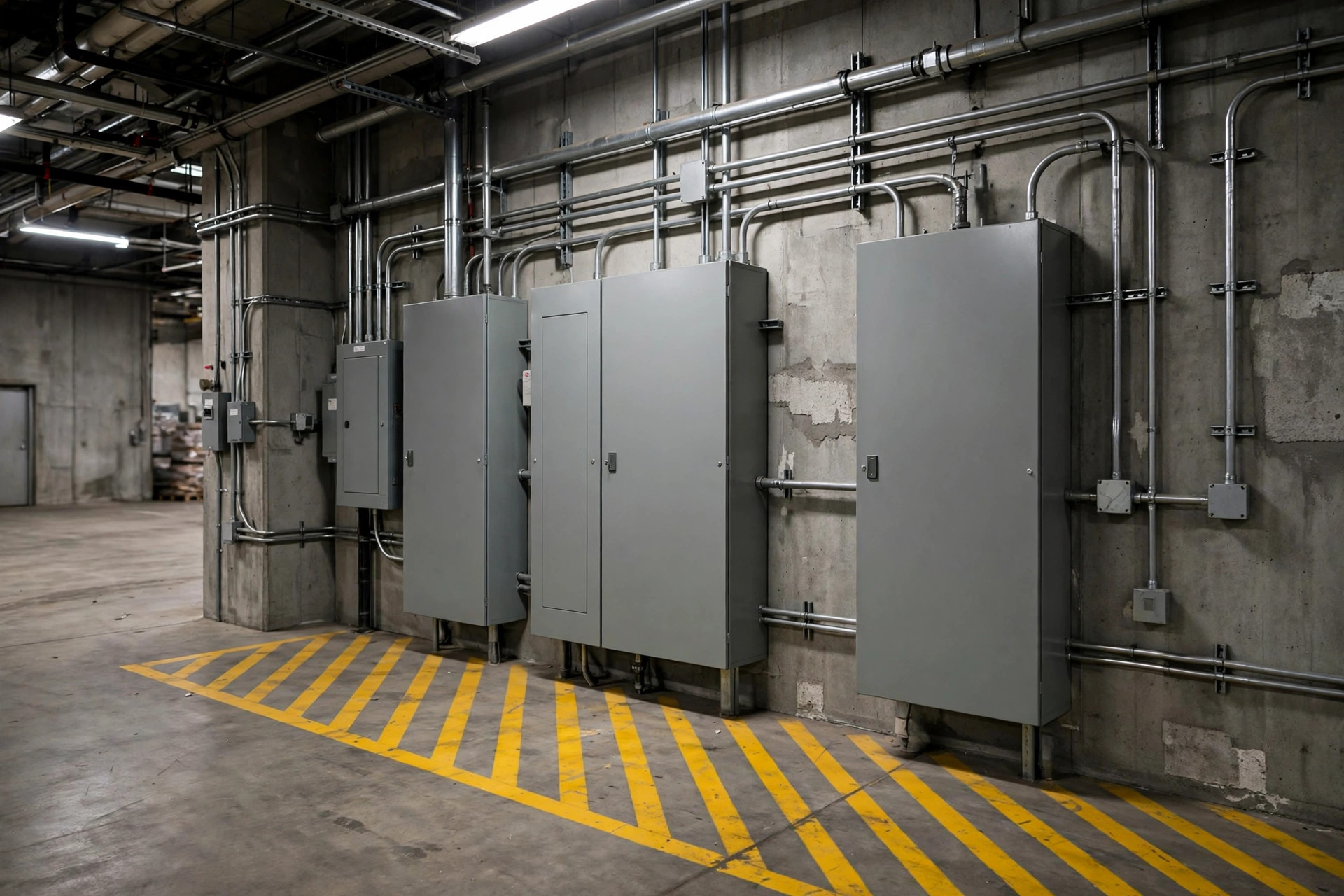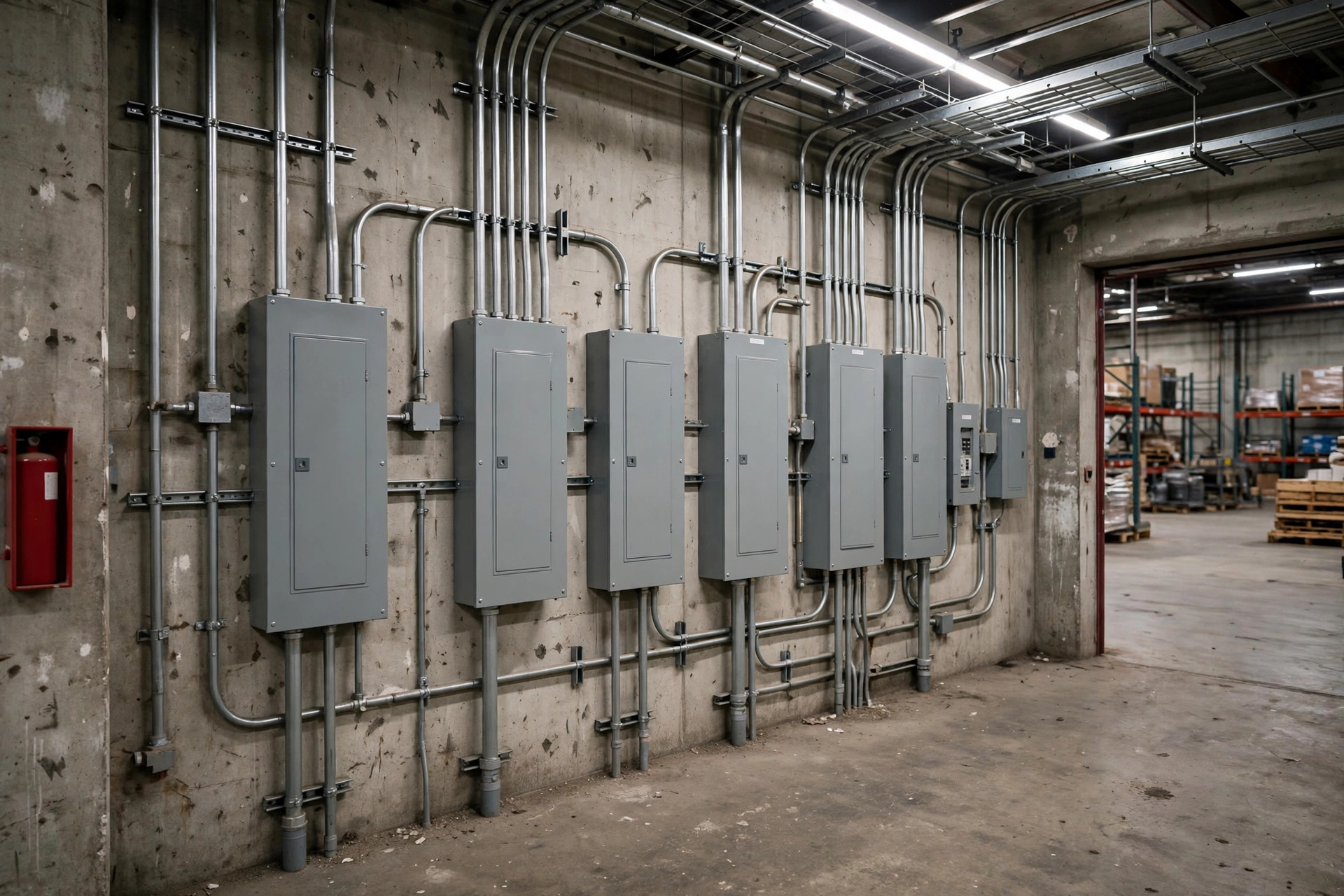
One night this past March, my phone buzzed me awake. A warehouse over in the neighboring logistics park had an electrical fire in its forklift charging area — three fire trucks, sirens up and down the whole street. Word got around later: the fire started at a row of charging batteries, unattended overnight. Smoke first, then flames, and by the time the night watch smelled it, the fire had already jumped to a stack of cardboard boxes nearby. That warehouse shut down for two weeks of mandatory rectification. The owner told me afterward the lost business alone was enough to make him sick.
A small warehouse like mine cannot afford that kind of money going up in smoke.
Here is the honest truth: small warehouses like ours cannot compete with the big players on equipment and budgets. Their electrical rooms are climate-controlled, their charging areas are standalone buildings with hydrogen alarms. Us? Our electrical closet doubles as a storage closet, and our "charging area" is a corner of the wall with some tape on the floor. But an electrical fire does not care how big your warehouse is. Aging wires, charging batteries giving off hydrogen, cardboard piled in the electrical room — put those three together and the fire does not ask about your square footage. The big players spend a fortune on systems; we cannot. But there are a few things a small warehouse can do for pocket change — do them, and you block most of the risk.
The Three Ignition Sources of an Electrical Fire: Hydrogen, Clutter, Overload
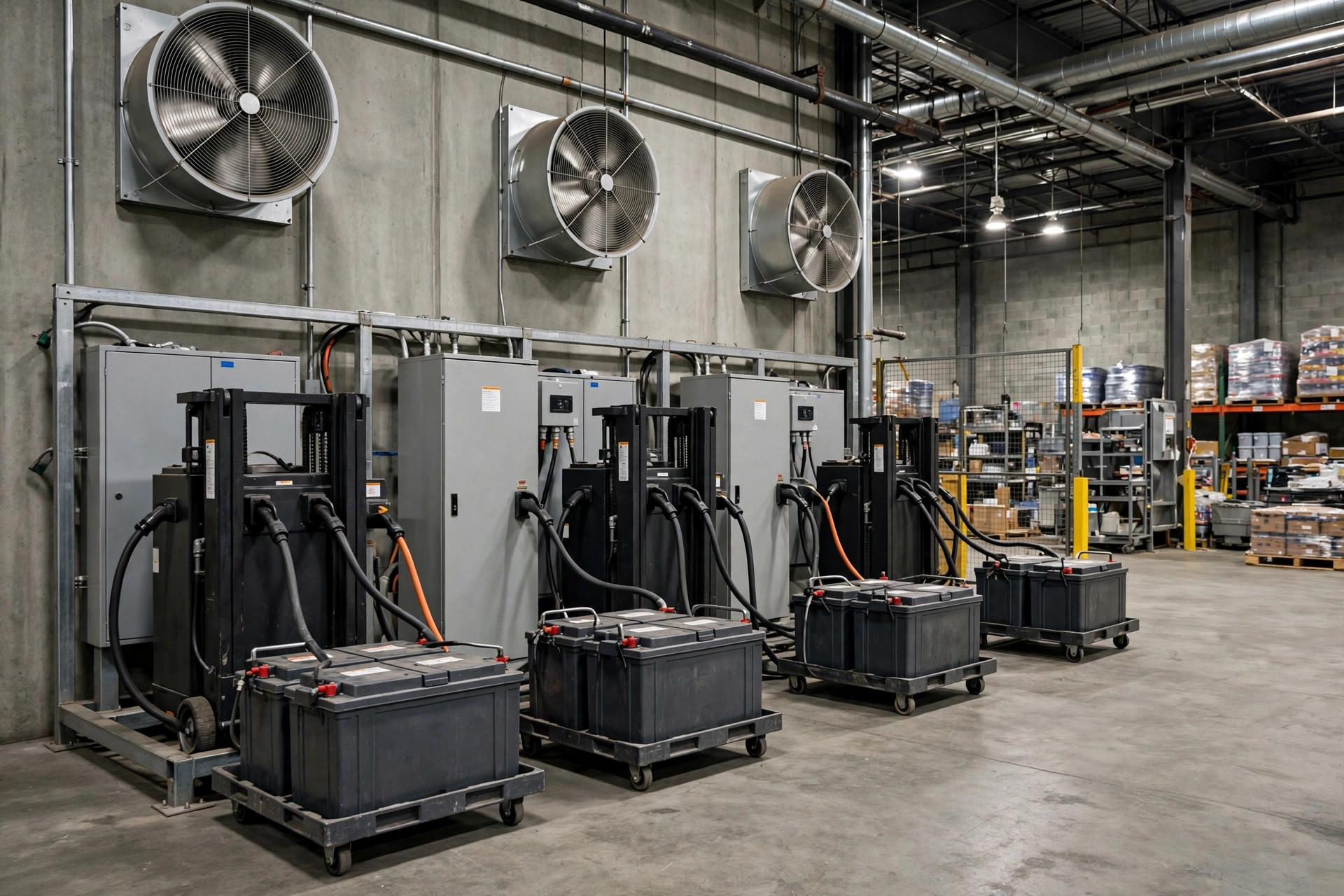
Let me get the technical part right first, because a cheap fix in the wrong place is no fix. Ignition source one: hydrogen in the charging area. Lead-acid batteries release hydrogen while charging. Hydrogen is lighter than air, so it drifts upward and pools under the ceiling where it does not disperse. In an enclosed space, once hydrogen builds up, one spark is all it takes. The neighboring warehouse's charging area sat in a windowless corner, and its exhaust fan had been broken for half a year with nobody fixing it — the classic "we knew, we just never dealt with it."
Ignition source two: clutter in the electrical room. Last fall, I had an electrician — Old Zhang — come replace some lights. He pushed open our electrical room door and his face went pale: cardboard boxes stacked waist-high inside, plus a few buckets of cleaning chemicals. "Xiao Ma," he said, "if any connection in here arcs, those boxes are ready-made kindling." My back went cold — because an electrical room doubling as a storage closet is standard issue in small warehouses everywhere.
Ignition source three: old wiring running overloaded. A lot of small warehouses inherit wiring from whoever was there before — nobody can say for sure whether the wire gauge is enough or the connections are solid. The worst habit is daisy-chaining: one outlet feeding chargers, fans, and lights, and nobody has ever touched the cord to check whether it runs hot. Wiring cannot talk; it protests by heating up. Protest long enough, and it catches fire.
Five Pocket-Change Fixes Against Electrical Fire Risk
The big-company playbook is "spend money on equipment." The small-warehouse playbook is "spend attention on gaps." We did all five of these. Total cost: under a thousand yuan.
First, separation: keep the charging area away from combustibles. We moved charging to a spot near an exterior wall, several meters from cardboard, pallets, and packing materials, and painted a yellow boundary line on the floor — nothing goes inside that zone. Cost: one bucket of floor paint, a few dozen yuan. Payoff: even if a battery goes bad, there is no fuel next to it, so a fire cannot get going.
Second, ventilation: give hydrogen somewhere to go. Hydrogen floats up, so open a path for it. We mounted an exhaust fan high on the charging-area wall — about eighty yuan online — and run it while charging so hydrogen gets pulled straight outside. Also: no sealed drop ceiling above the charging area. Hydrogen's favorite hiding place is an invisible pocket you cannot see. Old Zhang's exact words: "Give hydrogen an exit, and it won't come looking for you."
Third, timed shutoff: never charge overnight unattended. We used to plug batteries in and leave them all night, unplugging in the morning. Now every charging spot has a timer plug — around sixty yuan each — that cuts power automatically when the charge is done. A battery that keeps charging after it is full gives off more hydrogen and runs hotter; that is a bomb you plant for yourself at midnight. Since the timers went in, the charging area is basically "cold" overnight, and I sleep better.
Fourth, zero clutter in the electrical room. After Old Zhang's visit, I made an iron rule: nothing lives in the electrical room except the breaker panels. Cardboard, chemicals, old tubes — all moved out. Keep one meter of clear space in front of the panels, and I taped a note on the door: "This room houses electricity, not inventory." Cost: zero. Payoff: if a connection ever arcs, there is nothing flammable beside it, and the problem gets spotted fast.
Fifth, a monthly self-check list: fifteen minutes, one walk. I printed a checklist and stuck it on the office wall. On the first of every month, I walk it myself: does the charging-area fan spin, do the timers work, are any wire connections hot to the touch, has new clutter crept into the electrical room, are the extinguishers pressurized? Check the boxes, sign it, fifteen minutes, done. A small warehouse cannot afford a full-time safety officer — but the owner spending fifteen minutes a month? That we can afford.
Here is the cost comparison, big-company approach versus small-warehouse approach:
| Item | Big-company approach | Small-warehouse approach |
|---|---|---|
| Charging area | Standalone charging room with hydrogen alarms, tens of thousands | Moved location, painted lines, added exhaust fan — a few hundred |
| Charge management | Smart charging cabinets with monitoring | Timer plugs, a few dozen yuan each |
| Electrical room | Climate control plus gas suppression | Zero clutter plus a one-meter clear zone — zero cost |
| Daily checks | Full-time safety staff plus system patrols | Owner's fifteen-minute monthly checklist — zero cost |
And here is the counterintuitive part: electrical fire prevention is not about equipment — it is about laziness. Look at the three ignition sources: a fan broken for half a year, cardboard in the electrical room, hot wires nobody touched. Which of those takes big money to fix? Before a fire breaks out, it usually gives you three warnings — smoke, smell, heat. A small warehouse preventing electrical fires spends not money, but diligence.
Small Warehouses Have Their Own Way of Surviving
After that fire, the neighboring owner wised up too — re-zoned his charging area, added a fan, cleared his electrical room. Pretty much the same things we did. He told me: "If I had known a few hundred bucks could have saved two weeks of shutdown, I would have done it last year."
Electrical fire rules differ by region — check your local fire and electrical codes for the current requirements; I am not reciting clauses here. But one rule is universal: do not let your charging area and electrical room sit in the triple-neglect zone of nobody watching, nobody maintaining, nobody checking. Small warehouses have their own way of surviving — no budget for big systems? Then nail these five: separation, ventilation, timed shutoff, zero clutter, monthly self-check. All five together cost under a thousand. What they protect could be the entire warehouse.
By Xiao Ma, Small Warehouse Owner