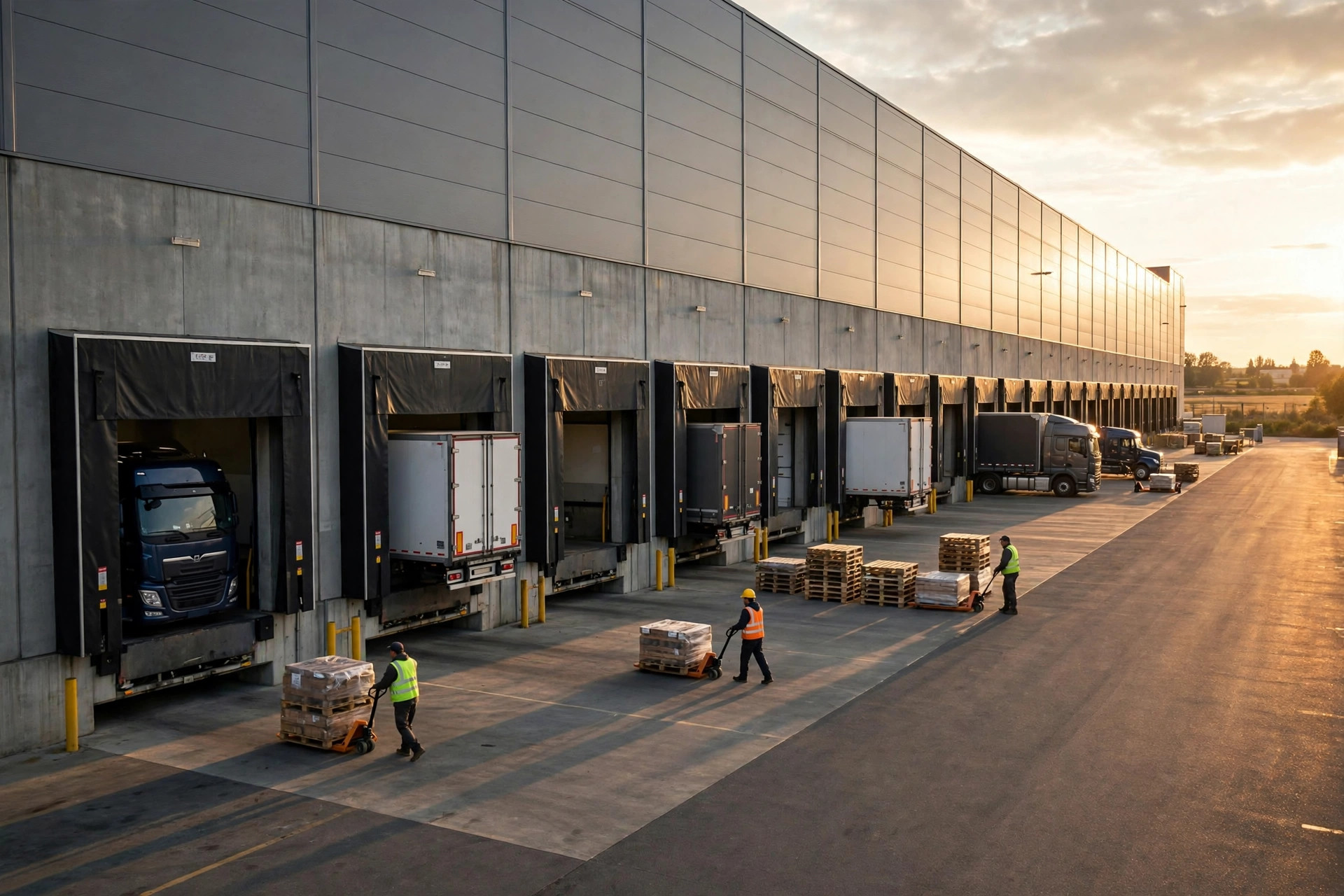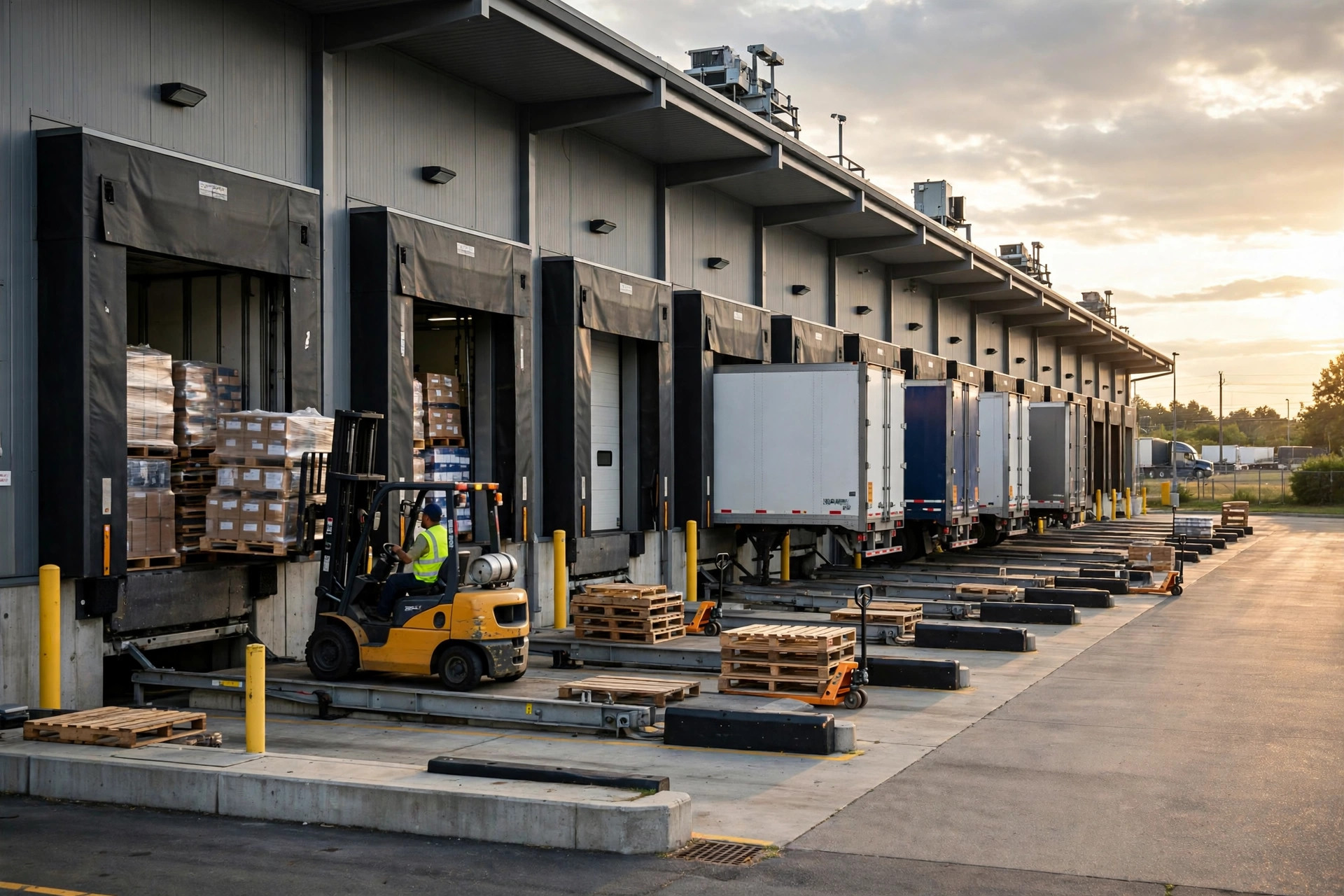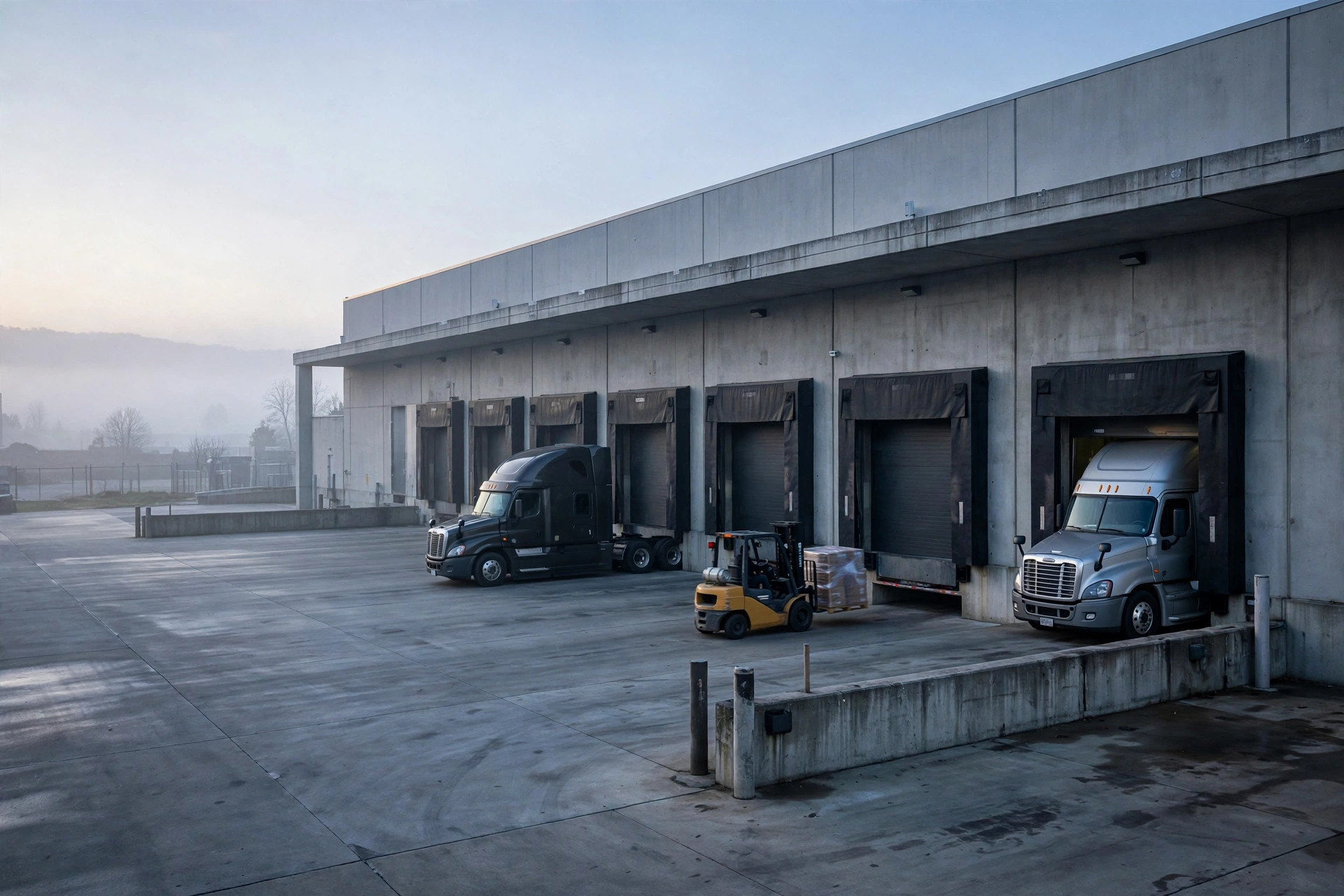
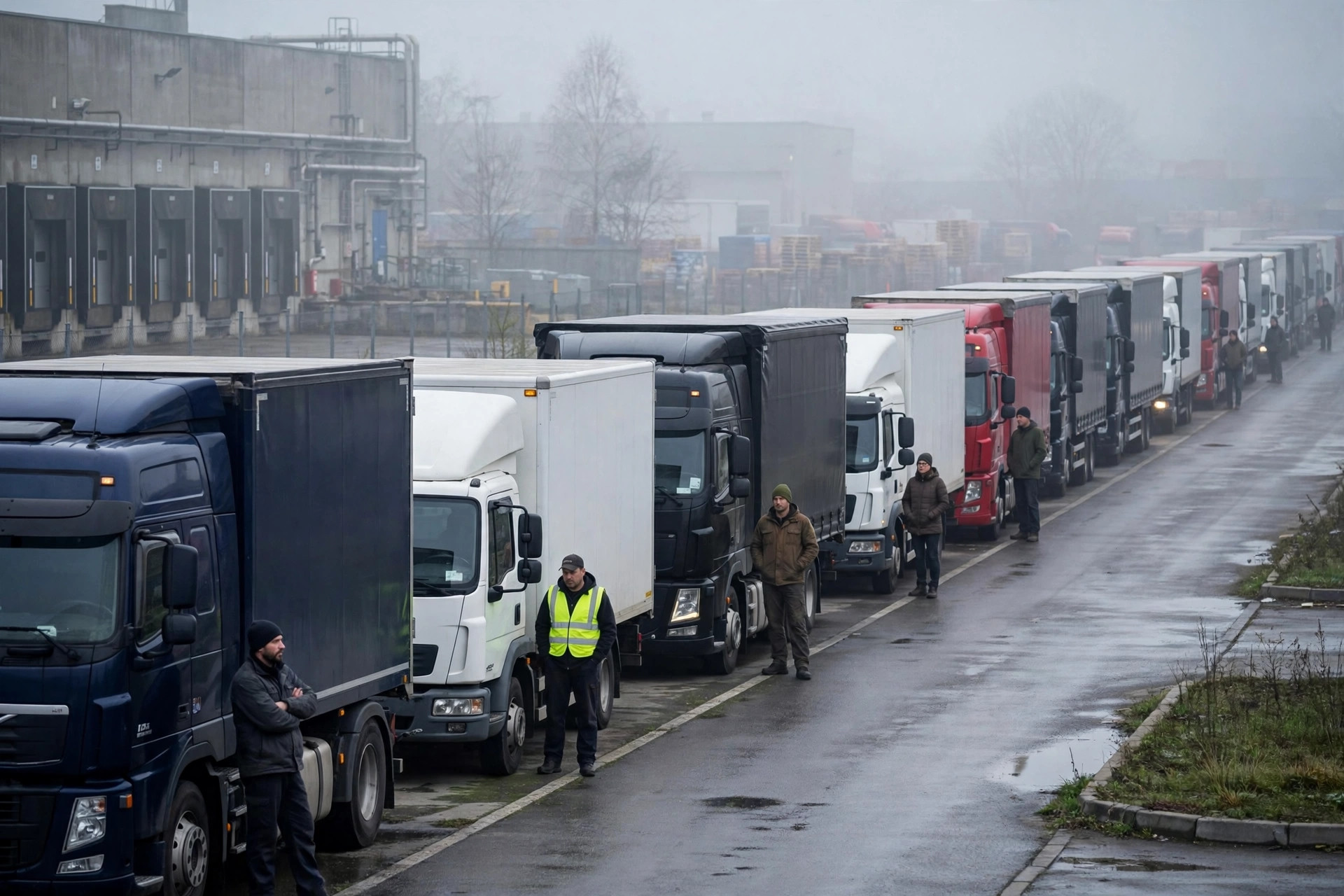
It was 6:30 on a November morning, two weeks before Black Friday, and there were already nine trucks lined up outside our gate. That was the morning I finally asked myself the question every warehouse manager eventually faces: how many dock doors does a warehouse need per square foot?
The first driver hopped out, walked straight up to me, and said, "Chen, you've got four doors. When are you opening two more?" I told him the truth: "Brother, that's all we've got. I can't conjure doors out of thin air." He pointed at the line behind him. "Then if my load doesn't get unloaded today, you're paying the detention fee."
Let me be straight with you: in this business, the worst feeling isn't having no orders. It's having the orders and not enough dock doors.
That day our four doors ran from 6 a.m. to 11 p.m., and one dock leveler broke down in the middle of it. Nine trucks showed up; seven got unloaded. Two spent the night outside. The next morning the driver group chat blew up — our warehouse was "too few doors, too slow." My boss called me in: "Chen, when we signed this lease, didn't you say four doors was enough?"
I had nothing to say. When we toured that building, I looked at square footage, ceiling height, rent. Door count? I glanced at it. "Four doors, close enough." Close enough turned out to be way off.
After that I dug into this properly. So today, let's talk about it: how many dock doors does a warehouse actually need, and how do you size that number from your square footage and throughput?
Too Few Doors? Peak Season Tells You on Day One
First story. In 2023 we leased a 120,000-square-foot building in California's Inland Empire. Four dock doors. On a normal day we handled about 20 inbound and outbound loads — four doors just barely coped, drivers waited an hour, nobody complained much.
Then the holiday peak hit. Daily volume doubled overnight — 40-plus trucks a day. Four doors, running full tilt: unloading one truck takes 40 minutes to an hour with paperwork. Do the math: four doors, 12 hours, that's 48 turns at best — and only with zero breakdowns, zero waiting, zero driver dawdling. Possible? Not a chance.
Every morning trucks backed up toward the street. Drivers cut each other off and argued. My crew ran nonstop, and I could watch morale drain in real time. One of my night-shift guys told me, "Chen, if we keep this up, the peak will outlast the crew."
That's when it clicked: door count isn't a "looks about right" detail. It's the throat of the whole warehouse. Biggest building, tidiest racks — if the doors can't keep up, your throughput is hard-capped.
How Many Dock Doors per Square Foot? Our Back-of-the-Envelope Method
After licking our wounds, I got a few fellow ops managers together over beers, pooled everyone's experience, and built the method we still use today. Fair warning: this isn't an official standard. It's the order of magnitude the industry commonly works with — calibrate it against your own throughput before you trust it.
Step one: get a baseline from square footage.
A common industry rule of thumb is one dock door per 8,000 to 10,000 square feet. Treat that as a magnitude, not gospel. A 100,000-square-foot building lands at roughly 10 to 12 doors.
But square footage is only the starting point. What really decides door count is throughput.
Step two: calculate inbound and outbound separately.
This is the lesson we learned the hard way: receiving doors and shipping doors must be calculated separately. Never lump them together.
Inbound depends on arrival concentration. In many warehouses arrivals bunch up — ocean containers all land in the morning, say 15 containers between 8 a.m. and noon. Unloading one takes 45 minutes to an hour. Fifteen containers in four hours means at least four doors running nonstop, plus one spare. That's five receiving doors.
Outbound depends on your cutoff waves. An e-commerce building might have waves at 2 p.m. and 8 p.m., each needing 8 trailers out the door in two hours. Loading a trailer takes 30 to 40 minutes. Eight trailers in two hours needs 3 to 4 shipping doors, plus a spare.
So the formula: receiving doors = peak 4-hour arrivals ÷ what one door handles in 4 hours + 1 spare; shipping doors = biggest 2-hour wave ÷ what one door handles in 2 hours + 1 spare. Don't skip that spare door, folks — broken levelers, late drivers, paperwork jams. It covers all of it.
Step three: multiply by your peak factor.
Normal days and peak season are two different animals. Our rule now: size for the peak, not the average. Our peak factor is 1.8 — 25 loads on a normal day, 45 at peak. We size doors for 45. Doors sitting idle on slow days cost nothing; running out of doors at peak costs everything.
| Item | How to fill it | Our building's example |
|---|---|---|
| Building size | Square feet | 120,000 |
| Size-based baseline | Size ÷ 9,000 (midpoint) | about 13 doors |
| Inbound peak (4 hrs) | Arriving loads | 15 loads |
| Receiving doors | Peak arrivals ÷ per-door 4-hr capacity + 1 spare | 5 doors |
| Biggest outbound wave (2 hrs) | Trailers to load | 8 trailers |
| Shipping doors | Wave trailers ÷ per-door 2-hr capacity + 1 spare | 4 doors |
| Peak factor | Peak ÷ normal | 1.8 |
| Final recommendation | (Receiving + shipping) × factor, round up | 12–13 doors at peak |
Cross-check the size baseline against the throughput math, and take the bigger number. If size says 13 and throughput says 12, you negotiate for 13.
That Door Count Can Win You Money at the Lease Table
Second story. In 2024 we moved buildings and found a 150,000-square-foot site. The landlord's offer included 10 doors. I walked in with this exact worksheet: by our throughput math, we needed at least 14. Ten wasn't enough.
The landlord pushed back at first — adding doors means structural work, real cost. So I showed him a different calculation: with too few doors, our trucks would queue onto the street at peak, the city would complain, fines would follow, and eventually we'd break the lease. An empty building costs him more than two doors. Two weeks of back-and-forth, and we closed: the landlord paid to add two doors, and the cost of two more came off our first-year rent — effectively a discount.
Honestly, landlords aren't afraid of your arguments. They're afraid of your math. Slap that door-count worksheet on the table with clean numbers, and they know you're not just haggling. Use this method next time you negotiate a lease.
More Dock Doors Isn't Always Better
Here's the counterintuitive part: more dock doors isn't always a good thing.
I know a fellow manager with 22 doors on 180,000 square feet. Looks impressive. But every door costs money: a dock leveler package isn't cheap, plus annual maintenance, safety inspections, pest control — door gaps are prime real estate for rats and roaches. With that many doors, his staging area got chopped into fragments, forklift routes turned into spaghetti, and efficiency actually dropped.
Worse was the management headache: 22 doors, six people on night shift — nobody could watch them all. Two doors sat half-open most nights. Product went missing twice, and the cameras couldn't even tell us which door it went out of.
Our take now: size doors for your peak, and spend the savings on process instead of concrete. Two fewer doors, but with a disciplined appointment system, drivers arriving an hour early, and four drop-trailer spots in the yard — throughput matches the 22-door building at a fraction of the cost.
So when you're touring a site, don't let "plenty of doors" dazzle you. Count them, run the math: cover your peak, keep a spare, and let process do the rest. That's how we run our building now.
One last reminder for fellow operators: next time you sign a lease or plan a build, fill out that door-count worksheet before you put pen to paper. Too few doors, and peak season teaches you a lesson on day one. Too many, and you're paying tuition every single day.
By Chen Feng, Warehouse Operations Manager