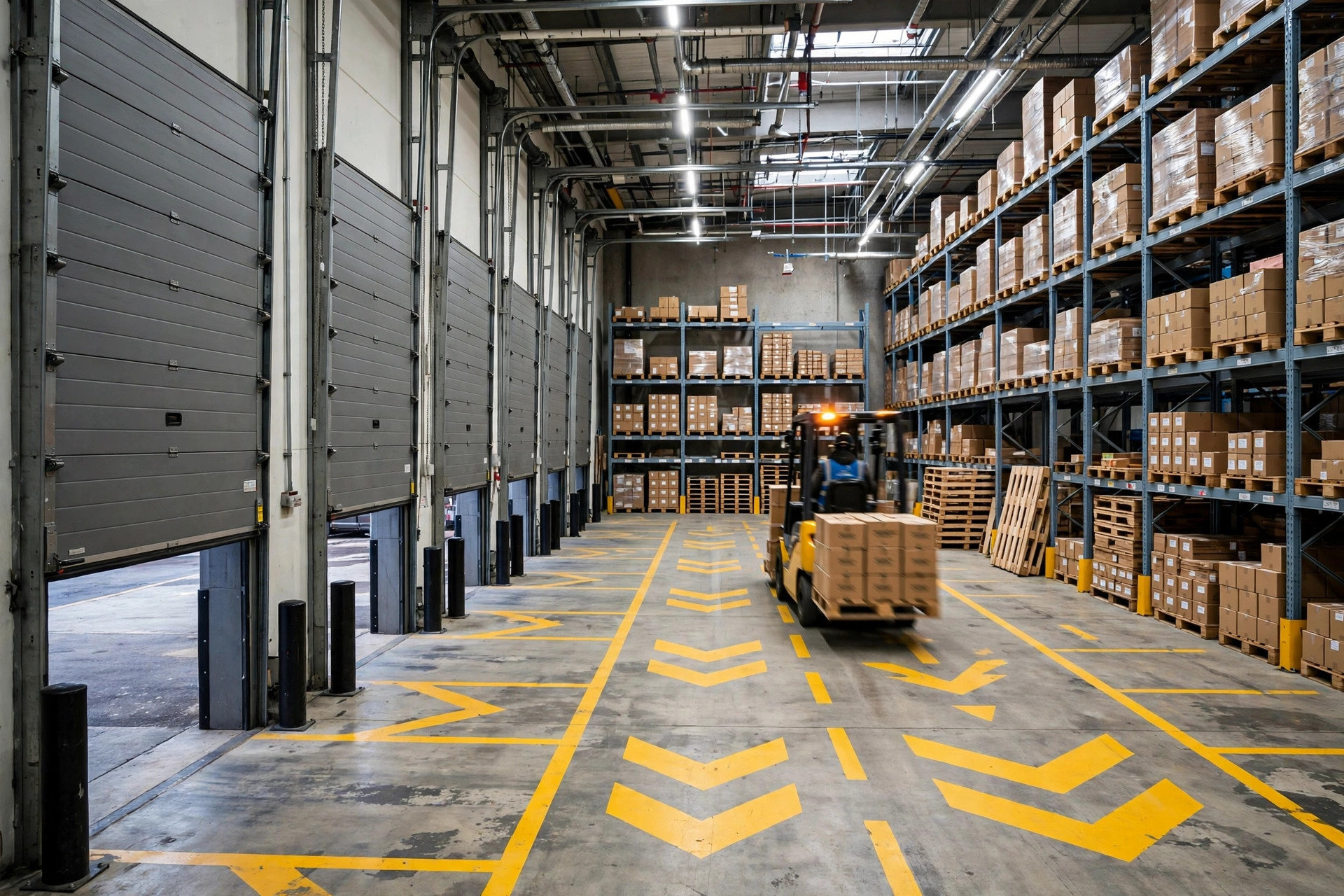
When I scope automation for a small warehouse, I look at the U-shape vs I-shape flow decision first — not equipment. Get it wrong and every dollar after that just patches a bad layout: conveyors, AMRs, racking, all expensive band-aids on a broken flow. Like replumbing a house wrong, then buying a fancier faucet.
Think of it this way: U-shape means receiving and shipping share one side of the building — product comes in the dock doors, loops through, and leaves from the same side, tracing a U. I-shape means product enters at one end and exits at the other, shooting straight through like the letter I. Big DCs love the I-shape. But when a small warehouse copies it, things go sideways. Let's run the numbers.
The Principle: U-Shape and I-Shape Flow Reduce to Two Numbers
Strip away the diagrams: flow quality collapses into two numbers. First: the average distance one pallet travels from dock-in to dock-out. Second: the number of crossing points on that path — every spot where forklifts meet forklifts, people meet equipment, or the inbound stream collides head-on with the outbound stream.
A U-shaped flow concentrates crossing points into one zone: the dock area. Receiving, shipping, staging, dispatch all crowd into that patch of floor. Congested, sure — but concentrated congestion is manageable. An I-shape spreads crossing points across the whole building: inbound heads east, picking heads west, outbound cuts back — the entire main aisle becomes potential head-on collisions.
Analogy: downtown traffic versus a suburban one-way loop. Downtown has intersections everywhere and jams daily; the loop is longer on paper but never fights itself. Flow design isn't about straight versus curved — it's about whether streams collide.
Back in my integrator days I ran the comparison more than once: for the same throughput, an I-shape typically needs 1.5 to 2 times the conveyor length of a U-shape, and the AGV loop stretches just as much. Longer lines mean more failure points, uglier MTBF, and maintenance climbing with every meter. Each crossing point adds a layer of safety sensing and scheduling logic — and each layer thickens your automation quote. Small warehouses run on tight budgets; whether that money buys conveying distance or actual capacity is decided by the flow, before you buy a single machine.
Two Field Stories: Small Warehouses Copying the I-Shape
In 2025 I walked a 2,800-square-meter warehouse east of Los Angeles with four dock doors. The owner had just toured a big-box DC and came back fired up: "They receive at one end and ship at the other — we're doing that." Receiving went west, shipping went east, picking in the middle.
The problem: the building was barely 60 meters long — no room for the I-shape to stretch. Receiving and shipping each swallowed one end, and the middle aisle became a two-way forklift battleground. Every morning peak was theater: inbound heading west, outbound heading east, nose-to-nose in a 4-meter aisle, neither yielding. Three or four standstills a day, ten-plus minutes each. With both ends active, QC crews covered double ground — supervisors logged kilometers just walking between ends.
Three months later he caved and reverted to a U-shape — both flows back at the south doors, west end to pure storage. His words stuck with me: "The dock area is the whole game. The big DC's I-shape works because scale absorbs its costs. At our size, we can't afford their disease."
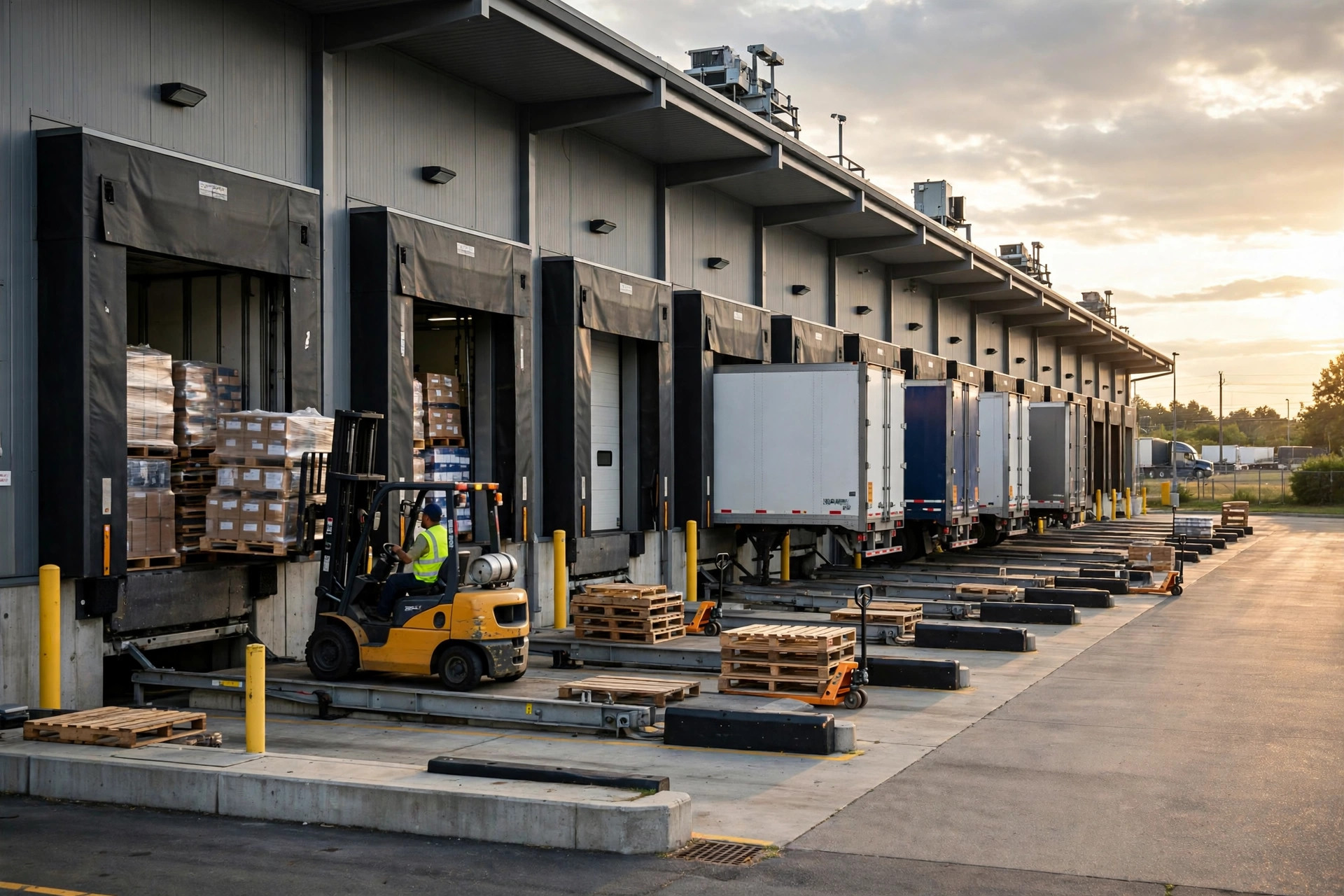
A second warehouse was even smaller — just over 2,000 square meters, two dock doors, so a shared inbound-outbound dock was physics, not a choice. Their problem wasn't the layout decision; it was dock management. Three receiving trucks at 8 a.m., outbound queuing at 3 p.m., staging bursting — inbound and ready-to-ship pallets got mixed, and one week they mis-shipped two orders, paying freight twice and losing a customer.
They fixed it with three moves, none costing money. First, time staggering: receiving before 10 a.m., shipping after 2 p.m. — a shared dock's worst enemy is both streams arriving at once. Second, painted zones with hard rules: inbound and outbound staging in different floor colors, one strike policy for mixing. Three months later, zero mix-ups. Third, a one-way dock loop — the bottom half of the U — no U-turns, no reversing. They timed it: average morning-peak dock wait dropped from over 20 minutes to under 10. A shared dock isn't a compromise. It's a different playbook, and played well it beats a forced I-shape.
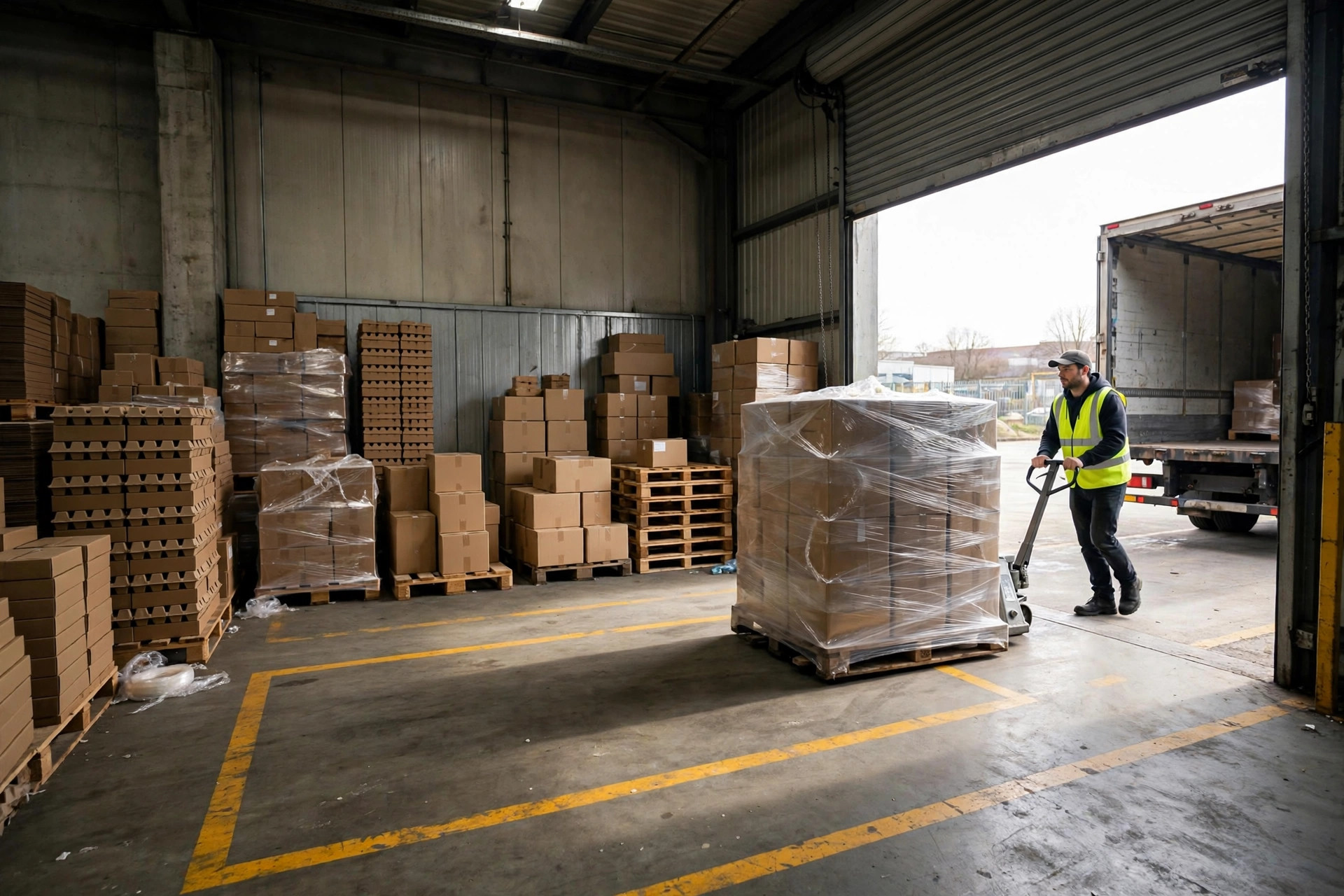
The Selection Threshold: When a Small Warehouse Should Pick U-Shape or I-Shape
This comparison table is the framework I've used for years scoping small-warehouse projects:
| Dimension | U-Shape (shared dock side) | I-Shape (receive one end, ship the other) |
|---|---|---|
| Avg. pallet travel distance | Short — backtracks but stays compact | Long — crosses the full building |
| Flow crossing points | Few, concentrated at the dock | Many, scattered across all aisles |
| Dock congestion | Peaks concentrate; solved with staggering + appointments | Dispersed — but only if you have enough doors |
| Conveyor / AGV cost | Short loops, smaller investment | Long runs, investment multiplies |
| Zone planning difficulty | Receiving/shipping hug the dock, compact zones | Both ends need full staging and staffing |
| Expansion | Adding doors or staging is relatively easy | If the building isn't long enough, you're stuck |
| Fits | Under 3,000 sqm, 3 doors or fewer | Over 5,000 sqm, 2+ doors on each end |
And here are the dividing lines, ready to use:
One: one or two dock doors — stop debating, it's U-shape. Put your energy into staggering and dock management instead.
Two: under 3,000 square meters, U-shape. The building is too short for the I-shape to earn its keep — no distance advantage, just new crossing points. That's paying money to suffer.
Three: over 5,000 square meters, at least two doors on each end, and receiving and shipping cleanly separable by shift — mornings inbound, afternoons outbound — and the I-shape becomes viable. Miss any one of the three and it won't stand up.
Four: the gray zone, 3,000 to 5,000 square meters — let daily pallet throughput decide. If dock queues past half an hour inside one shift are routine, the U-shape dock has hit its ceiling; split into an I-shape. If not, U-shape plus disciplined dock management wins.
Here's the counterintuitive call: the U-shape isn't backward — for a small warehouse it's the optimal answer. Don't let big-DC I-shapes lead you astray. The I-shape works at scale because scale dilutes its costs: long runs, scattered crossings, staffing both ends. Big operations absorb that with volume, doors, and shifts. A small warehouse has no such cushion. Forcing an I-shape means spending your own money to catch the big warehouse's disease.
And one shot at a sacred cow: some small warehouses buy a conveyor for "automated straight-through flow" before their flow makes sense. I've seen three — all ended up as the building's most expensive decorations, too short to connect or alarming all day at crossing points. Equipment doesn't fix flow. Wrong flow plus equipment just means you're wrong at a higher price.
The Maintenance Traps: The Real Spending Starts After You Pick
Choosing the right flow is only the first half. The second half is living with it, and the traps are real.
Trap one: a shared dock's biggest enemy isn't congestion — it's mixing. Once inbound and ready-to-ship pallets mingle in staging, mis-ships, lost pallets, and cycle-count chaos follow. Painted, color-separated zones with hard rules are the cheapest process step you'll ever buy. Skip it and the freight claims will cost you ten times over.
Trap two: before buying AGVs or conveyors, count your crossing points. A U-shape keeps crossings at the dock — short AGV loops, simple scheduling, uptime holds. An I-shape scatters crossings across the building, and each one adds scheduling logic and safety investment. The crossing count on your floor plan basically sets the length of your automation quote. Mark them on the drawing before you sign anything.
Trap three: stop treating staging as "just put it there for a minute." In a small warehouse, staging is the lungs of the flow — size dock staging for two hours of peak throughput. Undersize it and the whole flow suffocates at peak; every square meter you "saved" gets paid back with interest during rush hour.
Whether the money was worth it comes down to one number: average meters per pallet from dock-in to dock-out. Measure with a tape, don't estimate. My rule of thumb: under 80 meters, a small warehouse's flow passes; over 100, don't talk automation — fix the flow first. Right flow makes equipment an accelerator. Wrong flow makes it an amplifier — and what it amplifies is your loss.
By Da Liu, Automation Engineer