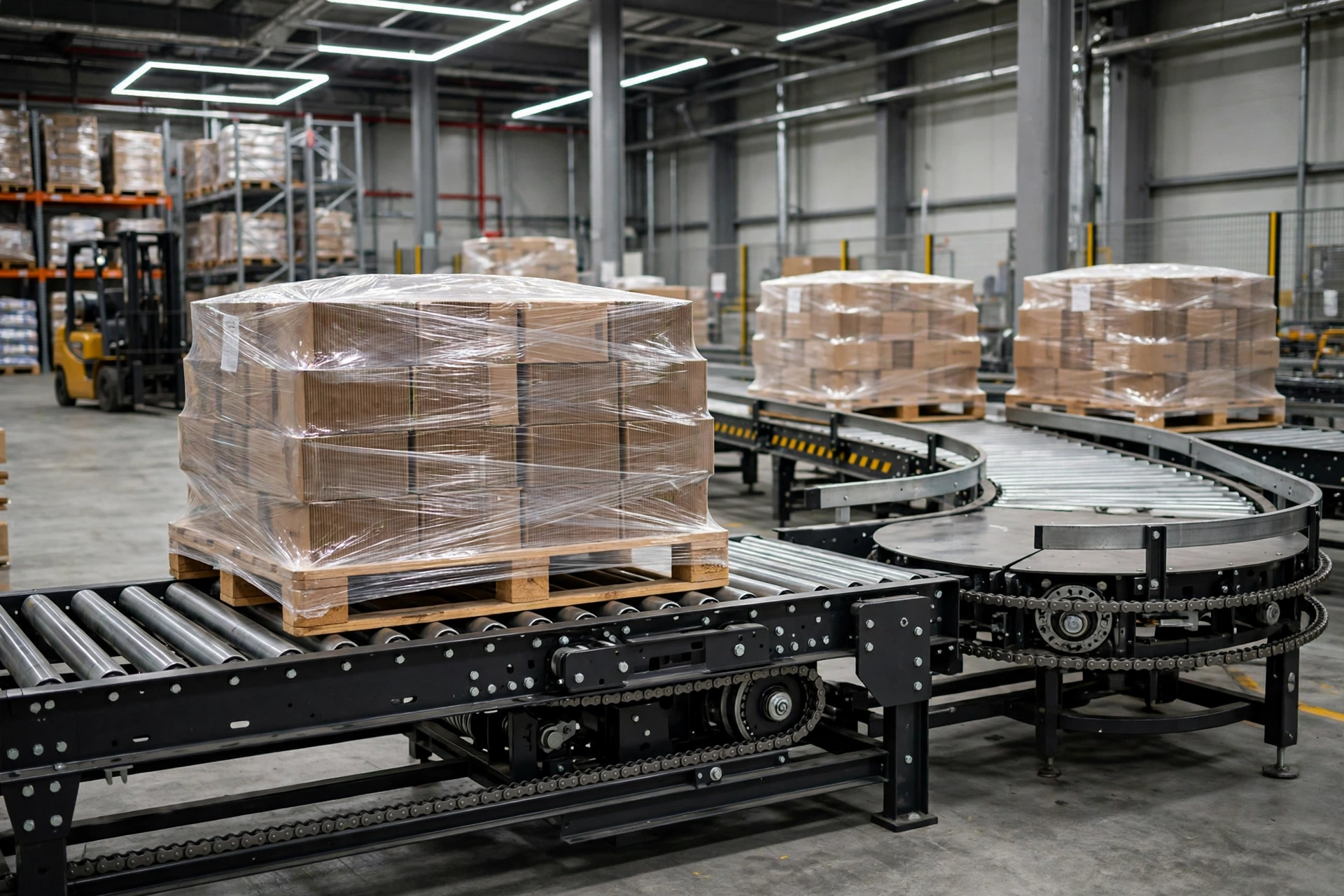
Warehouse conveyor belt tracking misalignment usually announces itself quietly. If you have run a conveyor line for any length of time, you have watched a belt drift to one side. It starts small — the edge kisses the frame, a little dust shows up where it should not be — and then one day the belt is chewing itself apart against the structure. The principle is simple. Think of the belt as a loop pulled by rollers at each end — you can understand it like a car pulling to one side. If one wheel is out of alignment, or one side pulls harder than the other, the car drifts. A belt does the same thing: if one side is tighter, or a roller is tilted, or something is stuck to one side of a roller, the belt walks toward the loose side.
Belt Tracking Problems Start at the Rollers
In the fall of 2024, I visited an e-commerce warehouse near Los Angeles. Their sortation line kept drifting right. The belt edge had been fraying for three months, and the crew had already replaced the belt twice. Each new belt ran straight for two days, then started walking right again.
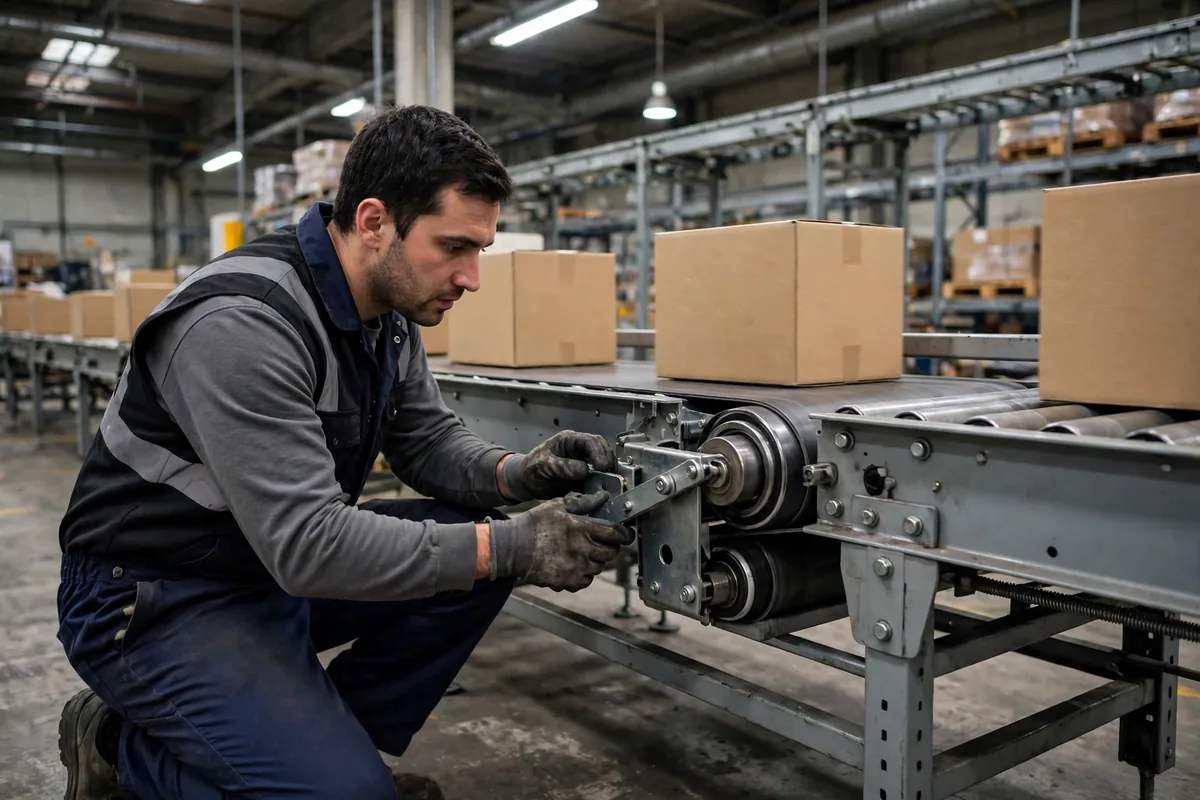
I crouched down and looked at the tail roller. There was a thin layer of tape residue and dust stuck to one side of it, maybe two or three millimeters thick. That sounds like nothing. But a roller that is thicker on one side makes the belt travel a slightly longer path on that side with every revolution, so the belt slides toward the thin side. It is like walking with one thick-soled shoe and one thin-soled shoe.
We cleaned the roller, re-checked it with a level, and the belt ran straight on the spot. Zero dollars spent.
That is why rollers are always step one in my order. Check the roller surface for buildup or uneven wear first, then check whether the roller shaft is square to the frame. A level will show a tilt you would never catch by eye. A lot of crews skip straight to adjusting the take-up when a belt drifts, and that is backwards. If the roller is not square, no amount of tension adjustment will hold the belt straight.
One more thing people miss: idlers. An idler that has seized, or an idler frame that is bent, will quietly steer the belt off course in that one section. The check is crude but it works — stop the line and spin each idler by hand. One that will not turn, or one that grinds, gets replaced. An idler costs almost nothing. The belt it destroys does not.
Tension Is the Second Check, and Tighter Is Not Better
If the rollers are fine, look at tension next. And here is the counterintuitive part: most people assume a drifting belt needs more tension, so they crank the take-up harder, and the drift gets worse.
The reason is simple. If the take-up has more travel on one side than the other, the belt ends up tighter on one side and looser on the other, and the belt walks toward the loose side. The harder you pull, the bigger that difference gets. That is how warehouse conveyor belt tracking misalignment gets worse the more you adjust it. Think of a tug of war where one side has more people — the rope slides toward the weaker side, and pulling harder does not fix the imbalance.
The right way is to back the take-up off completely, check that the travel marks on both sides match, then add tension evenly, watching the belt position as you go. How tight is tight enough? Not as tight as you think. The standard is that the belt does not slip on the drive roller and does not shudder when running empty. My rough field check: stop the line and press the middle of the belt with your hand. It should give a little and spring back, not bottom out on the idlers.
Early in 2025, a 3PL warehouse ran into this on night shift. The belt was drifting, and the night lead cranked the take-up to its limit. The belt stopped drifting that night. By morning, the splice had torn apart and the whole line was down for most of the day. They saved one adjustment and paid for it with half a day of lost throughput.
Speed and Load: the Amplifiers
If the rollers and the tension are both fine and the belt still drifts, look at speed and load. These two do not cause tracking problems on their own, but they amplify small problems until you cannot ignore them.
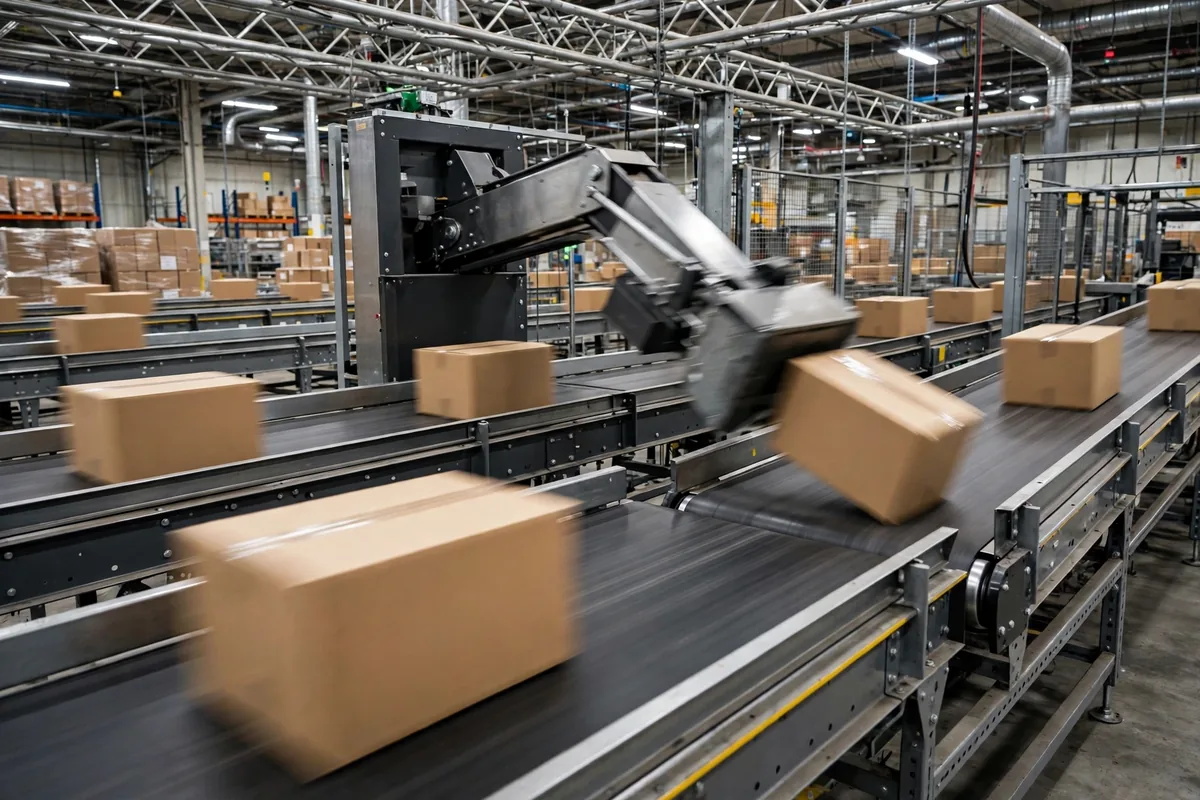
An off-center loading point is the classic case. Packages keep landing on one side of the belt, so one side carries more weight all day, and the belt gradually walks toward the heavy side. The check takes five minutes: stand at the infeed and watch where the packages actually land. If they keep hitting the same off-center spot, adjust the loading chute, not the belt. Fix the chute and half the drift disappears by itself.
Uneven loading does the same thing over a longer horizon. Heavy cartons always running down one side stretch that side of the belt a little more over time, and eventually the two sides are not the same length anymore. This slow drift gets misdiagnosed as an aging belt all the time. Put a new belt on, and three months later it drifts the same way. The real fix is to spread the load, or to flip the belt end for end on a schedule, if the splice and the construction allow it.
Speed matters too. On a slow line, a small misalignment is invisible to the eye. On a fast line, the same error chews the belt edge in minutes. So fast lines need tighter tracking tolerance and more frequent checks. That is not the equipment being fussy — speed just magnifies the error.
| Symptom | Check first | How to tell on the floor | Usual fix |
|---|---|---|---|
| Drifts to the same side every time | Roller surface and squareness | Look for buildup, check with a level | Clean the roller, square it up |
| Drift direction keeps changing | Take-up travel on both sides | Compare the travel marks left and right | Adjust both sides evenly |
| Straight when empty, drifts under load | Loading point and load balance | Watch where packages land at the infeed | Fix the chute, spread the load |
| Gets worse the more you adjust it | Tension too high | Press the belt mid-span with the line stopped | Back off, re-tension per the manual |
| Sudden drift in one section | Idlers in that section | Spin each idler by hand, listen for grinding | Replace seized idlers |
After You Fix Belt Tracking, Do Not Walk Away Yet
The belt is straight again and everyone wants to move on. That is exactly when tracking problems come back. My rule: let the line run empty for a while after the fix, then run it loaded for a while, and only call it fixed when it tracks straight both ways. Plenty of lines run straight empty and drift under load.
On preventive maintenance, the trade-off is straightforward. A few minutes at the start of each shift — look at the belt edge, listen to the idlers — costs far less than replacing a belt once a year. Cleaning rollers and spinning idlers by hand does not need a shutdown; it fits into a shift handover. Wait until the edge frays or the splice tears, and the downtime plus the replacement belt will pay for a year of those small checks.
One more thing, and I will be blunt about it. The moment a belt drifts, someone suggests buying an automatic belt tracker — sensors and an air cylinder that steers the belt back. Automatic tracking is not useless, but it corrects the symptom, not the cause. If the roller is still dirty and the idler is still seized, the tracker will be working overtime every day and the belt is still suffering. Get the mechanical basics clean first. Only consider automatic tracking when the root cause will not stay fixed, or when the line genuinely cannot afford to stop. Do it the other way around and you are paying for reassurance.
So is the money worth it? Look at one number: how long this line has been down because of tracking. One unplanned stop of half a day, and the throughput you lost would have paid for a lot of idlers and a lot of roller cleaning. Warehouse conveyor belt tracking misalignment is almost never a belt problem. It is a question of whether someone checked things in the right order.
By Da Liu, Automation Engineer