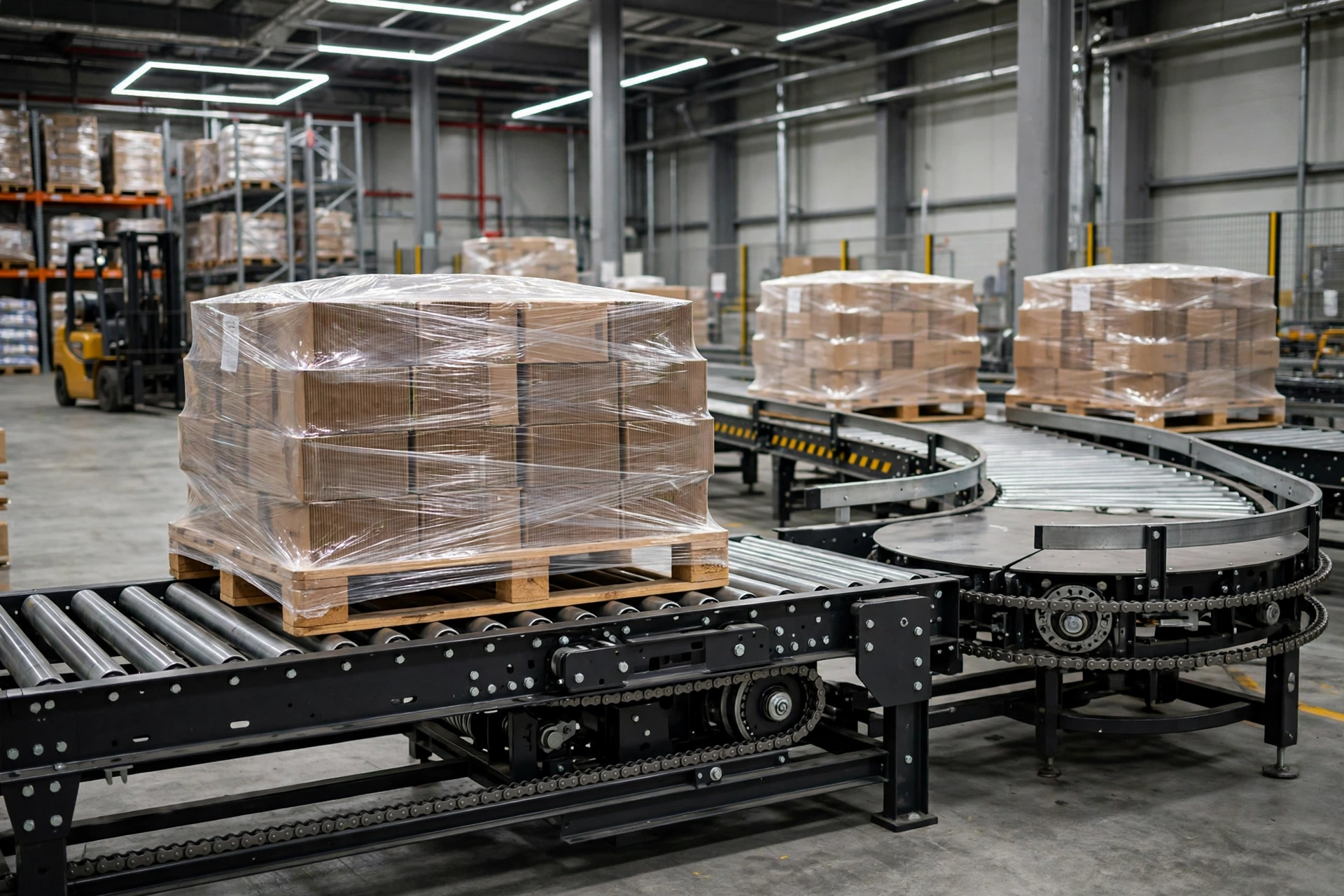
We had a client who needed a pallet conveyor system: a 3PL in East China doing fulfillment for daily-chemical brands. The owner, Chen, came to me with an integrator's proposal: chain conveyor, end to end, one type for the whole line. I looked at his freight. His heaviest pallet came in under 800 kilos, everything moved as full pallets, and he barely changed direction. A chain conveyor is not a bad machine. It was a butcher's knife for a chicken. Chains, sprockets, lubrication, tensioning — every one of those costs money. We reworked it to roller conveyor for the straight runs, with just two lift-and-transfer units at the turns, and the quote dropped by about thirty percent. That is the first thing this business teaches you: you buy the one that fits your freight, not the toughest machine.
Here is a truth from the seller's side of the table: integrators would rather sell you the expensive option than the right one. A chain conveyor carries a higher unit price, pricier spares, and an easy-to-sell maintenance contract. Roller conveyor is cheaper and easier to fix — swapping a roller takes fifteen minutes — and that is exactly why it earns the integrator less. So before you ask about price, ask one question: how much muscle does my freight actually need?
Your Pallet Conveyor System Starts With the Freight, Not the Catalog
Selection always starts with the freight, never with the brochure. A standard pallet is 48 by 40 inches; a heavy-duty roller line handles around 3,000 pounds per pallet, and a chain-driven roller line goes past 4,000. If your freight never reaches 1,000 kilos, the extra strength in a chain machine is strength you will never use. Freight falls into three kinds, and so do machines. Get the pairing wrong and you will be fixing the line every week. The first kind is full pallets moving straight in and straight out — neat loads, steady weight, no change of direction. Roller conveyor is the cheapest fit: steady, fast to repair, and a failed roller is a swap, not a project. The second kind is heavy freight, broken pallets, uneven deck boards. Rollers jam and drift on those; a chain machine is steadier, because two chains carry the pallet and forgive a rough deck. The third kind needs turns, diverting, or entry into a racking aisle. Straight runs alone cannot do it — you need lift-and-transfer units or a turntable to lift the pallet and change its direction.
We had a frozen-food client whose warehouse sat at minus 18 degrees all year. Frost built up on the pallets, rollers slipped, and the chain machine's lubricant was at risk of freezing. The integrator's proposal was polished and said nothing about the cold. The fix was not free: low-temperature grease, anti-slip roller treatment, and a heater jacket on the lift-and-transfer motor. But against losing half a line every winter, that money was well spent. Temperature, humidity, dust, pallet quality — settle those four before you sign, or the contract is a hole you dug for yourself.
Another client in auto parts ran pallets of engine blocks, close to a ton and a half each. The integrator had specified a lift-and-transfer unit, but the lift cylinder's stroke fell two centimeters short. The pallet rose, the chain could not reach it, and the pallet sat stuck at the transfer point. We rebuilt the cylinder and the bracket on site and lost four days. Lesson learned: a transfer unit is not judged by load rating alone. Check the pallet's deck shape, the forklift openings, and whether the lift height is enough. There is no standard answer for pallets. Your pallet is the only answer that counts.
And here is the judgment that surprises people: faster is not better. A pallet line usually runs around 30 feet per minute, while a carton line can hit 65. Plenty of buyers open by demanding speed, as if speed were throughput. A pallet is top-heavy with real inertia. Run it fast and it cannot stop cleanly, and at every transfer point it has to slow down and wait for positioning anyway. The seconds you gain on the straight run are spent waiting at the transfer. What sets your throughput is the cycle time of the transfer units and whether your forklifts can keep up. Double the line speed and you do not double the throughput — but the maintenance bill gets there first.
Where the Money Actually Hides in a Pallet Conveyor System Quote
The worst mistake in pricing is comparing equipment prices only. The equipment is the first payment. Three more follow: installation and commissioning, spares, and downtime. Installation is the one people underestimate most. An uneven floor needs leveling, misplaced embedded parts need rework, and a turning radius that looked fine on paper turns out short on site — every fix costs days. Spares are the one people get talked into: chains, sprockets, motors, sensors — which are wear items, how often they are replaced, what each one costs. Get all of that written into a contract appendix during negotiation. A verbal promise counts for nothing.
Take an illustrative example — the numbers are a made-up scenario, only the structure matters. A 100-meter line: roller equipment $100,000, chain $140,000. Over three years, spares and maintenance run about $12,000 for roller and $25,000 for chain. The chain line also needs two extra shutdown days per year; at $3,000 of lost output per day, that is $18,000 over three years:
| Cost over three years | Roller conveyor | Chain conveyor |
|---|---|---|
| Equipment | $100,000 | $140,000 |
| Spares and maintenance | $12,000 | $25,000 |
| Extra downtime | $0 | $18,000 |
| Total | $112,000 | $183,000 |
The $71,000 gap is the price of one decision made on selection day. So in negotiation, do not just cut the equipment price. Negotiate the three-year total cost — equipment, spares, and downtime together.
Acceptance day is the step sellers fear most when the buyer takes it seriously. My rule: never bring a sample pallet. Bring the heaviest, most broken, most crooked pallet in the warehouse and run it for twenty cycles — transfer, turn, divert, all of it. If the line handles that pallet, it is your line. If it cannot, the problem shows up on the spot, when it is still cheapest to fix. Too many buyers wave acceptance through and spend the next three months calling in repairs for problems that acceptance day would have caught.
The contract has three more places where sellers dread a buyer who reads closely. First, when does the warranty clock start — delivery, installation, or acceptance? A month of difference is real money. Second, response time: how fast does someone arrive when the line breaks, and how fast is it fixed? If that is vague, a breakdown means waiting. Third, who owns the software and the controls. Can the program be changed, and what does one change cost? If that is not in the contract, every future line change means begging the integrator. We had a client who learned this the hard way: two extra divert points, and the integrator quoted a fortune, because the program was in his hands.
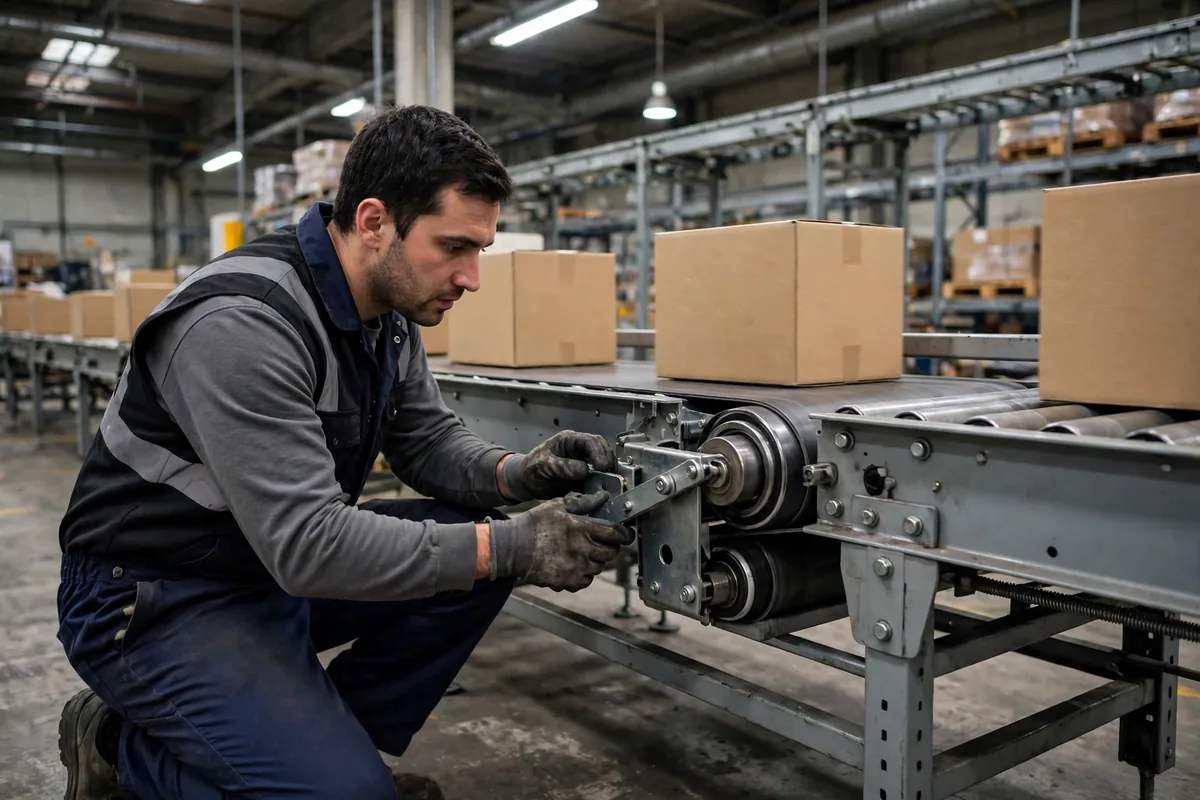
One more move: go see an integrator's installed site. Photos are always clean and beautiful; the site tells the truth. Oil sludge on the chains, whether the rollers run smooth, whether a technician can reach the parts, whether the spares cabinet holds working stock or decoration. I once walked a three-year-old roller line with a client: the cabinet beside it was neatly stacked with rollers and bearings, changed about once every three months, the old technician said. At another site, a chain machine had a pile of removed old chains beside it, and the technician just shook his head. One look at a live site is worth ten pages of proposal.
And do not forget the pallets themselves. Many warehouses run a mixed fleet — good and broken, wood and plastic, three-stringer and five-stringer decks — all fed onto the same line. No line survives a daily diet of broken pallets; one jam is one stoppage. Grade the pallets before they go on the line. Repair the broken ones, retire the ones beyond repair. The stoppages you save are worth far more than the pallets you save.
Next time you sit down to negotiate a contract, ask these three questions. First, how much load does my freight actually need — and show me the load proof. Second, how is the three-year total cost calculated, with spares and downtime written into the appendix? Third, who owns the program and the drawings, and what does a line change cost? Ask those three and the integrator knows you are not an outsider — half the padding in the quote disappears on its own. A pallet conveyor system is not bought for the cheap day it arrives. It is bought for three years of not having to think about it.
By Susan, 3PL Sales Director