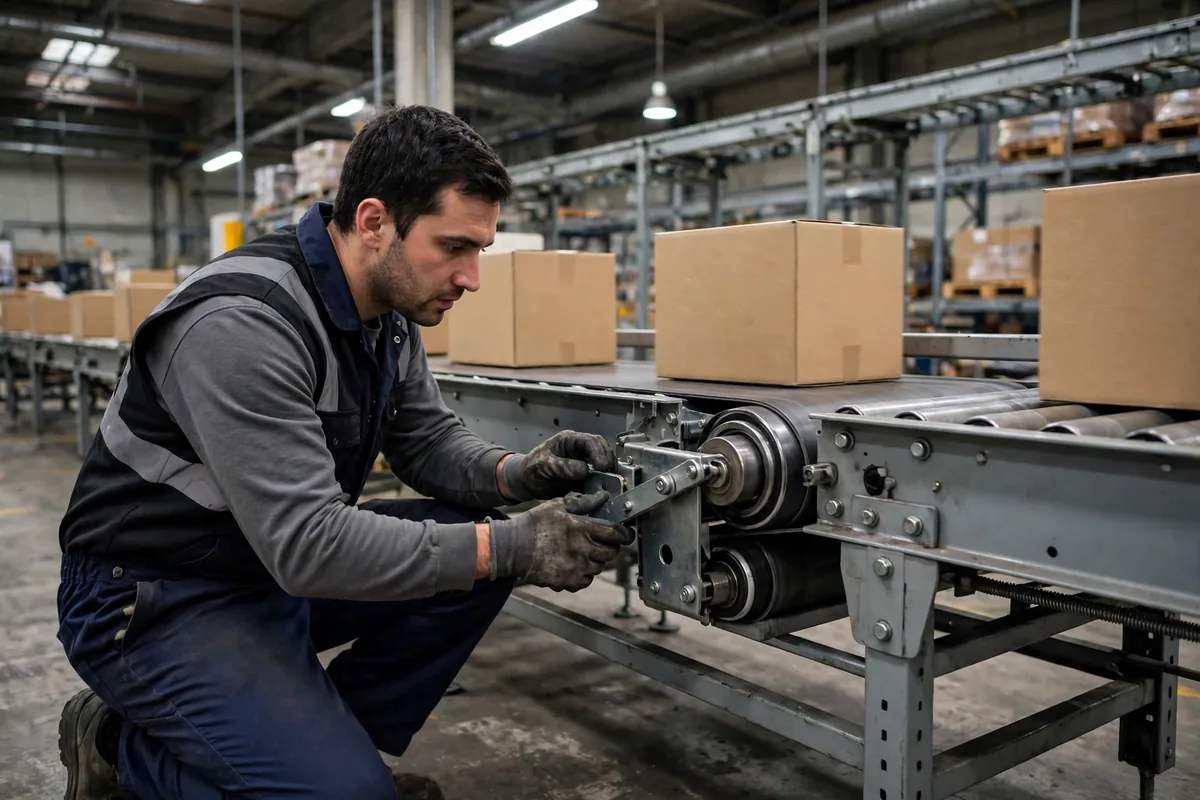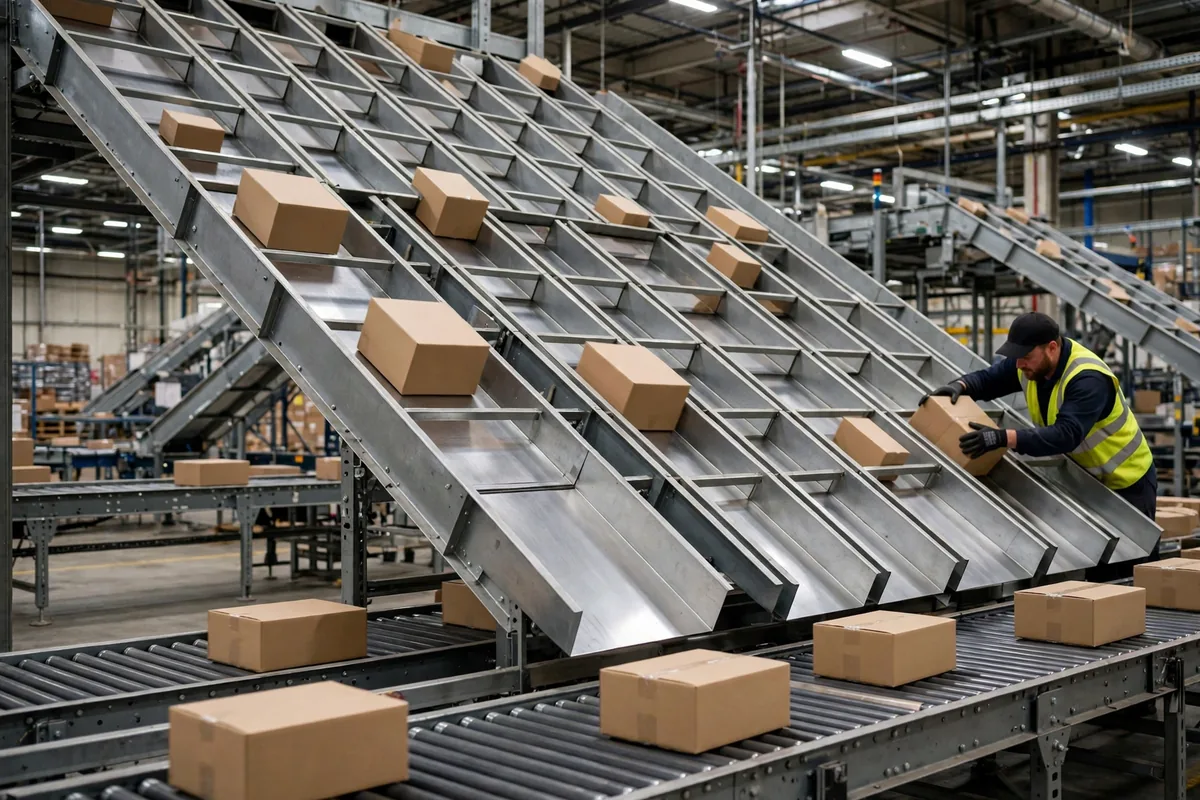
Let me say something that might annoy a few people: warehouse sortation chute expansion is rarely about the chutes. When you run out of chutes, eight times out of ten the chutes are not the problem. Your destination planning is.
Before Double 11 in 2025, I was called to an e-commerce warehouse in eastern China for an inspection. Their cross-belt sorter had 48 chutes. Peak-season destinations had jumped to 72. The site manager was in a panic and asked me, "Can we add 24 more chutes? Money is no object, we need them next week." I looked at their sort plan and had to smile: of those 72 destinations, 19 saw fewer than 30 parcels a day. Giving a destination with 30 parcels a day its own dedicated chute is like reserving a guest room for a visitor who comes once a month — and then complaining the house is too small.
Think of a chute as a parking space on the sorter's loop. The main line is the ring road, parcels are the cars, and chutes are the parking spaces. When spaces run short, you can build more spaces, stagger when cars park, or divert some cars before they ever reach the lot. All three work. Their costs are completely different, and picking the wrong one is worse than doing nothing.
First, do the math: how many chutes are you actually short?
Before touching anything, calculate the gap. Do not go by feel. The real bottleneck of a chute is not how many there are, but how fast each one is cleared. The math is simple. Take one example (hypothetical scenario): a standard chute holds about 40 small parcels, and a clearing worker empties it every 10 minutes, so its theoretical ceiling is roughly 240 parcels an hour. If clearing falls behind, the chute fills up, parcels on the main line keep recirculating, and anything that still has nowhere to go drops to a manual exception lane.
My back-of-envelope formula is three lines: peak hourly parcel volume divided by one chute's hourly clearing capacity equals the minimum chute count; minimum count minus existing chutes equals the gap; gap times the cost of one chute retrofit equals your budget floor. Once people run those three lines, the gap is usually smaller than they feared.
That eastern China warehouse ran the numbers: peak volume of 8,000 parcels an hour, about 200 parcels an hour per chute of clearing capacity, 48 chutes giving a theoretical ceiling of 9,600 parcels an hour. They were not short on capacity at all. They were short on destinations. The problem changed from "not enough chutes" to "how do we fit 72 destinations into 48 chutes," and the answer changed with it.
One more number to pin down first: what class of sorter are you actually running? Published manufacturer figures put loop cross-belt sorters at roughly 10,000 to over 40,000 parcels per hour, linear cross-belt lines at about 8,000 to 12,000 parcels per hour with belt speeds of 1.5 to 2.5 meters per second. One vendor's loop sorter, for example, is rated up to 16,000 items per hour at 2 meters per second with a 35-kilogram maximum payload. Those are equipment ceilings, not your real throughput — real throughput is set by the shortest of three legs: induction, identification, and chute clearing. When chutes run short, check clearing first and the sorter second. Do not get the order backwards.
Three temporary fixes for warehouse sortation chute expansion
The first fix is logical expansion, and it needs no hardware at all — the cheapest form of warehouse sortation chute expansion there is. Destinations share chutes by wave: wave A uses chutes 1 to 24 in the morning, wave B switches the same chutes to a different set of destinations in the afternoon, and the control system just loads a different mapping table. You can go further with dynamic allocation, where the system watches which chutes are filling up and temporarily merges low-volume destinations into a shared chute. This is the cheapest and fastest option, and it fits gaps under about 20% where long-tail destinations dominate. The catch is that switching waves means stopping the line for 10 to 20 minutes (hypothetical scenario, based on that site's measured changeover time), so the shift plan has to be agreed in advance.
The second fix is mobile expansion: add physical chutes without construction. Bolt mobile slide chutes onto the end of the line, or sort into floor staging with gaylords and cages for manual secondary sortation — the main line splits into 8 broad carrier-level chutes, and workers behind each one split by city. This fits big gaps and short peaks of two or three weeks, because the slides and cages are rented and go back when peak ends. The downside is more manual handling, which means higher error rates and an extra clearing shift.
The third fix is pre-sort diversion, adding zero chutes. Split the flow before induction: by carrier, by region, by bulky versus small, sending parcels to different induction points or different shifts so that fewer destinations are live at the same time. This moves the pressure from the chutes to the induction stage, and it suits warehouses where destinations are many but each one is small. The downside is that induction points need rework, pre-sorting takes labor of its own, and the total cost has to include that labor — not just the chute side of the equation.
| Fix | Cost | Speed to deploy | Fits a gap of | Biggest weakness | | Logical reuse (wave sharing) | Lowest, software mapping only | Same day | Under ~20% | Brief line stop to switch waves | | Mobile chutes + gaylords | Medium, mostly rental | 2–3 days | ~20–50% | More manual work, higher error rate | | Pre-sort diversion | Medium, induction rework | About a week | Long-tail destinations | Induction becomes the bottleneck |
Selection comes down to one number: the size of the gap. Under 20%, start with logical reuse. Between 20% and 50%, rent mobile chutes to get through peak. When long-tail destinations make up more than half the list, pre-sort diversion is usually cheaper than adding chutes. Whether the money is well spent comes down to that one number.
Three traps to clear before your warehouse sortation chute expansion
The most expensive lesson I have seen happened at an express parcel hub. In the 2024 peak season they paid good money to add 16 chutes — and throughput went down, not up. The problem was clearing. More chutes, same clearing crew. Chutes filled up with nobody to empty them, parcels recirculated on the loop, and the more parcels recirculated, the lower the effective capacity. A chute field works like a parking lot: more spaces do not fix a jammed exit. A jammed exit with more spaces is just a bigger mess.
The second trap is letting a temporary fix become permanent. Mobile slides and gaylords are emergency gear, and they should leave when peak ends. Some warehouses get used to them and never take them away. Three months later the "temporary" slide is a permanent fixture, manual secondary sortation is a fixed process, and a peak-season cost has quietly become a year-round cost. My rule: when a temporary chute expansion is approved, its removal date goes into the plan on day one, and within two weeks after peak ends there is a review — keep it or take it out.
The third trap is staring at chutes while ignoring identification. No matter how many chutes you have, if label read rates are poor, the rejects pile into the exception chute, the exception chute fills up, and the whole line slows down. Before adding chutes, check a week of read rates and exception volumes. If the read rate is under 99%, fix identification first. I have seen plenty of fake requirements in this business, and behind the words "not enough chutes" there is usually one of three problems: identification, clearing, or shift planning.
So back to where I started: short on chutes, do not rush to add them. Calculate the gap, check clearing, and only then talk about building. Peak-season warehouse sortation chute expansion is not a contest over who has the most chutes. It is a contest over who did the math. Expand correctly, and when peak ends the equipment goes away and the cost stops. Expand wrong, and long after peak is over, the bill keeps coming.
By Da Liu, Automation Engineer