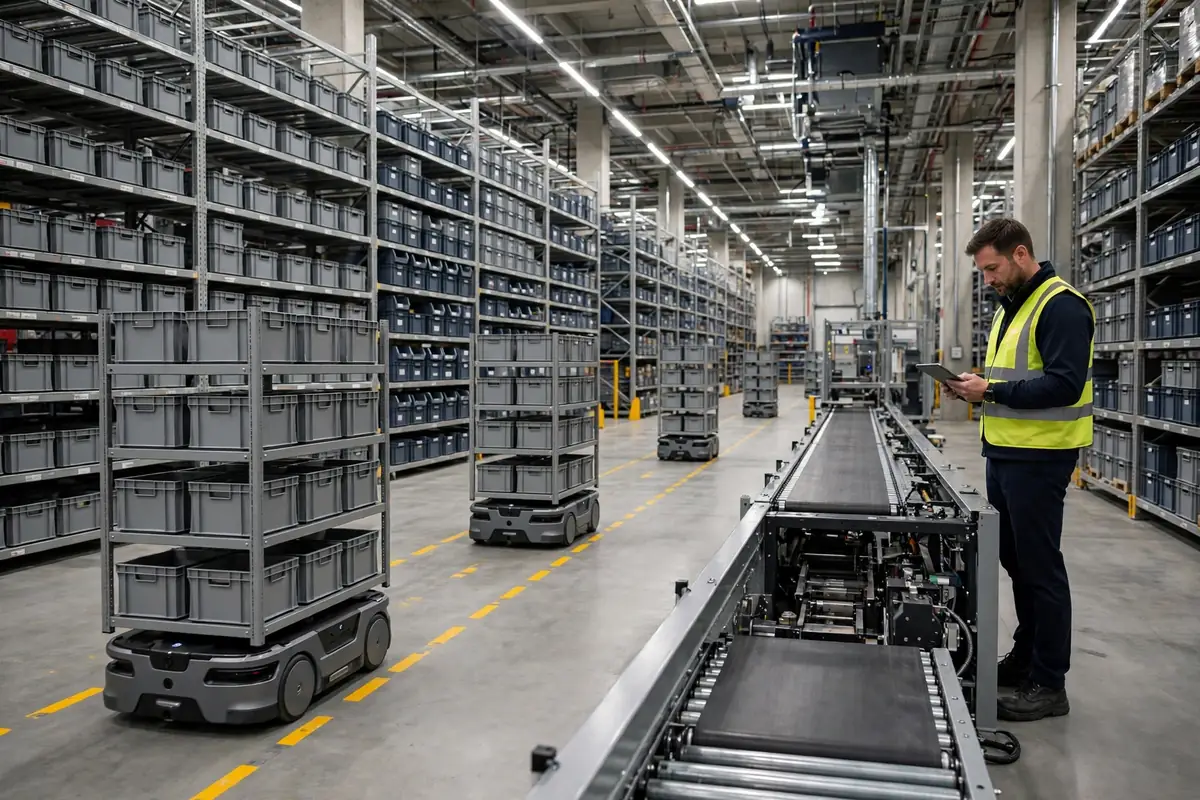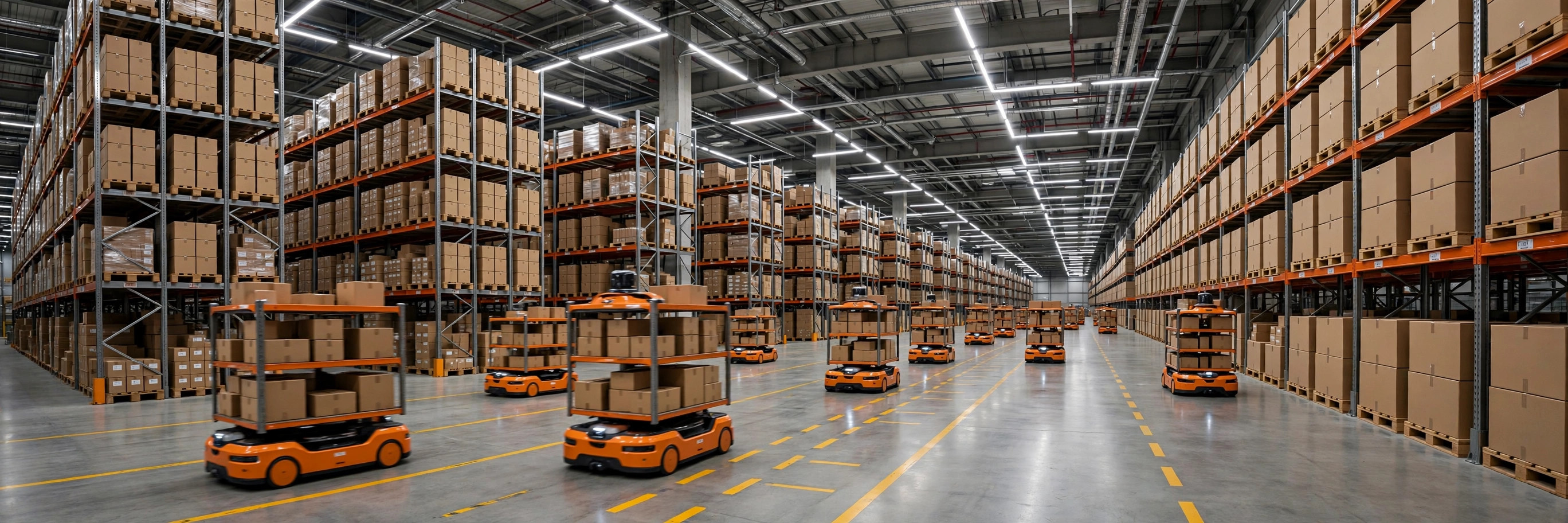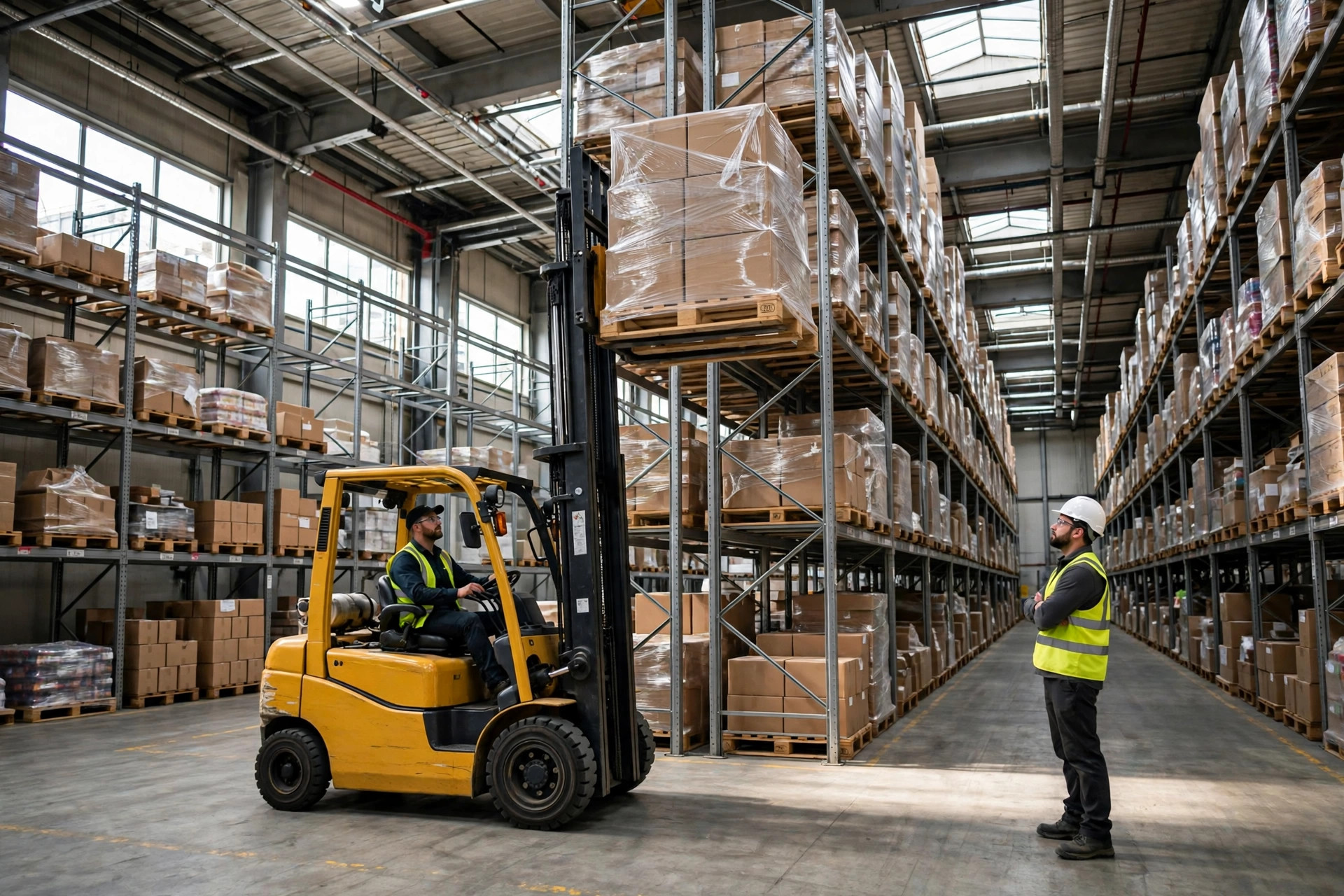
"How soon does it pay back?" The warehouse automation payback period is the first question every boss asks, and the wrong way to answer it is with a round number and a confident tone. Take a worked example: a warehouse invests $2.4 million in automation and saves $400,000 a year. The payback period is six years. That arithmetic is trivial. The hard part is proving that the $2.4 million and the $400,000 are real, because most ROI calculation decks fail on those two numbers, not on the division.
The payback period starts with total cost, not the quote
A vendor quote is a price for equipment. A payback calculation needs total cost of ownership, the full bill from decision to steady operation. Leave out any line and the payback period comes out shorter than reality, the boss approves on a fiction, and operations inherits the gap.
| Cost item | Worked example | Note |
|---|---|---|
| Equipment and software | $1,600,000 | AMRs, racking, WMS integration, per contract |
| Implementation and retrofit | $325,000 | Floor work, network, fire and layout changes |
| First-year maintenance and spares | $190,000 | Service, wear parts, system support |
| Training and ramp-up loss | $140,000 | Lower output in the first three months |
| Cost of capital | $145,000 | Actual financing or internal capital cost |
| Total | $2,400,000 | This is the denominator, not the equipment price |
In 2024, an electronics accessories distribution center outside Columbus, Ohio, learned this the expensive way. The proposal said $1.3 million for equipment and a two-year payback. Once the floor needed reinforcement, the WMS interface needed rework, and overtime piled up during ramp-up, the real bill was close to $1.9 million. Recalculated on the full cost, payback stretched from two years to three and a half. The money was not wasted. It was never counted. That is the worst kind of overspend: money paid for work the quote never mentioned.
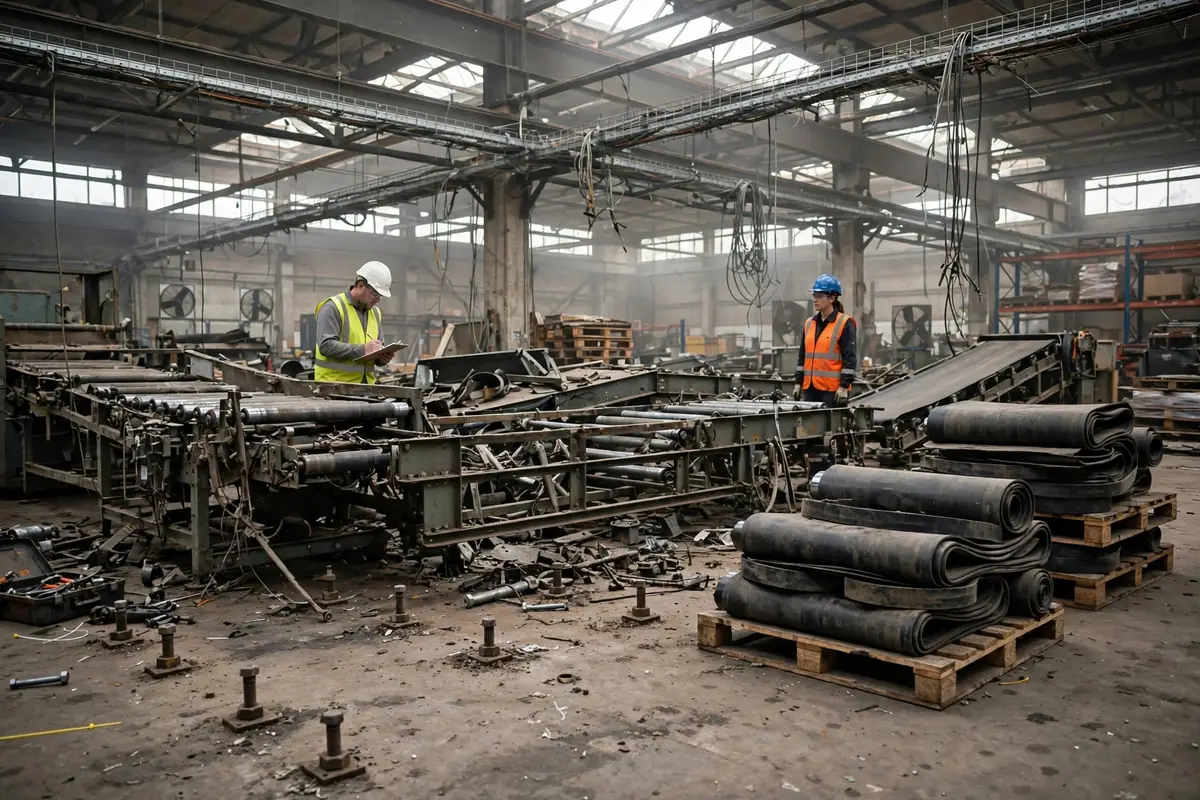
Here is the counterintuitive part: the most expensive piece of automation is often not the machine. It is everything you change around it — the floor, the process, the interfaces to the old system. Machines can be compared side by side. Retrofits cannot, because every building has a different floor, ceiling height, and legacy system. Pick a vendor on equipment price alone and you are buying a house by looking only at the asking price and ignoring the renovation.
How to calculate warehouse automation payback period with three numbers
The math itself is simple. What matters is what goes into each number. The standard ROI calculation uses three inputs: total investment, annual net savings, and any residual value or grant actually received. Payback period equals total investment divided by annual net savings. Annual net savings equals labor and error savings minus added operating and energy costs. Residual value and grants count only at the amounts in a signed contract or a banked payment. Nothing promised counts. Nothing hoped for counts.
Run the example through. The warehouse used to spend $1.2 million a year on picking and moving labor. After automation that falls to $750,000, saving $450,000. Fewer errors cut rework, reshipping, and refunds by $125,000 a year. Added energy and maintenance cost $175,000. Annual net savings are $450,000 plus $125,000 minus $175,000, which is $400,000. Divide $2,400,000 by $400,000 and payback is six years. That is a number you can defend in a meeting, because every line in it can be traced to a contract, a payroll report, or an error log.
In 2025, an apparel distribution center in Texas showed how much the sizing decision matters. Normal volume ran 8,000 orders a day. Peak season hit 24,000. Sized for peak, the automation bill rose by nearly 40 percent and payback stretched past seven years. Sized for normal volume, with temporary labor covering the peak, investment fell and payback came inside four years. Management picked the second option. Automation is not the tool for absorbing peaks. People are cheaper for a six-week spike than fixed assets that sit idle for the other forty-six weeks. The lever is not how fast the robots run. It is whether you accept that peak volume is not worth buying steel for.
One more rule on labor savings: do not multiply headcount cut by average wage and call it savings. The people who stay need new skills — operating the system, clearing faults, reading the data — and their pay, training, and cover shifts change with the job. "Ten fewer people" is not the same as a clean annual saving until recruitment, training, and night-shift premiums are in the same calculation.
Recheck the math after go-live, too. For the first three months, recalculate payback every month using real order volume and real downtime. Vendor models assume continuous running. Real warehouses have shift changes, network drops, racking moves, and rush orders. If actual savings land at 70 percent of the model, payback must be recalculated at 70 percent, and the revised date goes into the update to the boss. Finding out at year-end is not a reporting delay. It is a year of decisions made on a wrong number.
Where the money leaks: three levers worth pulling first
The first lever is errors. Many ROI models count labor and skip errors. One wrong shipment costs far more than the item inside the box: re-pick, reship, return, customer service time, and the customer who does not come back. Cutting the error rate from 5 per 1,000 orders to 1 per 1,000 often saves more than the labor cut. Break out the error cost before you model anything else, or the automation case will look weaker than it is and the wrong project will win the budget.
The second lever is process. Before any machine arrives, fix the pick path, the wave plan, and the replenishment rules. The Ohio site found after go-live that the same AMRs moved 20 percent more orders per hour once the routes were reworked. Automating a broken process is like buying a faster car for a jammed road. The speed is real. The road still does not move.
The third lever is phasing. Going all-in at once is the most expensive way to learn. Automate picking first, run it for three months on real volume and real failure rates, then decide on conveying and sorting. Phasing is not delay. It is replacing a vendor model with your own data. The efficiency figures in a sales deck were measured in an ideal hall. Your warehouse is not an ideal hall.
Contracts should follow the same discipline. Put efficiency, failure rate, and response time into the acceptance terms, with a clear remedy if they are missed, not a line that says "guaranteed stable operation." Acceptance means running a full week at real volume and passing the agreed rate. A loose contract is not a paperwork issue. The dispute time it creates after go-live belongs in total cost just as surely as a spare part does.
Here is the calculation to take away. Fill in total investment on a total-cost basis. Fill in annual net savings as labor savings plus error savings minus added operating cost. Put zero for residual value and grants unless the money is contracted or received. If payback comes in under three years, the case is worth a serious discussion. Between three and five years, it depends on whether order growth can pull the number down. Beyond five years, stop and fix process and errors first. Most warehouses find at that point that a real sum can be saved before any machine is bought, and the automation decision gets easier, not harder, once that work is done.
By Lao Zhou, Logistics Cost Analyst