We had a client — a 3PL in Chicago doing e-commerce fulfillment — whose boss got asked one question in a board meeting: "We put money into this automation equipment — how long until it pays back?" The sales director froze. Not because he didn't understand the business, but because the proposal listed what the equipment cost and never said how the payback period was calculated. That freeze cost us four months. The deal stalled, and the boss's trust in the vendor went with it.
I've seen this too many times. The warehouse automation ROI payback question always comes, and it always comes at the worst possible moment — in a board meeting, the night before a budget review, the day a competitor's quote lands on the table. If you can't answer it, you don't just lose the deal. You lose the client's belief that you know what you're doing.
Let me be clear about the concept first. The payback math itself isn't hard. Payback period equals total investment divided by annual net savings. Total investment means equipment, installation, software, integration, and training, all of it. Annual net savings means the labor, errors, and overtime you save, minus the new maintenance, software fees, consumables, and spare parts you take on. The formula is never the hard part. The hard part is where every number inside it comes from.
The Math: How a $1.8 Million Project Pays Back
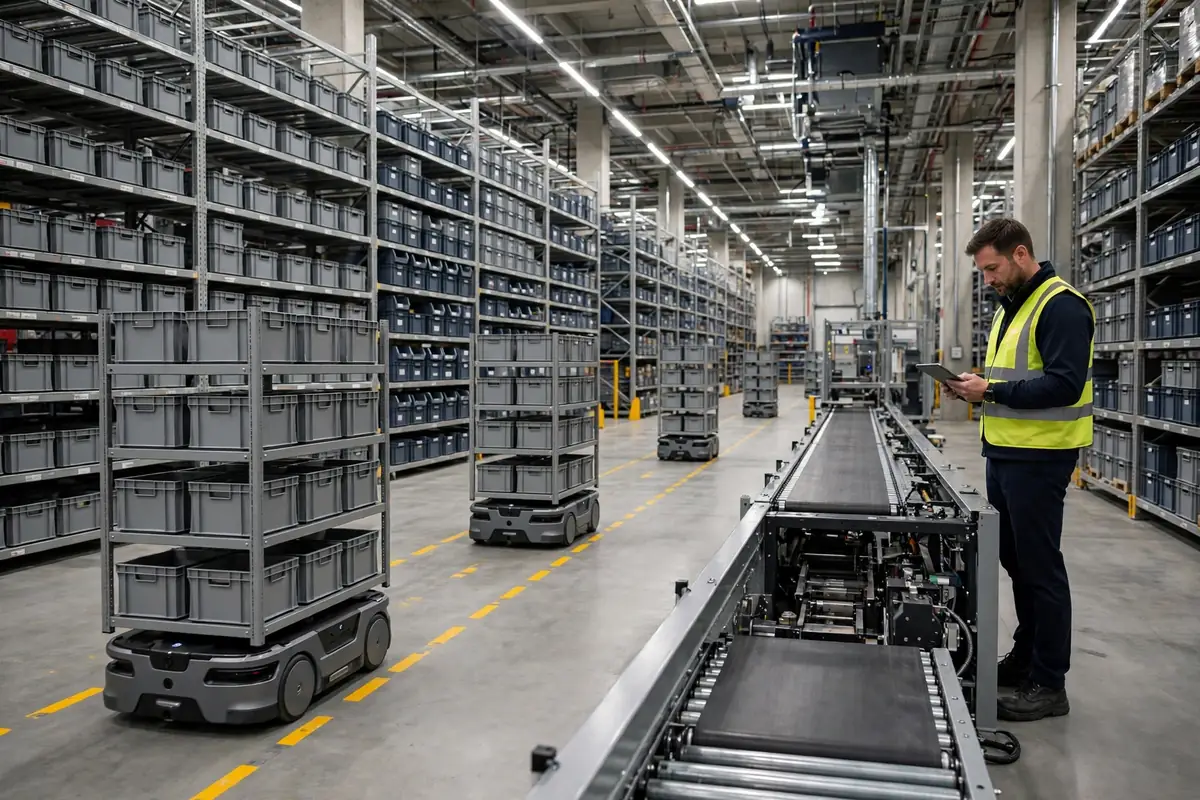
Take the Chicago client. The plan was a fleet of AMRs plus conveyor lines, with a total investment of $1.8 million. Forget about how it amortizes over three years — the real question is how much it saves each year.
| Item | Annual amount (USD) |
|---|---|
| Labor saved (12 picking roles, at local wage levels) | ~$620,000 |
| Fewer errors, fewer returns and claims | ~$90,000 |
| Less seasonal temp hiring and overtime | ~$140,000 |
| New maintenance, software fees, and spare parts | ~-$130,000 |
| Total annual net savings | ~$720,000 |
$1.8 million divided by $720,000 gives a payback period of about 2.5 years. The math is sound, but the first thing I told the client was: don't treat 2.5 years as a promise. Treat it as a range. If order volume holds, labor costs rise at today's pace, and equipment utilization hits the level assumed in the plan, payback lands somewhere between 2.5 and 3.5 years. Change any one of those assumptions, and the number moves.
That's the standard answer I've set for my team, in three sentences. First, state the method up front: payback is total investment divided by annual net savings. Say it before the client has to guess. Second, give a range, not a single number: say "two and a half to three and a half years," never "2.53 years." A payback period quoted to two decimal places is a sales trick, because every variable inside it is an assumption. Third, put the conditions on the table: this number holds only if order volume, labor cost growth, and equipment utilization all behave as assumed.
Three Places Where Quotes Hide the Real Cost
After this many years in sales, I have to say it straight: when a payback calculation goes wrong, the problem usually isn't the formula. It's the quote. The same equipment from three vendors can show payback periods a year apart — and the difference hides in three places on the quote.
The first is maintenance. Some quotes include the first year of maintenance for free and never mention what the contract costs from year two onward. The second is the software fee — the system needs a license and upgrades every year, and that money is real, but it's often buried in the fine print of an attachment. The third is integration: connecting the equipment to your existing WMS, commissioning, training staff. Some vendors quote all of it; others quote half and recover the rest mid-project as "change orders."
How do you protect yourself? Ask three questions at the negotiating table: starting in year two, what do maintenance and software cost together each year? Are integration and training fully included, or could there be add-ons? And if equipment utilization falls short of what's assumed in the plan, how much longer does payback stretch? Once you've asked those three, the other side knows you're not easily fooled, and the numbers they quote get a lot more honest. In the end, the payback question isn't about who calculates fastest. It's about who digs out the hidden costs first.
The Client Who Got the Payback Math Wrong
Early in 2025, we had another client, a smaller one, that bought a semi-automated sorting setup. Their calculation counted only the labor saved. Maintenance, software fees, battery replacements, spare parts — none of it was in there. Year one looked great on paper. In year two the maintenance contract renewed, in year three a batch of batteries needed replacing, and suddenly the payback period was a full year longer than promised. The boss was furious in the review meeting, and the sales side had no good answer — the cost items had been quietly "optimized" away to make the number look pretty.
Here's what clients actually want, and it's simpler than most vendors think: not a pretty number, but a number that still holds up when something goes wrong. Quote 2.5 years and deliver payback in 3.5, and the client remembers you lowballed them. Quote 2.5 to 3.5 years and deliver in 3, and the client remembers you as reliable. That's what a range is for. It protects your credibility, not your quote.
And here's a counterintuitive one: the fastest-payback automation project is usually not the most expensive equipment — it's the cheapest process fix. I've seen a warehouse spend under $100,000 on slotting optimization and pick-path redesign and earn it back in six months. I've also seen warehouses spend heavily on full automation, run it at under 60 percent utilization for years, and watch payback stretch past five years. Equipment doesn't generate returns. Utilization generates returns. Whatever utilization number is in the proposal, that's the number to question at the negotiating table.
So the next time the boss asks "how long until payback," don't rush to give a number. Ask three questions first: how is order volume trending over the next three years, what labor cost growth rate are we assuming, and what's the longest payback period you can live with? Once those three answers are on the table, the range writes itself — and the number finally has something solid underneath it. Vendors who don't know the business love quoting a beautiful single number. People who do quote a range with its conditions attached.
By Susan, 3PL Sales Director