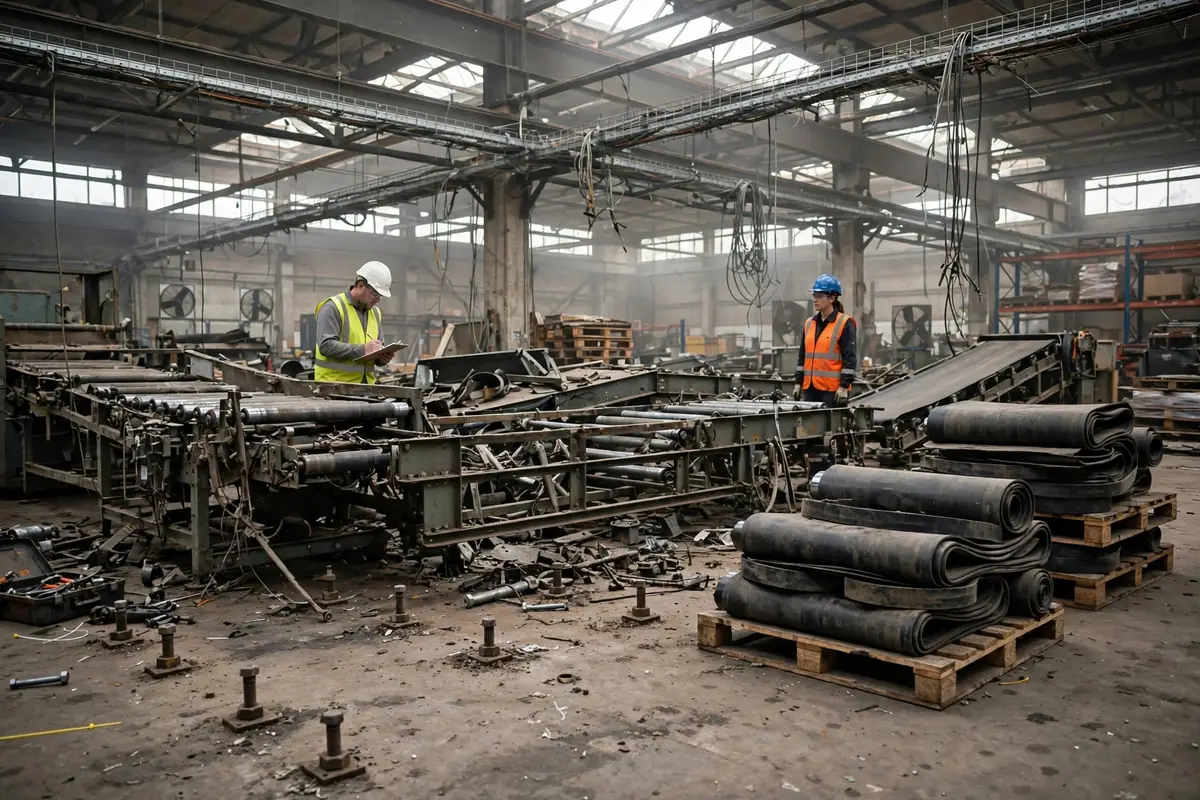
A cross-belt sorter bought in 2018 for $940,000 sat idle in a Columbus, Ohio 3PL warehouse in February 2025. The warehouse manager expected $220,000 for it. Warehouse automation equipment retirement resale value is not the number in the first email from a broker. It is the number left after de-installation, floor restoration, storage, and the months you wait. In this case the net recovery was $58,000, buyer collected and dismantled. The $162,000 gap was not a bad market. It was costs the seller never put in the spreadsheet.
All figures below are hypothetical worked examples to show the method, not market quotes. Change the warehouse and the numbers move. The arithmetic does not.
Three Exit Routes for Warehouse Automation Equipment Retirement
There are only three ways out: sell the system whole, part it out, or scrap it. Comparing headline prices is a waste of time. Compare net recovery, defined as sale price minus de-installation, minus floor restoration, minus storage and insurance, minus broker commission. The route with the highest net recovery wins, even when its headline price looks lower.
| Exit route | Gross proceeds (hypothetical) | De-install and freight | Floor restoration | Net recovery | Time to cash |
|---|---|---|---|---|---|
| Sell whole | $220,000 | Buyer pays | $31,000 | $189,000 | 2–4 months |
| Part out | $287,000 | $61,000 | $31,000 | $195,000 | 6–9 months |
| Scrap | $21,000 | $38,000 | $31,000 | −$48,000 | 3–6 weeks |
In the table, parting out wins by $6,000. In the real Columbus case, it would have lost. The sorter ran on a control system two versions behind current, and the only buyer willing to take it whole offered $89,000 after inspection, not $220,000. The broker's first number was a guess made before anyone powered the machine up. A verbal price means nothing. A written price after a full-shift test run is the only price that counts.
A second case shows why time beats headline price. In June 2025, an e-commerce warehouse outside Kansas City retired 36 autonomous mobile robots, bought in 2022 at $41,000 each. A dealer offered $9,500 each whole, $342,000 for the fleet, cash in five weeks. Parting out batteries, lidar units, and drive wheels would have brought $12,400 per unit, $446,400 in total, $104,400 more on paper. The warehouse did the other half of the math. Parting out needed two technicians for 12 weeks, 1,400 square metres of floor the site did not have spare, and three months of rent at $24,000. Each part needed a photo, a listing, and a buyer. After labour, rent, and the risk that a third of the parts never sold, the extra $104,400 shrank to about $28,000. The warehouse took the dealer's $342,000. Parting out pays more only when you have the people, the floor, and the patience to wait. Most warehouses retiring equipment have none of the three.
Here is the counterintuitive part: the route that brings the highest gross proceeds is often the wrong choice. Cash in six weeks at a lower price can beat a higher price that takes nine months, because every month the equipment sits on your floor you pay rent and insurance on space that earns nothing. Retirement is a cash-flow decision dressed up as a sales decision.
What Sets Warehouse Automation Equipment Retirement Resale Value
Four variables set the price: brand, maintenance history, software version, and de-installation cost. Brand decides whether a buyer pool exists at all. A mainstream brand has dealers competing for the machine. An obscure brand has buyers who first have to work out where spare parts will come from, and they price that risk into the offer. Maintenance history decides whether a buyer believes you. A complete service log, a list of replaced wear parts, and a record of unplanned stops in the past year are worth real money. In one hypothetical comparison, identical machines with complete records sold for 18% more than the same model with gaps in the log. That 18% is an illustrative gap, not an industry average.
Software version is the variable sellers forget. Hardware can move. Software that the manufacturer no longer supports cannot. A control system that will not talk to the buyer's warehouse management system, or that needs a custom interface written from scratch, loses that development cost straight off the offer. De-installation cost is the one variable the seller controls. Rusted bolts, unlabelled cables, and missing drawings turn a five-day removal into a twelve-day removal. A removal crew billing $4,500 a day in this hypothetical example charges $31,500 extra for that extra week. That money comes directly out of resale value.
Score each variable before you negotiate. A machine with a real buyer pool, a complete log, supported software, and a removal that fits inside a week is a full-price machine. Fail one of the four and you are negotiating a discount, whether you admit it or not.
The Hidden Costs: Removal and Putting the Floor Back
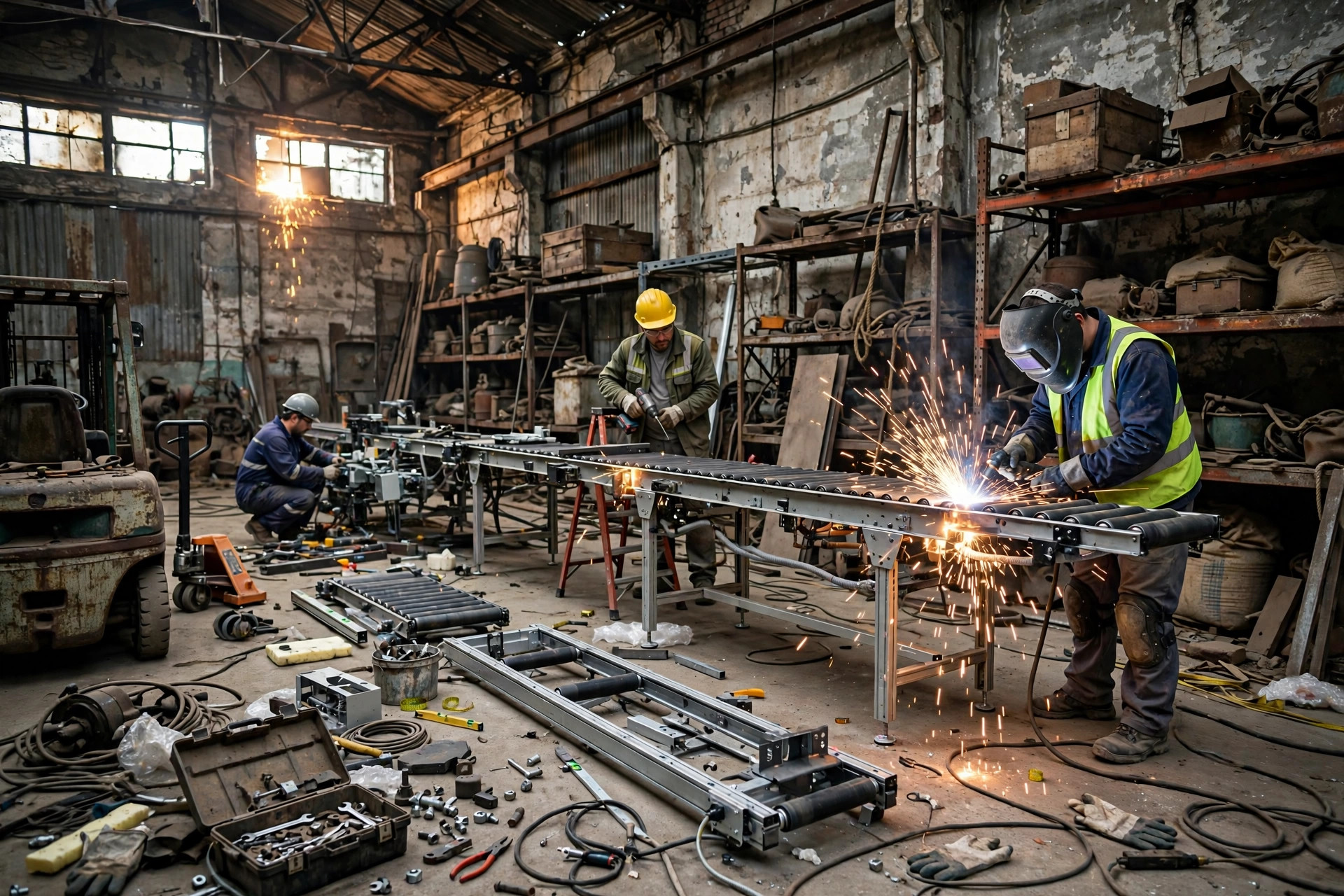
Removal is not one line item. Floor repair, electrical disconnection, fire-system and racking reinstatement, and taking the interface out of the warehouse management system each carry a cost, and each tends to surface after the budget is set. In Columbus, the sorter left 70 anchor-bolt holes in the slab. Cutting, filling, and re-coating the floor cost $31,000. Electrical disconnection and cable removal added $12,000. Taking the interface out of the warehouse system and testing the rest of the operation cost $7,000 in internal time. Together, $50,000, close to a quarter of the broker's first price.
Storage is the quieter leak. The sorter occupied 900 square metres while it waited for a buyer. At $8,000 a month in rent and insurance in this hypothetical example, three months of waiting cost $24,000. Sellers who count only the sale price get the direction of the decision wrong. Set the vacate date first, then work backwards: buyer search, inspection, contract, removal. Once the vacate date is fixed, every day of delay has a price on it, and the negotiation has a deadline that means something.
How a Used-Equipment Buyer Inspects Your Machine
Look at the deal from the buyer's side and the discount becomes predictable. A serious buyer does three things: runs the machine for a full shift and counts unplanned stops, checks the service log and the software support status, and checks whether the machine can come out without cutting the building apart. Fail any one of those and the offer drops by a third, sometimes more.
A seller can prepare for all three. Three months before retirement, close the gaps in the service log, upgrade the control software to the last stable version the manufacturer still supports, gather the drawings and label the cables, and get a fixed-price removal quote from one crew before talking price with any buyer. A machine that passes inspection in one visit sells at the inspected price. A machine that needs two rounds of inspection costs another month of rent and takes another cut on price.
The calculation to run before any decision is simple. Net recovery equals sale price minus de-installation, minus floor restoration, minus storage and insurance, minus broker commission. Use the written price after inspection, not the verbal price before it. Run it for all three routes. Pick the highest net recovery. When all three routes are negative, pick the smallest loss and move at once. Every day the machine stays on the floor, its resale value falls by a day of rent.
By Lao Zhou, Logistics Cost Analyst