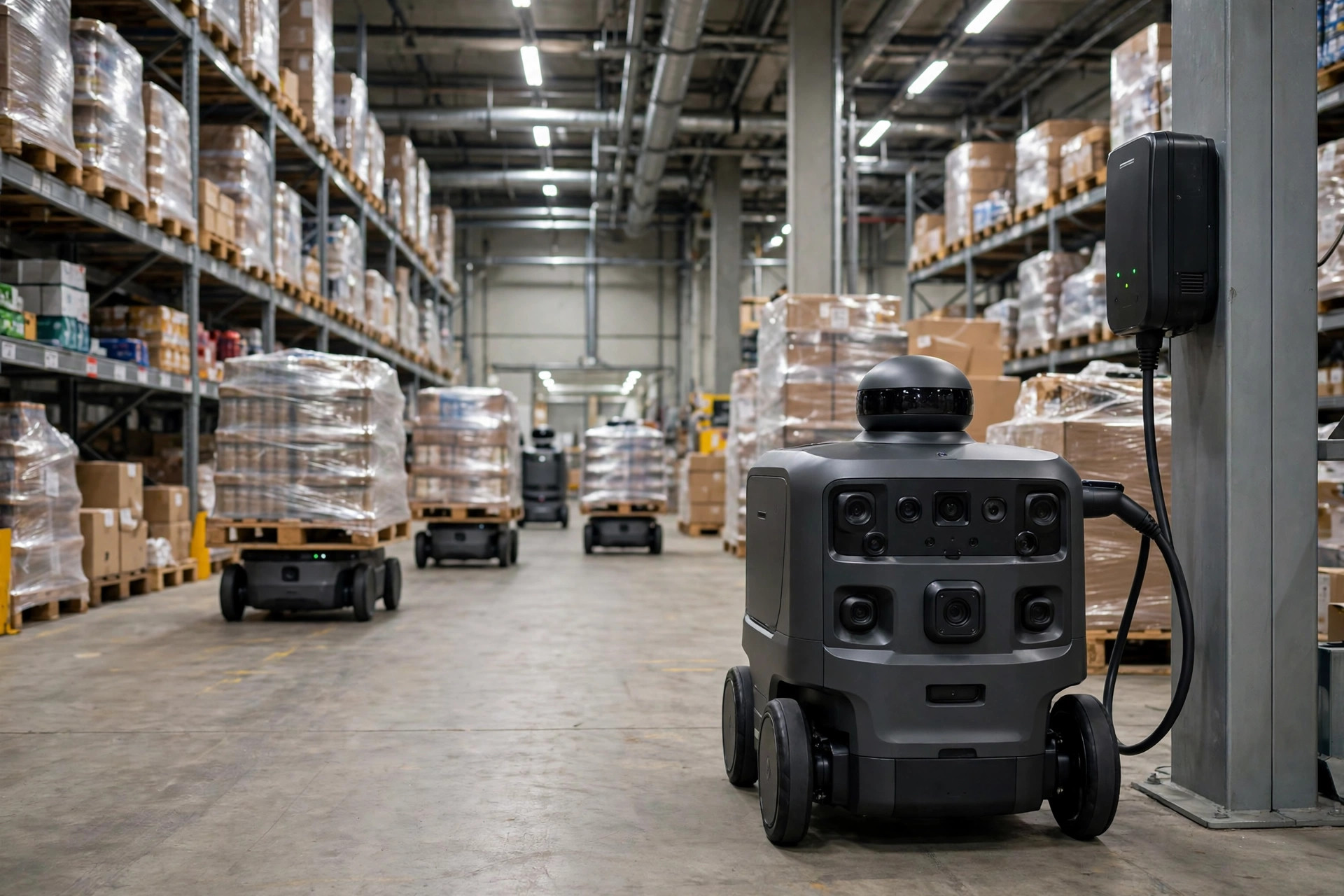
Excerpt: An AMR charging strategy warehouse managers can actually run comes down to timing, not battery size. This guide compares opportunity charging with battery swapping, with real warehouse numbers and a clear dividing line for choosing between them.
An AMR charging strategy warehouse teams get wrong usually fails in the same quiet way. Nobody notices a single robot going to charge. People notice it when five robots queue for chargers at 3 p.m., picking lines wait, and the shift lead starts moving orders by hand. The cause was rarely a bad robot.
Think of it like a phone. If you insist on running it to zero and then charging it to full, you spend a large part of the day tethered to a cable. A warehouse robot is no different. Lithium batteries are happiest in the middle of their range, and constant deep discharge or repeated fast charging at high temperature ages a pack faster. Opportunity charging uses short gaps between tasks to top up inside a comfortable band. Battery swapping takes another path: the robot drops a depleted pack at a station, picks up a full one in minutes, and the empty pack charges slowly off the vehicle.
Neither approach is better in the abstract. The question is which one fits your task pattern, your daily distance, and your floor.
How AMR Charging Strategy Works in Real Operation
Start with the physics, because the rest follows from it. A robot does not consume energy evenly across a shift. Travel distance, payload, acceleration, lift cycles, and waiting time all change the drain rate. A robot doing short, light transfers in a compact zone can run for hours on a partial charge. The same robot hauling heavy pallets across a large building, with long empty travel back to the start, drains far faster.
Opportunity charging works when work itself creates gaps. Robots wait for orders, wait for elevators, wait for a human to confirm a pick, or sit between waves. Those minutes are free charging time if a charger sits on the route. Swapping works when work does not create gaps. If the line runs around the clock and stopping a robot costs more than the swap station, the swap wins.
I worked with an e-commerce warehouse in eastern China that ran 45 AMRs during the 2024 peak season. The original plan was simple: charge everything overnight, run it down during the day. By mid-afternoon, robots began peeling off for low-battery charging one after another. On paper the fleet had 45 robots. During the peak window, the number actually available often fell to about 36. Uptime for the fleet hovered just above 90 percent, and the picking team felt every missing robot.
We changed the rhythm rather than the hardware. Short top-ups were scheduled into natural gaps between waves, each lasting roughly ten to fifteen minutes, holding batteries between about 40 and 80 percent. Two robots that ran the longest routes were moved to swapping. Within a month, peak availability rose to 43 robots or more, and lost running time per day fell from nearly two hours to under twenty minutes. The robots were the same. The batteries were the same. The charging rhythm changed.
Opportunity Charging vs Battery Swapping: Where to Draw the Line
I draw the dividing line with three checks, and that is how an AMR charging strategy should be chosen in practice. The first is whether tasks can pause. If orders arrive in waves with natural breaks, opportunity charging is usually the economical choice. The robot charges while it would otherwise be waiting anyway. If work is continuous and a pause cascades into congestion downstream, swapping protects throughput.
The second check is daily distance and load. Measure one robot's real operating time on a full charge under your actual tasks, not the brochure number. Then measure how much gap time that robot can collect in a normal day. Multiply gap time by charging speed. If the result covers roughly 80 percent or more of daily consumption, opportunity charging can hold. Below that, the fleet will drift toward low battery in the second half of the shift, and no dispatch trick fixes a physics gap.
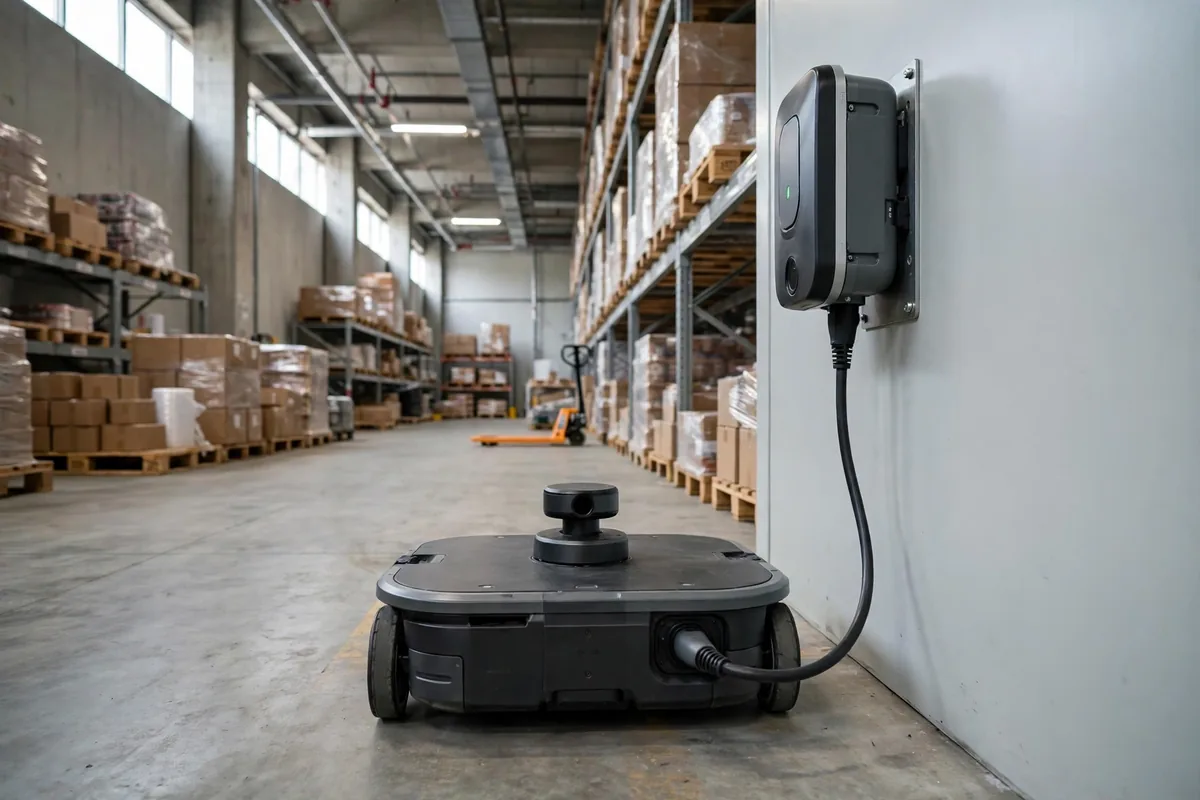
The third check is floor space and capital. Swapping needs a station, spare packs, and room to rotate them. It also needs a clear owner for pack rotation and health tracking. Opportunity charging needs chargers placed along task routes, which is cheaper and easier to retrofit, but it demands disciplined placement. A charger far from the hot zone is almost useless, because the robot burns energy driving to it.
| Factor | Opportunity charging | Battery swapping | Overnight full charge only |
|---|---|---|---|
| Downtime | Uses waiting time, little extra stop | Minutes per swap, then back to work | Unplanned daytime charging, least predictable |
| Battery life | Shallow cycles in a mid-range band, generally kind | Slow station charging, easier to manage | Repeated full cycles, faster aging |
| Upfront cost | Low, chargers along routes | High, station plus spare packs | Lowest, but throughput loss is high |
| Best fit | Wave work with natural gaps | Continuous work, high stop cost | Light work with long idle periods |
Here is the counterintuitive part many teams resist at first: charging to 100 percent during peak hours can lose money. Charging slows sharply at the top of the range. The last 20 percent can take as long as the previous 50 percent. Parking a robot at a charger to chase that last slice trades scarce peak throughput for peace of mind. My rule is blunt: during peak, charge only to enough. Save full charges for night shifts or low-demand windows.
Maintenance Traps That Sit on the Charging Side
Most charging failures I see are maintenance failures wearing a different label. The first trap is charger placement. If chargers sit far from task hot spots, robots make long empty trips just to charge, and the trip eats much of the energy just gained. Chargers belong on the route, where a robot passes anyway.
The second trap is dispatching by percentage alone. Two packs can both read 60 percent and deliver very different run time. An aged pack with higher internal resistance drops faster under the same task. If the system sends that robot on a long route because the percentage looks fine, it will stall halfway. Battery health has to enter dispatch weight. Weaker packs get short, nearby tasks. Stronger packs take the long runs.
The third trap is swap-pack rotation without records. Without a rotation log, a few packs get used every day while others sit idle. The busy packs age fast. The idle packs still age on the calendar and self-discharge. Every pack needs a visible record: cycle count, health score, and last full charge. The system, not memory, should decide which pack goes out next.
The fourth trap is freezing the strategy. Peak season and slow season have different rhythms. A charging parameter set that works in February can fail in November. Review charging settings with each wave change and each season change, and let the task pattern set the parameters.
A second warehouse shows the other side of the line. An auto-parts warehouse in northern China ran continuous work, including nights, and adopted swapping in spring 2025. Opportunity charging covered only about 60 percent of daily consumption there, so it was never a real option. The swap station and spare packs cost more upfront, but a ten-minute line stop backed up work far beyond the line itself. After swapping, each robot gained close to an hour of effective daily running time compared with the old overnight-charge pattern. The investment paid back from throughput within about a year.
I have also seen the reverse mistake. A small warehouse with just over 2,000 square meters installed swapping even though its work came in clear waves, and opportunity charging could already have covered about 90 percent of consumption. The swap station took floor space that could have held buffer positions, and spare packs tied up capital, while fleet availability barely improved. The technology was sound. The fit was wrong.
So ask one number before you spend: peak-hour available robots divided by total fleet size, tracked for a month. If charging is right, the ratio stays high when it matters. If it falls every afternoon, the schedule is the problem, not the robot.
By Da Liu, Automation Engineer