Here is the short version: do not pick a navigation method by how advanced it sounds. Pick it by how often your routes change. If a route sits still for a year, magnetic tape will serve you well. If you move routes every three months, tape will eat your budget in rework. Think of it like roads versus a driver who reads a map. A highway is fast once it is built, but if you change destination every day, you want the vehicle that can find its own way. Navigation is three jobs at once: where am I, what does the room look like, and which way gets me there fastest. Magnetic tape and QR codes answer only the first one. Laser SLAM answers all three. The cost shows up in three places too: the vehicle, the floor, and the day you change a route.
How AMR Navigation Works: Magnetic Tape, QR Codes, and Laser SLAM
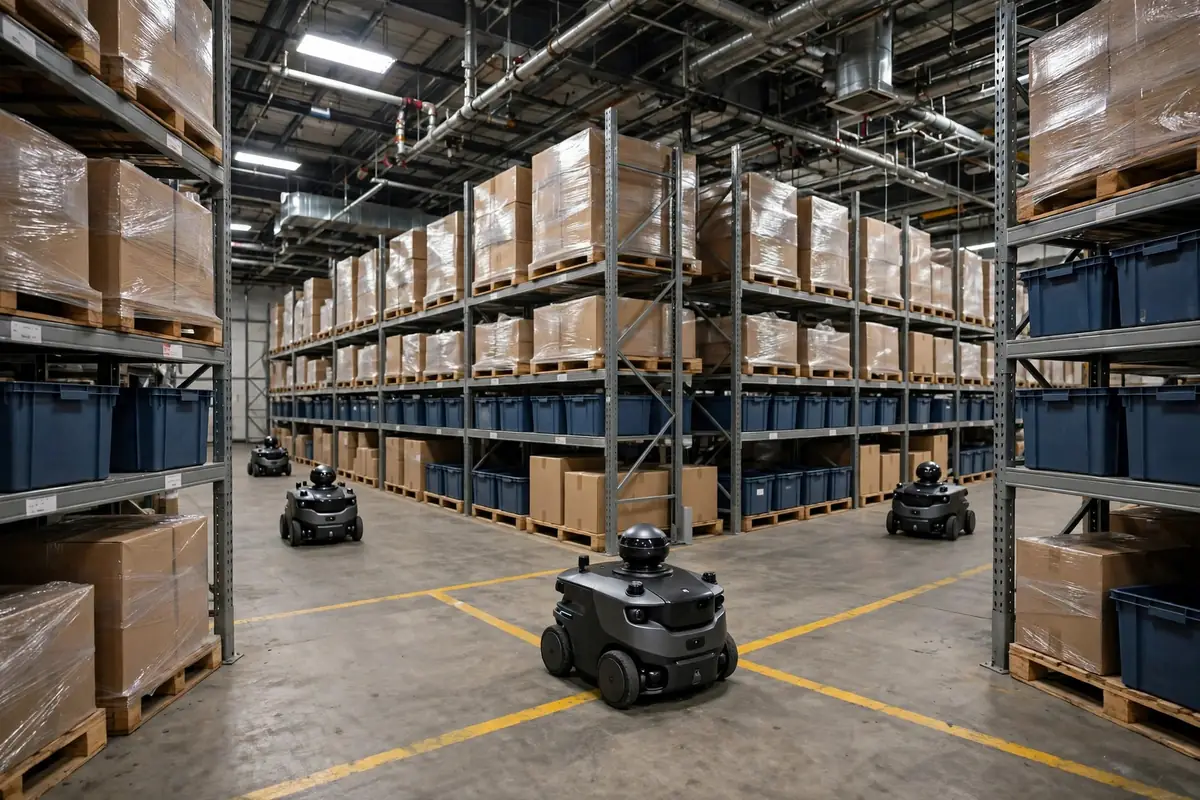
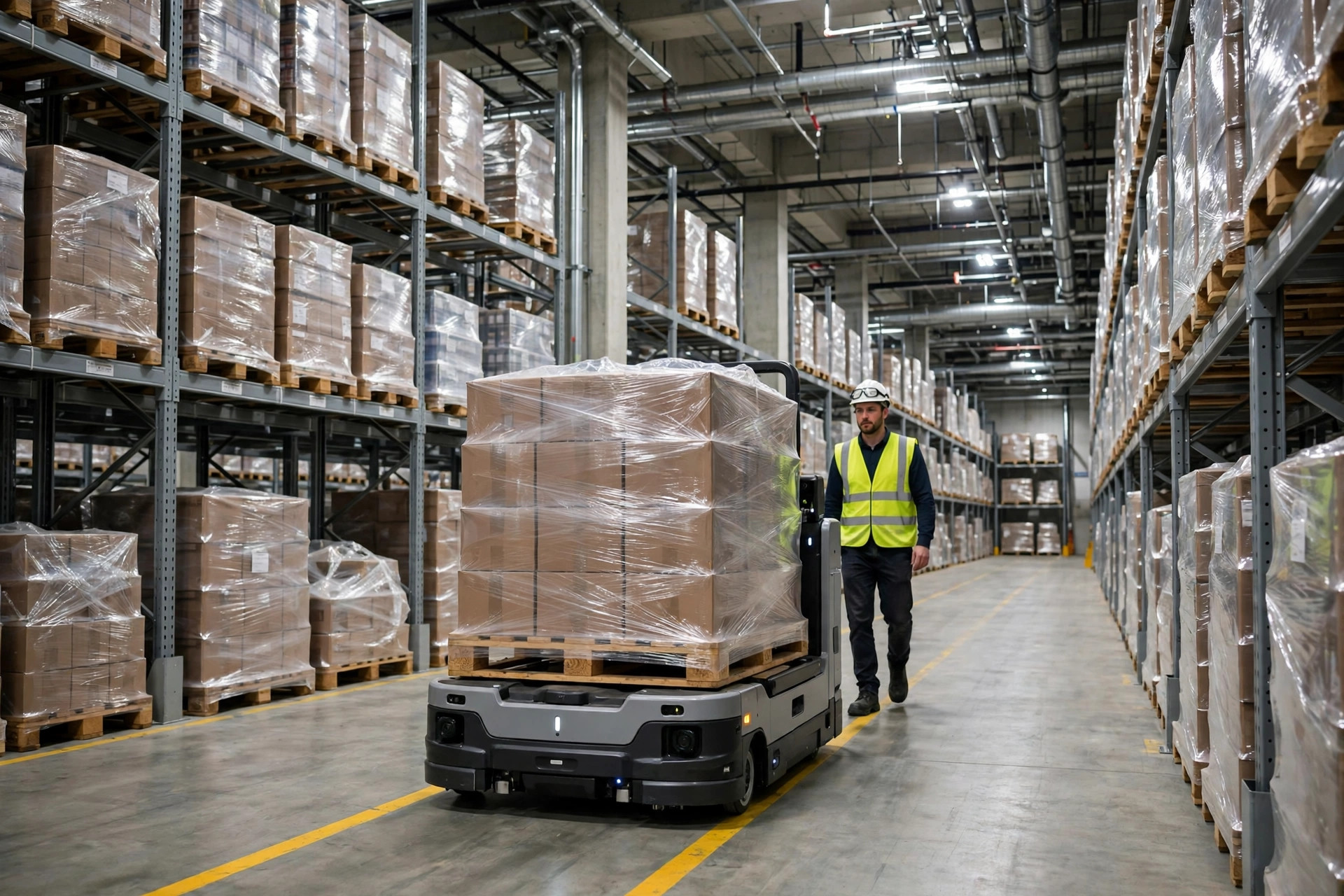
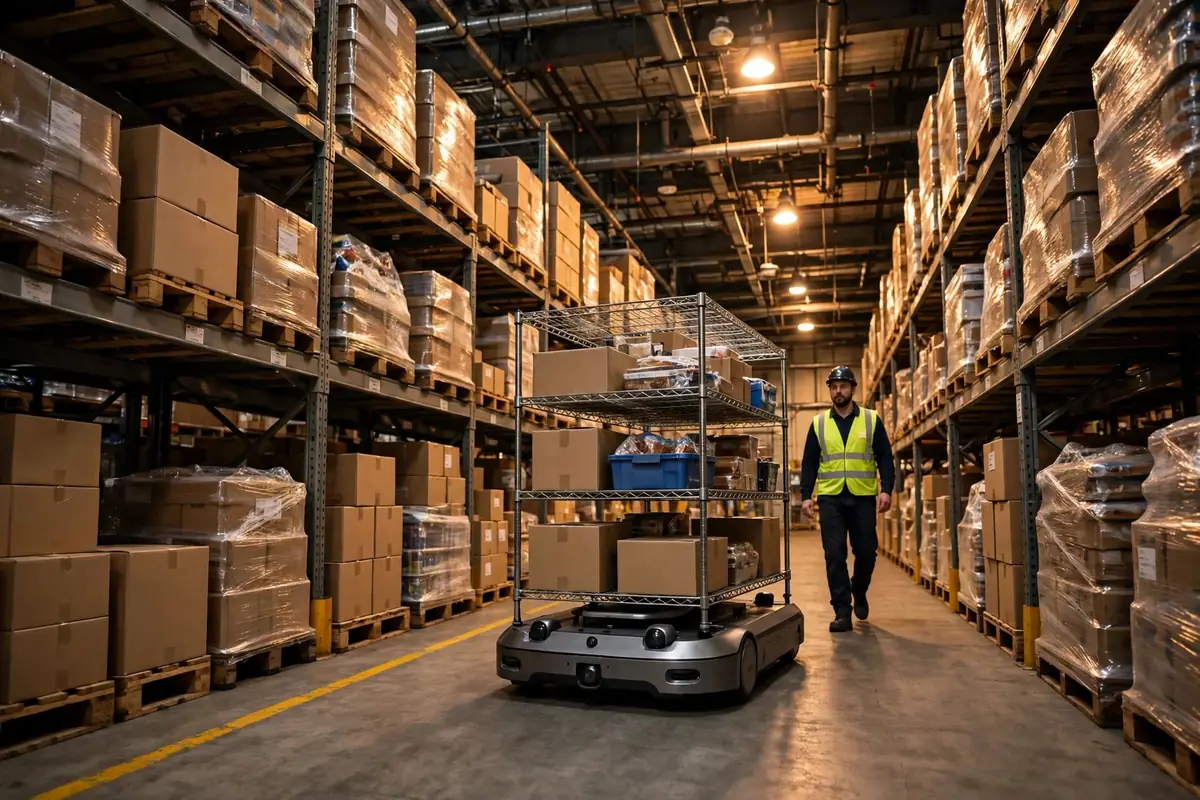
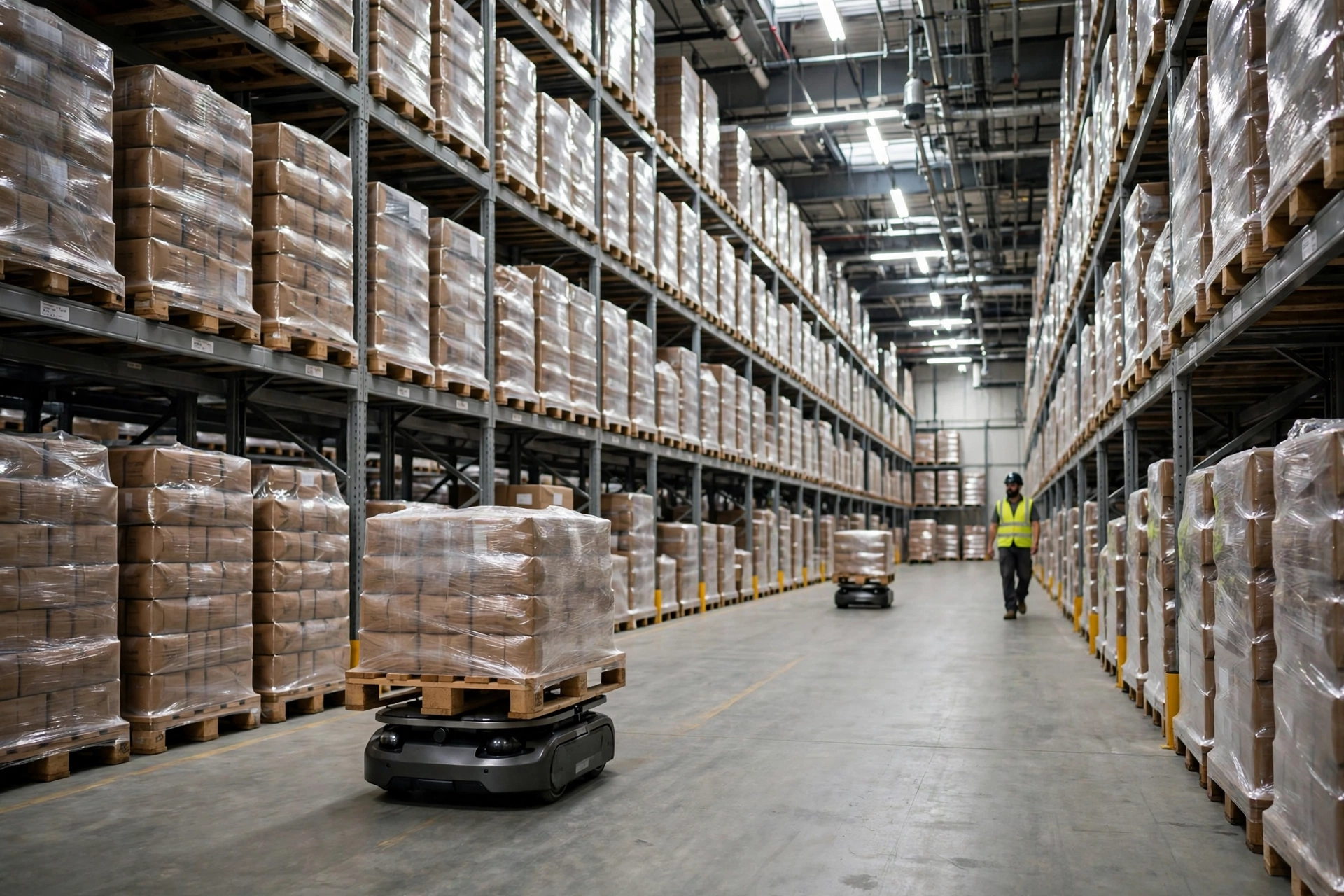
Magnetic tape is the honest old workhorse. A ferrite strip is stuck to the floor, a sensor under the vehicle reads the magnetic field, and the vehicle steers to stay centered. Accuracy runs around plus or minus 5 millimeters. It is cheap, stable, and indifferent to lighting, dust, and condensation. Its weakness is just as plain: the route is glued to the floor. Forklifts roll over it all day, and in high-traffic zones the tape typically needs replacing every 6 to 12 months. Change a route and you peel tape, lay new tape, and recalibrate while that lane is out of service. QR codes are the other fixed-route family. Small codes are stuck to the floor every few feet, and the vehicle reads each one to confirm its position, reaching accuracy of a few millimeters at the code itself. Goods-to-person operations love this setup: the vehicle slides under a shelf, lifts it, and follows a tidy, predictable grid that is easy to schedule. The weakness is that codes get dirty and worn. Forklift tires grind over them, and a smudged code is a code the vehicle cannot read. Uneven floors make the problem worse, because codes do not stick well in the first place. Laser SLAM works differently. It needs nothing on the floor. A LiDAR unit on the vehicle scans walls, columns, and racks, builds a map of the building, and localizes against that map in real time. Natural-feature laser SLAM typically holds path accuracy around plus or minus 10 to 50 millimeters, coarser than tape but good enough for most pallet and tote moves. Change a route and you edit the map in software. No floor work, no downtime for construction. What it fears is an environment with nothing to lock onto: wide open space, glass walls, polished metal, or heavy dust that blinds the sensor. Last fall I walked an e-commerce fulfillment warehouse in Ontario, California. The aisles were full of temporary promotional stock, and the operator wanted six vehicles and asked which navigation to buy. Two laps around the floor told me the answer. They add temporary locations for every promotion and tear them down after the season, so a tape route would need rework within three months. They chose laser SLAM, and mapping took 1 to 2 days: drive the vehicle around once and the map exists. A different warehouse I advised, an auto-parts operation whose routes had not changed in five years, with heavy forklift traffic and oily floors, got the opposite advice. Tape plus a regular inspection round was the cheaper, saner choice. There is no best technology, only the one that fits your floor and your rate of change.
What AMR Navigation Costs on the Floor
Price this in three buckets: the first build, the cost of changing a route, and the ongoing maintenance. Look at only the first bucket and laser SLAM wins, because it barely touches the floor. Look at only the vehicle price and tape usually wins. Add all three together and you get the real number. Here is a worked example, labeled as a hypothetical scenario using published cost ranges: a warehouse needs a 500-meter loop route.
| Item | Magnetic tape | QR codes | Laser SLAM |
|---|---|---|---|
| Floor work | USD 5 to 15 per linear meter, so 500 meters runs USD 2,500 to 7,500 | Codes themselves are cheap; labor and calibration are the real cost | Near zero; mapping takes 1 to 2 days |
| Accuracy | About plus or minus 5 mm | A few mm at each code | About plus or minus 10 to 50 mm |
| Route change | Peel and relay tape, lane out of service | Relay codes and recalibrate | Edit the software map, floor untouched |
| Upkeep | Replace worn sections every 6 to 12 months in high-traffic zones | Replace dirty or worn codes | Recheck the map; rebuild it after big layout changes |
| Worst enemy | Forklift wear | Dirty codes, uneven floors | Open space, glass, heavy dust |
| Check the arithmetic: 500 meters times USD 5 is USD 2,500, times USD 15 is USD 7,500. That is the whole range. The money looks small until you count the second bucket. A magnetic tape route change typically takes 2 to 5 days of installation and calibration, and a buried-wire route is measured in weeks. A laser SLAM route change is a software edit. Multiply your expected route changes per year by that cost and the ranking flips fast. | |||
| One more number people miss: buried-wire installation runs about USD 15 to 50 per linear meter, so the same 500-meter loop costs USD 7,500 to 25,000 in floor work alone. The math is 500 times 15 equals 7,500, and 500 times 50 equals 25,000. Same fixed-route idea, far higher floor bill. Do not pick buried wire unless your floor conditions truly demand it. |
The Day You Change a Route Is the Day You Learn the Price
Here is the counterintuitive part: the most accurate navigation is not always the cheapest overall. Tape holds about plus or minus 5 millimeters, laser SLAM about plus or minus 10 to 50 millimeters, yet many warehouses never need 5 millimeters. Moving a pallet to a staging lane does not care whether you are 3 centimeters off or 5 millimeters off. Only a few jobs truly eat precision: docking to a conveyor, entering a narrow aisle, or lifting a shelf. Ask how accurate your work actually needs to be before you pay for accuracy you will never use. Maintenance splits the same way. Tape fears forklifts, QR codes fear dirt, laser SLAM fears big environmental change. Before any selection meeting, answer three questions. First, how many times will routes change in the next two years. Second, how many forklifts cross the floor daily, and how bad are the oil and dust. Third, is there glass, large reflective racking, or wide open space with no features to lock onto. Answer those three and the choice mostly makes itself. I will also call out a fake requirement when I see one. Some warehouses with fixed routes and steady volume insist on laser SLAM because it looks modern. Modern is not the same as worth it. The vehicles cost more, commissioning is more demanding, and the map still needs someone to maintain it, all for route flexibility you will never use. The reverse is just as bad: a warehouse that rearranges constantly and still lays tape is paying for every change in construction fees and lost production time. My dividing line is simple. Routes stable for more than six months, harsh floors, high precision needs: start with magnetic tape. Goods-to-person, fixed routes, tidy scheduling: give QR codes a serious look. Routes that change often, many small batches, or a pilot you want to scale later: start with laser SLAM. Hybrids are common too, for example laser SLAM on the main lanes with QR codes added at docking points for fine positioning. Pilot before you pave the whole building. Run one real route for two weeks and log three numbers: how often the vehicle loses its way, how long a route change takes, and how many labor hours floor maintenance eats. Tape pilots should watch wear spots, QR pilots should watch dirty and missed codes, and laser SLAM pilots should watch open areas and reflective zones for lost localization. Two weeks of real data beats three hours of argument in a selection meeting. Is the money worth it? Look at one number: how many route changes you expect in the next two years. Add up the construction, downtime, and calibration labor for each change, compare it with the vehicle price gap between the two options, and the answer will show itself. By Da Liu, Automation Engineer