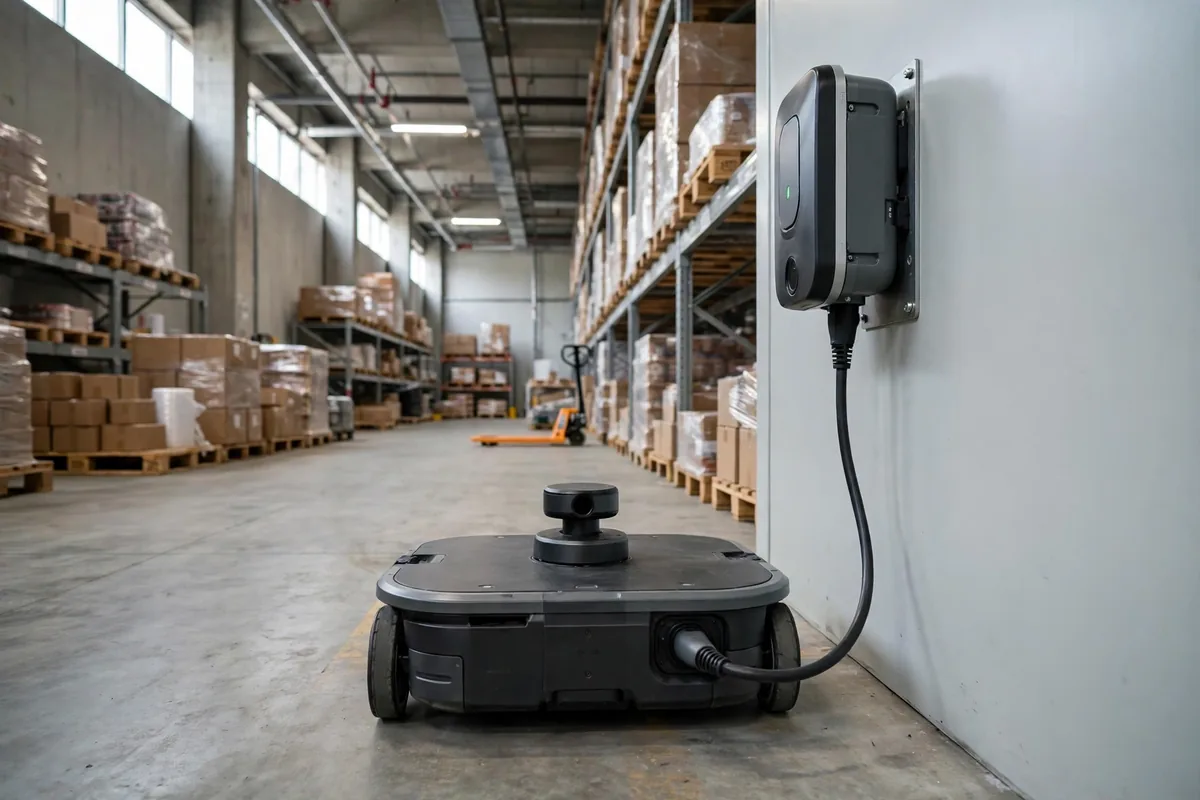
Start with the principle. Think of AMR charging like fueling a delivery fleet: tank size, fueling speed and where the stations sit decide how many trips the fleet makes in a day.
One AMR's cycle is simple: work, drain, charge, work again. Capacity decides runtime per charge, charging speed decides each stop's length, and strategy decides when it stops. Multiply the three and you get real utilization — and if it won't climb, more AMRs just means more expensive charging bricks sitting in your warehouse.
Three mainstream strategies. Let me take them apart.
Battery swap: the robot drives to a swap station, a mechanism or an operator pulls the depleted battery out and slots a full one in — the whole thing takes a few minutes. The upside is the shortest downtime. The downside is the hardest math: a spare battery costs roughly 30 to 40 percent of the whole vehicle (illustrative assumption — confirm against vendor quotes), the swap station takes floor space and maintenance, and you need spare batteries in rotation. Think of it this way: you are not buying one vehicle, you are buying one vehicle plus half a vehicle's worth of batteries.
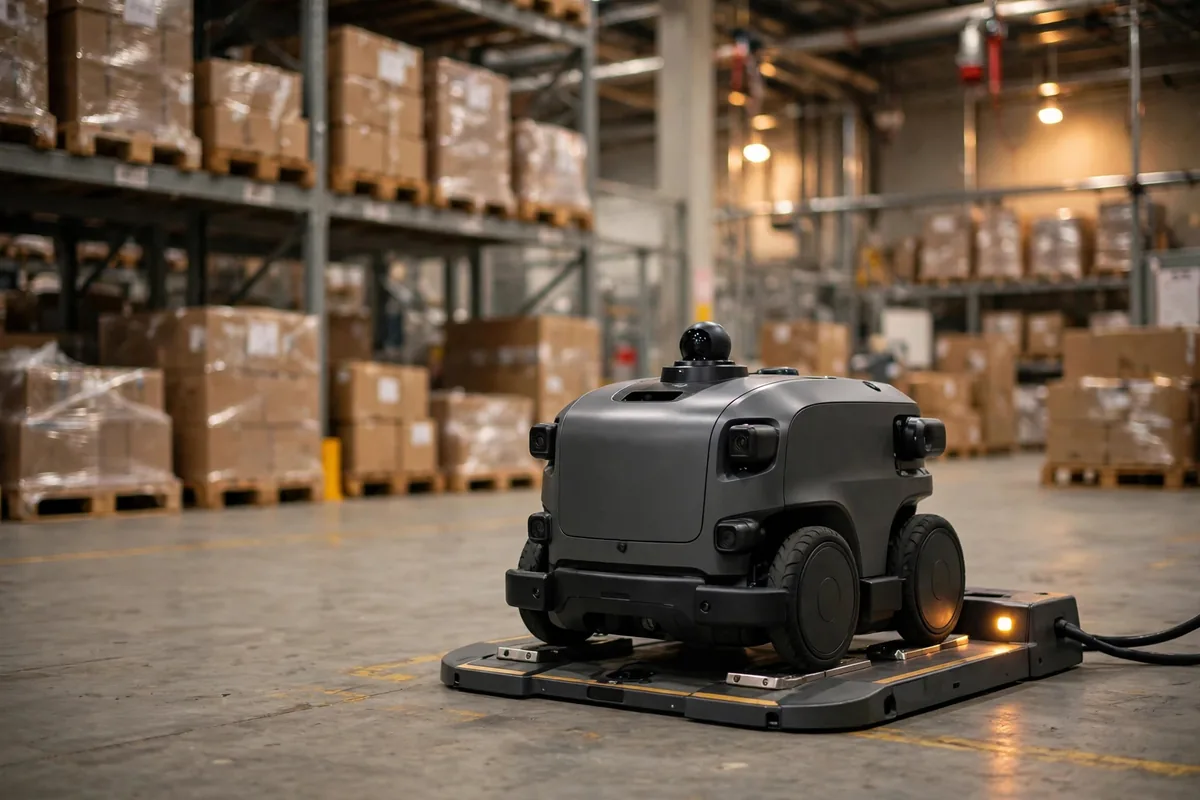
Fast charging: high-power direct charging, the robot docks for roughly half an hour to an hour and returns to work at about 80 percent. The upside is simplicity — no spare batteries, no swap mechanism. The downside is hard on the battery. Lithium cells hate heat and full charge-discharge cycles, and fast charging means high current and heat, so a battery fast-charged for its whole life degrades noticeably faster than one slow-charged. Vendor cycle-life figures are measured under gentle lab conditions; real-world hot fast charging usually delivers less (confirm against vendor field data).
Opportunity charging is the most underestimated of the three: the robot tops up in the gaps between tasks — three minutes waiting for an order, two minutes queued at an elevator, half an hour in the overnight lull. Each top-up is small, but across a day the top-ups add up to a serious amount of energy. Think of it like charging your phone in fragments: never waiting for the battery to hit empty, never insisting on a full charge.
The Real AMR Charging Bill: Downtime Is the True Cost
Most people get the charging-strategy math wrong because they only price the hardware. The real cost is downtime: every minute a robot sits at a charger is a minute producing zero orders.
Let me work through an illustrative example so the method is clear (all figures below are assumptions for demonstration — calibrate against your own order volume, vehicle model and vendor parameters):
Assume a warehouse runs 20 AMRs, each good for 8 hours of continuous work on a full charge, operating 16 hours a day across two shifts. Under battery swap, each vehicle swaps twice a day at 5 minutes per swap — 10 minutes of downtime, about 99 percent utilization. Under fast charging, each vehicle fast-charges twice a day at 45 minutes each — 90 minutes of downtime, about 91 percent utilization. Under opportunity charging, robots top up in task gaps with almost no extra downtime, but the fleet needs more chargers and a smarter dispatch algorithm — about 97 percent utilization in practice.
On utilization alone, swap wins and fast charging trails — but swap needs 20 spare batteries plus two swap stations, fast charging needs almost no extra hardware, and opportunity charging needs roughly 30 percent more chargers plus a dispatch upgrade. Amortized per vehicle per day (illustrative assumptions), swap is most expensive, fast charging cheapest, opportunity charging in the middle.
The deciding line is order volume. Below about 3,000 outbound orders a day (illustrative threshold — calibrate with your measured data), fast charging's downtime barely matters, because orders never fill the schedule anyway and robots have idle time to charge. Push past 8,000 orders a day and 90 minutes of downtime means two fewer robots online at peak, orders pile up, cut-off times slip — and the extra money spent on swap or opportunity charging pays for itself quickly in fewer temp workers and less overtime.
| Strategy | Downtime per stop | Extra hardware | Battery wear | Fits order volume (illustrative) | | Battery swap | ~5 minutes | Spare batteries + swap station | Lowest | 8,000+ orders/day | | Fast charging | ~45 minutes | Almost none | Highest | Under 3,000 orders/day | | Opportunity charging | Near zero | More chargers | Middle | 3,000–8,000 orders/day |
This table is a quick reference for the selection boundary — but remember, the boundary is calculated, not copied. Change your volume curve, your peak-to-trough ratio or your vehicle parameters, and the line moves with them.
AMR Charging Layout: Traffic Conflicts Hurt More Than Charging Speed
Once you have picked a strategy, the second hurdle is where the chargers go. I have seen too many warehouses treat chargers as something to shove into a spare corner — and then robots queueing to charge block the main aisle, and at peak the charging area turns into a traffic jam.
Three hard rules for layout:
First, put charging close to the work zones, but never on a main artery. The sweet spot is the transition zone between picking and storage, where a robot can swing in on its way past without a detour. The farther a charger sits from the task area, the more dead mileage each round trip burns — kilometers of wasted travel across a day.
Second, size charger count for the peak, not the average. On averages, one charger per five robots looks fine. At peak, ten robots hit low battery at once, the chargers run out, and robots wait in line. Queuing is downtime by another name — minutes producing zero orders. My rule of thumb: count how many robots charge simultaneously at peak, then add one spare.
Third, opportunity charging demands a capable dispatch algorithm. Fragmented top-ups only work if the system knows each robot's charge level, the energy cost of its next task, and which charger is free. With a weak scheduler, opportunity charging degenerates into random "charge when free" behavior and the benefit evaporates. Before buying AMRs, ask the vendor one question: does your dispatch support battery-aware task assignment? If they dodge or hedge, don't count on opportunity charging.
Battery Life: The Trade-Off Nobody Prices
Batteries are among the most expensive consumables in an AMR's life. One replacement battery costs a serious fraction of the vehicle. Choose the wrong charging strategy and the battery bill comes due sooner or later.
Here is the counterintuitive judgment: the fastest-charging option usually carries the highest total battery cost. Fast charging saves downtime today and spends battery cycle life to do it. Lithium degradation is not linear — capacity fades slowly through the first 80 percent of life, then falls off faster. A battery fast-charged its whole life may reach a capacity that hurts operations at half its rated cycle count. Then you either replace batteries early or accept robots that need a charge after every trip. Both cost real money.
Opportunity charging is kindest to batteries: shallow charge and discharge keeps cells in their comfortable 40-to-80-percent band, which extends cycle life compared with full-to-empty use. It is the same advice as phone battery care: don't wait for 5 percent, don't always charge to 100 percent. Same physics.
Battery swap has the most interesting battery math: batteries charge centrally at the swap station, slowly and at controlled temperature, so they last longest. But you bought extra batteries to make that work. So the swap equation is: does the money saved on battery life cover the cost of the extra batteries? Every warehouse gets a different answer. Run your own numbers.
Maintenance Traps: Chargers Are Not Install-and-Forget
Finally, the maintenance traps — the part I get asked about most.
Charging contacts are consumables. An AMR docks dozens of times a day; contacts wear and oxidize, contact resistance climbs, charging efficiency drops, and in bad cases they arc. I have seen chargers run two years untouched until a robot simply couldn't charge and the contacts were found burned black. My advice: inspect contacts quarterly, replace them when wear exceeds spec, don't wait for a failure.
Second is heat. Fast-charge posts and swap-station charging cabinets are serious heat sources. On a hot summer day in the warehouse, charging power derates automatically, charging takes longer, and the whole schedule unravels. Leave ventilation and thermal headroom around charging equipment — don't cram cabinets into an airless corner.
So is the money worth it? AMR charging done right shows up in one number: fleet-wide AMR utilization. Fold in charging strategy, charger layout, battery life and maintenance cost. If utilization holds above 90 percent, the money was well spent. If it sits below 85 percent for weeks, don't rush to buy more robots — rework the charging math first.
By Da Liu, Automation Engineer