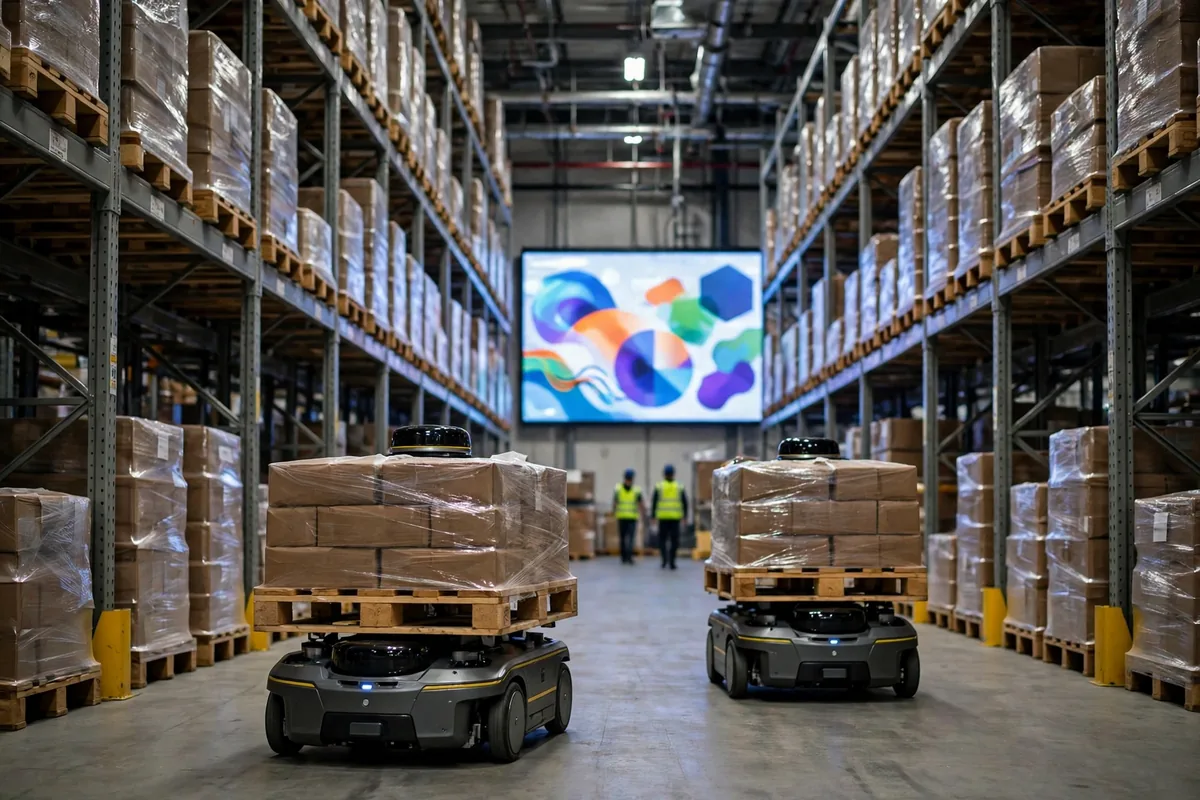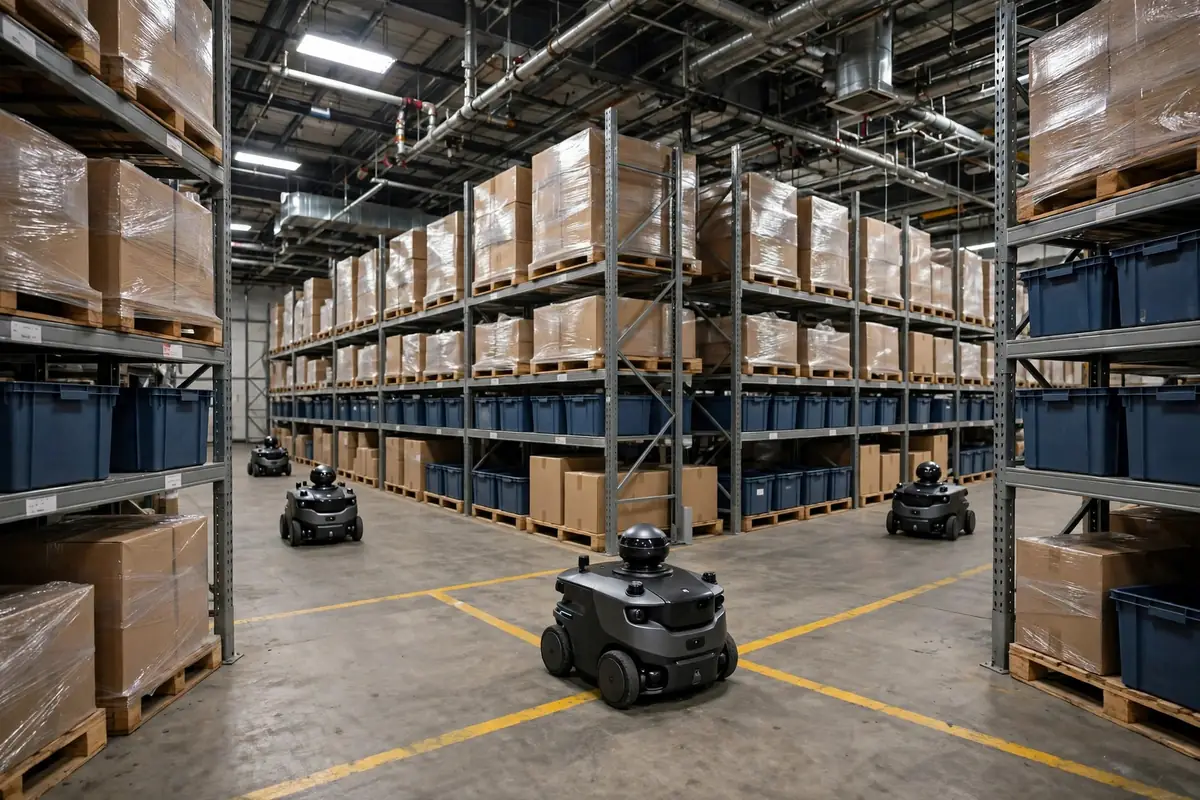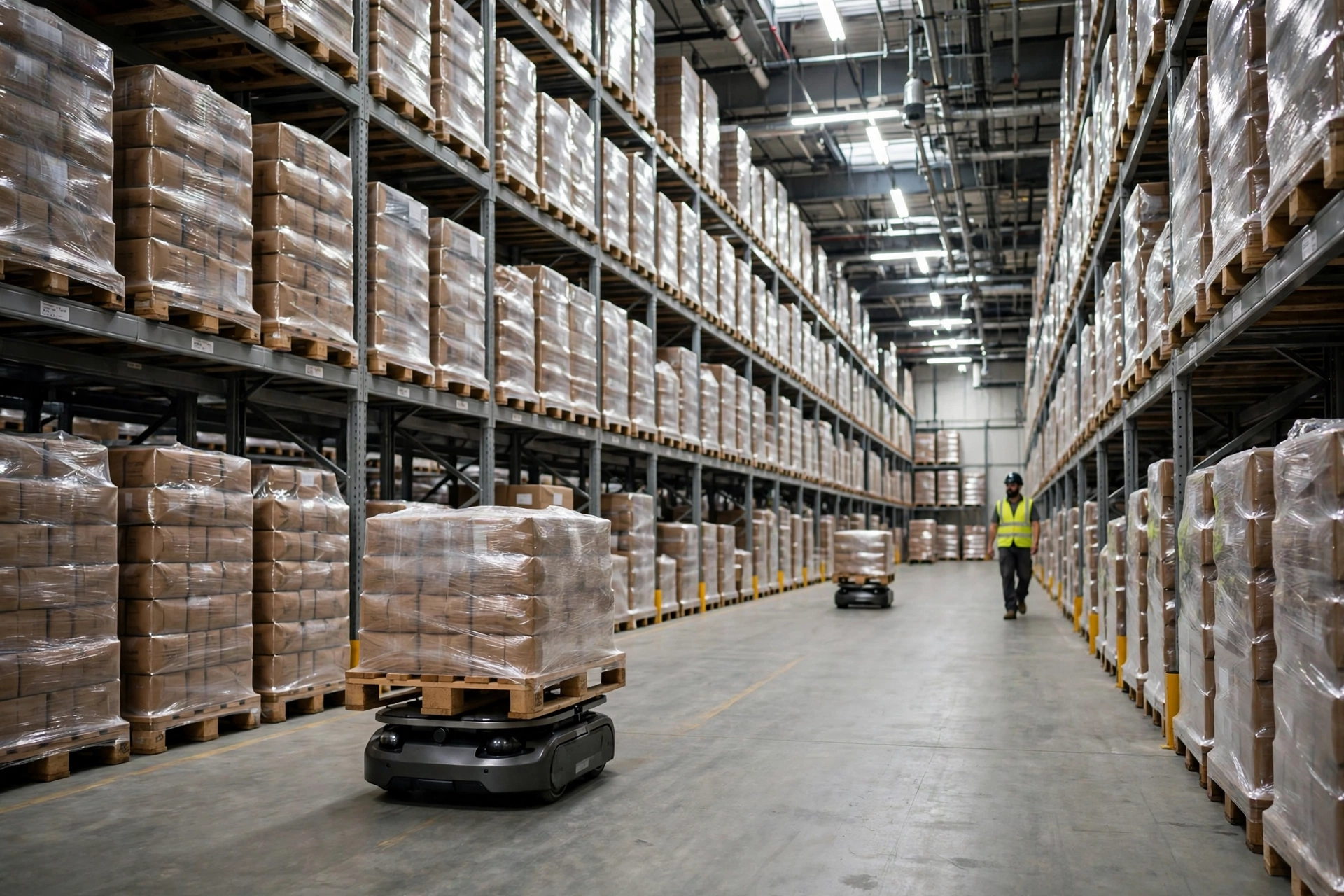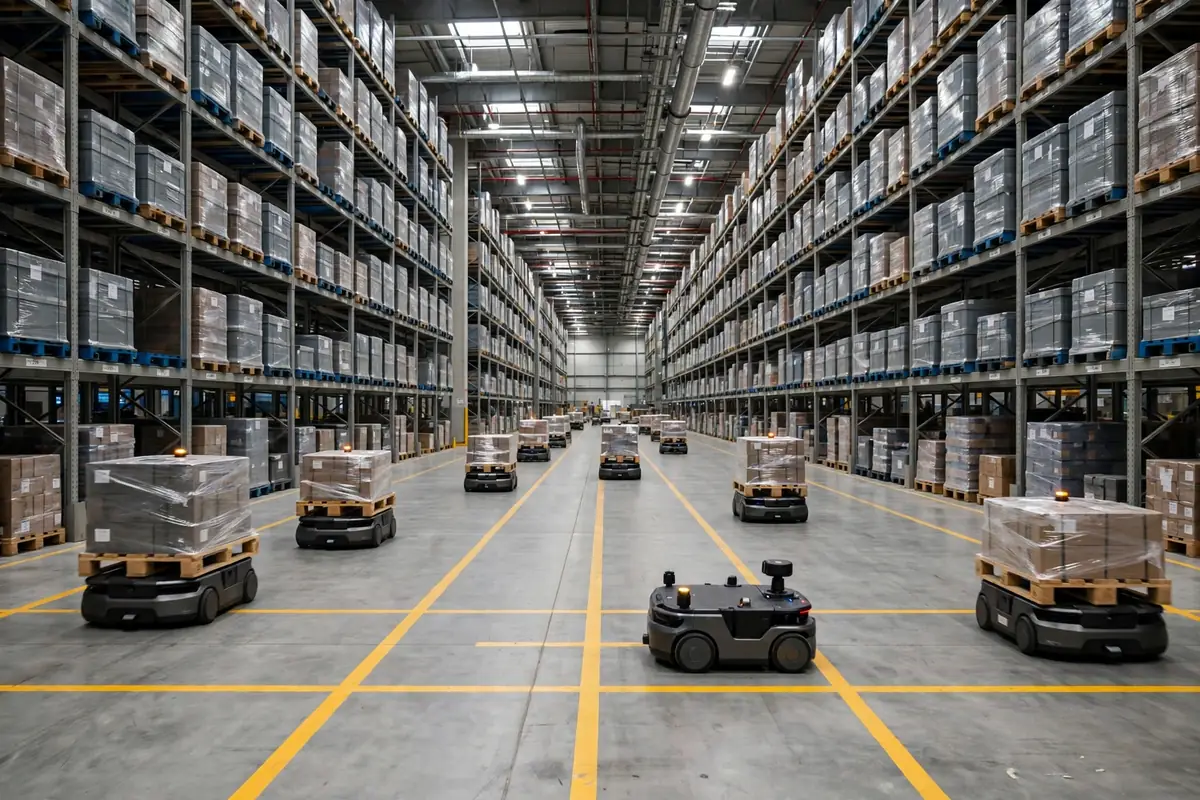
One AMR is a toy. A fleet of AMRs is a multi-agent system. That sounds harsh, but anyone who has done integration work knows it: one robot runs beautifully, and the moment you have ten or twenty on the same floor, every problem changes. Which robot takes which job, who yields in a narrow aisle, who waits at the charger, and what happens when one machine dies mid-shift — that is what multi-agent scheduling is about. Strip the algorithms down and there are three things: assign the work, manage the traffic, schedule the charging. Get those three right first.
The principle: what multi-agent scheduling really schedules?
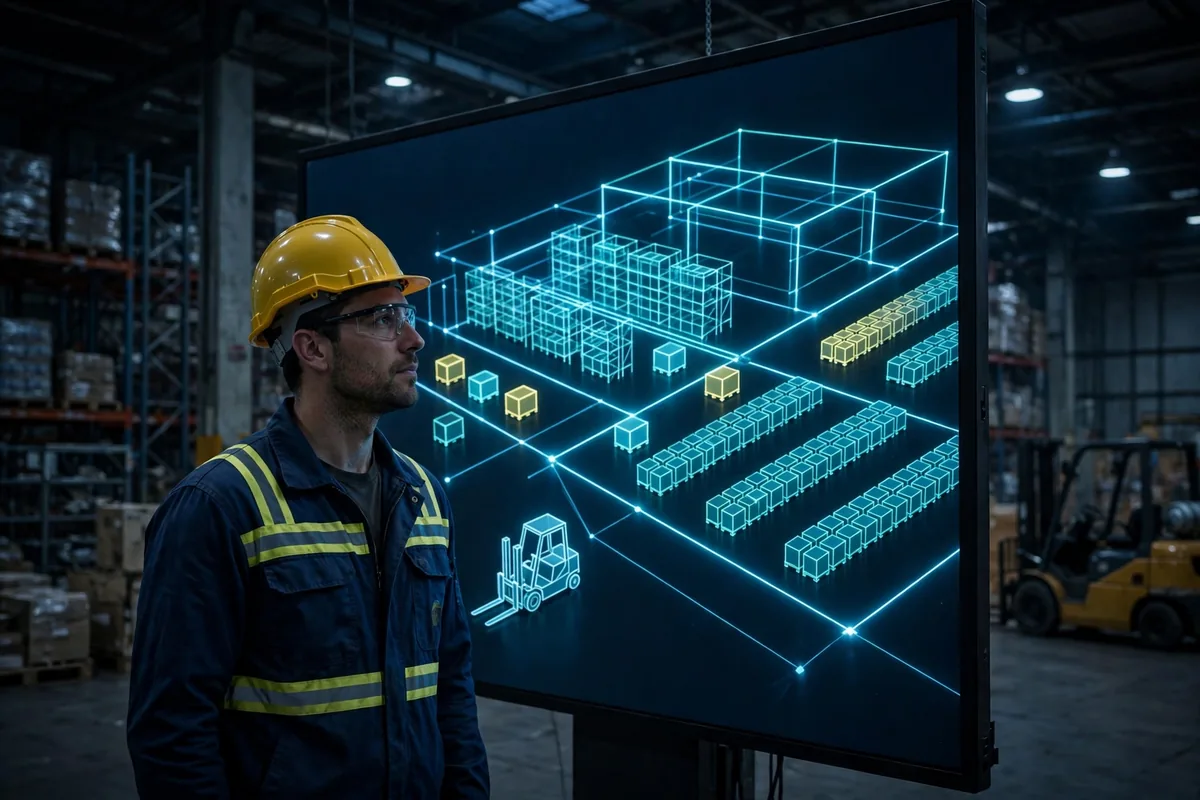
Multi-agent scheduling gives a group of brainless machines a brain — except that brain can be built two ways. One way is centralized: one control center sees the whole floor like an airport control tower, deciding where every robot goes, which route it takes, and when it charges. The other way is distributed negotiation: each robot carries a little brain, and at every intersection the robots signal each other and yield — a roundabout with no traffic lights.
Centralized control gives you global optimization: the tower sees every robot and computes the lowest-total-time plan. The price: if the tower goes down, everything stops, and more robots mean harder computing. Distributed control is tougher: one robot dropping out bothers nobody, and adding robots is easy. The price is local optimization — each robot only cares about the road ahead, so efficiency suffers and deadlocks show up more. Neither is absolutely better — it depends on your floor.
What is a deadlock? Four robots drive into a four-way intersection at once, each waiting for the one opposite to move first, and nobody moves until a technician walks in with a joystick. A single robot can never deadlock — the difficulty is not in the robot, it is in the relationships between robots.
A scheduling system manages four things. First, task assignment: the nearest robot, the fullest battery, or the one already heading that way? Assign it wrong and robots spend the day driving empty. Second, routing and traffic control: who yields in a narrow aisle, who goes first at an intersection, which lanes run one-way. Third, charging: do not let every robot get hungry at once when there are only two chargers. Fourth, degraded operation: one robot breaks down — who takes over, and how do the rest route around it?
Traffic control is the first wall: an intersection with no lights.
In June 2024, an electronics plant in Dongguan ran 12 AMRs across a compact floor: two main aisles, one crossroads. Single-robot tests were flawless. On the third day with all 12 running, the morning peak pushed four robots into the intersection at once, nose to nose. The LiDAR worked. The safety logic worked — and precisely because it worked, the robots sat still, waiting on each other for 40 minutes, until the shift lead walked in with a joystick and moved them out by hand. The lines lost material supply twice that morning.
The root cause was right-of-way: twelve robots sharing one signal-free intersection, coordinated only by each machine's own obstacle avoidance, handed traffic rules to drivers' good manners. The fix was not exotic: the intersection switched to time-slot reservations — whoever books the slot goes first; the main aisles became a one-way loop, clockwise only; loaded robots got priority over empty ones. Same intersection, same 12 robots, no deadlock since. Leave room for humans too — their routes are random while robot routes are planned, so slow down at blind corners and cap speed where people work.
Charging: do not let a multi-agent fleet get hungry at once
Charging is the most underestimated part of the problem. People size a fleet by transport volume and forget charging entirely. Then one afternoon at 3 p.m., every battery drops below 20% at once, a queue forms at two chargers, and the whole floor slows down.
A typical warehouse AMR runs at 1 to 2 meters per second — treat the spec-sheet top speed as a rumor, because a loaded robot turning a corner never reaches it. OMRON's MD-650 tops out at 2.2 m/s and the MD-900 at 1.8 m/s, with 8 hours of runtime and a 5%-to-95% charge in under 30 minutes; OTTO's 600 runs at up to 1.4 m/s, carries 600 kg, and charges 10% to 90% in 30 minutes; KNAPP's Open Shuttle runs at up to 1.5 m/s, carries 50 kg, runs 7 hours. Speed and runtime are a seesaw — the heavier the load, the slower the robot.
The charging rule: stagger. Send a robot to top up at 40%, not 20%. Size chargers so no more than a third of the fleet charges at once. Fill up before peak hours, rotate charging through the quiet hours, and use opportunity charging: a robot waiting at a workstation tops up from a nearby charge point. More chargers is not automatically better — two in the right spots beat four in the wrong ones.
The dividing line: centralized or distributed AMR fleet control?
| Dimension | Centralized scheduling | Distributed negotiation |
|---|---|---|
| Fits | Under 20 robots, or a simple layout | 20+ robots, or multi-zone, multi-vendor floors |
| Overall efficiency | High — the tower optimizes the total | Medium — each robot optimizes locally |
| Deadlock risk | Low — right-of-way is reserved ahead | Higher — relies on rules and yielding |
| Single point of failure | Tower down means everything stops; needs hot standby | One robot down affects nobody |
VDA 5050 is the cross-vendor interoperability standard from the German automotive and mechanical engineering associations, built on MQTT and JSON so robots from different brands can share one scheduling layer. Before you buy, ask: does it support VDA 5050? If not, mixing brands later is a painful project.
Fleet management guides put the scaling wall at around 20 to 40 robots on a contested floor with weak orchestration — every robot added makes traffic worse faster than it adds throughput. The bottleneck is never the robot — it is the scheduling.
Three sums to work out before a small warehouse adds robots
Sum one is the fleet-size dividing line. Under 300 transport jobs a day, 3 to 5 robots are enough; 300 to 800 jobs, 5 to 10; above 800, talk about 10 or more. Those figures are a worked example, calculated on one robot completing 15 jobs an hour across 8 effective working hours — rerun it with your own numbers. Count jobs first, then robots, never the other way around.
Sum two is single-robot utilization. Buying a robot is not the same as using it — check how much of each day it spends working. Below 50% utilization, you bought too many robots or assign jobs unevenly; above 85%, the fleet is stretched tight and peak season forces you to add robots or overtime. The scheduling software shows this number — check it weekly for the first month.
Sum three is the cost of the scheduling software. The robot price is easy to count; the software cost is easy to miss: is the license charged per robot or per site, does cross-vendor integration cost extra, and what share of the software price is annual maintenance? Some vendors sell cheap robots and charge an annual per-robot software fee — over five years, the software can cost more than the robots. Put all three sums on one sheet first.
Here is the counterintuitive part: more robots does not always mean faster. Past a certain point, every robot added makes the aisles more crowded, the intersections more congested, and the charging queue longer — and throughput goes down. If you want speed, fix the scheduling first. Adding robots is the last resort, not the first move.
The maintenance trap: go-live is where the real work starts.
The last trap is maintenance. An AMR is not a buy-it-and-forget-it machine. LiDAR lenses need regular cleaning, floor markers wear out, and when the map changes it has to be rescanned. Most common: the warehouse moves two rows of racking, nobody tells the scheduling system, and the robots keep driving the old map, emergency-stopping in front of the new racks every day. Layout changes, map gets rescanned — someone owns that process.
Ask under what floor conditions the spec-sheet mean time between failures was measured — if they cannot answer, do not take it seriously.
So is the money worth it? Look at one number: effective jobs per robot per hour. Strip out charging, waiting, empty runs, and traffic jams — how many real jobs does one robot finish in an hour? With good scheduling, that number climbs steadily; with bad scheduling, double the fleet and it does not move. Watch that number — it does not lie.
By Da Liu, Automation Engineer