Here is the conclusion up front: this warehouse aisle width design forklift guide has no standard answer, only a trade-off. The extra pallet positions from a narrower aisle are real, and so are the repair bills from forklifts hitting racking. Put plainly, every 30 centimeters you shave off an aisle saves rent and buys you repair costs, injury risk, and pickers walking extra distance every day. Most warehouses end up with aisles too narrow not because anyone did the math, but because the racking looked good on the drawing.
I Have Seen Too Many Warehouses Treat Aisle Width as a Number on a Racking Drawing
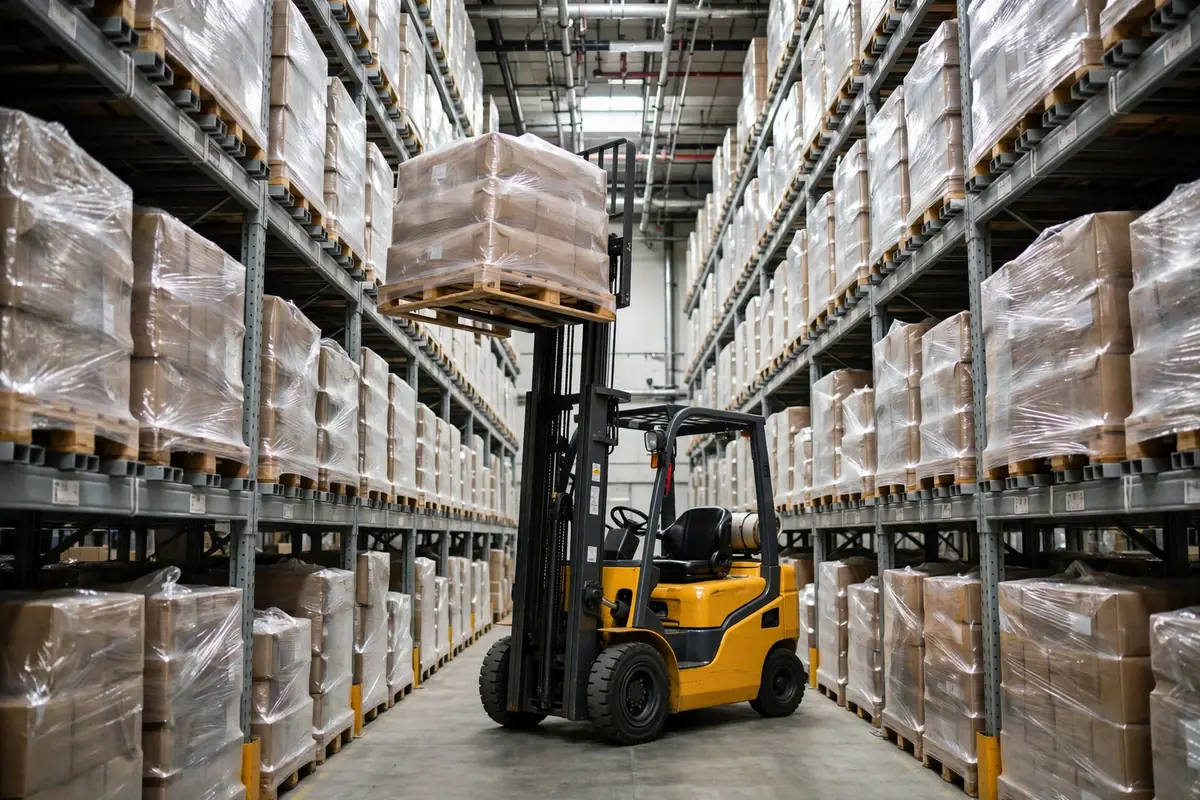
A few years ago I assessed a 3PL warehouse in Ontario, California: 80,000 square feet, six levels of selective racking, aisles drawn at 3 meters, and sit-down counterbalance forklifts doing the work. The owner told me the racking vendor drew the layout and the forklifts were bought later. Nobody had checked the two against each other. On the floor, drivers had to reverse twice to enter an aisle, pallets went in crooked half the time, and the rack protectors at the base of the uprights were replaced every three months. The worst of it was the high bays: a driver lifting a pallet to the fifth level in a 3-meter aisle, vision blocked by the load, had clipped and bent seven or eight beams. When I added it up with the owner, beam and protector replacement was running close to $20,000 a year, before counting downtime. He stared at the number and said he wished he had left another 30 centimeters.
There are two sides to this. The racking vendor did not lie to him: a 3-meter aisle works fine with a reach truck. The failure was that forklift selection and aisle width were decided by two different groups, and nobody checked the right-angle stacking aisle figure. That number is printed on every forklift spec sheet: the minimum clear width a truck needs to turn ninety degrees out of the aisle and place a pallet square into the rack. Add 15 to 30 centimeters of operating clearance on top of it, and that is the aisle width you can actually work in. Skip that step and every centimeter saved on paper gets paid back double on the floor.
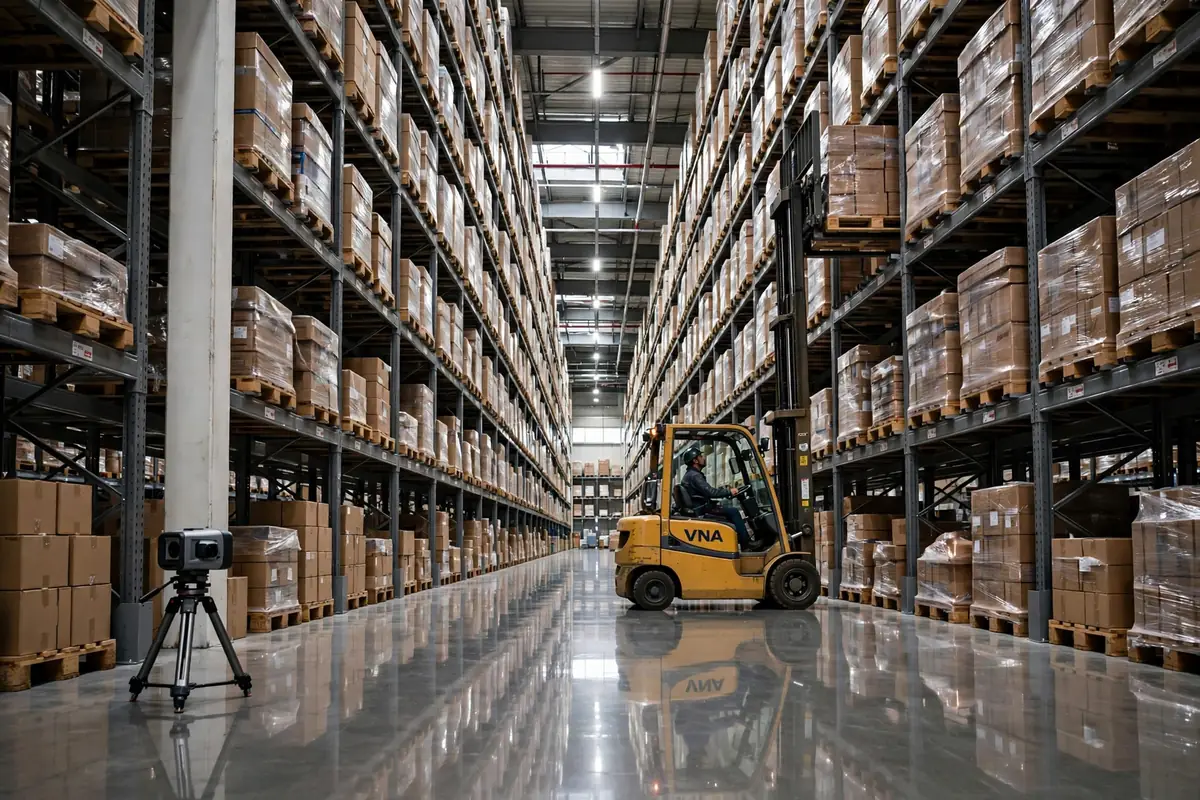
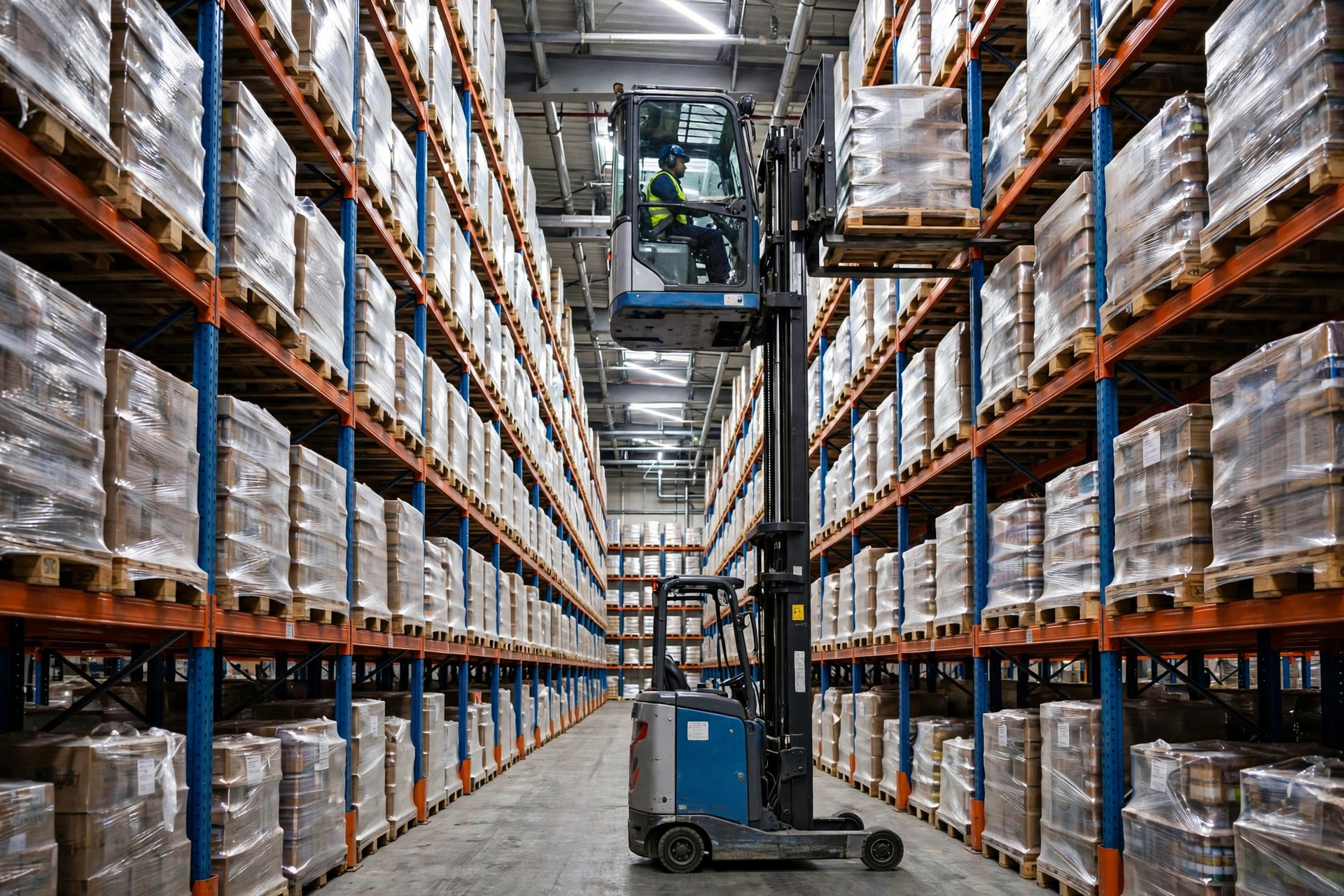
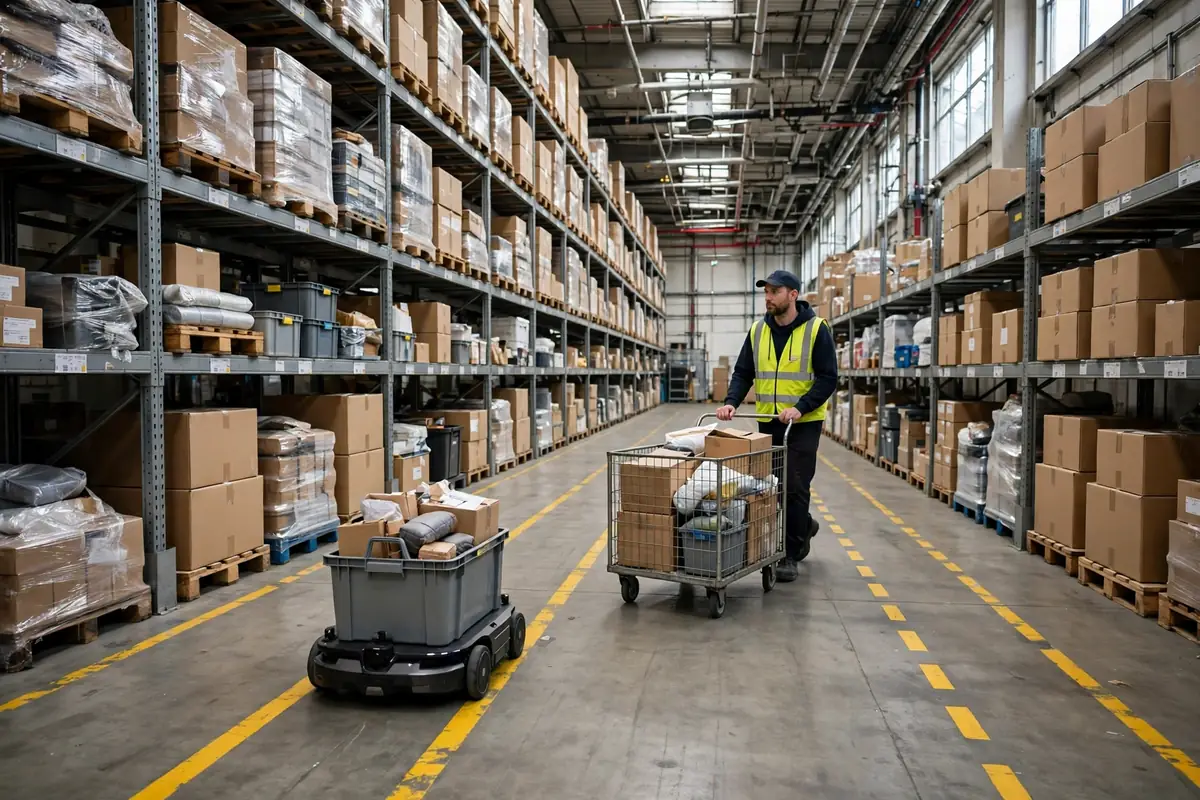
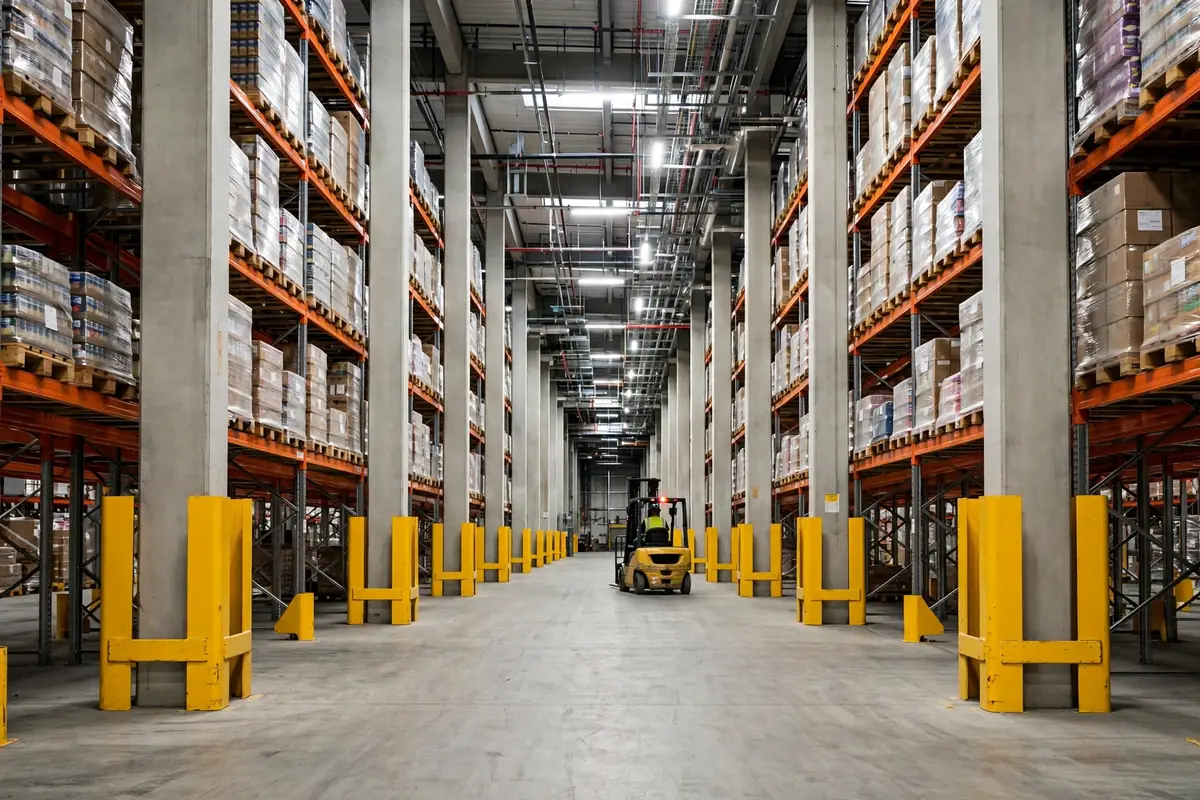
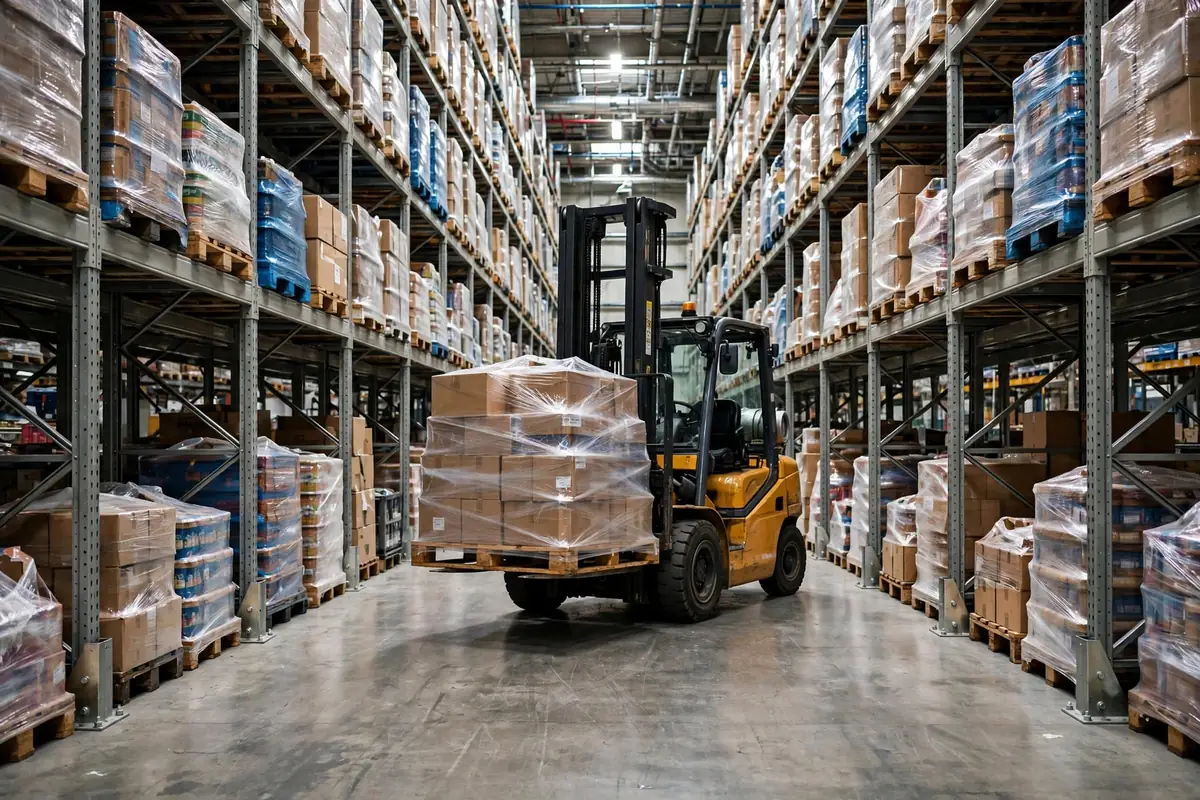
The typical industry ranges, by truck type, are worth knowing, though the exact figure must always come from the spec sheet of the specific model: a four-wheel sit-down counterbalance truck needs a working aisle of roughly 3.6 to 4.3 meters; a three-wheel electric counterbalance, about 3 to 3.4 meters; a reach truck, about 2.7 to 3.1 meters; a very narrow aisle turret truck, about 1.6 to 1.9 meters. OSHA guidance says aisles should be at least three feet wider than the largest equipment used in the facility. The numbers are not hard to find. The hard part is getting someone to pick the truck before drawing the racks.
What Does Narrowing an Aisle by 30 Centimeters Actually Earn? A Worked Example
Talk is cheap, so let me do the math. The example below is a hypothetical worked example: the figures are illustrative, built around a common small-warehouse footprint to show the method, not a real facility's accounts.
Assume a warehouse with about 10,000 square feet of usable space and 10 racking aisles, each about 30 meters long. Narrow the aisles from 3.6 meters to 3.3 meters and each aisle gives back 0.3 meters; across 10 aisles that is 90 square meters, enough for roughly two extra rack runs. At about 40 pallet positions per run, that is roughly 80 extra positions. If pallet positions in this market rent for around $8 each per month, the extra income is about $7,680 a year. Looks good, right?
Now look at the other side. With narrower aisles, the same drivers doing the same volume will hit racking more often. Assume 12 extra impacts a year at an average of $800 each in repairs and downtime: that is $9,600 a year, which already eats the extra rent, before injury risk and insurance increases. The hidden cost is speed: narrower aisles force an extra reverse on every putaway, and at 200 putaways a day, 10 extra seconds each is more than half an hour a day, roughly a full worker's time over a month. These are illustrative figures, but the direction is real: the benefit of a narrower aisle grows in a straight line while the cost grows on a curve, steeper the narrower you go.
So I work backwards: pick the truck first, set the aisle from its right-angle stacking figure plus 15 to 30 centimeters of clearance, and only then draw the racking. People call that wasting space. I call the space on the drawing wasted; what it saves is repair bills and injury reports.
Three Warehouse Aisle Width Options and What Each Costs You
| Option | Aisle width | Truck | Cost | Benefit | | Wide aisle | 3.6 to 4.3 m | Counterbalance forklift | Fewest pallet positions | Any truck can work it, drives straight to the dock to load a trailer, maximum flexibility | | Narrow aisle | 2.7 to 3.1 m | Reach truck | Pricier truck, cannot work outdoors, demands a flat floor | About 20%–30% more pallet positions than wide aisle | | Very narrow aisle | 1.6 to 1.9 m | Turret truck | Most expensive truck, needs rail or magnetic guidance, changing truck type means rebuilding | About 50% more pallet positions than wide aisle |
The row most people skip in that table is the flexibility cost. A 12-foot wide aisle with a counterbalance truck does everything: putaway, loading, yard work, one truck. A 6-foot very narrow aisle is impressively dense, but that turret truck never leaves its aisle, and loading a trailer needs a second truck, a second driver, and a second set of spares. Warehouses that narrow their aisles usually count the pallet positions and forget the extra truck, the extra driver, and the extra parts inventory.
Here is the counterintuitive part: the warehouse with the narrowest aisles is often not the most efficient warehouse. Very narrow aisles save floor space but cost time on every single pallet move: the turret truck rotates its forks, lifts, and aligns at every stop, each step slower than a counterbalance truck. As a rule of thumb, if your warehouse moves fewer than about 200 pallets a day in and out, density should win; above roughly 800 pallets a day, forklifts queuing in the aisles can cost more than the extra positions are worth. These are illustrative thresholds, not industry benchmarks, but the point stands: there is no free lunch between density and speed. Which side you choose depends on your order profile, not on a racking vendor's brochure.
Before You Change Anything, Measure These Four Things
If you are going to change aisle widths, do not start by tearing out racking. A warehouse aisle width design forklift decision that skips measurement is a guess, not a design. Measure four things first. One, the spec sheets of the trucks you actually own: right-angle stacking aisle, overall length, fork length. Using a brochure's family average to set an aisle is digging your own hole. Two, floor flatness: reach trucks and turret trucks demand flat floors, and a rough floor in a narrow aisle turns every trip into a shudder test. Three, fire and sprinkler requirements: aisle widths must satisfy fire egress and sprinkler design, and those are not negotiable with a tape measure. Check with the local fire authority and your insurer before changing anything. Four, your real collision history: pull last year's rack repair orders and sort them by aisle. The aisle with the most damage is usually the one that needs widening, not narrowing.
One last piece of advice, and the whole point of this warehouse aisle width design forklift guide: aisle width is not a design problem, it is a business problem. Drawing two extra rack runs on paper takes a pencil. One tired driver on a night shift hitting a beam takes a second. If you are not sure, set the aisle from the truck's spec sheet plus 30 centimeters and keep it. The rent you give up is an insurance premium, and when the day comes to claim on it, you will be glad you paid.
By Lao Mi, Supply Chain Veteran (20 yrs)