Warehouse floor load capacity is one of those numbers people get wrong in exactly the same way: they only look at total weight. Three hundred tonnes of stock on a floor rated for five hundred, so it must be fine. That is like judging a bridge by how many cars it can hold while ignoring the one overweight truck sitting right on an expansion joint. Floors rarely fail because the total weight is too much. They fail because one rack leg, or one forklift wheel, concentrates the force onto an area the size of your palm.
Take a published worked example from an engineering consultancy. One rack bay holds 24 pallets at 2,000 lb each, plus 2,000 lb of rack self-weight, for a total of 50,000 lb. Eight legs share the load, so each leg carries a reaction of 6,250 lb. The base plate is 6 inches square, a contact area of just 0.25 square feet, which puts the bearing pressure under the plate at 25,000 pounds per square foot. The floor itself was rated for a uniformly distributed load of 500 psf. And the second calculation is worse: the bay covers 80 square feet, so 50,000 lb divided by 80 is 625 psf on average — already over the distributed-load rating before you even get to the point load. That is how floors usually die: the headline number looks fine while the detailed numbers fail everywhere.
Warehouse Floor Load Capacity: Distributed Load and Point Load Are Two Different Books
Start with the principle. Warehouse floor load capacity comes in two forms, and mixing them up guarantees a mistake. A uniformly distributed load is weight spread evenly — pallets laid flat, cartons stacked in neat rows. A point load is weight concentrated in one spot — a rack leg, a forklift wheel, a machine foot. You can think of it this way: a distributed load is snow on a roof, a point load is a person in stiletto heels standing on the same floor. The roof handles the snow; the heel leaves a dent.
The units need aligning first. Warehouse listings often quote tonnes per square metre, and one tonne per square metre is about 9.8 kN/m². In practice, warehouse floors are commonly listed at 1.5, 3, or 5 t/m². The 1.5 t/m² band is fine for light goods and a sortation area, but before you add rack levels you have to ask one question: is that number a distributed load, or does it already account for point loads? Many leases quote a single number without saying which one it is. Checking a rack leg against a distributed-load rating is like checking blood pressure with a thermometer. Wrong instrument entirely.
So my rule is simple: floor capacity only counts in three documents — the original structural drawings, the as-built test report, and the rack supplier's leg-reaction table. Missing any one of the three, and adding rack levels is off the table until it is fixed. "This floor is solid" from a landlord and "the last tenant stored heavier stuff" do not count. Go by the design institute's and the manufacturer's parameters, and when in doubt, get a structural engineer to measure. Never guess.
Rack Legs and Forklift Wheels Are the Real Examiners
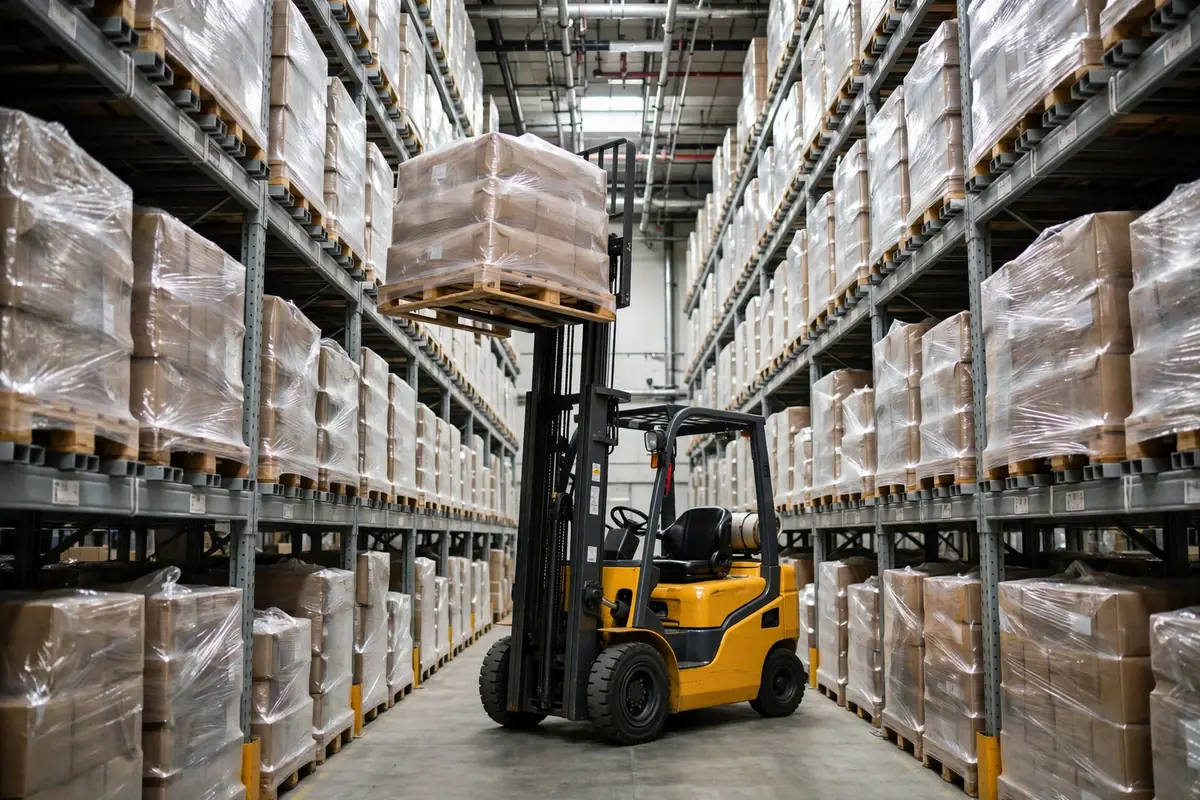
We did the rack-leg math above. Now look at the forklift, where the numbers are even more telling. A Toyota 2.5-tonne counterbalance truck weighs 3,600 kg on its own. Loaded, its front axle carries 5,300 kg and the rear just 800 kg. A Linde truck of the same capacity weighs 4,061 kg, with a loaded front axle of 5,818 kg. See the point? The truck weighs more than the load it is rated to lift, and when loaded, more than 80% of the weight sits on the two front wheels. What a floor fears is not how heavy a load the forklift carries — it is the truck itself, driving the same wheel track day after day.
Here is the counterintuitive part: most people blame rack weight for floor wear, but forklift aisles usually deteriorate faster. A rack leg is a static load — it sits there. A forklift wheel is a moving load with impact: steering, braking, and crossing a saw-cut joint all add a jolt. Run the same aisle for three years and the wheel tracks start dusting and cracking while the rack area still looks fine. That is why I look at the forklift aisle floor first when I walk a warehouse, and the rack area second. If the aisle surface is already spalling, sort out the aisle before talking about taller racks.
This is the comparison table I use with clients. The figures are an illustrative example, to show how the cost of each fix differs:
| Fix | Upfront cost | What it improves | What it does not fix |
|---|---|---|---|
| Larger base plates | Low | Point-load pressure roughly halves | Nothing for forklift wheels |
| Local thickening or steel plates | Medium | Helps legs and aisles both | Plate edges can lift and curl |
| Limiting forklift loads and rack levels | Zero | Costs nothing, earns less | Peak season hits the limit first |
The selection line is really just one formula: take the worst leg reaction, divide it by the base-plate area, and compare the result with the allowable value from your structural engineer. If it is over, you either enlarge the plate, drop a level, or upgrade the floor. There is no fourth option. I have seen operators bet on "the floor looks thick enough" and end up with radial cracks spreading from a rack leg — the repair bill ran about three times what the thickening would have cost.
Warehouse Floor Load Capacity: Three Lines That Decide Whether the Floor Can Take More Load
The first line is the drawing line. With structural drawings and a test report, the distributed load, concrete strength, and slab thickness are written down in black and white. Without them, you have nothing — and no warehouse floor load capacity claim is worth anything without them. The second line is the leg line. The rack supplier must give the maximum leg reaction at full load; divide it by the plate area and compare it against the floor's allowable point load. The third line is the joint line. Saw-cut joints and construction joints are the weak spots — keep rack legs and forklift wheels off them where you can, and discount the allowable value for any leg that has to sit on one.
Here is a real calculation to show how cheap the fix can be. A 6,250 lb leg reaction on a 6-inch plate gives about 25,000 psf under the plate. Swap the plate for a 9-inch one and the contact area grows from 0.25 to 0.56 square feet, cutting the pressure to around 11,000 psf. One steel plate, a few dozen dollars, and you have doubled your margin on the point-load calculation. The fake requirements cluster here: operators happy to spend big money raising racks two levels, but unwilling to spend small money on a floor survey. Put the survey fee next to the repair fee and the choice is obvious. The other fake requirement is the oversized slab: thickening from 150 mm to 250 mm adds a large chunk of cost when your leg reactions never came close to needing it.
Nine Times Out of Ten, the Problem Is Joints and Curing
A floor is not a pour-and-forget asset. When the sealant in an expansion joint ages and falls out, every forklift wheel crossing it delivers a small impact. The joint edge chips, water collects, freezes, and expands, and within a year a joint can rot into a trench. Then there is curing: a new slab loaded before it has had its full curing time never develops its surface strength, and the wheels grind a layer off it. Dusting becomes an annual event. And do not underestimate oil — hydraulic fluid and engine oil seeping into concrete slowly powder the surface layer.
Repairs have their own trap. The worst thing you can do with a cracked floor is smear ordinary cement mortar over it. The patch has different strength and shrinkage from the original slab, so it cracks again within three months, longer than before. Match the patch to the original strength grade, cut or inject the crack properly, and cure the repair. None of this is expensive.
Whether the money is worth it comes down to one number: your heaviest rack leg, fully loaded, divided by its base-plate area. If that number is under what the structural engineer allows, taller racks, higher levels, and heavier stock are all on the table. If it is over, no rack is worth stacking. A floor never negotiates. One day it simply hands you the bill in the form of a crack.
By Da Liu, Automation Engineer