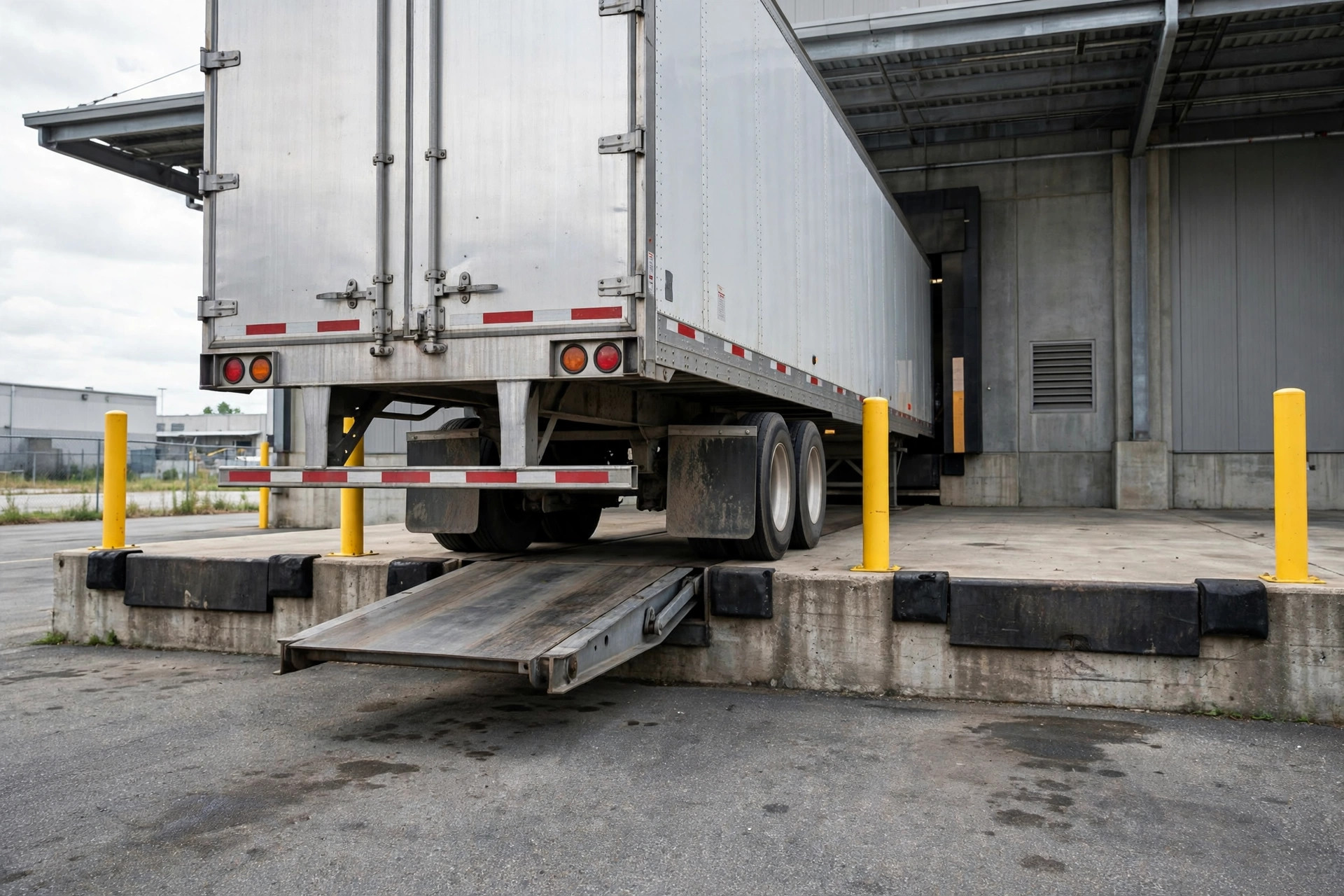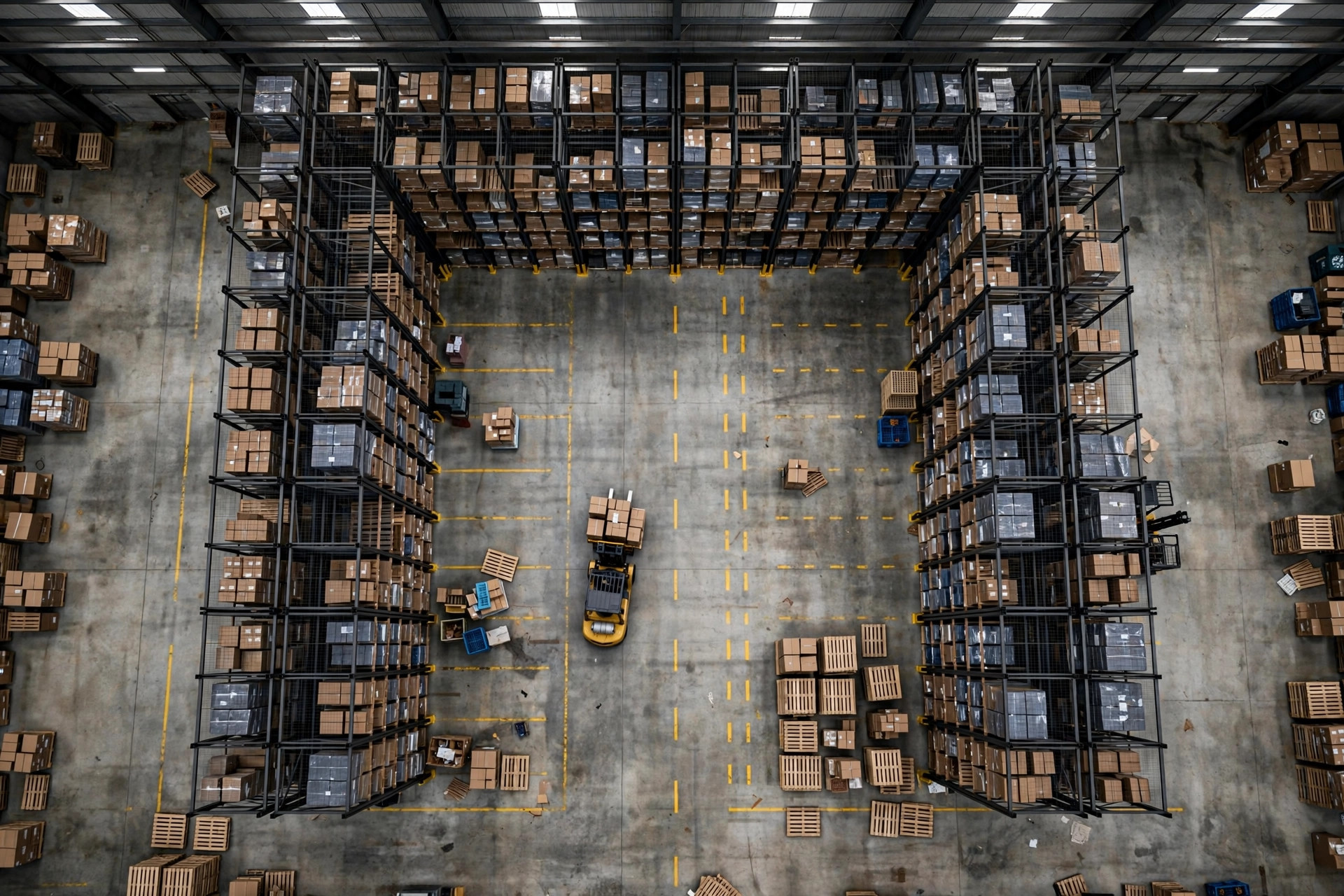
In the u shaped vs i shaped warehouse layout debate, most operators argue about dock doors and building shape. I argue about dollars. Last fall, the ops director of an Ohio 3PL called me in because labor costs were "a little out of control." His 80,000-square-foot building ran an I-shaped flow: receiving on the east end, shipping on the west. Ten minutes at his whiteboard and I had the number: at their throughput, that layout burns roughly $45,000 more in labor every year than a U-shaped one would. The money isn't going to overtime. It's going to walking. That's money spent for nothing.
Ground rules before the math. Every figure below comes from a stated-assumption model, because I don't invent industry data: an 80,000 sq ft single-story warehouse (400 by 200 feet), 400 pallet moves a day inbound plus outbound, a fully loaded labor rate of $22 an hour, 300 working days a year, and a blended travel speed of 3 mph. The numbers are assumptions. The method is real. Plug in your own figures and the conclusion still holds.
The three flows in one line each: U-shaped puts receiving and shipping on the same side, so product travels a big U through the building. I-shaped puts inbound at one end and outbound at the other, so product walks straight through. L-shaped puts them on adjacent sides, so product turns a corner. Different flow, different travel distance. Travel distance is labor hours, and labor hours are money.
U Shaped vs I Shaped Warehouse Layout: Running the Numbers
Assume average travel per pallet, inbound to outbound: about 300 feet in a U-shaped building, 500 in an I-shaped one, 380 in an L-shaped one. These are my assumptions for illustration, not published benchmarks.
At 400 pallet moves a day:
- U-shaped: 400 x 300 = 120,000 feet, about 22.7 miles of travel a day.
- I-shaped: 400 x 500 = 200,000 feet, about 37.9 miles. That is 15.2 extra miles every day versus U-shaped.
- At 3 mph, 15.2 miles is 5.1 extra labor hours a day. Over 300 days that is 1,520 hours. At $22 an hour: roughly $33,000 a year.
Read that again: the I-shaped building costs an extra $33,000 a year in this model, and nobody stole anything. The building just makes people walk.
The U-Shaped Case: Same-Side Receiving and Shipping
The U-shaped layout wins on one thing: nobody deadheads across the building. Forklifts and pickers work the same side for both inbound and outbound, so labor and equipment get reused instead of duplicated. The price you pay is dock congestion on that one side — receiving and shipping peaks fight for the same doors. If your operation is labor-heavy with fast-moving SKUs, that trade is worth it. The dock problem is a scheduling problem. The walking problem is a payroll problem, every single day.
The I-Shaped Illusion: Cheap Rent, Expensive Operation
Here is the counterintuitive part: I-shaped buildings often have the cheapest rent in the Midwest. Long, narrow, doors on both ends — there is a glut of older industrial buildings in exactly this shape, and landlords price them to move. But the rent you save routinely gets eaten by labor, with interest.
An auto-parts e-commerce seller outside Indianapolis signed an I-shaped building in 2024 because the rent was $0.60 per square foot per year cheaper — $48,000 a year saved on 80,000 square feet. Their volume ran about 600 pallet moves a day. My math: 600 moves x 200 extra feet = 120,000 extra feet a day, about 22.7 extra miles; divided by 3 mph that is 7.6 extra labor hours a day; times 300 days is 2,273 hours; times $23 an hour is roughly $52,000 a year in extra labor. They saved $48,000 in rent and spent $52,000 in labor — net negative $4,000 a year, plus the headache of managing two ends of a building. That's money spent for nothing.
The L-Shaped Middle: A Compromise Nobody Models
L-shaped flow lands between the two: about 380 feet per pallet in my model. Adjacent-side doors suit sites where the footprint won't allow a clean U. The weak point is the corner — congestion builds there, and staging areas never sit quite right. The math: (380 - 300) x 400 moves = 32,000 extra feet a day, about 6.1 miles; divided by 3 mph is 2 extra labor hours a day; times 300 days is 606 hours; times $22 is roughly $13,000 a year more than U-shaped. Better than I-shaped, but the savings are thinner than most people guess.
| Layout | Travel per pallet (assumed) | Extra travel vs U-shaped / day | Extra labor cost / year (assumed) | Fits when |
|---|---|---|---|---|
| U-shaped | 300 ft | baseline | baseline | High throughput, labor is the big cost |
| L-shaped | 380 ft | ~6.1 miles | ~$13,000 | Constrained site, medium throughput |
| I-shaped | 500 ft | ~15.2 miles | ~$33,000 | Straight-through flow, dock access at both ends |
Table based on the stated-assumption model: 400 pallet moves/day, $22/hour, 300 days/year.
Three Levers That Actually Save Money
Stuck with your layout? Three places still give up cash.
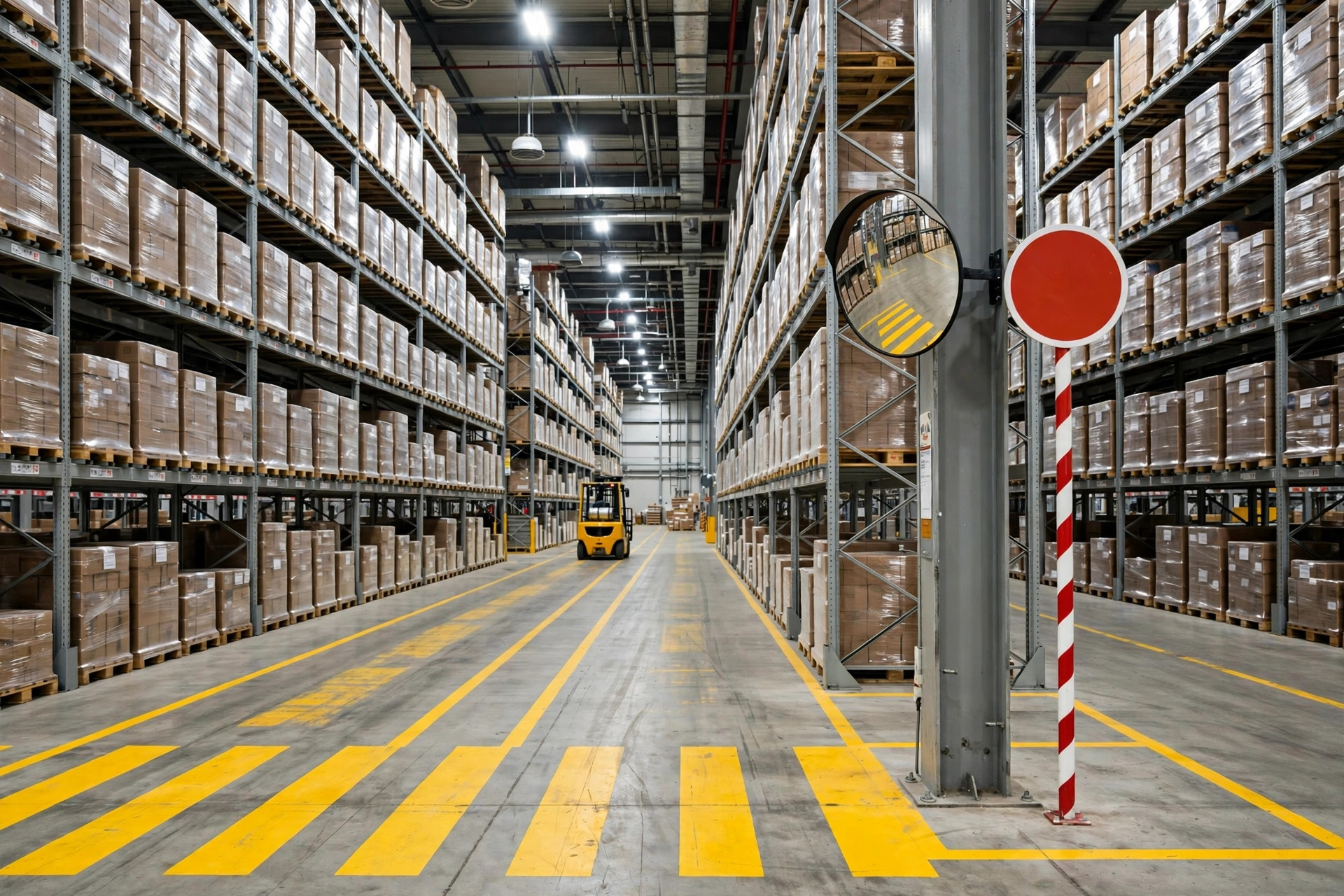
First, aisle width. A standard counterbalance forklift needs 12-13 foot aisles; a reach truck gets by on 8-10; very narrow aisle (VNA) equipment runs 5-7. Narrowing one 400-foot aisle from 12 feet to 9 frees 1,200 square feet. Do it across six aisles and you recover 7,200 square feet — about 9% of an 80,000-square-foot building. One guardrail: keep pedestrian walkways at 4 feet or more, per OSHA guidance. Don't save on aisles by spending on injuries.
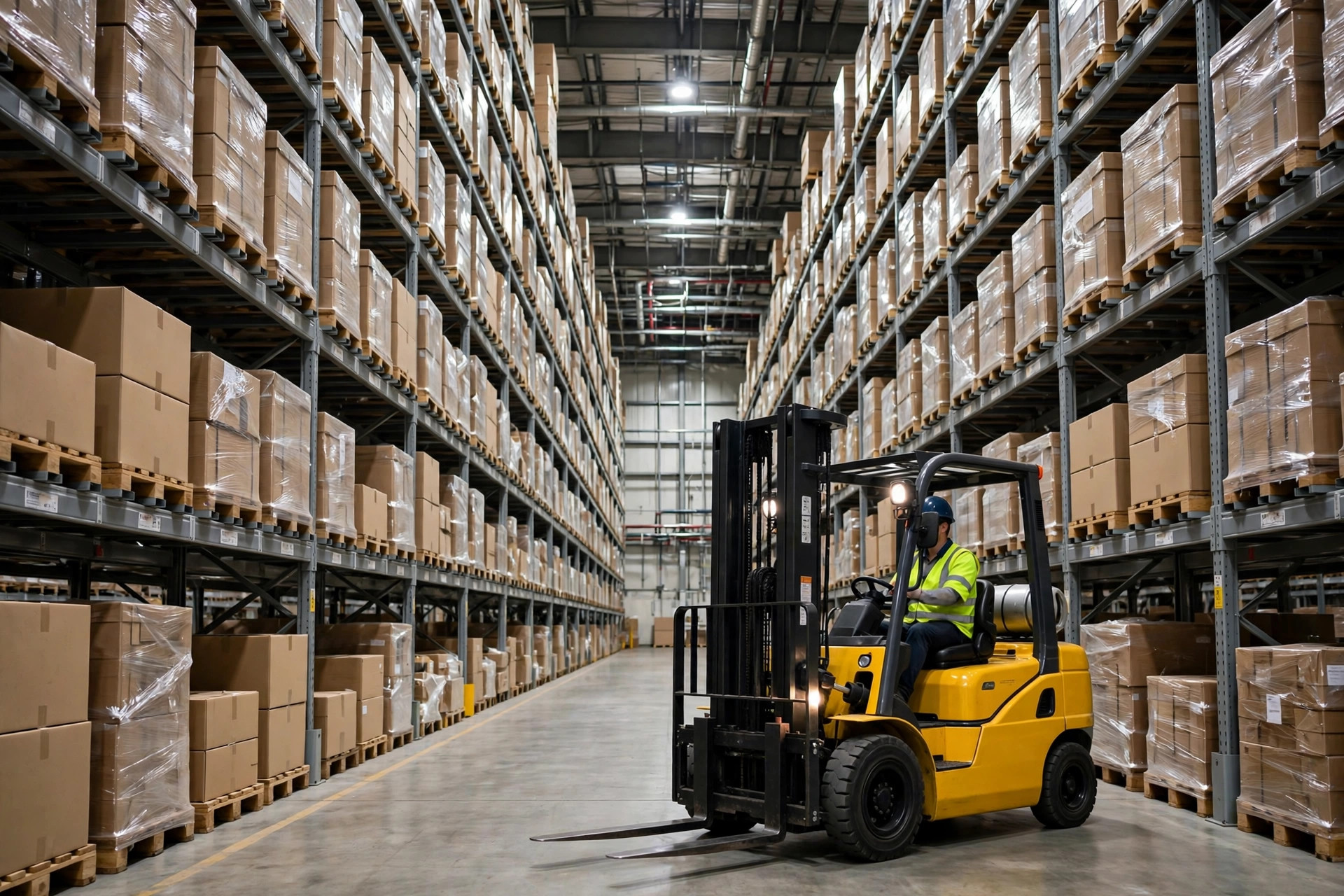
Second, put staging in the middle. An I-shaped building's biggest waste is product traveling empty between the two ends. Breaking the staging area into a few mid-building points cuts dozens of feet per pallet trip — thousands of dollars a year.
Third, reuse equipment across receiving and shipping. In a same-side U-shaped layout, one forklift does inbound in the morning and outbound in the afternoon. In an I-shaped building you station a set at each end, and idle time is baked in. Equipment costs money too.
Decision Framework: Which Layout, When
| Your situation | Pick | Why |
|---|---|---|
| 300+ pallet moves a day, labor dominates cost | U-shaped | Shortest travel, biggest labor savings |
| Lease under 3 years, modest throughput | Cheapest rent available | Short-term labor delta won't cover a move |
| Long narrow site with dock access both ends | I-shaped | Accept reality, but stage in the middle to offset |
| Irregular footprint, lots of corners | L-shaped | Don't fight the building; use corners as buffer zones |
The Formula You Can Take Home
The u shaped vs i shaped warehouse layout question ends as arithmetic. Here is the formula:
Annual labor delta ($) = daily pallet moves x extra feet per pallet / 15,840 x hourly rate x working days per year
(15,840 is feet per hour at 3 mph: 3 x 5,280.)
Plug in your own numbers. At 500 moves a day, $24 an hour, 300 days: 500 x 200 / 15,840 x 24 x 300 comes out to about $45,000 a year for I-shaped over U-shaped. Compare that against your rent delta. Whichever is bigger wins. After that, nobody gets to say "I-shaped feels cheaper" in a meeting again.
By Lao Zhou, Logistics Cost Analyst