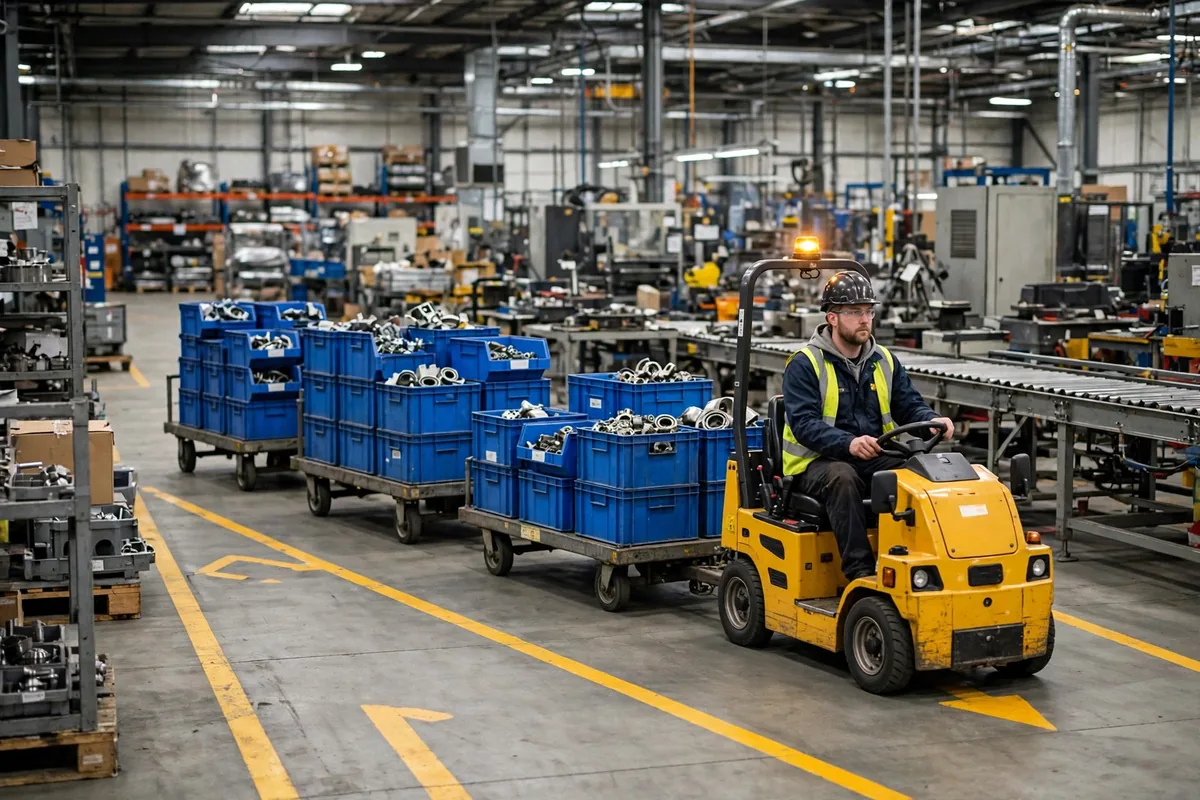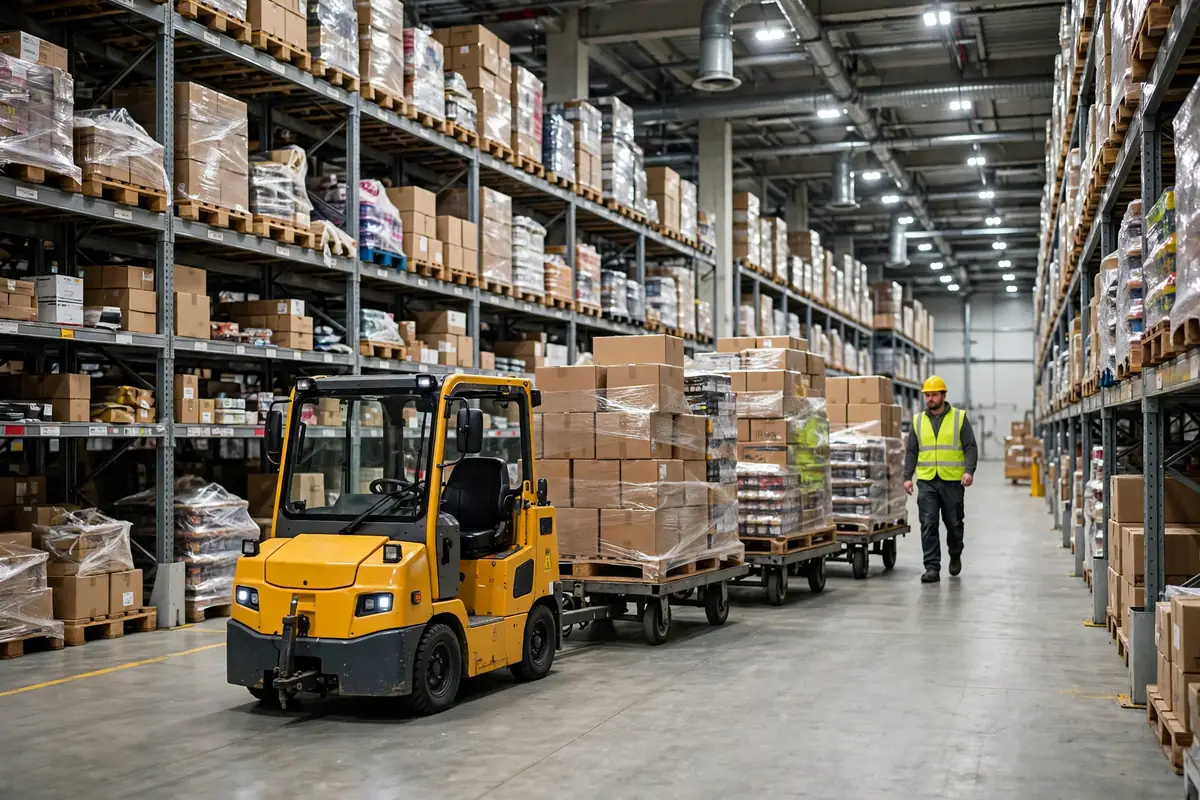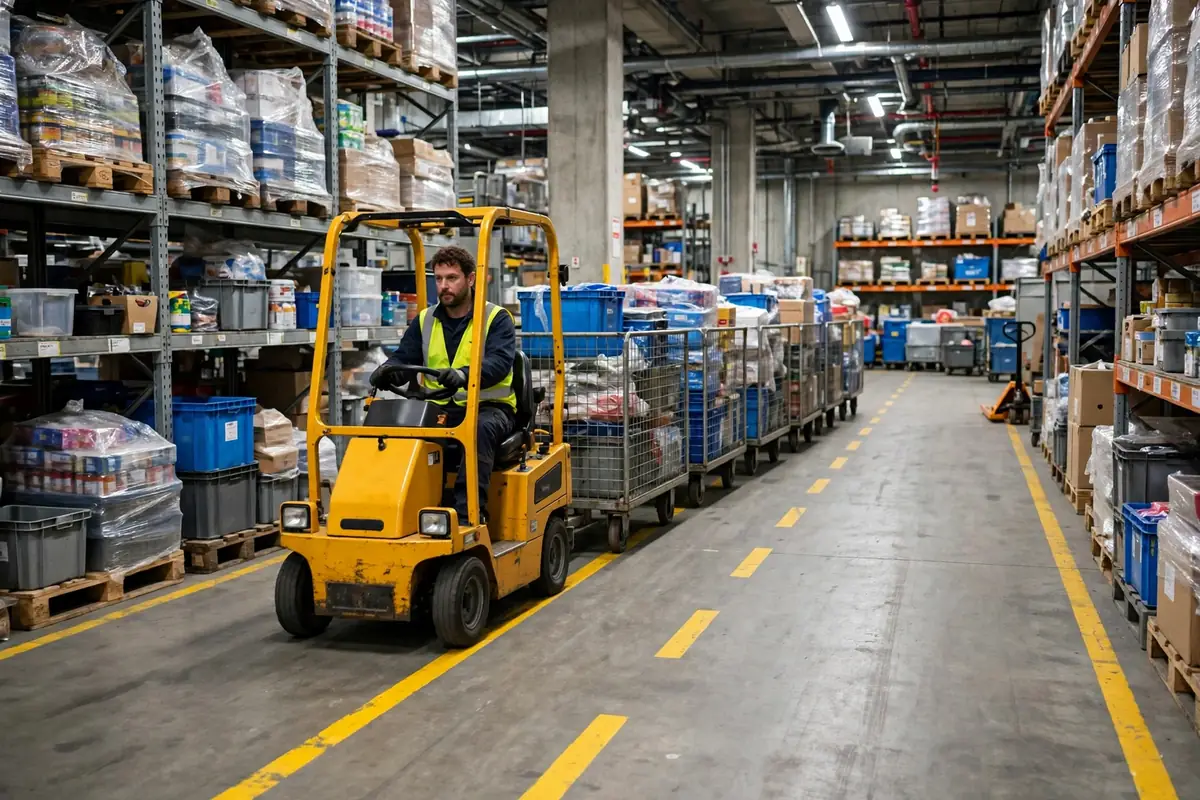
6:40 in the morning. Day shift has barely clocked in and I can already hear shouting at the end of aisle three. One of our tugger train units, pulling four carts, is trying to enter the aisle to drop empty totes. A forklift is trying to come out with a pallet. Neither driver wants to back up. Honestly, I have seen this scene too many times. The train had been in the building for months and the boss asked me why headcount had not dropped. My answer was simple: the vehicle was fine. We had never planned a route or a timetable. Without those, a train is just a long thing wandering the warehouse.
What fixed it was treating the route like a bus line. Fixed stops, fixed direction, fixed departure times. Anyone on the team can run it by the sheet. For the broader picture of what these trains move and where they fit, see the overview on tugger train warehouse material transport. This piece is only about routes and schedules — the part that actually saves the labor.
tugger train warehouse route planning starts with a loop
The rookie mistake is point-to-point running. A station calls for material, so the train runs from staging to that station, then improvises the next trip. Within two days the pattern collapses: the train runs east, then west, deadheads half the time, and keeps meeting forklifts head-on.
We switched to a milk-run. One loop, a string of stops, out loaded and back collecting. Three steps got us there.
First, count the stops honestly. Mark every point with steady daily demand for delivery or pickup: receiving staging, pick-zone entrances, the pack area's empty-tote collection point, the waste point, outbound consolidation. If a point only needs service once in a while, it does not earn a fixed stop. It stays on call.
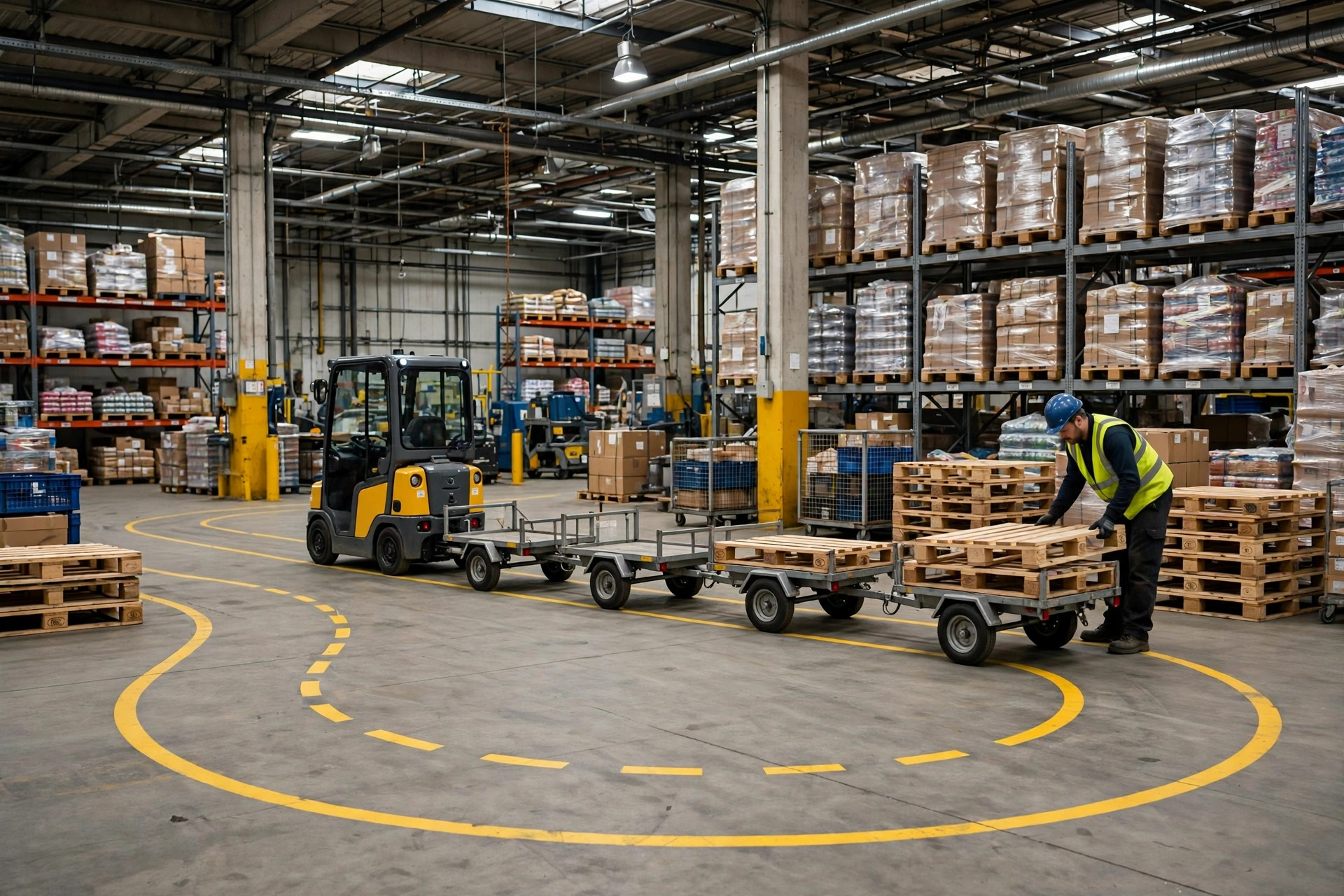
Second, draw a one-way loop. The train never reverses across the main travel path and never runs the loop backwards. We tested the turning sweep with our longest cart consist before painting anything — if the longest train cannot make the turn cleanly, the route changes, not the driver's luck. Our main loop follows the perimeter wall, with short spurs into aisles that exit in the direction of travel.
Third, sequence the stops. Heavy deliveries come off first, so the train gets lighter as the loop progresses. Urgent stations sit early in the loop; collections of empties, returns, and waste ride the second half. By the time the train comes home, the outbound goods are delivered and the carts carry what the floor needed removed. An empty return leg should be rare enough to notice.
One more detail that mattered: put your most predictable stations in the first half of the loop and the volatile ones in the second half. The first half runs to the clock. The second half gives the driver room to absorb a messy station without wrecking the whole round.
The timetable: one sheet runs the day
A route is a skeleton. The timetable is the muscle. We split the day into three bands with very different departure densities. The intervals below are our floor's working pattern — treat them as a template, not a universal number, and tune them to your own volumes.
| Period | Departure pattern | Main job | Notes |
|---|---|---|---|
| Morning peak, roughly the first two hours | Shortest headway, extra rounds | Deliver first production material, clear night-shift collections | Pre-stage one round so the train is at stop one before shift start |
| Midday steady state | Longer headway, fixed clock departures | Replenish stops, collect empties | Driver tidies each stop's racks before leaving |
| Evening peak before outbound waves | Short headway again | Push packing supplies, pull finished goods to consolidation | Departures offset from wave release times |
The most important words on that sheet are "fixed clock departures." Before this, drivers left "when loaded." Stations never knew when the train would come, so material sat waiting or a station ran dry minutes after the train passed. Now departure times are posted at every stop. Station staff stage against the clock, dwell time at each stop actually shrank, and the whole loop got calmer. Being predictable beats being fast, every single shift.
The second trick is offsetting from picking waves. Wave releases flood the aisles with forklifts. We deliberately slot train departures into the gaps between waves rather than against them. We tried running head-on into wave traffic. That is how you get the 6:40 standoff I opened with. After the offset, the same drivers ran the same number of loops with noticeably less waiting.
Separate the train from the forklifts — and mean it
The real hazard in a mixed fleet is not speed. It is a long, wide-sweeping train and a fast, poor-visibility forklift fighting for the same narrow aisle.
We set three rules and we enforce them. One, territory: the perimeter main route belongs to the train, short in-aisle moves belong to forklifts, and handover happens at fixed points at aisle mouths. Forklifts stay out of the loop; the train stays out of deep aisles. Two, peak staggering: when forklifts are doing concentrated put-away, the train timetable yields that stretch of route. Losing a few minutes on one loop is cheaper than one aisle standoff. Three, a marked waiting point at each aisle mouth: if a forklift is working inside, the train waits at the point instead of nosing in and blocking the exit. That rule came from a near-miss, and we have not had an aisle deadlock since.
People ask whether separation wastes capacity. My experience says the opposite. Mixed traffic looks flexible, but every vehicle spends its day waiting for someone else to move. Separated, predictable routes let drivers settle into a rhythm — and that rhythm is where the labor saving lives. We stopped needing a person to constantly direct traffic, because the sheet directs it.
Use the return leg, and hand over like you mean it
Two smaller habits made a bigger difference than I expected.
First, the return leg must earn its keep. A milk-run that returns empty wastes half its travel. Our return loads are empties and pallets for reuse, supplier returns, or containers being pre-staged for the next loop. On the rare round with truly nothing to carry, the driver uses the time on stop upkeep — straightening racks, clearing floor debris at stations — instead of deadheading back at speed.
Second, shift handover. The train runs all day across shifts, and a sloppy handover costs the next driver half a loop figuring out what changed. We use a pocket-sized handover card: current round number, station exceptions, any change to the cart consist, and battery status. Four lines, signed. That morning blockage I described? The root cause was a night-shift temporary stop change that never got handed over, so the morning driver ran the old pattern into a forklift's path. A small card prevents an expensive morning.
One last word to fellow floor managers: before you judge a tugger train by labor saved, spend a week just walking the loop, fixing the stops, and running the timetable with your drivers. Get the route right and the savings show up on their own. Get it wrong and the best vehicle in the catalog is just a very long obstacle. Pair this with the general overview of tugger train warehouse material transport and your material flow will hold together on the busiest day of the season.
By Chen Feng, Warehouse Operations Manager