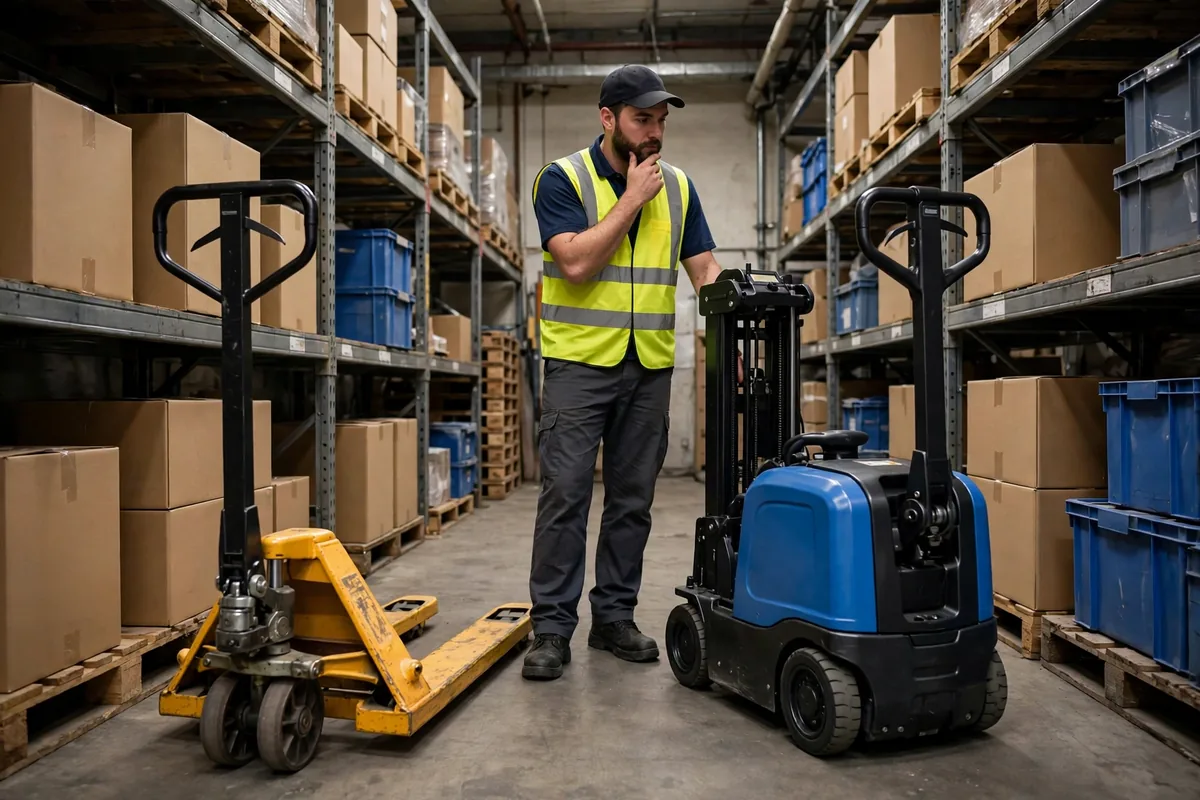
On pallet jack vs walkie stacker warehouse cost, we small warehouses cannot afford to guess. I am not going to read you a spec sheet. I will tell you about the week my manual jack stopped being a money-saving hero and became a machine for eating labor, and the month I finally bought a walkie stacker and knew the money had gone to the right place.
Some background first. My warehouse is a rented small industrial unit, a few thousand square meters, racking up to four levels, and a crew of four or five people on a normal day. When we opened, the whole building ran on two manual pallet jacks. Each one cost in the hundreds-of-dollars range. Prices move with the market, so always check live quotes, but you know the scale: compared with powered equipment, a manual jack costs almost nothing. In year one I praised those jacks to anyone who would listen. Cheap, no charging, nothing to break. By the peak season of year two, I had stopped praising them.
Pallet jack vs walkie stacker warehouse cost starts with one question: how high does the pallet need to go?
A pallet jack has a ceiling, and I mean that literally. It lifts a pallet just clear of the floor. Horizontal moves are fine. Putting a pallet into racking is not something it can do at all. If all your stock lives on the floor or at ground level, a jack and some muscle will carry you a long way. The moment you need to put full pallets into the second or third level, the jack is out of the game entirely. At that point you are not really comparing a jack with a stacker. You are comparing a stacker with renting a forklift or paying someone else to do your putaway, which is a completely different bill.
Here is the dividing line I use. If everything moves at floor level, you handle fewer than about 30 full-pallet moves a day, your aisles are wide enough, and your floor is in decent shape, the manual jack is the right answer. Do not overcomplicate it. Once you start using second-level racking and above, or you count more than about 20 full-pallet lifts a day, or your typical pallet runs heavy, in the 800-kilogram class and up, it is time to seriously price a walkie stacker. A walkie stacker puts a full pallet into low and mid-level racking with one operator walking behind it, which suits a small crew far better than full forklift arrangements. Always follow your local rules and the equipment manual for operator requirements and safety. Do not take my word as your safety procedure.
Here is the counterintuitive part nobody told me. For a small warehouse, the biggest return on a stacker is often not speed. It is that you finally dare to use your upper racking. Plenty of small operators rent a building with tall racks and then leave the top levels empty for years because they own nothing that can reach them. They pay rent on air every single month. I did exactly that. Once I put the value of those empty levels into the spreadsheet, the stacker price suddenly looked a lot less frightening.
Two rough weeks: a wrecked back and a load that nearly came down
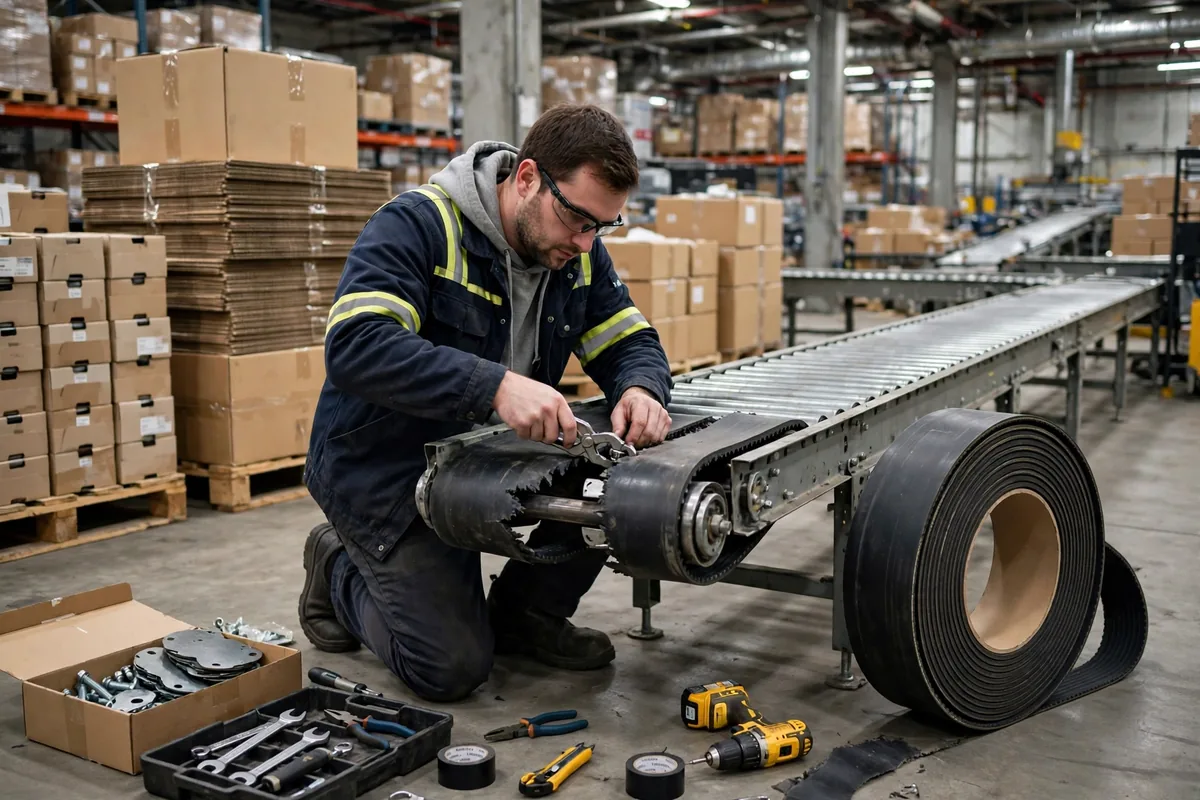
Story one comes from October 2024, when we took on a small beverage distribution client. Heavy product, fast turnover. For five straight days we were moving sixty to seventy pallets a day over short distances. Each pallet weighed several hundred kilograms. Getting a loaded manual jack moving takes a hard pull from your legs and lower back, every single time. By the end of that week neither I nor my teammate could stand up straight comfortably. One afternoon I hit a floor joint with a loaded pallet, the wheels caught, I lurched forward, and the load rocked hard enough to scare everyone nearby. It stayed upright, luckily. That weekend I added up the hours the two of us had spent purely on pushing. Converted into labor cost, it was already a serious number, and that style of work simply does not survive a second peak season. Nobody signs up to be a human forklift twice.
Story two is from spring 2025. Trying to save money, we started putting stock into the second rack level using a borrowed manual lifting setup and a fair amount of improvisation. One day, lifting a pallet of packaging material, the chain started making a noise I did not like, and halfway up the load visibly felt unstable. We brought it straight back down with our hearts in our throats. That pallet was light. If it had been a pallet of bottled drinks, the same wobble could have ended very differently. That day I set a hard rule: improvised lifting stops. Either stock stays at ground level, or we buy proper equipment. Saving money is fine. Saving money with safety is not.
For two months we used a free workaround: heavy, fast-moving stock moved to ground positions near packing, only light stock went to level two, and our lift count dropped sharply. It taught me something useful: fix your slotting before you buy equipment. A good layout deletes fake demand. Whatever lifting need survives it is the real need worth paying for.
The three-year pallet jack vs walkie stacker warehouse cost table
The table below is a hypothetical worked example. All figures are ranges and orders of magnitude only. Prices move with the market, so drop in live quotes for your area before you decide anything.
| Cost item | Manual pallet jack (worked example) | Electric walkie stacker (worked example) |
|---|---|---|
| Purchase scale | Hundreds of dollars per unit | Thousands to low tens of thousands, by capacity and lift height |
| Energy and consumables | Almost zero, wheels and seals | Very low electricity cost, battery aging is the real item |
| Repairs | Simple structure, most fixes in-house | Electronics and hydraulics need a service provider, annual service cost |
| Labor efficiency | Slow with heavy pallets, pure physical effort | One operator moves and lifts, gap is biggest at peak |
| Space return | Floor and ground level only | Low and mid rack levels become usable, spreading rent |
| Resale and risk | Hard to lose much money | Wrong model is hard to resell, battery condition is critical |
My own break-even logic runs on daily throughput. Suppose a stacker saves you one and a half to two hours of heavy manual work a day, and add the avoided cost of renting overflow space once your upper levels become usable. On those assumptions, many small warehouses recover the price gap somewhere in the 12 to 24 month range. If your building only moves a dozen light pallets a day, that payback stretches out so far that the honest answer is to keep the jacks and keep your cash for working capital. Equipment bought too early is a burden. Equipment bought too late is an injury report. The skill is landing in the middle.
One used-equipment warning. A second-hand stacker at half price looks wonderful until you meet its battery. An aged lead-acid battery can look fine and still have poor runtime and heavy degradation. If you buy used, bring someone who knows the machines, run a loaded lift test on site, and work it continuously for half an hour while watching charge drop and heat. If it fails that test, walk away from the bargain. A large part of what a new machine's price buys you is simply a known battery and a warranty that answers the phone.
My upgrade order, so you do not buy in the wrong sequence
Here is the sequence that worked for us. First, fix the layout: heavy stock low, fast stock close, and cut pointless travel before you spend anything. Second, count your lifts. For one honest week, write down every full-pallet lift to level two or above. If the number sits above twenty a day and you expect it to hold for at least six months, the stacker has earned a place on the budget. Third, rent the exact model for a week before you buy. Spec sheets do not tell you about your turning space, your floor joints, or where the charger will actually live. Your own crew, in your own aisles, will find all of that in two days.
One last honest thought. We do not buy equipment for show. We buy it so four or five people get through peak without wrecked backs, and so rack levels we already pay rent on finally earn their keep. I kept two manual jacks, and for light horizontal moves nothing beats them. The stacker did not replace the jack. It covers the height the jack was never built to reach.
Small warehouses have their own way of surviving.
By Xiao Ma, Small Warehouse Owner