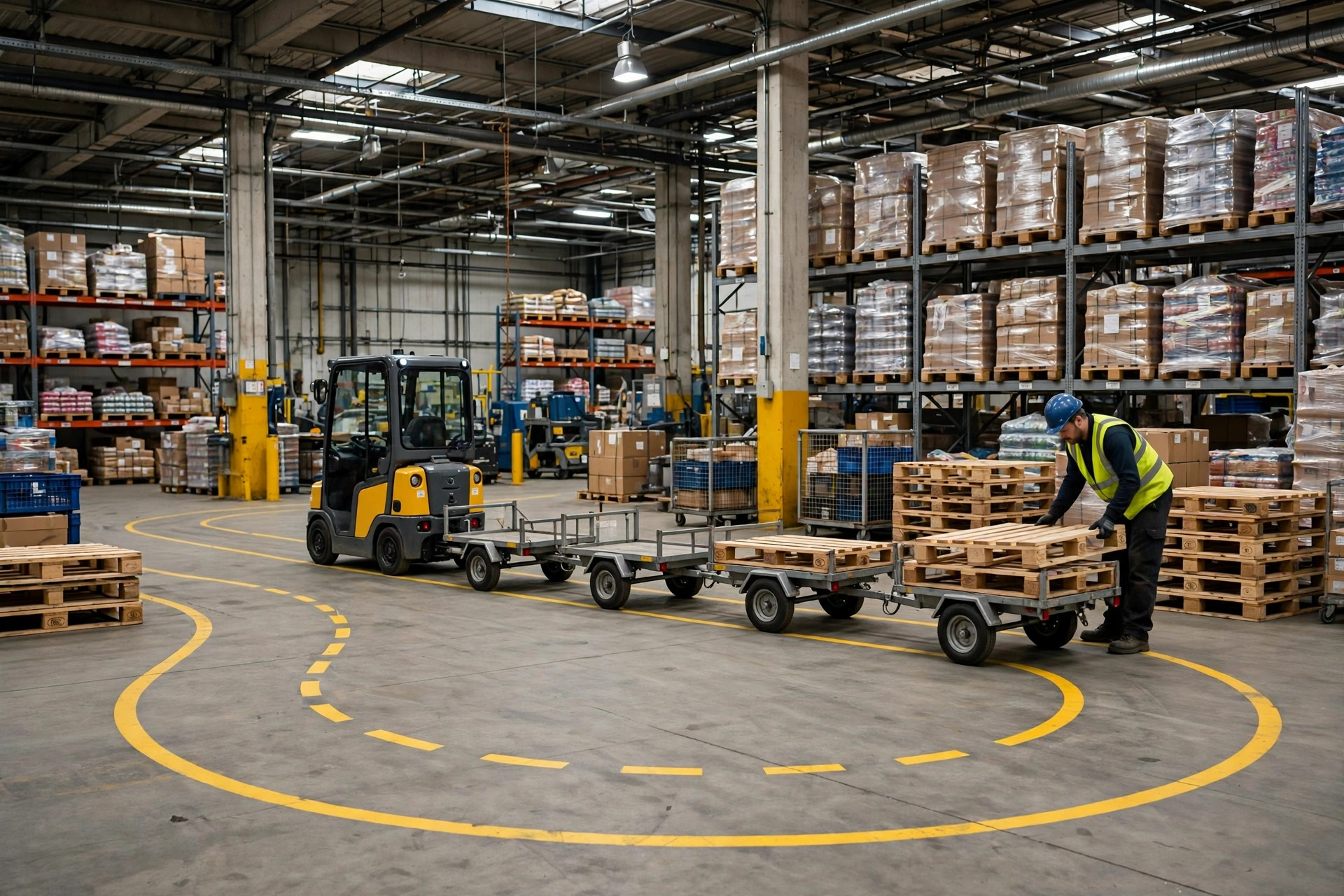
It was 4:30 in the morning, and our tugger train route design was failing in real time. The last night-shift run had just come through the dock door, and the day-shift pickers were already waiting on material at the line stations. I remember that morning clearly, because three lines went short at the same time, my phone kept ringing, a driver was shouting over the radio that the intersection was blocked, and the stations were shouting that the train still had not arrived. Let me be straight: that morning I was sweating. A tugger train is sold as a labor saver. Get the route wrong, and every hour it saves gets spent on firefighting.
Tugger Train Route Problems: How Ours Showed Up
We brought in tugger trains to replace forklifts running small replenishment trips back and forth. The first route we drew was simple: start at the staging area, run down the main aisle in one big loop, hit six stations, and come back. It looked smooth. Within a week, it was not.
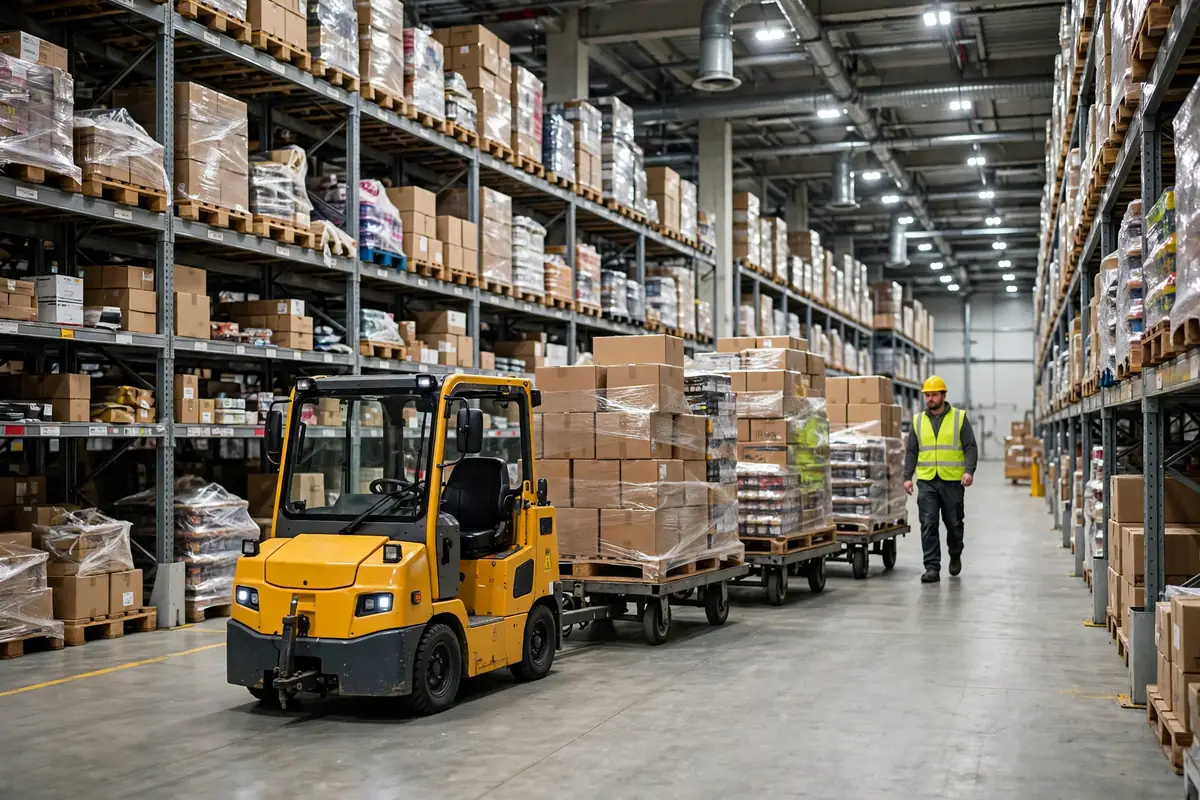
The first problem was the intersection. The junction between the main aisle and the picking zone is only so wide, and a tugger pulling four carts takes up most of it on a turn. When a forklift arrived, everything waited, and waiting turned into a queue. The second problem was uneven stops: one station needed three carts unloaded, another needed none, so dwell time varied station to station and the whole rhythm fell apart. The third problem was people. Drivers started driving faster to make up time, carts swayed on turns, and we dropped a load once. After that, everyone on the floor gave the train a wide berth.
Honestly, the problem was not the train and it was not the drivers. We designed the route without ever calculating takt. We drew a line on a map but never measured how long a loop took, how long each stop took, or how many runs a day we actually needed. A route map without times on it is just a drawing.
What We Tested: Three Loop Layouts
Version one was a single big loop serving every station. The upside was simplicity — drivers never had to remember a branch. The downside was loop time: stations at the far end waited a long time between runs, and when they went short, they could only wait. In peak season, the single loop was the first thing to break.
Version two was two loops, splitting the warehouse into a north loop and a south loop, one train each. Loop times got shorter and station waiting dropped. But both loops shared one loading point at staging, and during the morning rush both trains fought for the same loading spot. We were back to a queue. Splitting the loading point into two finally fixed that.
Version three is what we still run today: two loops with staggered departures. Separate loading points, departures offset by half a loop, one-way rules at the intersections, and forklift traffic rerouted away from tugger lanes during peak hours. It looks more complicated than version one on paper, but it runs with fewer surprises, because every variable now has a number attached.
| Loop layout | Loop time | Station waiting | Best for |
|---|---|---|---|
| Single big loop | Longest | Far stations wait a long time | Few stations, low volume |
| Two loops, shared loading | Medium | Rush-hour fight for the loading spot | Medium volume, if loading can be staggered |
| Two loops, staggered | Shortest and most stable | Predictable wait at every station | Many stations, big seasonal swings |
Tugger Train Route Design: How We Calculate Takt
Takt is the easiest number to get wrong in tugger train route design. Our method is fixed now, in three steps.
Step one, measure dwell time at every station: unloading, scanning, sign-off, returning empty carts. Measure for three days and take the slowest day, not the average — averages mean nothing in peak season. Step two, measure pure drive time for a full loop, including turns and intersection waits, also measured at peak hours. Step three, takt equals total loop time divided by the stations one run can cover, multiplied by a buffer factor. In peak season we use 1.2.
An example: say a measured loop takes 24 minutes including stops. Daily station demand totals 40 carts, each run carries 8 carts, so the day needs 5 runs. If you schedule exactly 5 runs, any single blocked intersection wrecks the whole day. We schedule 7. Those 2 extra runs are the buffer. And here is the counterintuitive lesson: faster driving does not mean faster delivery, and adding a train does not always mean smoother flow. We tried adding a train at peak once, and intersection conflicts doubled — on-time performance went down, not up. The bottleneck in a tugger system is always the intersections and the loading point, never the driving speed.
The arguments with drivers taught us the same lesson from the human side. Drivers said the scheduled runs were impossible. At first we thought they were pushing back on the work. Then we rode along for two days and found the truth: the schedule was built on average times with no allowance for intersection waits, so the only way drivers could keep up was to speed. Now the schedule is built on the slowest station plus buffer, drivers do not have to rush, and the arguments mostly stopped. Scheduling and morale are route design questions, whether you treat them that way or not — if you skip them at design time, they come back as people problems after go-live.
If you are still deciding whether a tugger train is even the right tool for your moves, start with a broader tugger train warehouse material transport guide covering use cases and vehicle choices, then come back and draw your loop. Confirm the job belongs on a tugger first; design the route second. Do not reverse that order.
What We Run Today
Our current practice is posted on the wall, so a new driver gets it at a glance: two staggered loops, one-way intersections, forklifts rerouted at peak, cart counts checked before every departure, and stations flagging shortages one run early instead of waiting until the train arrives. One more rule came the hard way: any route change gets a one-week trial in the slow season, judged on on-time rate. No gut-feel changes straight into peak.
My advice to other managers is one line: in tugger train route design, do not draw the line first. Measure first. Measure dwell time at every station, wait time at every intersection, and real daily demand. Once you have those numbers, the route practically draws itself. A good loop is not judged by how pretty it looks on a map. It is judged at 4:30 on a peak-season morning, by whether anyone on the floor still has to call and ask where the train is.
By Chen Feng, Warehouse Operations Manager