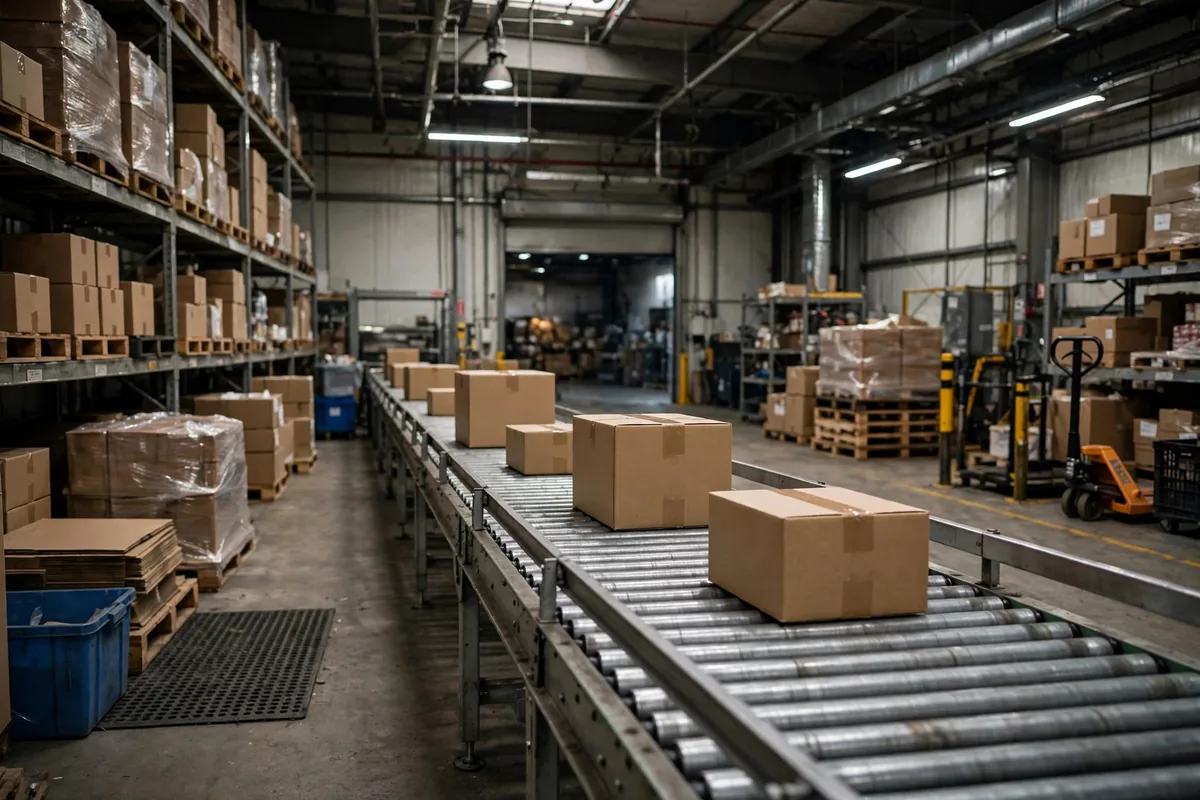
Last month I visited an auto-parts warehouse where line replenishment still ran on forklifts, one trip at a time. A production line ran short of two small cartons, the line lead called, and the forklift driver dropped a full pallet job to make a twelve-minute round trip for them. The warehouse manager asked me: "Would a tugger train fix this?" I told him not to place the order yet. This is not an equipment question. It is an arithmetic question. Think of it this way: a tugger train is a bus running a fixed route in your warehouse, and a forklift is a taxi. A bus is cheap per passenger, but an empty bus is still an empty bus. A taxi costs more per ride, and sometimes that is exactly what you need.
How a Tugger Train Actually Moves Material
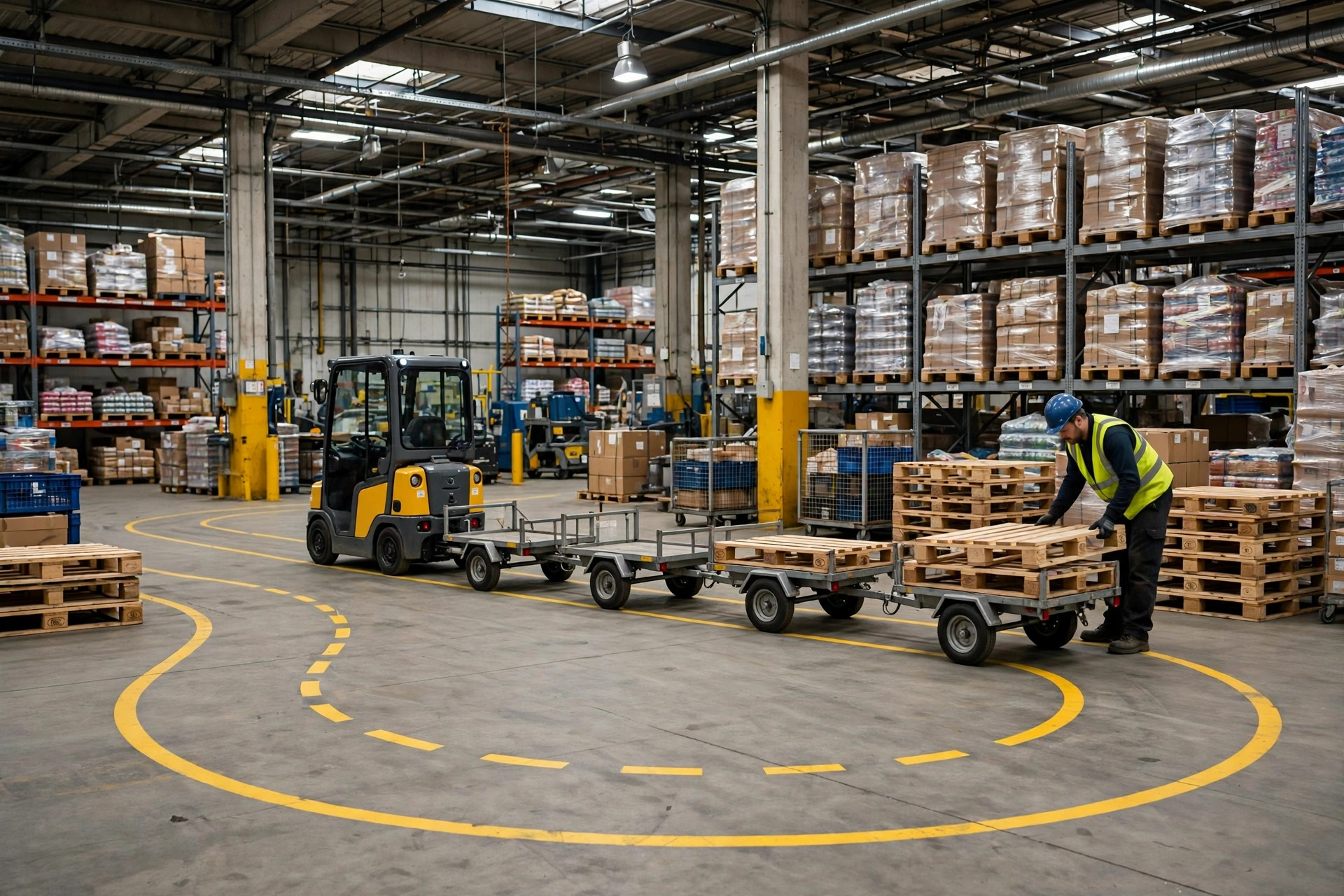
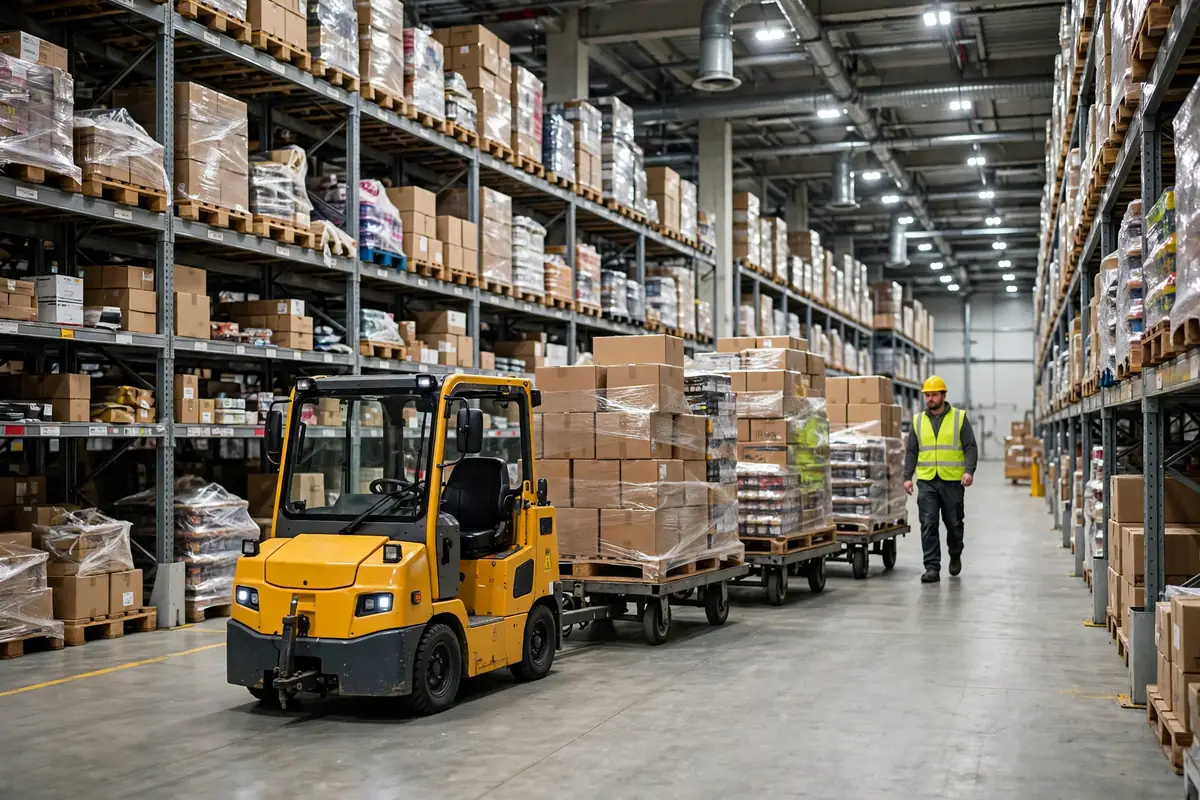
Principle first, money second — never the other way around. A tugger train does not carry freight by itself. A small tow tractor pulls a string of carts on a fixed route with fixed stops, delivering to several points in a single loop. You can understand it as a bus: passengers wait at stops, the bus does not go hunting for them.
So the first dividing line is not a spec sheet. It is the shape of your material flow. Is your replenishment rhythmic, predictable, and batched? If yes, a tugger train has a case. If most of it is ad-hoc calls and random requests, a tugger train just drives empty loops around the building. The classic fake requirement I keep seeing: a warehouse where seventy percent of replenishment calls come in by phone, ad hoc, and management buys a tugger train anyway. The driver still waits for the phone, the train still runs empty, and the phones keep ringing. The money is spent, the problem is not.
For cart types, route design, and stop layout, the general guide to tugger train material transport covers the general how-to. This article answers a narrower question: against a forklift, when does the tugger train actually pay off?
The First Number: Tugger Train Labor — Where Do the Driver's Hours Go?
A forklift serves one point per trip. Take an illustrative scenario — an assumption, not a benchmark: a warehouse with six replenishment points, each forklift round trip averaging twelve minutes, forty trips a day. That is 480 minutes — one driver spends the whole shift on the road. The numbers are made up for the arithmetic; the logic is not. A forklift's cost hides in the trip count.
Now the same six points on a tugger train route: one loop hitting all six stops takes about 25 minutes, and twelve loops a day take 300 minutes. That frees up nearly three hours for other work. Here is the counterintuitive part: most people price a tugger train on fuel and purchase price, but the big money is labor. One tugger train does not replace one forklift. It replaces the fragmented hours of two or three drivers running back and forth.
But the math has to be run in reverse, too. If your warehouse only needs eight replenishment trips a day, the forklift driver handles them between other jobs, and the labor a tugger train saves does not cover its own empty running, depreciation, and upkeep. My rule of thumb: if fixed replenishment trips run above twenty a day, start talking tugger trains. Below that, fix the forklift routes and slotting first — that saves more money, faster.
A second scene, from an electronics assembly warehouse I worked with in 2023: the line needed material every two hours, on a schedule as regular as a school bell. Once the tugger train ran on a timetable, the line stopped calling for material altogether, and the job of "chasing replenishment by phone" simply disappeared. Note what disappeared. Not the driver — the coordination. The tugger train's real opponent is not the forklift. It is the phone call and the wait.
The Second Number: Equipment — Never Compare Bare Purchase Prices
Comparing sticker prices is amateur arithmetic. A tugger train plus four carts may cost more up front than one forklift, but a forklift carries costs nobody books separately: tires, mast maintenance, battery depreciation, and the racking and product damaged when forklifts clip things in the aisles. Plenty of warehouses bury that repair bill under "miscellaneous" and never see it.
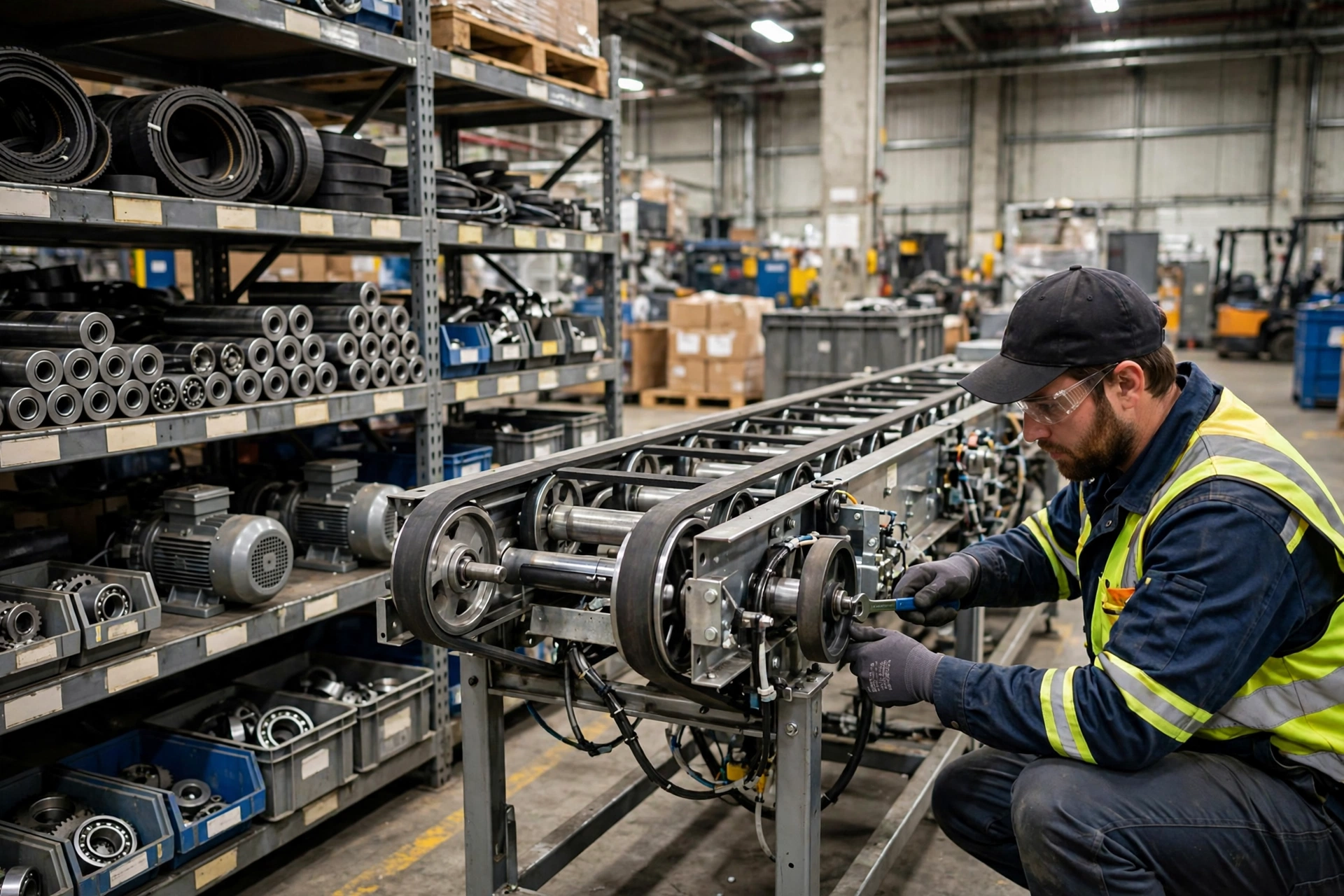
Break the tugger train's equipment cost down honestly: the tractor, the carts, and the route itself — floor markings and stop signage. Carts are consumables; wheels, tow pins, and brakes wear out and need scheduled replacement. Route marking is a one-time cost, cheap but not optional: without painted lines and stop signs, drivers drift off the route within three days.
And here is the maintenance trap you need to hear before you buy. A tugger train's MTBF looks great on paper, but only on the assumption of on-time maintenance. I saw a warehouse where nobody had replaced a tow pin in two years, until one day a cart unhitched in a turn and half a train sat sideways across the main aisle, blocking the warehouse for forty minutes. When a forklift breaks down, one truck is down. When a tugger train drops a cart, the whole route is down. On maintenance, a tugger train is less forgiving than a forklift — its uptime is measured for the entire route, and one worn pin can zero the whole trip.
The Third Number: Tugger Train Throughput — Watch Load Per Trip, Not Speed
Yes, a tugger train is slower than a forklift. That is a fact, and it is also a bad reason to reject one. Speed is not throughput. Load per trip is. A forklift moves one pallet per trip. A tugger train pulling four carts, two pallets per cart, moves eight pallets per loop. Even at half the speed, it moves several times the freight per hour. Same bus-versus-taxi logic: a taxi is faster, but a bus moves more people per hour.
Flip it around, though, and the same number kills the case: four carts dispatched with only one and a half carts' worth of load is a bus running on air — a forklift on demand would have been cheaper. So the efficiency number that matters is a single one: average load per trip. Below half, do not add another train; fix the dispatch rhythm and the pull schedule first. If it stays below half for months, your flow simply does not fit a fixed loop, and the forklift was the right tool all along.
There is one more trade-off that never makes it into the spreadsheet: a tugger train needs a fixed route, and a fixed route costs flexibility. When production re-lays a line or peak season adds temporary locations, the forklift driver just takes a different aisle after a radio call; the tugger train route needs re-painting, re-signing, and retraining. That flexibility has no line in Excel, but during one peak month it can cost more than the other three numbers combined.
When Not to Buy One: Three Red Lines
First, if demand is random and rush orders are more than about three in ten, do not buy one. A tugger train is a metronome, not a fire truck. Second, if aisles are narrow and turning radius is tight, do not force it — a string of carts needs far more room to turn than a single forklift, and forcing it means hitting racking every week. Third, if nobody owns the route and the timetable, do not buy one. A tugger train's worst enemy is "whoever is free drives it." With no one accountable for the schedule, it degrades into a very expensive forklift within three months.
On the other hand, if three conditions hold at once — four or more replenishment points, more than twenty fixed trips a day, and a predictable flow rhythm — the case is serious. Even then, do not convert the whole warehouse at once. Run one route for a month, verify the three numbers with real data, and then decide whether to expand.
Is the money worth it? Look at one number: average load per trip. Run it for a month. If it holds steadily above sixty percent of full load, the tugger train is earning its keep. If it sits below half for weeks, cut your losses — the forklift was your machine all along.
By Da Liu, Automation Engineer