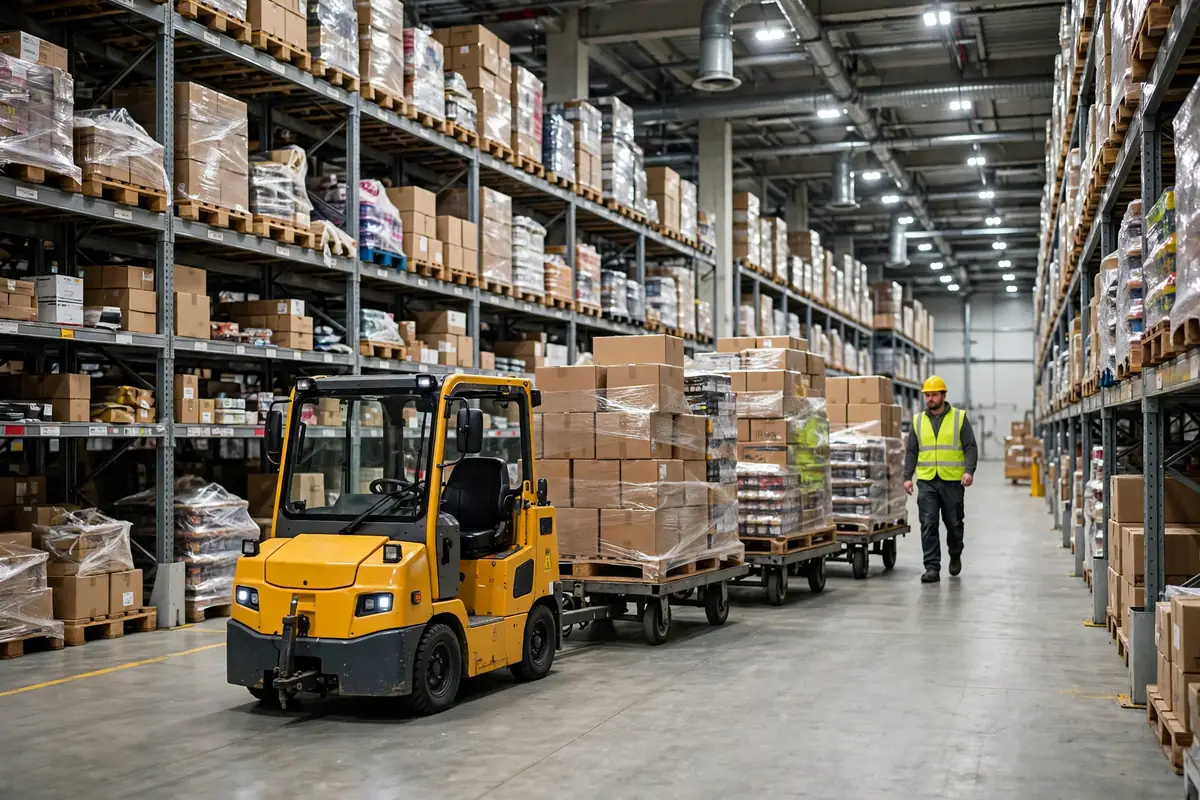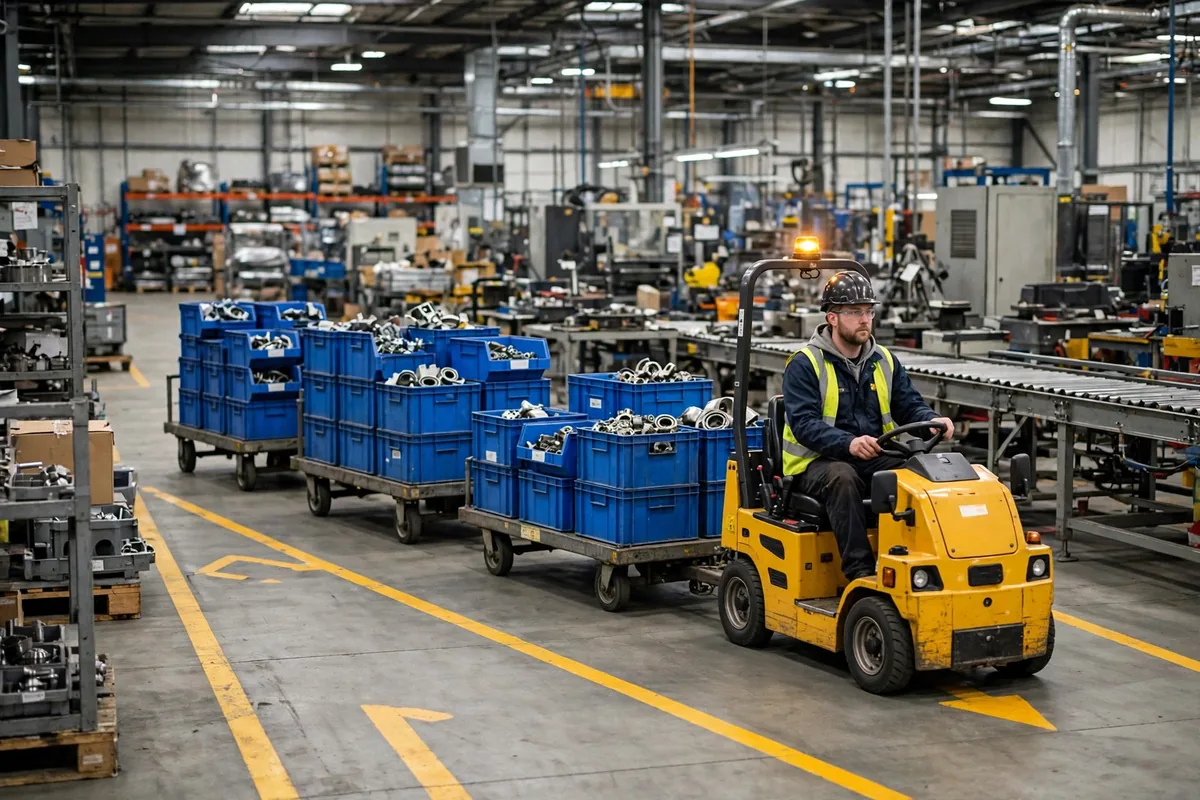
Start with the principle. A tugger train is not really a vehicle. It is a conveyor belt on wheels — a fixed conveyor line cut loose, put on casters, and sent circulating between dock, warehouse, and line side on a beat. Design a conveyor wrong and you unbolt it and start over. Design the route wrong and you pay daily, in driver minutes and waiting time, for years. So this article skips the brand debate and goes straight to the route: stop spacing, how long the consist can run before corners defeat it, the timetable, and how dock-to-line replenishment locks onto consumption. Get those four wrong and no tractor upgrade will save you.
The failure pattern is consistent. Week one runs beautifully. By month two: drivers say the route wanders, line side says material arrives off-beat, the dock says the train blocks the doors. The equipment is almost never the problem. Stops were placed wherever someone once shouted loudest. The consist grew one cart at a time because more per trip felt like efficiency, until corners needed a shuffle. The timetable was set to round hours because round hours are tidy, ignoring how fast line side consumes anything.
tugger train stop spacing: measure the walk, not the map
Stop spacing is governed by one number: how many seconds an operator spends walking from workstation to stop and back, per retrieval. Think of it as a bus route. Stop at every corner and the passengers suffer; space stops too far apart and the walkers suffer. Every stop costs a deceleration, a positioning, an uncouple-couple cycle, and a restart — string enough together and a loop gains minutes. Space stops too far apart and line-side staff push hand carts down long aisles instead: the driver's saved minutes get repaid, with interest, by dozens of operators walking.
The dividing line I use is simple. Count a full week of delivery records per pickup point: frequency and quantity per retrieval. High-frequency, high-volume points earn their own stop. Low-frequency, small-quantity points merge into the neighboring stop, with a hand cart covering the short final walk. Do not decide by feel. The points at the bottom of the frequency table are, eight times out of ten, the ones that should be merged.
At an auto parts plant two years ago, the loop had more than a dozen stops, two separated by a single rack block — a walk of a few dozen paces. The driver stopped twice there every loop for nearly identical coupling work. We merged them into one stop. The driver saved a stop per loop, line side covered the extra walk with one small cart, and the crew reported something I had not predicted: deliveries got clearer. Two adjacent stops had been receiving each other's material; one stop, one named contact, ended the mix-ups. Merging buys back clarity, not just time.
The opposite error exists too. An electronics plant cut intermediate stops aggressively, leaving two large end stops. Line-side teams then spent serious shift time pushing material down a long corridor themselves — assembly hands doing logistics work. The stops went back in within a quarter. Cutting stops removes dwell time from the driver's report and adds walking to everyone's day. Count only the driver and the arithmetic will lie to you.
Train length and turning: the tightest corner sets the limit
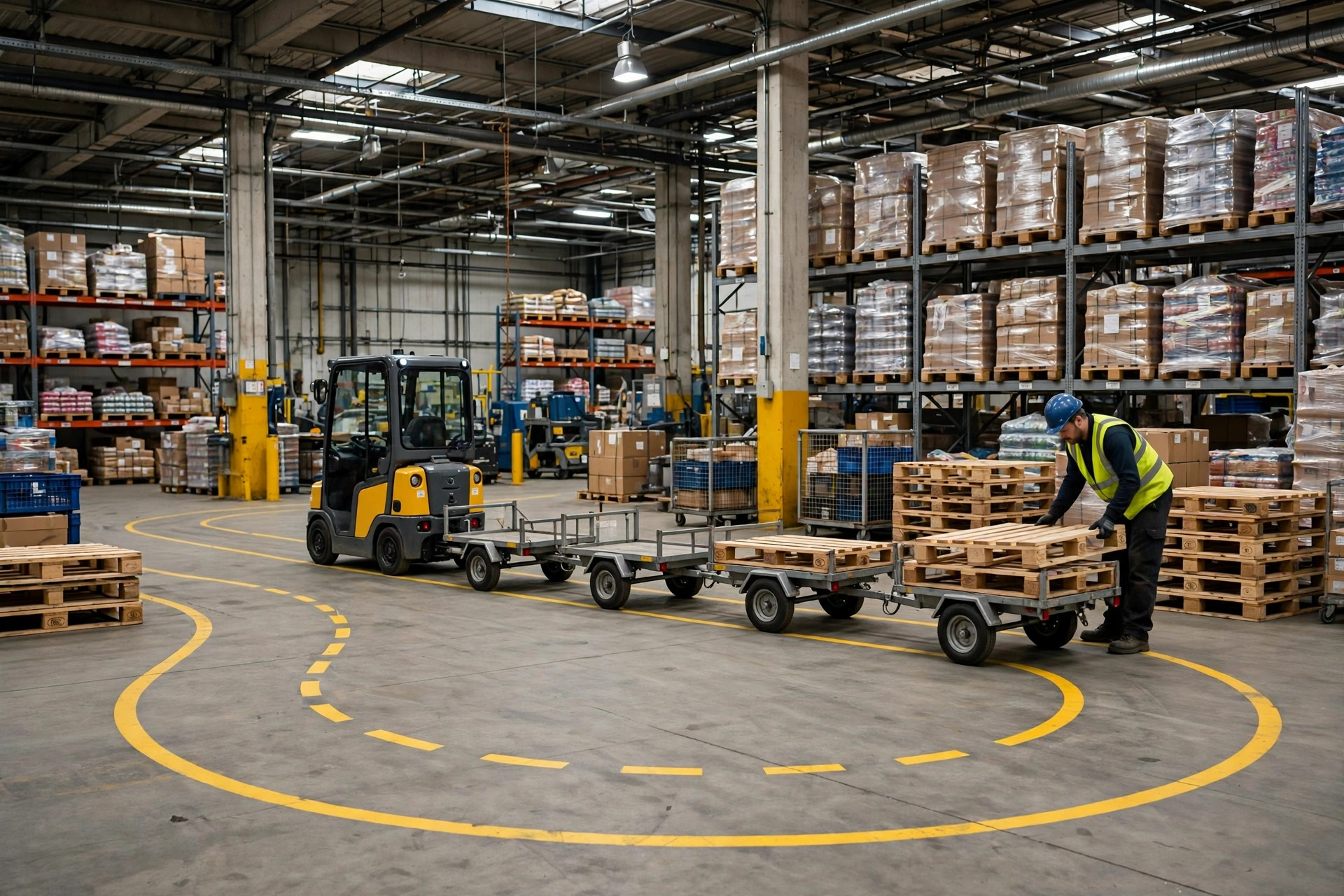
Second principle: geometry. A consist is a chain of articulated carts: the longer the chain, the further the rear wheels cut inside on a turn, and the wider the swept fan. Picture a railway train cornering — the locomotive clearing the bend says nothing about the tail. On rails, the track constrains the path. In a warehouse there are no rails; aisle width and corner clearance are all you have.
So maximum consist length is set not by the longest straight but by the narrowest corner and tightest dock turning area on the loop. Survey every turn first: clear width, rack ends, hydrants, and the pallets staging always grows into corners. Then run a swept-path check for the candidate consist through each one. A corner the full train cannot clear in one motion means one of three fixes: shorten the consist, reroute around it, or clear the staging — in that order. Rebuilding racking to suit an already-purchased over-long train is the most expensive sequence in materials handling.
An appliance assembly customer learned this with a consist sized by straight-line capacity. It looked superb on the straights. At the dock turning area, the tail swung into the staging lane and the driver had to shuffle back and forth twice to get through — at peak, every following movement queued behind him. They shortened the consist by one cart. Capacity per trip visibly fell, loop time fell further, loops per shift rose, and total delivered volume ended up higher, not lower. That is the central trade-off: beyond the length your corners and stops can absorb, an extra cart does not carry freight. It carries everyone's waiting time.
A clearly labelled hypothetical example — assumed figures, method only, substitute your own data: a 600-meter loop, a conservative measured speed, roughly 40 seconds of dwell loss per stop. Consist A hauls more per trip with 8 stops and loops in about 18 minutes. Consist B hauls about a fifth less, merges to 6 stops, and loops in about 14 minutes. Trips per hour times load per trip puts B slightly ahead — before counting A's corner shuffles blocking traffic. Consist debates settled on load-per-trip are settled on the wrong number; settle them on throughput per hour.
| Decision | Measure first | How the line gets drawn |
|---|---|---|
| Stop spacing | Retrieval frequency, walking distance per point | Frequent points get stops; rare points merge with cart-fed last leg |
| Consist length | Clear width at tightest corner, dock turning area | Full train sweeps every corner in one motion, no shuffling |
| Departure interval | Consumption rate, smallest line-side buffer | One interval's consumption never exceeds the tightest buffer |
| Route direction | Pedestrian peaks, main forklift aisles | One-way loop preferred; crossing yield rules fixed in advance |
The timetable: run the tugger-train loop on consumption, not on the clock
Third principle: beat. Dock-to-line replenishment is a translation job — bulk arrivals at the dock, translated into small lots line side can absorb on rhythm. The train is the translator. Its timetable cannot be built around driver convenience or tidy clock hours. It must be built around consumption: find the fastest-consuming workstation with the smallest buffer, measure how long that buffer lasts, and the departure interval must not exceed it. Intervals too long force line side to hoard stock or starve. Intervals too tight send half-empty carts circulating, burning driver hours and battery for nothing.
The method is unglamorous and it works. Identify the tightest buffer, back-calculate the interval from it, then slice every other station's delivery quantity to fit. Fix departure times and post them at the dock and every stop. The driver departs on the minute, line side expects on the minute, and call-for-material systems handle exceptions only. Routine supply running on exception calls is a system permanently firefighting.
For the equipment side — cart types and tractor selection — see the earlier overview: how tugger-based material transport is organized inside a warehouse. That piece answers "what should run"; this one answers "how the route gets drawn."
The cleanest implementation I have commissioned was a machining plant's dock-to-line route. Receiving landed in a morning surge while consumption ran all day; the old pattern buried the dock by noon and starved line side by mid-afternoon. On a fixed-interval timetable, the dock pre-staged per departure, line side held small buffers, the afternoon starvation vanished, and staging space freed up. The trick was never the tractor. It was welding dock preparation to the timetable: staging counts backwards from departure time, and the driver on arrival does nothing but couple and go.
Finally, the discipline pitfalls I flag on every project. Once the route is frozen, floor marking must follow: stop bays, stand positions, one-way arrows, no-standing corner zones — painted clearly and defended against staging creep. Review the route after its first month with evidence: loop timing and shortage records, merge the stops the data condemns, add buffer where it asks for it. Most routes do not fail at design. They fail by slow drift, as the floor grows back around them and nobody re-measures.
The verdict, as always, comes down to one number: throughput per hour. Stop spacing, consist length, and timetable arguments all report to it. Judge by that number and the route gets smoother every quarter. Judge by load per trip and the train gets longer, the corners tighter, and the loop slower — hauling, mostly, its own delay.
By Da Liu, Automation Engineer