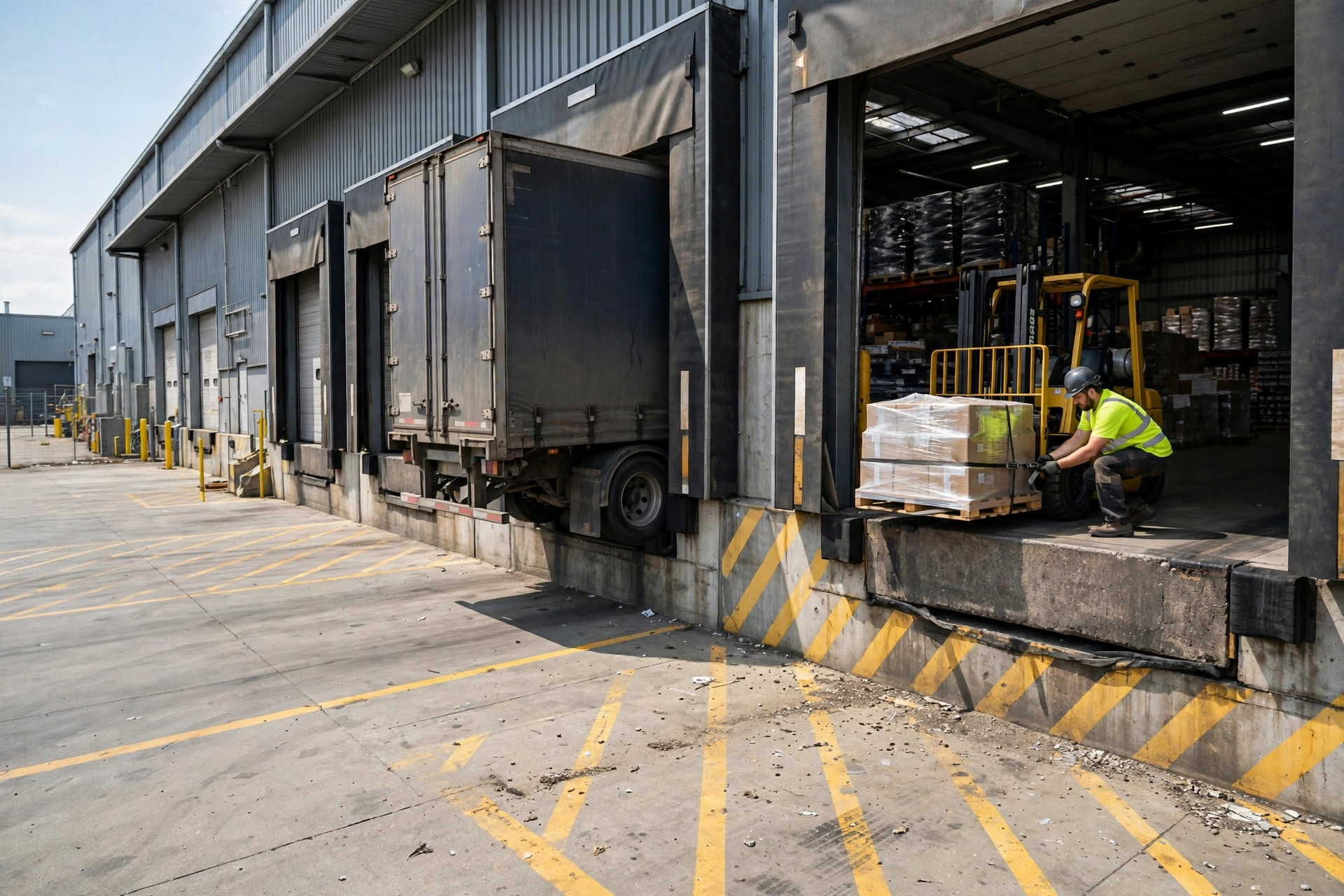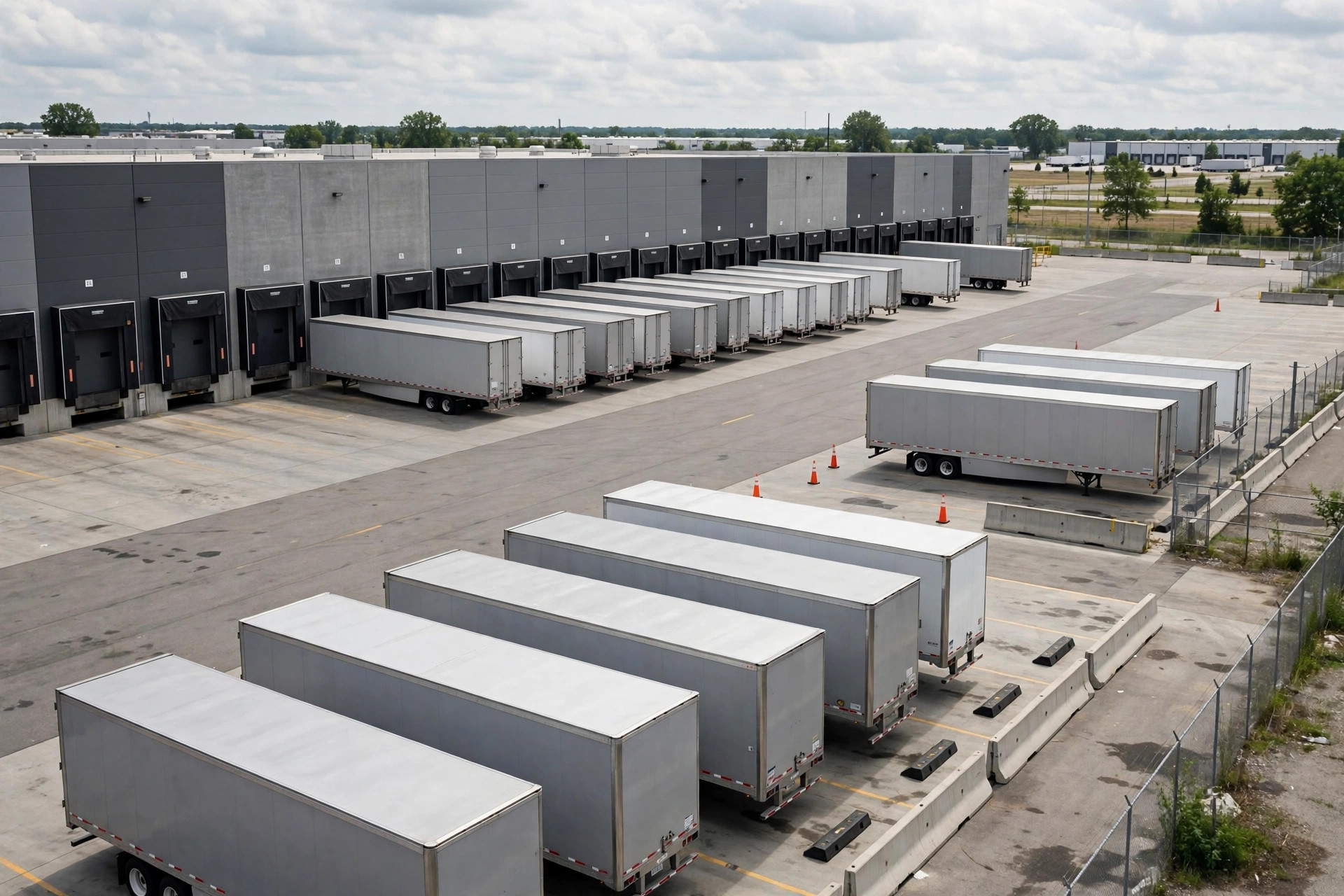
Let me open with the math that nobody wants to do. A distribution center with 40 dock doors and 80 trailer stalls. Trailer stalls typically eat 15% to 25% of a logistics site's total occupancy cost — rent amortization, paving, striping, insurance, all of it. I won't quote you a per-stall dollar figure because it varies three or four times over between states; check your local market. But here's the point: every extra 20 stalls is 20 silent tenants on your payroll. They produce nothing. They just collect rent, year after year.
That's why the trailer parking stalls per dock door ratio deserves its own spreadsheet. How many stalls per door isn't a planner's gut call — it's the cost collision between two operating models: drop-trailer and live-load. Let's do the accounting properly.
The Formula for the Trailer Parking Stall to Dock Door Ratio
The core formula fits on one line:
Stalls needed ≈ daily arrivals & departures × average dwell hours per move ÷ 24 × peak factor
Four inputs. Let's interrogate each one, because every one of them lies if you let it.
Daily arrivals and departures. Not your door count — your actual truck volume. One truck arriving and leaving counts as two moves, and empty drop-trailer swaps count too. Pull the last 90 days from your system. Do not use the design capacity from the leasing brochure. Design capacity is fiction; actual moves are the truth.
Average dwell hours per move. This is the number that decides everything. Live-load trucks — driver waits, unloads, leaves — typically dwell 2 to 4 hours. Drop-trailers get spotted in a stall and sit there half a day to two or three days waiting on your schedule. Double the dwell time and you double the stalls needed. It's linear. No mercy.
÷ 24. Normalizes "truck-hours" into "stall-days." Pure arithmetic, nothing to argue about.
Peak factor. Off-season 1.1 to 1.2; peak season 1.5 to 2.0. Between Thanksgiving and Christmas, many US warehouses see daily truck volume hit 1.8x normal. Size your yard for the off-season and peak season trailers will be lined up out the gate. Size for the peak and half your stalls sunbathe all spring. That factor is really a question of how much you're willing to pay for peak insurance.
A worked example (illustrative numbers, not an industry standard): a warehouse with 60 daily moves, 10-hour average dwell, peak factor 1.5. 60 × 10 ÷ 24 × 1.5 = 37.5, call it 38 stalls. If that building has 20 dock doors, the ratio is 1:1.9. If it has 12 doors, it's 1:3.2. See it? The same formula produces wildly different per-door ratios under different operating models — which is why the industry's favorite folk wisdom, "two stalls per door," is nonsense the moment you detach it from the operating model.
The Real Divide: Drop-Trailer vs. Live-Load, Two Ways to Pay the Same Bill
The ratio question is really a drop-trailer versus live-load cost-structure question:
| Dimension | Drop-Trailer | Live-Load |
|---|---|---|
| Stall demand | High — trailers dwell in the yard, ratios run 1:2 to 1:4 | Low — trucks come and go, ratio near 1:1 or less |
| Labor cost | Low — dock crew works at its own pace, never waits on drivers | High — slow unloading burns driver hours |
| Detention risk | Low — trucks aren't held, detention claims are rare | High — past the free waiting window, the meter runs hourly; peak season is the killing field |
| Land/stall cost | High — stalls are sunk cost, paid by the year | Low — smaller yard, but you own the queue risk at peak |
| Yard complexity | High — you need a yard management system tracking every trailer's position | Low — trucks map one-to-one with doors, simple to run |
Read it again: drop-trailer trades land rent for labor efficiency and detention immunity; live-load trades queue risk for land savings. There is no free lunch, only different ways to pay.
Most warehouses that pick drop-trailer cite "drivers don't wait, unloading is efficient." Half true. The other half: does the extra annual stall rent actually beat what you saved in detention and labor? I've seen warehouses go drop-trailer, grow from 30 stalls to 90, and add hundreds of thousands a year in rent — while annual detention savings came in under a hundred thousand. That's money spent for nothing.
Two Real Ledgers: One Yard Starving, One Yard Bloated
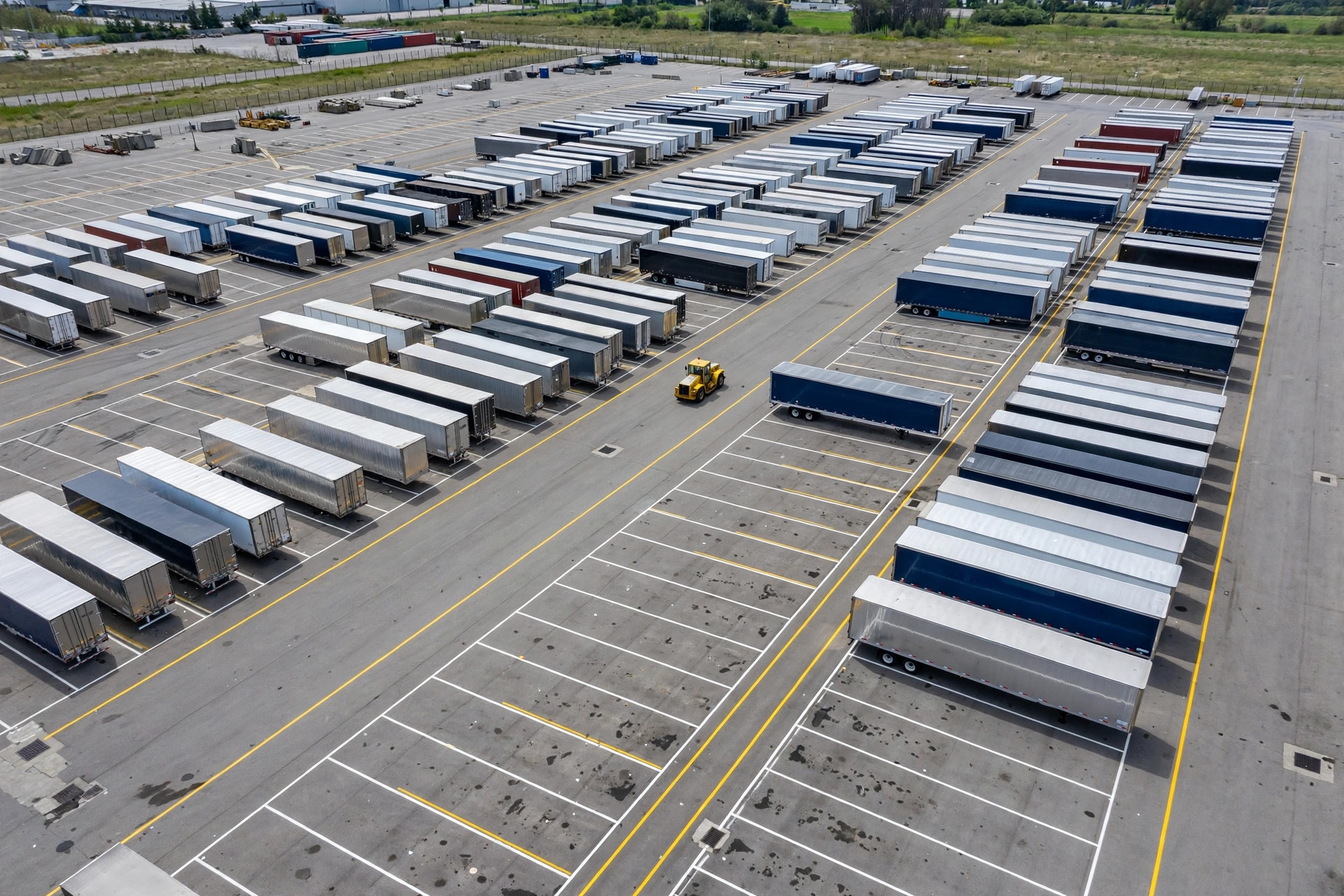
Case one: 40 dock doors, peak-season trailers lined up to the street. A 3PL distribution center in the US Midwest. Forty doors, about 110 daily moves in normal times, 60 trailer stalls. Thanksgiving peak 2024: daily moves hit 170, average dwell stretched from 9 hours to 16 — drivers stuck in traffic, trailers arriving but not getting unloaded. The formula says 170 × 16 ÷ 24 = 113 stalls needed. Short by more than 50. Trailers backed up three blocks outside the gate, the city issued citations, carriers started filing detention claims, and two carriers simply stopped showing up. The fix was renting a temporary lot next door — three months' rent plus temporary fencing, lighting, and security. That one quarter's extra spend would have covered 40 stalls for a full normal year. That's the real cost of too few stalls: not the queue itself, but the detention claims, the fines, and the carriers walking away. The queue is just the symptom; the money leaks out of those three holes.
Case two: 6 doors, 18 stalls, half of them permanently empty. A small e-commerce warehouse in California. Six dock doors. The owner listened to a "consultant" who said "at least three stalls per door" and striped 18. Reality: mostly live-load, 22 daily moves, 3-hour average dwell. 22 × 3 ÷ 24 = 2.75; with a 1.5 peak factor that's about 5 stalls needed. Ten-plus of the 18 sit empty year-round. Worse, this is Southern California, where land costs are among the highest in the country — the annual rent on ten empty stalls would cover a full-time yard jockey with change to spare. The owner's words: "I should have rented that land out as a parking lot and collected money instead." More stalls is not better. Every surplus stall is sunk cost paid by the year, producing zero revenue.
The Uncomfortable Truth: The Enemy Isn't "Too Few" — It's "Never Calculated"
Here's the counterintuitive part: most warehouses don't have a stall problem, they have a never-did-the-math problem. The ratio was copied from the warehouse next door, or "suggested" by the developer, or set by the owner's gut. Gut feel is the most expensive decision tool in logistics.
Second uncomfortable truth: the peak factor is the easiest number to fudge. Anyone can tell a peak-season story. "What if we get slammed" — and just like that, the factor goes from 1.3 to 2.0, stalls grow 40%, and the annual rent bill grows by hundreds of thousands. Meanwhile the truth is sitting in your system: pull three years of actual peak data and count how many months exceeded 1.6. Set the factor with data, not with anxiety.
Third: switch operating models and the ratio must be recalculated. Dwell time is the parameter that halves or doubles overnight. I've watched a warehouse switch from live-load to drop-trailer without adding stalls — three months later the yard was bursting every day. Business didn't get better; the denominator of the formula changed and nobody recalculated.
The Takeaway: An Algorithm You Can Walk Away With
Stop asking "how many stalls per door." Run this sequence instead:
- Pull 90 days of actual daily moves from your system — no gut estimates.
- Set average dwell hours by operating model: 2–4 for live-load, 12–48 for drop-trailer, using your own measured numbers.
- Set the peak factor from history: 1.1–1.2 off-season, and let your worst three-year peak month set the ceiling.
- Run the formula, round up, add 2–3 flex stalls.
- The step that matters most: multiply the calculated stall count by your local annual cost per stall, and compare it against your annual detention spend. If stall cost is 3x or more of detention, your operating model is probably wrong — either switch models or accept the queue. Don't burn money on both ends.
Remember my rule: every stall in your yard is either saving you money or spending your money. There is no middle state. Figure out which one it is before you decide how many you need.
By Lao Zhou, Logistics Cost Analyst