I'm telling you, after all these years on the road, the thing I dread most isn't traffic. It's rolling into a pitch-dark warehouse at 2 AM. Fifteen years of night runs have taught me more about warehouse high bay LED lighting than any catalog ever could — mostly by suffering through buildings that got the fixture count wrong.
Winter 2024, 2:30 in the morning. I pulled into a logistics park outside Langfang, Hebei, for a 3 AM pickup. I was half an hour early. The gate rolled up and inside it was dark as a coal mine — two lonely fixtures burning near the door. The forklift driver held up his phone flashlight to read my pickup slip, squinting at the order number for a full minute. I helped him count cartons, and then he clipped a pallet with the forks — bang — nearly toppled the whole stack. That mess put loading 40 minutes behind, and I spent the rest of the night racing the clock to make my port cutoff at Tianjin.
You'd think darkness is the only way lighting goes wrong. It's not. March 2025, an e-commerce warehouse in Dongguan, Guangdong — bright as high noon in the aisles. And the handheld scanners went on strike. Barcodes on the cartons caught the glare of the overhead fixtures straight on, and the PDAs just beeped and beeped with nothing to show. The receiving crew cursed, dragged boxes into the shadows of the racks, and scanned them there. That night we lost nearly an hour to scanning alone, and the queue of trucks waiting to unload backed up to the front gate.
What those two nights taught me
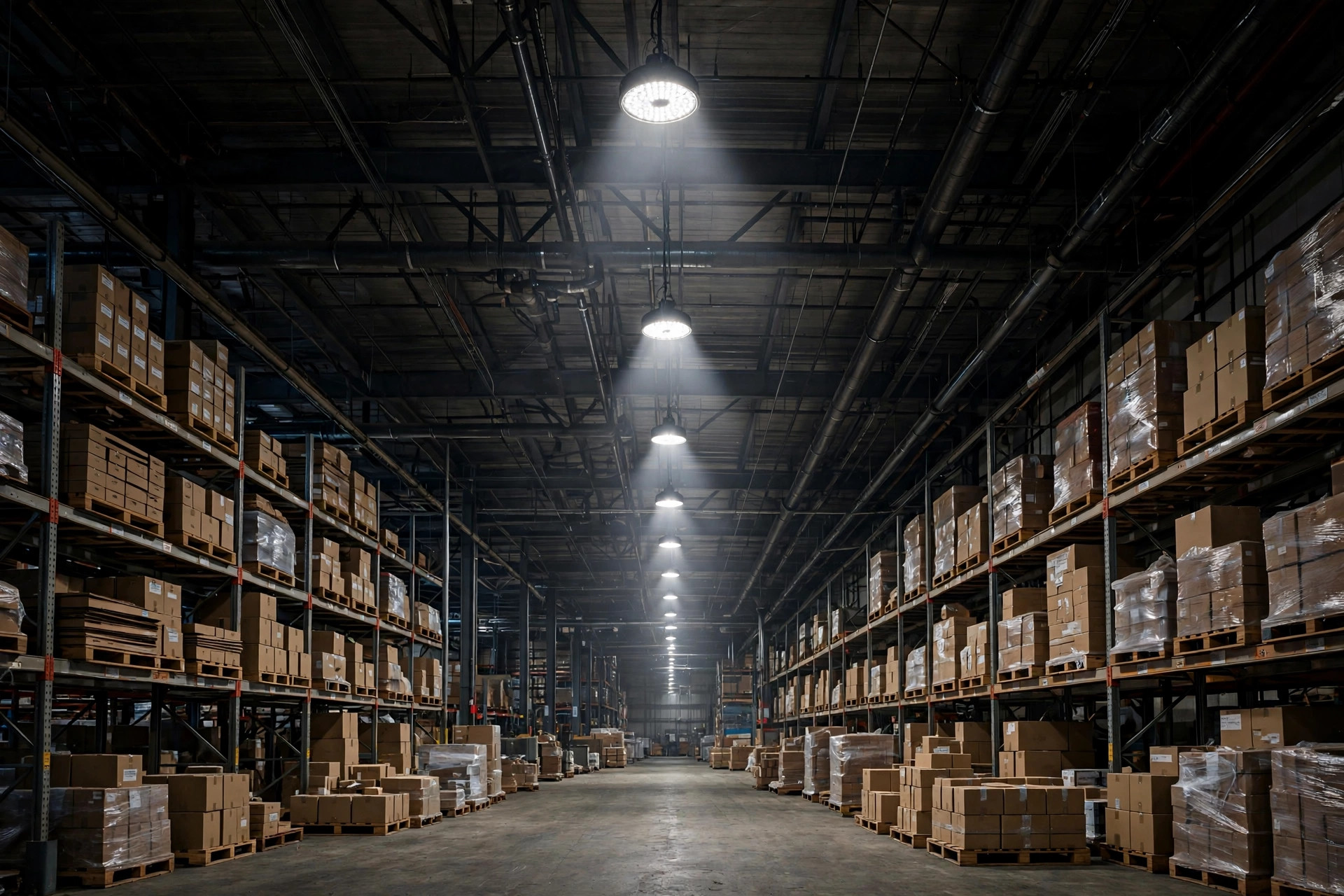
Two jobs, one lesson: warehouse lighting is like salt in cooking — too little and it's bland, too much and it's inedible. Too few fixtures and you're working in the dark; too many and the glare blinds your scanners; put them in the wrong spots and you get bright pools under each fixture with dead zones between them. A forklift rolling from a bright patch into a dark band gives the driver's eyes two seconds to adjust — and those two seconds are when things go wrong.
A buddy in the lighting business told me the trade has had a formula for this all along. It's called the lumen method, and it's grade-school math. Whether you're leasing warehouse space or relamping a building, you want this math in your head before you spend a dime. Here's the plain-English version.
How many lights needed? The one formula that settles it
Number of fixtures = (target illuminance × floor area) ÷ (lumens per fixture × utilization factor × maintenance factor)
Let me translate each piece into human language:
- Target illuminance: how bright you want the floor, measured in lux. A storage area does fine at 150–200; a pick-and-pack zone wants around 300. Those are industry-typical magnitudes — for a real project, go by a lighting standard like EN 12464-1 and your engineer's drawings.
- Floor area: square meters (or square feet — just keep your units consistent).
- Lumens per fixture: printed on the product nameplate. A 150W LED high bay usually puts out around 21,000 lumens, but check the nameplate, not the wattage.
- Utilization factor: how much of the light actually lands on the floor. In a warehouse — high ceilings, dusty air — 0.6 to 0.8 is the honest range; older, dirtier fixtures go lower.
- Maintenance factor: fixtures dim as they age and dust cakes the lenses. Use 0.8 or so. Don't skip it — I'll explain why below.
Let's run a real example. A 5,000 m² building, 10-meter ceiling, storage aisles targeted at 200 lux. 150W LED high bays at about 21,000 lumens each, utilization factor 0.7, maintenance factor 0.8.
Fixtures = (200 × 5,000) ÷ (21,000 × 0.7 × 0.8) = 1,000,000 ÷ 11,760 ≈ 85 fixtures.
85 fixtures over 5,000 m² — each one covers about 59 m², so spacing lands around 7–8 meters. Ceiling is 10 meters, spacing is under the ceiling height, and the floor lights up evenly with no dark bands.
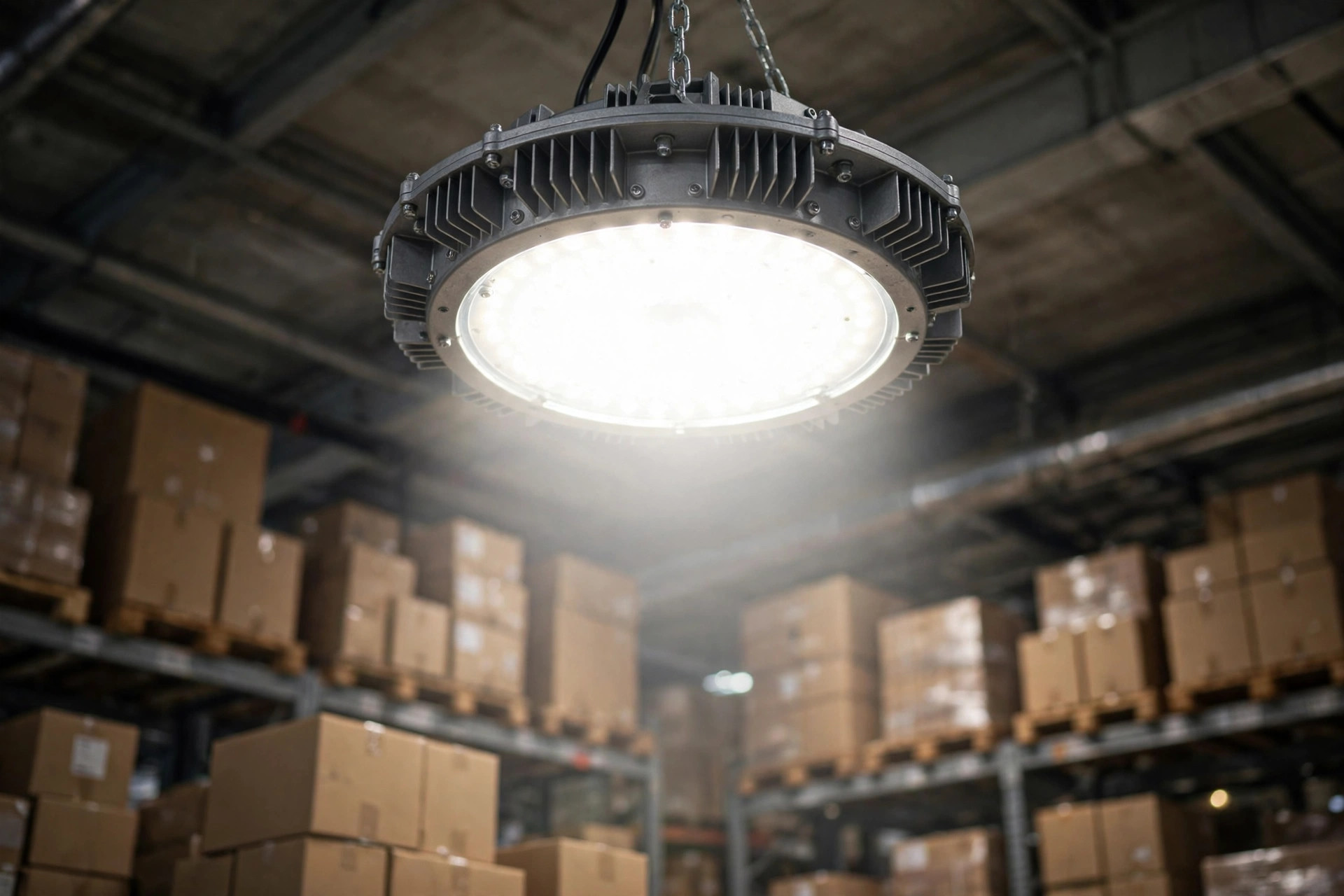
Ceiling height, wattage, spacing: the quick-pick table for warehouse high bay LED lighting
Ceiling height decides the wattage. The higher the fixture hangs, the more light scatters on the way down, so the wattage has to climb. Old hands in the trade carry this cheat sheet in their heads (wattages are magnitudes; buy by the lumen nameplate, never by watts alone):
| Ceiling height | Fixture wattage (typical) | Suggested spacing | Best for | | 6–8 m | 100W | 6–8 m | Low-bay, small buildings | | 8–10 m | 150W | 8–10 m | The most common setup | | 10–13 m | 200W | 10–12 m | High-bay racking | | 13 m and up | 240–300W | 12–15 m | Very high-bay, AS/RS |
One iron rule on spacing: keep fixture spacing at or under the ceiling height. A 10-meter ceiling with fixtures 13–14 meters apart will grow dark bands between them, guaranteed. Half the dark bands I've driven through were born the day somebody trimmed a few fixtures to cut the quote.
Warehouse high bay LED lighting zones: how much light each area needs
One uniform density for the whole building is the most common waste of money. Pick, pack, and inspection zones earn their extra light. Industry-typical levels:
| Zone | Illuminance (typical) | Good for | | Storage racks / aisles | 150–200 lux | Reading labels, finding product | | Pick / pack stations | ~300 lux | Small print, barcode scanning | | Receiving / QC inspection | 300–500 lux | Spotting defects | | Offices / dispatch rooms | ~300 lux | Normal desk work |
Light the task, not the building: the finer the work, the more lux it gets.
Three things most people get backwards
First, uniformity beats peak brightness. When you commission a lighting job, don't stand under a fixture and admire how bright it is — stand halfway between two fixtures and check the dimmest spot. A building that reads 200 lux under the lamp and 80 between them looks bright on paper and feels awful to drive through. Eyes bouncing between bright and dark all shift wear drivers out, and tired eyes miss things.
Second, fewer big fixtures isn't always cheaper. The logic sounds right: hang 200W units, buy fewer of them, save money. Here's the catch — big fixtures on wide spacing wreck your uniformity, and you end up adding fixtures back into the dark zones. Plus, when one big fixture dies, a whole patch goes black. Smaller fixtures spaced tighter: one failure is barely noticeable. And warehouse law says the fixture that dies is always the one over your busiest aisle.
Third, LED dimming is a slow bleed. Fresh out of the box they're all bright; two years in, losing 15–20% of output is perfectly normal (check the product's lumen maintenance curve). A building designed to "just enough" on day one is a dim building by year three — and that's when the crew starts complaining and working by phone flashlight. That 0.8 maintenance factor in the formula is brightness you're pre-paying for two years from now. Don't value-engineer it away.
A real payback story
2023, a logistics park in Hebei — 8,000 m², 9-meter ceiling. They were running 120 metal-halide high bays at 250W each (real draw runs higher once you count the ballasts), burning 12 hours a day. The monthly power bill sat just under ten thousand yuan. We redid the math with the lumen method: storage aisles at 150 lux, 21,000-lumen fixtures, utilization 0.7, maintenance 0.8 — about 102 fixtures, and they installed an even 100 LED high bays at 150W.
The next power bill came in a little over four thousand yuan a month. Sixty to seventy thousand yuan a year back in the owner's pocket — the fixtures paid for themselves inside a year, and the building got brighter to boot. The owner's exact words: "If I'd known the math was this simple, I wouldn't have donated two years of power bills."
Advice for shippers and warehouse managers
Touring a warehouse to lease? Don't only visit in daylight. Before you sign, make the landlord light the whole building at night and walk it. Count the fixtures: in a 10-meter building, spacing wider than 12 meters means dark bands after dark. You can't see them at noon; your first night shift will find them for you.
Before a relamp, run the formula yourself — don't take the lighting vendor's "years of experience" at face value. Vendors earn per fixture; every extra ten units is your tuition money.
Pick color temperature around 5000K, a neutral white. Skip the 6000K-plus "daylight" that looks impressive in the catalog — it glares harder off barcodes and wears out night-shift eyes faster. The grumbling on the night crew starts with the lighting.
And don't light rack aisles and open floor with the same optic. Aisles want narrow-beam lenses (around 60°) that throw the light down the aisle instead of into the racks; open areas want wide beams. That little bit of care costs almost nothing and changes everything.
There's an old saying back home: sharpen the axe before you chop the wood. Get the lighting right, and the midnight run into your warehouse stops feeling like a gamble.
By Shifu Zhao, Trucking Veteran (15 yrs)