Let me start with the bill, because that is where every wire rope decision should start. A planned stacker crane wire rope replacement — rope, labor, and a scheduled shutdown — runs in the low thousands of dollars. A rope that fails at height, with a loaded carriage halfway up the rack, costs a multiple of that before you even count the downtime. These figures are a hypothetical scenario for illustration, but the ratio holds in every warehouse I have costed: the planned job is the cheap one, and it is not close.
A few years ago I reviewed costs for a third-party warehouse in eastern China whose automated storage system had been running for seven years on its original ropes. The maintenance contractor inspected them every year, and every year the report said the same thing: appearance good, continue to monitor. In the eighth year, on a night shift, a crane carrying a full pallet stopped halfway up when the rope parted near the drum. The carriage dropped two levels before the safety device caught it. One pallet of goods was destroyed, two rack uprights were bent, and the aisle was down for four days. The emergency repair bill alone would have paid for replacing every rope in the building twice over. And when the insurer asked for the inspection records and the retirement criteria, the warehouse had very little to show.
The real problem in that story was not that the rope was old. It was that nobody had set a hard line for "continue to monitor." Wire rope retirement is not a judgment call. The international reference is ISO 4309, the standard for inspection and discard of wire ropes. In the United States, ASME B30.2 puts hard numbers on it: retire the rope when you count 12 randomly distributed broken wires within one rope lay length, or 4 broken wires within one strand. When the outer wires have worn down to a third of their original diameter, the rope is done too. These are not suggestions. They are the line, and once you cross it there is no "one more month."
Stacker Crane Wire Rope Replacement Starts With the Inspection Rhythm
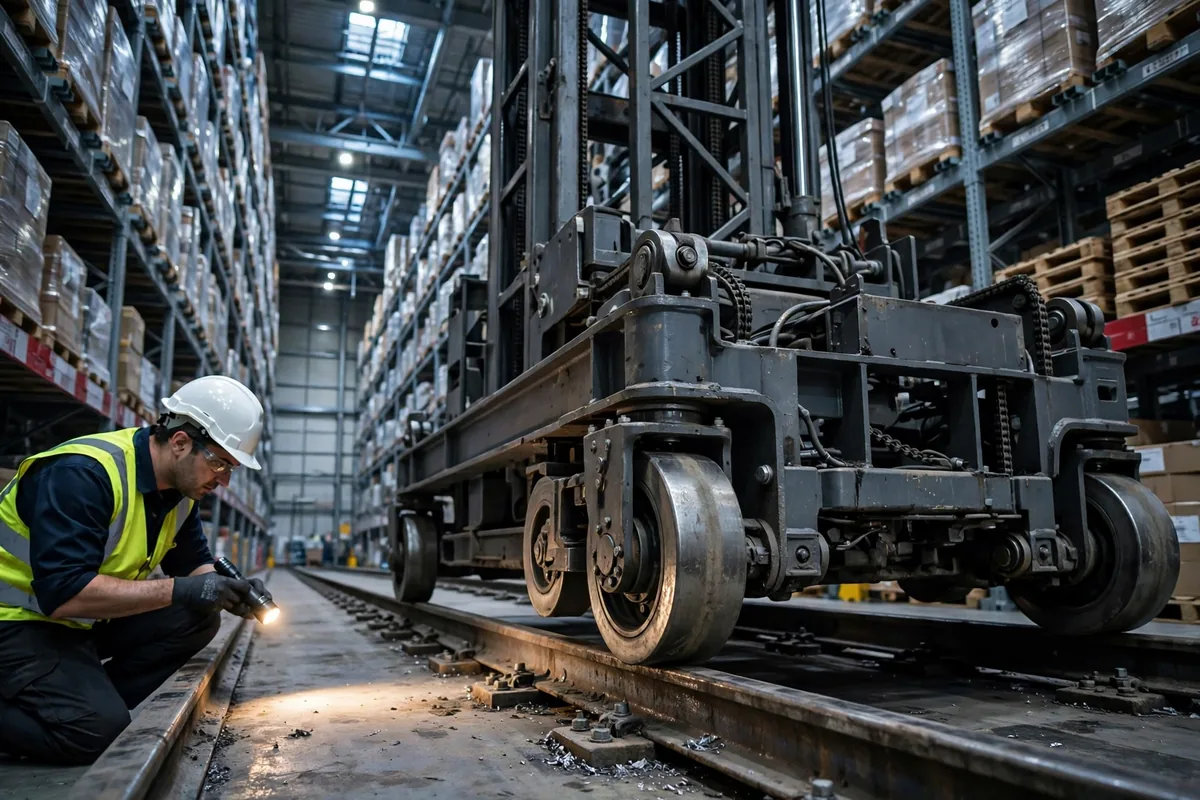
The hardest thing about wire rope is that it usually looks fine from the outside. Broken wires start inside, where strands grind against each other, and by the time the outer wires are visibly thinning and snapping, the rope may already have lost a large share of its strength. Daily visual inspection is the first line of defense: the operator walks the rope before each shift, looking closely at the drum entry, the sheave contact sections, and the end terminations, which is where broken wires and wear show up first. But eyes can only see the surface, so you also need periodic professional inspection, at least once a year, by someone qualified to measure diameter, count broken wires, and check the core.
The U.S. Occupational Safety and Health Administration's rhythm is a good reference point. OSHA 1926.1413 requires a pre-shift inspection, a monthly inspection, and a comprehensive annual inspection of wire rope. Three layers, three different people, and nobody signs for anyone else. I have seen too many warehouses collapse all three into one annual contractor visit and call it done, leaving eleven months to luck. That saves inspection fees on paper and concentrates the risk into one big surprise.
Stacker Crane Wire Rope: Preventive Replacement Versus Running to Retirement
This is the question finance always asks me, and my answer has not changed: for wire rope, there is no "run it to retirement" option. The retirement criteria are the floor. Reaching the floor before you act is parking on the edge of a cliff. The honest comparison is total cost, both ways.
| Preventive replacement | Run to retirement | |
|---|---|---|
| Timing | Inside a planned window, scheduled ahead | The day broken wires exceed the limit — stop now |
| Downtime | Controlled, half a day to a day | Uncontrolled, days of repair plus waiting for parts |
| Direct cost | Rope plus labor, one fixed price | Rope plus labor, plus emergency repair premiums |
| Collateral damage | Practically none | Damaged goods, bent racking, delayed orders |
| Liability | Clean inspection records | Hard questions from insurers and regulators |
The numbers are a hypothetical scenario for illustration: assume a planned rope change costs around 8,000 dollars all in, while a failure with downtime and damage easily reaches 50,000 dollars. Replacing the rope six months early looks like wasting the tail end of its life, but what you buy is a controlled shutdown and a clean record. Run that through any finance lens and the answer points one way.
Here is the counterintuitive part: the most dangerous moment for a wire rope is often not when it is oldest, but right after it has been replaced or adjusted. If the end termination is not seated properly, the drum spooling is uneven, or a worn sheave groove was never dealt with, a new rope can fail faster than the old one. Replacement is not the finish line. The re-inspection in the first week after the change is. Plenty of warehouses treat the rope swap as case closed and skip that check entirely, handing the new rope straight over to luck.
Scheduling the Shutdown Window Without Losing Money
The real cost of a rope change is not the rope. It is the shutdown. One aisle down means picking and replenishment reroute around it, and in peak season there is simply no window. So rope replacement has to follow the business calendar: schedule changes in the slow season, finish inspections before peak, and deal with any rope that flags a problem before peak starts, even if it has not hit the retirement line yet. My approach is to rank every crane's ropes in three tiers by age and inspection results — red goes on the schedule immediately, yellow within three months, green on the annual plan. Every tier decision goes into the maintenance log with broken-wire counts, wear measurements, and inspection dates. No blank rows.
And keep one spare rope in stock. Wire rope is made to order — length, diameter, and construction all matter — and a rush order still takes days. A spare rope of your most common specification is insurance against downtime. The spare needs inspecting too, stored somewhere dry and ventilated. A rusted spare is the same as no spare.
There is no universal number of days for a stacker crane wire rope replacement cycle. Operating environment, load intensity, and duty cycle all rewrite the answer. But inspection rhythm, retirement red lines, and planned windows are three things any automated warehouse can put in place tomorrow. The rope bill is always cheapest before the break.
By Lao Zhou, Logistics Cost Analyst