A sliding shoe sorter does not break down when its shoes wear out. It just gets quietly worse. The mis-sort rate creeps from 0.1% to 0.8% over a few weeks, nobody gets an alarm, and the team burns two weeks retuning WCS divert timing before someone finally pulls a shoe and sees the real problem. I have watched this exact movie play out on a mezzanine in Ohio. Sortation shoe wear is the most common mechanical degradation on these machines and the most misdiagnosed one, because it never announces itself.
How a Sliding Shoe Sorter Actually Diverts
Think of the machine as a high-speed belt with little "riders" sitting on slats every few inches. In normal travel the shoes do nothing. When a parcel is due at chute 12, the PLC works out the lead time from the encoder, an electromagnet fires, and the shoe slides diagonally along its guide track — like a hand sweeping the parcel sideways off a table, sending it gliding into the chute. Belt speeds typically run 2 to 3 meters per second, pushing well over ten thousand parcels an hour.
Everything hinges on that sweeping motion. The shoe's contact face, usually nylon or UHMW polyethylene, has to deliver just the right friction and geometry to transfer force into the parcel. Once sortation shoe wear sets in, the contact face thins and polishes smooth, and the force vector drifts. Worse, the wear cascades: debris from the shoes packs into the guide track, the track clearance opens up, the shoes start to wobble, and divert timing drifts by a few milliseconds. On a machine running 2.5 m/s, a 5-millisecond drift is 1.25 centimeters of position error — enough for a parcel to clip a chute edge, drop into the wrong one, or straddle two chutes. That is the full failure chain of sliding shoe sorter mis-sorts: not one broken part, but the systematic decay of divert precision.
The Counterintuitive Call: Don't Blame the WCS First
Here is where I get blunt. When the mis-sort rate climbs, nine out of ten operations teams reach for the WCS divert-timing parameters first. They tweak, the rate improves slightly, then it creeps back. They tweak again, it creeps back again, until the parameters are unrecognizable and the mis-sort rate is doing whatever it wants.
The logic is simple: a WCS can compensate for a fixed, repeatable timing offset. It cannot compensate for wear that is continuously degrading and different on every single shoe. Using software to patch a mechanical error that changes daily is like putting a lid on a leaking bucket — the water keeps coming out the bottom. The correct triage order is the reverse of what most teams do: mechanical first, parameters second.
In the fall of 2023, a 3PL facility in the Midwest running about 80,000 parcels a day watched its mis-sort rate climb from 0.12% to 0.74% over six weeks. Their engineers went through two full rounds of WCS timing retunes. Nothing moved. They were one round away from pushing parameters outside the vendor's recommended range when we shut the line down for two hours and pulled a section of shoes: of 200 shoes sampled, over 60% were worn past limits, and the guide tracks were packed with debris. That night they swapped the full shoe section and cleaned the tracks; three days later the mis-sort rate was back under 0.1%. Two hours of inspection beat two weeks of parameter tuning. That is the temperament of a mechanical problem.
A 3-Level Sortation Shoe Wear Grading System
Do not wait for the mis-sort alarm. Sortation shoe wear grades into three levels, each with clear physical signs you can check with a caliper and your eyes. The thresholds below are common industry rules of thumb — always defer to your equipment vendor's manual for the exact numbers:
| Level | Visual signs | Quick measurement | Mis-sort signal | Action |
|---|---|---|---|---|
| 1 — Serviceable | Contact face shiny, light scratches | Under ~10% thickness loss | Rate wobbles but stays under 0.3% | Keep running, add to monthly checks |
| 2 — Warning | Step or groove worn into contact face | 10–25% loss, or visibly loose track clearance | 0.3–0.8% and climbing steadily | Plan the swap, order spares now |
| 3 — Replace | Cracked shoe, chipped corners, or shoes jamming in track | Over 25% loss | Above 0.8%, or batch mis-sorts appearing | Stop the line and replace |
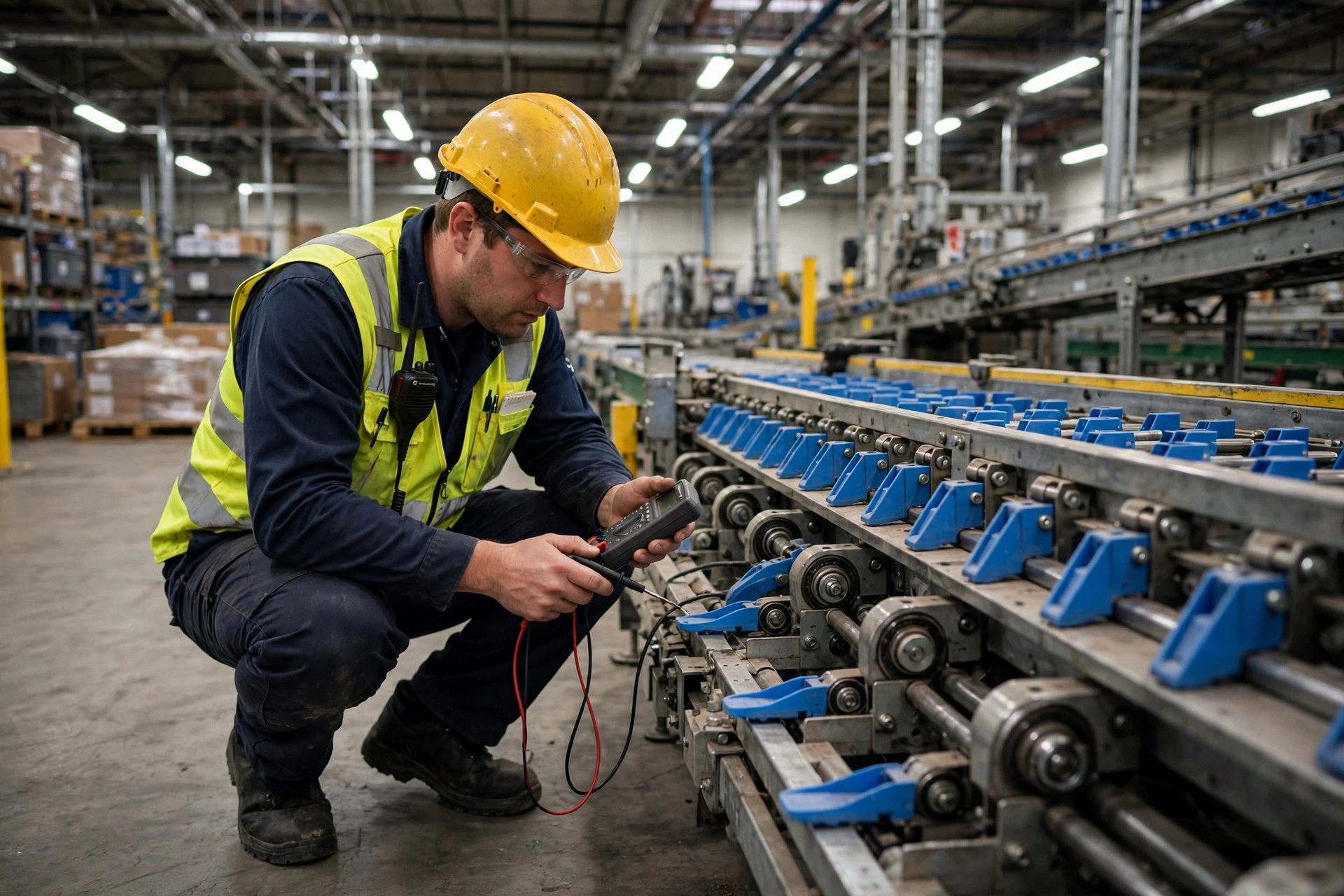
A field trick that works surprisingly well: keep one brand-new shoe as your reference standard. Hold a used shoe next to it and run your finger across both contact faces. If you can feel a step, you are at Level 2 or worse. And while you are down there, run a finger along the guide track — debris buildup means wear has entered its accelerating phase, and your window is closing.
The Line Between a Shoe Swap and a Full Overhaul
First, a shot at a common pseudo-need: if your daily volume is under roughly 20,000 parcels and your SKU mix is stable without big peak swings, you probably should not own a sliding shoe sorter at all. Its sweet spot is high speed, small-to-medium parcels, and large peak-to-valley swings — e-commerce peak season, parcel hubs. Below that volume, a belted diverter or even a manual put wall gives you better economics. Depreciation and maintenance will eat you before the shoes ever wear out.
For those who already run one, Level 2 or 3 wear presents a fork in the road: swap the shoes, or overhaul the whole machine. Run the numbers (USD, approximate — get real quotes from your vendor):
| Item | Shoe swap only (~300 shoes) | Full overhaul (tracks, chain, drives) |
|---|---|---|
| Spare parts cost | ~$8,000–15,000 | ~$60,000–120,000 |
| Downtime | 4–8 hours, one night shift | 3–7 days |
| Downtime cost | ~Half a day of throughput | Days of lost throughput plus outsourced sortation |
| Result | Mis-sort rate back to baseline | Near-new-machine performance |
| When it fits | Wear is the main problem, rest of machine healthy | Chain stretched, tracks deformed, drives noisy — all at once |
In early 2024, an e-commerce DC in Texas came out of peak season at a 0.9% mis-sort rate. The equipment vendor proposed a full overhaul at roughly $90,000. The site team did not sign. They graded the full line with the three-level system first: mostly Level 2 wear, tracks dirty but not deformed, chain and drives in decent shape. A shoe swap plus deep track cleaning cost about $12,000, and the mis-sort rate settled back at 0.15%. The savings covered two more years of spare shoes. Remember the dividing line: wear as the root cause means swap the shoes; only when the chain, tracks, and drives are aging together is a full overhaul worth discussing.
Three Maintenance Traps
Trap one: replacing only the worst few dozen shoes. New and old shoes differ in contact-face height by fractions of a millimeter, which unbalances divert force all over again — the mis-sort rate dips, then bounces back within weeks. Swap the full section or don't bother.
Trap two: swapping shoes without cleaning the tracks. Leave the debris and buildup in the guide tracks and the new shoes will show wear marks within two weeks. Wear is never a single-part problem; shoes, tracks, and cleanliness are one system.
Trap three: skipping the divert-timing recalibration after the swap. New shoes have different friction characteristics than the worn ones they replaced, so the WCS timing parameters tuned for old shoes become a fresh source of error. Run an empty-load plus loaded calibration so the parameters match the new hardware. This step gets skipped an astonishing amount of the time, and it is behind nearly every "the swap didn't quite fix it" story.
Is the money worth it? Look at one number: for every 0.1 percentage point of mis-sort rate the swap buys back, how many parcels per day stop being mis-sorted, times your rework cost per mis-sort — re-sort labor, customer service, reshipment, all of it. If that total beats parts plus downtime, the money is well spent. If it doesn't, keep running to late Level 2 and swap then. Maintenance, in the end, is not a technical contest. It is arithmetic.
By Da Liu, Automation Engineer