I have watched a lot of small parcel sorting robot demo videos. Dozens of little machines zip across the floor, parcels drop into chutes on their own, and the whole thing looks deeply satisfying. What the demo never tells you is whether the system pays back at your volume, whether it turns into a parking lot when you run short on chutes, and who fixes one when it breaks at 2 a.m. So here is the short version: sorting robots win in the middle band — medium volume, lots of chutes, tight floor space. Too little volume and it is overkill. Too much volume and a cross-belt sorter will run circles around it.
How a Small Parcel Sorting Robot Actually Works
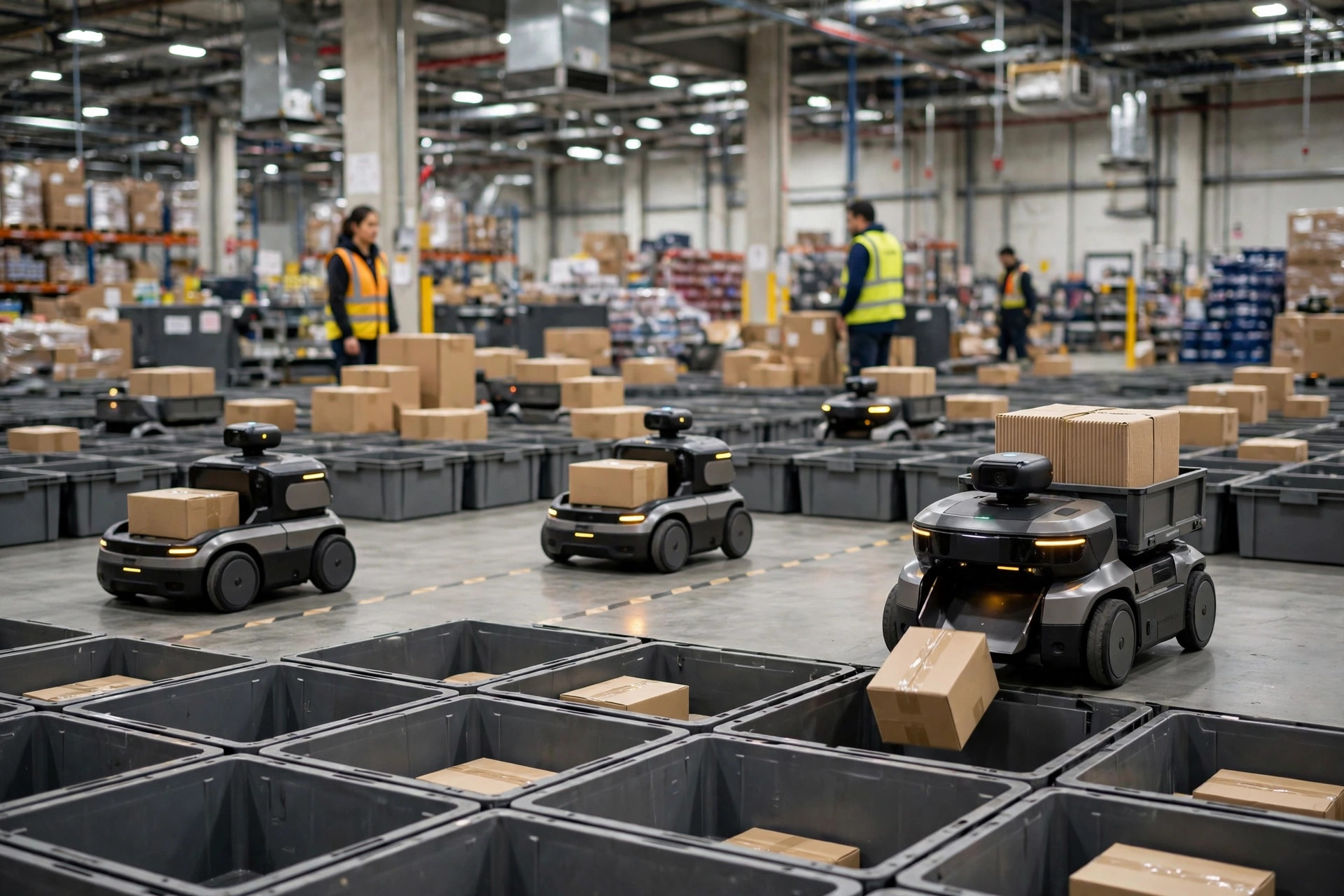
There are two mainstream designs, and the difference matters more than the paint color. The first is the carry-and-tilt type: the robot carries a parcel on top, drives to the target chute, and tips its tray so the parcel drops in. Think of it as a fleet of tiny delivery scooters, each hauling one parcel and unloading itself on arrival. The second is the belt-eject type: the robot carries a short conveyor belt and pushes the parcel sideways into the chute when it arrives. The motion is gentler, which helps with light, floppy poly mailers that love to bounce off a tilt tray.
Either way, one full cycle has four parts: pick up, travel, unload, and return empty. People obsess over top speed. That is the wrong number. What sets your cycle time is chute layout: the farther the chute sits from the induction station, the longer every cycle gets, and the more robots queue up waiting for a gap. Treat vendor spec sheets as a starting point, not a promise. Before you write a business case, measure cycle time on your own floor, with your own parcel mix. The same goes for uptime and mean time between failures. If a number has no measured test behind it, it does not belong in your justification.
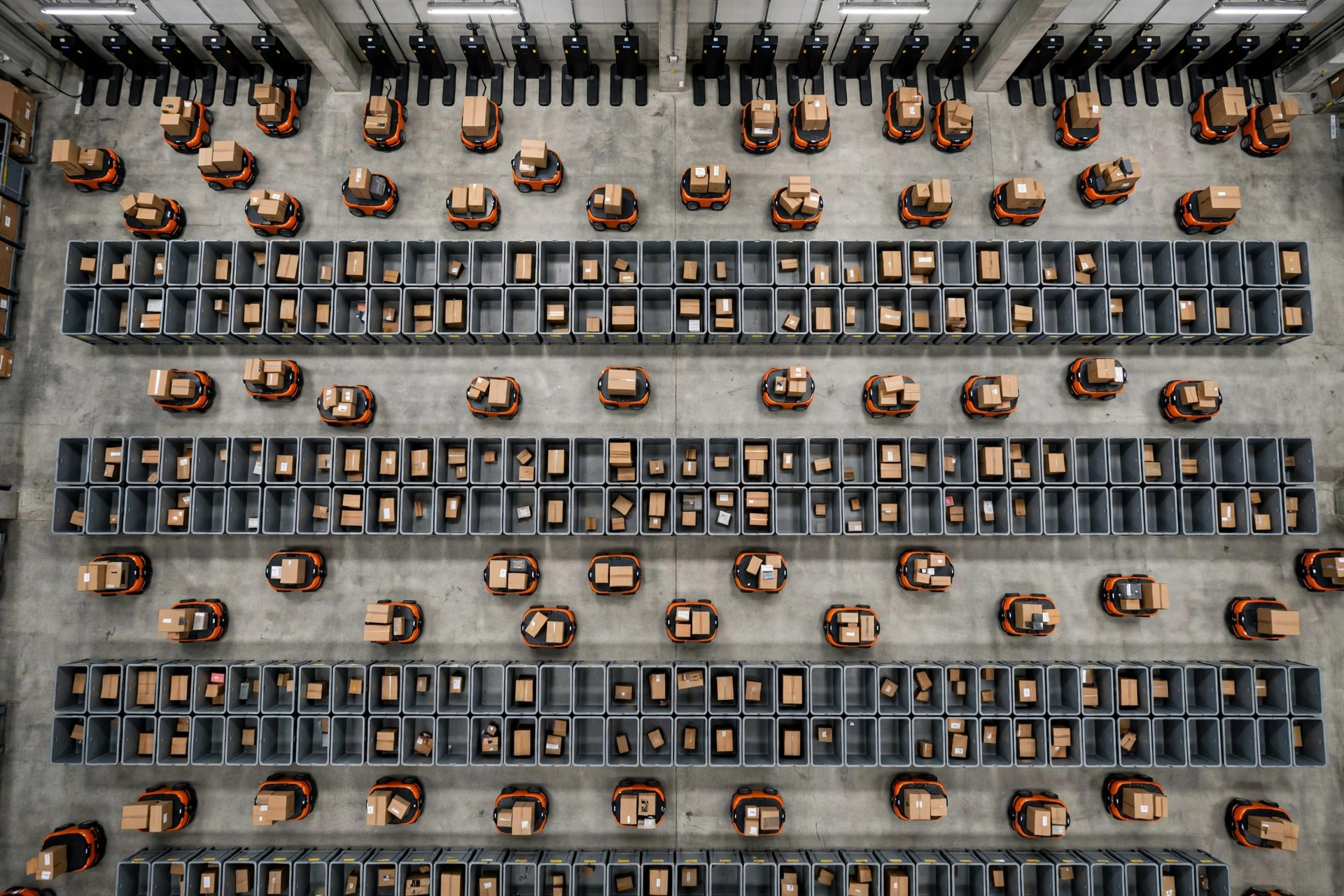
One more thing demos hide: sorting robots save walking, not thinking. The robot only knows which chute to aim for because upstream scanning and the WMS sort logic told it. A crooked barcode or a wrinkled label, and the fastest robot in the world still delivers the parcel to the wrong place. I have seen projects pour the whole budget into robots and staff a single manual induction station, and then watch the robots queue up waiting for parcels. The bottleneck was the human handing them freight.
The Volume Line: When a Sorting Robot Beats a Cross-Belt
Get the denominator right first. Do not size on daily average volume. Size on peak-hour volume. A warehouse averaging 20,000 orders a day can easily push half of that through a three-hour evening peak. If the system cannot survive the peak, it does not work. The robot count math is straightforward:
Robots needed ≈ peak-hour parcels ÷ parcels per robot per hour
And parcels per robot per hour = 3600 ÷ cycle time in seconds × utilization. Take a planning example, clearly labeled as one: a 24-second cycle at 80 percent utilization gives roughly 120 parcels per robot per hour. A 1,200-parcel peak hour needs 10 robots in theory, and 12 to 13 in practice once you add charging rotation and breakdown cover. Plug in your own peak hour and your own measured cycle time, and you get your answer.
Put the three options side by side and the boundary lines show up fast:
| Factor | Manual sort | Small parcel sorting robots | Cross-belt sorter |
|---|---|---|---|
| Daily volume fit | A few thousand orders | Roughly 10,000–30,000 orders | 30,000+ orders |
| Chute count | Dozens | 100–300 | Several hundred, stable long-term |
| Floor space | A few tables | Flat floor, no major rebuild | Fixed install, big footprint, height requirements |
| Investment shape | Mostly labor cost | Mid-range, pay per robot | Heavy one-time spend, long install |
| Scaling | Add people | Add robots and chutes in days | Changing the line is nearly a rebuild |
| Biggest fear | No-shows, peak volatility | Starved induction, odd-shaped parcels | Volume drop, chute layout change |
Treat those bands as planning magnitudes, not vendor guarantees. Confirm with measured cycle times and the vendor's latest quote before anyone approves a budget.
A real case: an apparel e-commerce warehouse in eastern China. Before the 2024 peak season it ran about 8,000 orders a day, then spiked to 26,000. Temp labor simply was not available at that scale. They deployed 60-plus robots and 180 chutes and got through the peak. When volume settled back to 12,000, they pulled 20 robots off the floor and closed a third of the chutes. That is the robot's real edge — it scales both ways. A cross-belt cannot do that.
A second case, a third-party logistics warehouse in northern China: just over 800 square meters, 220 chutes needed. A cross-belt would not fit without knocking down walls and pouring concrete. Robots went straight onto the existing floor and were running within two weeks. But the parcel mix fought back. Long thin boxes and soft packs tipped off the tilt trays too often. The fix was unglamorous: a manual exception chute for odd shapes, robots handling standard small parcels only. Sorting robots are not a cure-all. If your parcel mix is unruly, no machine saves you.
Here is the counterintuitive part: faster is not better. Push the speed up and stopping distance grows, mis-sorts and drops climb, batteries cycle harder, and tires wear faster. There is a second trade-off most plans miss: chute density fights robot count. Pack the chutes tighter and robots spend more time queuing around the chute zone, so per-robot throughput goes down. It is rush-hour traffic — more cars, slower road. Set your chute layout first, then size the fleet. Never the other way around.
Where Sorting Robots Break Down in Real Life
The first failure mode is starved induction. Robots waiting on parcels is more common than parcels waiting on robots. Induction speed caps the whole system. Design induction capacity at roughly 1.2 times full robot throughput, with room for meal breaks, shift changes, and scan failures.
The second is charging and spares with no slack. Robots need charging, chargers need floor space, and a charging robot sorts nothing. Count the charging rotation in your fleet size. Keep spare robots: lose one and you lose capacity, lose two in peak season with no backup and humans are sorting by hand again. Same for spare parts — tires, sensors, tray motors. Keep them on the shelf. The days you wait for a vendor shipment are days your volume does not wait for you.
The third is no exit for exception parcels. Oversized, overweight, misshapen, or damaged parcels cannot ride a robot, so they need somewhere to go. Build a manual exception chute and a reject slide from day one. A system with no exception path will be stopped cold by a handful of odd parcels in the first peak. And do not shrug off small maintenance either. Dust on sensors degrades scanning and obstacle avoidance. Put sensor cleaning and daily inspection on the shift checklist.
So is the money worth it? It comes down to one number: cost per sorted parcel = (equipment amortization + floor space + labor + maintenance) ÷ actual parcel volume. Run it with your own volume. If it beats your current manual sort cost, buy. If the math does not close, wait.
By Da Liu, Automation Engineer