Let me tell you straight: if your apparel warehouse ships fewer than 10,000 orders a day, don't touch a pouch sorter. Past 20,000 a day, sit down and run the numbers seriously. Stuck between 10,000 and 20,000? Then it comes down to two figures — your SKU count and your return rate. That's the whole answer. The rest of this article is me showing you the receipts.
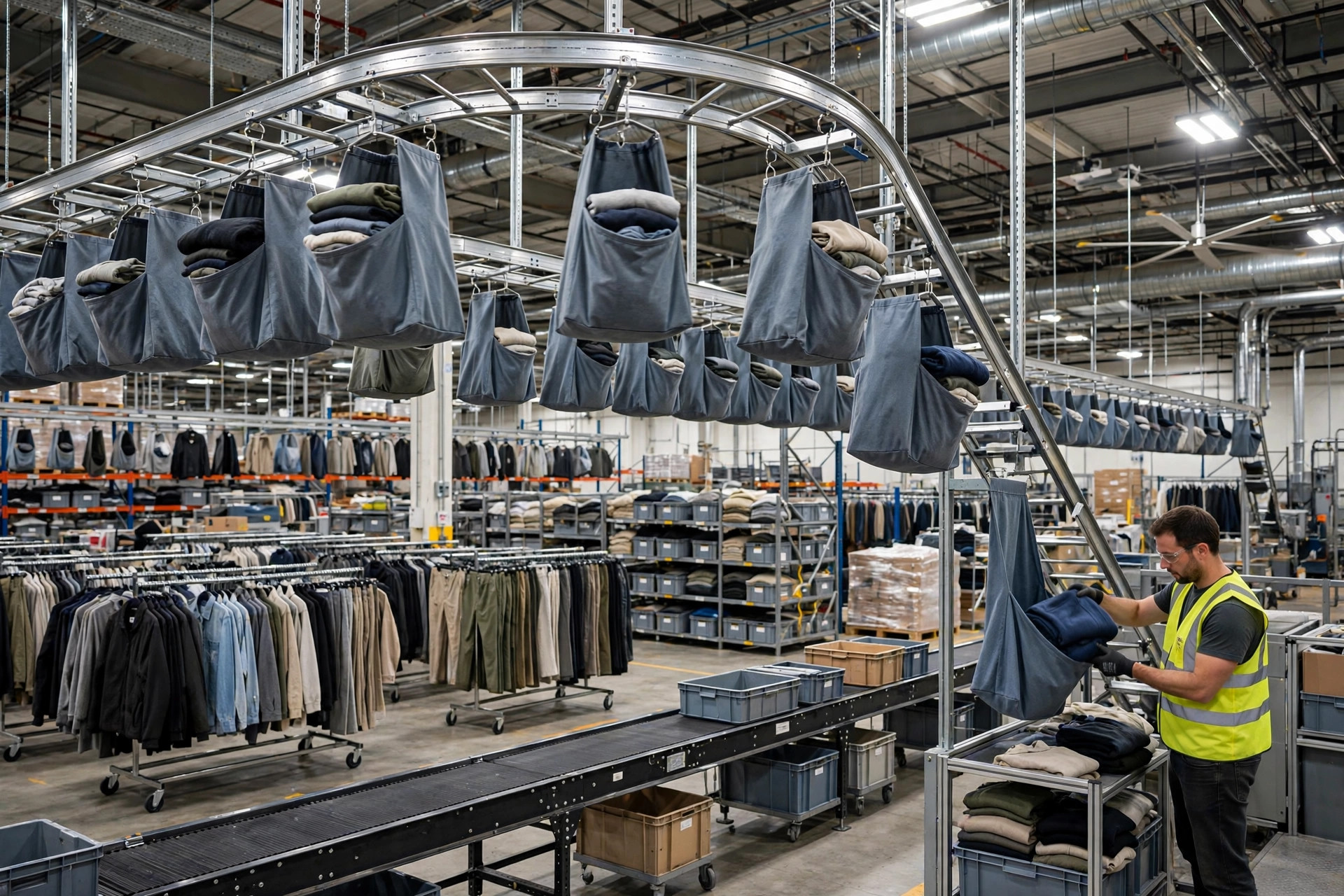
It was 2 a.m. in March 2024. I was waiting on a pickup slip on the dock of an apparel ecommerce warehouse in Ontario, California — a building with a pouch sorter humming overhead. I looked up and saw rows of fabric pouches full of folded clothes gliding silently along steel rails. A worker below stuffed folded tees into the pouches as they passed, and each pouch rode the loop on its own until it dumped its garment into the right order tote at the discharge point. Fifteen years behind the wheel, and that was the first time I ever saw sorting done that quietly.
Ever since, the question I hear most from apparel sellers is: how much daily volume justifies a pouch sorter? So let's do the math, the way a trucker sees it.
The verdict: under 10,000 orders a day, keep your money
Blunt and simple. Under 10,000 daily orders, a manual put wall plus conveyors is still the cheapest way to sort — a pouch sorter at that volume is a money fire. Over 20,000 a day, it's time to talk to vendors seriously. In the 10,000-to-20,000 band, look at your SKUs and returns: more than ten thousand SKUs or a return rate above 20%, and you can lower the bar; concentrated SKUs with few returns, and you wait.
What I took away: in apparel sorting, the bottleneck was never the "sorting" — it was the walking
Here's what makes apparel brutal: every SKU explodes into sizes and colors, so one style can fill a dozen put-wall slots. And returns run 20% to 30% in apparel ecommerce, which means a huge share of garments get sorted twice — once outbound, once when the return comes back for re-inspection and restocking.
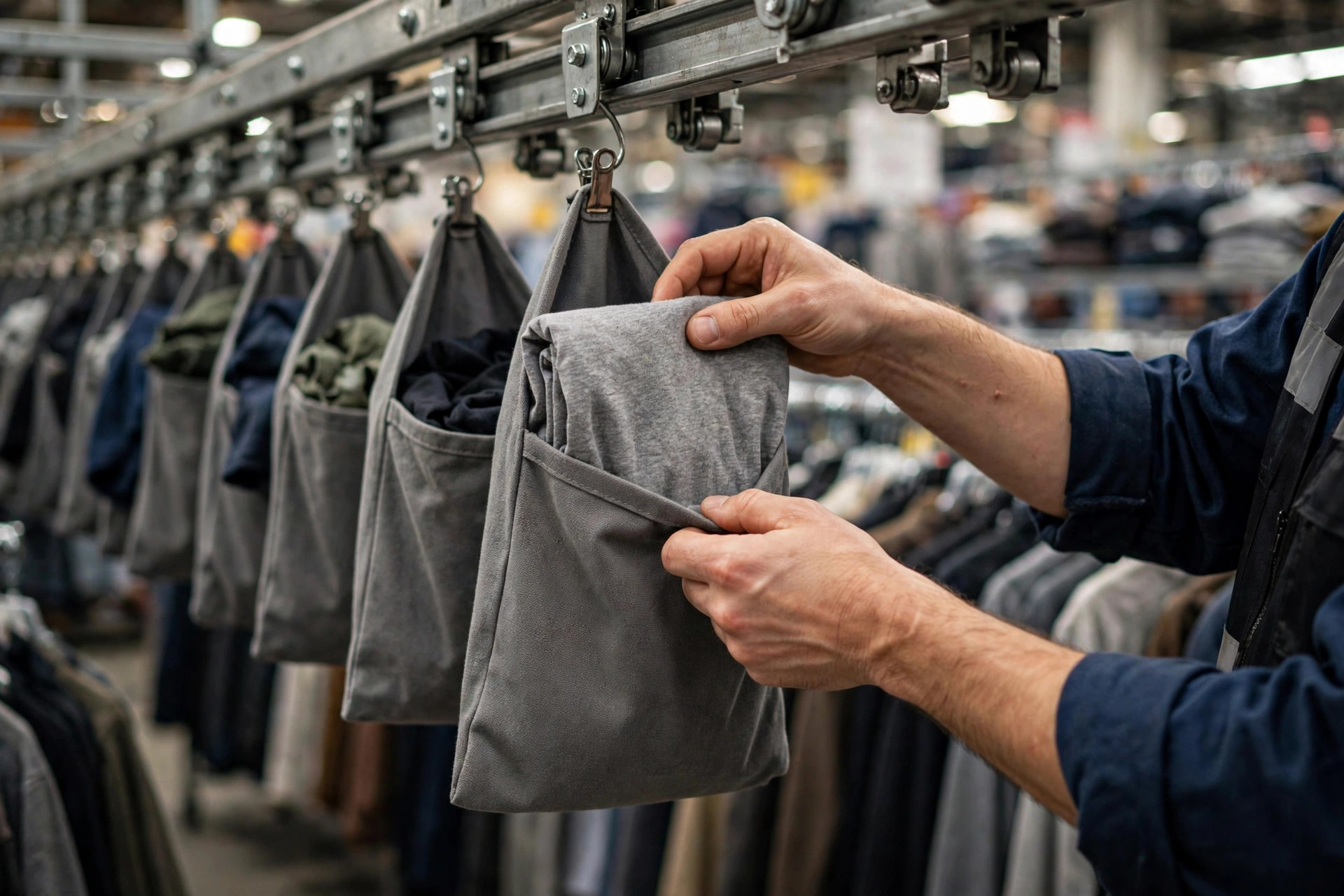
On a manual put wall, workers spend roughly 70% of their time pushing carts and hunting for slots; the actual act of "sorting" is the smaller half of the job. A pouch sorter hands the walking to the overhead rail: garments ride in pouches to fixed pack stations, and people barely move. It also solves a problem unique to apparel — the pouch itself is a buffer. Returns, short picks, and held-for-consolidation garments can simply wait on the rail instead of landing on the floor and needing a home found for them.
Two true stories: one got it right, one got it wrong
October 2023, that same Ontario warehouse — a women's fast-fashion brand doing about 8,000 orders a day. Forty put-wall workers across three shifts, and on the Halloween push the outbound line still wasn't done at 11 p.m. The UPS driver was cursing at the dock door. They commissioned their pouch sorter in March 2024: four induction stations now handle a 20,000-order peak day, headcount cut by more than half, and mis-ships dropped from a few percent to a few per thousand. The owner told me he underwrote it on a three-year payback, and one peak season with each station doing the work of ten people settled the argument.
The cautionary tale is from 2022, near Dallas, Texas. A small streetwear seller pushing just over 3,000 orders a day. The owner came back from a trade show determined to buy a used pouch sorter. The building's ceiling was too low, the overhead rail retrofit dragged on for the better part of half a year, and volume never came close to feeding the machine — while maintenance bills arrived right on schedule. Three years later the system went for used-equipment money. His own words: "Nothing wrong with the machine. My volume just never deserved it."
Pouch sorter vs. cross-belt: where the line is
Apparel warehouse owners always ask me about the other option too — the cross-belt sorter. Here's the dividing line:
| Pouch sorter | Cross-belt sorter | |
|---|---|---|
| Best for | Garments, soft goods, hanging items | Cartons, rigid standard parcels |
| Investment scale | Millions of dollars and up | Same scale or higher |
| Footprint | Runs overhead, saves floor space | Big floor loop, eats square footage |
| Volume threshold | Worth discussing at 10k–20k orders/day | Worth discussing at 30k–50k units/day |
| Returns re-sorting | Natural fit — the pouch is the buffer | Returns still need manual handling |
| SKU scale | Comfortable from thousands to tens of thousands of SKUs | Too many SKUs starve the chutes |
One line to remember: if you sell clothes, the pouch sorter was practically built for you. If you sell standard cartons, stay out of this conversation — cross-belt is your machine.
The counterintuitive part: the most expensive thing isn't buying the machine — it's letting it idle
Most ROI math I see only counts "labor saved," and that's the wrong math. The real cost structure of sortation equipment is depreciation and maintenance — and depreciation doesn't care whether the loop runs 4 hours a day or 20. So there is exactly one correct way to justify a pouch sorter: can your daily volume keep it fed at 60–70% or more of its rated throughput (vendors advertise north of 10,000 units an hour)? If not, every dollar of saved labor goes straight back into depreciation, and then some.
There's a trade-off nobody talks about enough: the pouch sorter merges sorting and buffering into one system, which kills a mountain of totes and double-handling — but you pay in complexity. WMS integration, induction-station takt time, exception-pouch handling: if any one link stumbles, the whole loop slows down. The manual put wall's underrated virtue is fault tolerance — lose one person, replace one person. Below the volume threshold, manual isn't backward. It's flexible.
Honest advice for shippers and warehouse owners
First, model three years of volume, not the peak. A warehouse doing 50,000 orders on Black Friday and 8,000 on a normal Tuesday can still lose money on a pouch sorter — the machine depreciates 365 days a year, not the 30 days of peak season.
Second, check ceiling height and structural load before anything else. The rail hangs overhead, and reinforcing an old building is the cost everyone underestimates. Get a structural engineer to look before you sign.
Third, if your return rate is over 20%, move the pouch sorter up a tier in value — returns re-sorting is the most expensive manual labor in the building, and it's exactly what this machine is best at.
Fourth, write spare-parts response time into the maintenance contract. An hour of downtime in peak season can cost ten times what it costs in February. That clause matters more than squeezing the purchase price.
And I'll leave you with an old saying from back home: only the foot knows whether the shoe fits. The pouches spinning happily in someone else's warehouse might be a money pit in yours. Volume not there yet? Don't envy them. Volume there? Don't hesitate — every day you wait, your workers are paying the "manual tax" for you.
By Shifu Zhao, Trucking Veteran (15 yrs)