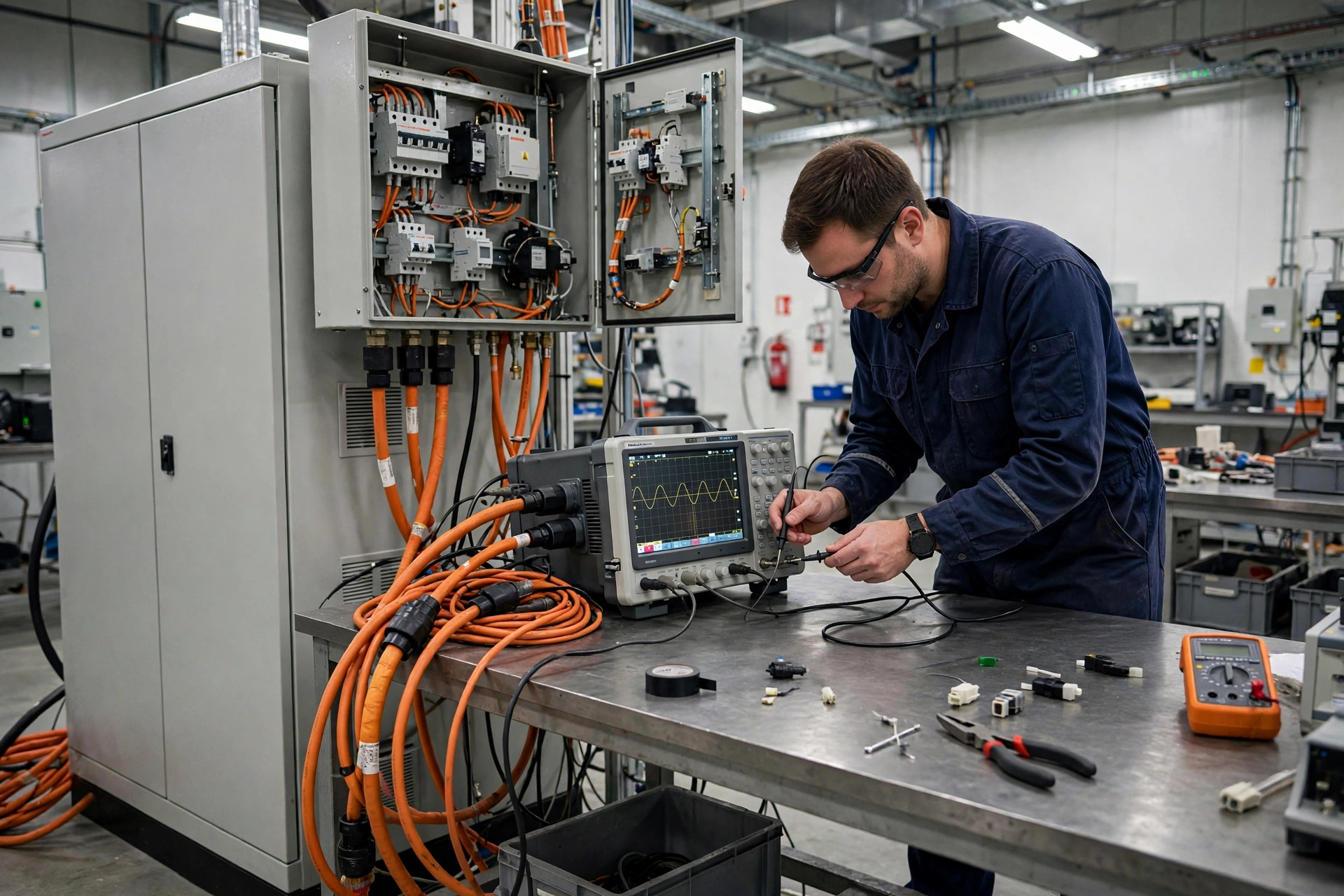
Fall 2023. A Shenzhen manufacturer ships six control cabinets for stacker cranes to Toronto, ready to power up a client's automated warehouse. The build quality is fine. The CE marks are printed nice and straight. Then the Ontario electrical inspector walks the site, takes one look, and says: no CSA certification, no field evaluation label, no energizing. Six cabinets sit in a bonded warehouse for five weeks while the company scrambles through an SPE-1000 field evaluation, getting each unit labeled one by one. Storage fees, evaluation costs, and late penalties added up to more than a full certification would have cost in the first place.
That is the reality of the Canadian market. If you sell warehouse equipment into Canada, CSA certification is the stamp that gets you through the door. A CE mark is just a piece of paper there, and even a US UL mark does not always cut it. Here is the whole thing, taken apart.
What CSA Certification Actually Is: Canada's Gate Pass
Think of it this way: the Canadian Electrical Code only allows "approved" equipment to be energized, and "approved" means carrying a mark from a body accredited by the Standards Council of Canada (SCC). CSA is just one of them — UL's cUL, Intertek's ETL (tested to Canadian standards), and TUV sit alongside it. One rule governs everything: the mark has to be issued against Canadian standards.
It is like a driver's license: your EU license (CE) can be perfectly legitimate, but you still need the locally recognized one to drive in Canada. Three "I thought" assumptions burn manufacturers every year — CE works globally, UL covers all of North America, CSA-approved components mean the assembly is fine. Each one is worth a few hundred thousand in tuition.
Let me call out a fake need while I am at it. Some shops ship CE-marked cabinets to Canada with the nameplates swapped and a lookalike "CSA" sticker slapped on. That is not certification — that is forgery. An inspector checks the certificate number and the whole shipment gets held, the manufacturer lands on a watchlist, and every future shipment gets inspected. There is no saving money on this.
The Three Paths of CSA Certification for Warehouse Equipment in Canada
There are exactly three ways through. No fourth option.
Path one: full product certification. Send your control panel or conveyor control system to a lab for the complete test program under CSA C22.2 No. 14 (Canada's counterpart of UL 508A), earn the certificate, and accept annual factory audits. Expect costs in the tens to low hundreds of thousands of USD — confirm with the certification body for an actual quote — and a 12 to 24 week timeline. It fits standardized products with high volumes and frozen designs: certify once, label every unit, and inspectors generally wave you through.
Path two: SPE-1000 field evaluation — the door left open for small runs and custom builds. CSA SPE-1000 is explicit: no more than 500 units per model per year, one-off custom equipment, and equipment already installed and awaiting acceptance. An inspector comes on site, runs three mandatory non-destructive tests, and a SCC-accredited inspector personally applies a serialized evaluation label to each unit that passes. Pricing is per unit — a few thousand CAD per unit is the common order of magnitude, plus travel, with the actual quote from the agency — and the timeline runs 2 to 4 weeks. The Shenzhen company from the opening story took this path.
Path three: cULus dual certification. If you are already selling into the US, do UL first, then add the Canadian deviations and walk away with the cULus dual mark. The incremental cost is far lower than a standalone CSA certification run, and the timeline is shorter. For anyone serving both the US and Canadian markets, this is the cheapest play in the book.
Which path fits you? Run it through this:
| Full product certification | SPE-1000 field evaluation | cULus dual certification | |
|---|---|---|---|
| Volume fit | Over 500 units/model/year, repeat production | Under 500, custom builds, already installed | US + Canada markets |
| Timeline | 12–24 weeks | 2–4 weeks | Incremental on top of UL |
| Cost order | Tens to low hundreds of thousands USD, one-time plus annual fees | Per unit, a few thousand CAD each | UL base plus Canadian deviations |
| How hard it opens doors | Strongest — inspectors rarely push back | Serialized per-unit label, valid for that unit only | Accepted on both sides of the border |
| The catch | Change the design without notifying and the certificate dies | Every unit gets inspected; labels do not transfer | Assumes you have the UL base |
The Selection Line: Which Equipment Takes Which Path
The first dividing line is voltage. Industrial sites in Canada commonly run 600 V class systems — 600Y/347 V is everywhere — while shops used to the US habitually spec 480 V. Real case from 2024: an integrator built a conveyor sortation line for the Greater Toronto Area with motors and drives all selected for 480 V. The customer's distribution turned out to be 600 V. Emergency transformers, rewiring, three weeks of schedule gone. Certification covers safety, not whether your equipment actually runs on the customer's power — voltage selection is the manufacturer's own homework, and no certification body will do it for you.
The second dividing line is marking. Canada requires equipment markings in English or French — Quebec is a French-speaking province and enforces this hardest — and the short-circuit current rating (SCCR) must be marked explicitly. Plenty of cabinets leave the factory with the SCCR field blank. An inspector fails that on sight. This is a ten-minute job at the design stage and a rework nightmare in the field.
The third dividing line is the province. Inspection authority in Canada sits with each province's AHJ: ESA in Ontario, RBQ in Quebec, and enforcement temperament varies. Before signing the contract, ask which agencies the customer's provincial AHJ recognizes. Do not walk into Quebec with Ontario experience and hope for the best.
Five Pitfalls That Bite at Delivery and Maintenance
Pitfall one: certifying components but not the assembly. Your breakers, contactors, and PLCs can all be CSA-approved and the cabinet still counts as zero. Canada releases complete equipment, and the inspector looks for the assembly-level mark. Practitioners on industry forums report the same story: EU-built equipment with every component certified still gets held for full certification or field evaluation. Component approvals do not substitute for assembly approval.
Pitfall two: modifying wiring on site without re-evaluation. The integrator tweaks a wire run during installation, swaps a breaker model — and the evaluation label still belongs to the old configuration. Found at re-inspection, the label is voided and the evaluation starts over. Remember: the label is bound to the equipment in its current state. Touch the electricals, re-confirm.
Pitfall three: treating CE as a passport. CE is a European self-declaration; Canada does not recognize it. Worse, some CE equipment is designed for 230 V / 50 Hz while Canada runs a 60 Hz grid — motor speeds and transformer parameters all need recalculation. Forcing CE equipment onto a Canadian site means rework on both the electrical and mechanical sides.
Pitfall four: ignoring provincial AHJ differences. Ontario's ESA and Quebec's RBQ are not the same animal, and Quebec's French marking requirement is non-negotiable. Writing "complies with Canadian standards" in the contract is not enough — spell out delivery against the customer's provincial AHJ requirements, and ideally have the customer name the acceptance agency.
Pitfall five: changing the design after certification without reporting. A certified cabinet gets a cheaper breaker brand the next year, unreported. The annual factory audit catches it, the certificate is suspended, and every shipped batch needs supplementary evaluation. Certification is not a one-time purchase — it is ongoing compliance.
Here is the counterintuitive call: the most expensive option is not the safest. For low-volume custom builds, full certification is the worst deal on the table — a six-figure sum over 20 units a year means thousands per unit. SPE-1000 field evaluation charges per unit and inspects every single one, yet the total bill often comes in at less than half, three times faster. There is no best certification. There is only the one that matches your shipment rhythm.
So is the money worth it? It comes down to one number: total certification or evaluation cost per unit, versus the cost of getting stopped — warehouse rent, delay penalties, lost customer trust. That Shenzhen company watched six cabinets sit for five weeks, and the damage would have paid for two full certification runs. In the business of exporting warehouse equipment to Canada, compliance money is always the cheapest line item on the invoice.
By Da Liu, Automation Engineer