

Last fall I walked through an electronics components distributor's warehouse in Dongguan: tens of thousands of SKUs, fewer than 400 orders a day, more than 20 lines per order on average. Pickers pushed carts up and down flow racks; one wrong component and the whole batch went back for rework. The warehouse manager told me they had priced AMRs — roughly two million yuan for a starter fleet — and the board killed it on the spot. Paper picking, meanwhile, bled errors every day. "Is there anything in between?" There is: the DPS, the digital picking system — a warehouse picking setup where electronic tags, not paper lists, tell the picker what to grab. This piece unpacks what a digital picking system actually is, what the published numbers say it is worth, and which warehouses end up regretting the purchase.
First, the naming mess: what a digital picking system actually covers
Digital picking system translates cleanly, but the industry's naming is a persistent mess — worth two minutes to untangle, because selection meetings routinely burn half an hour on it.
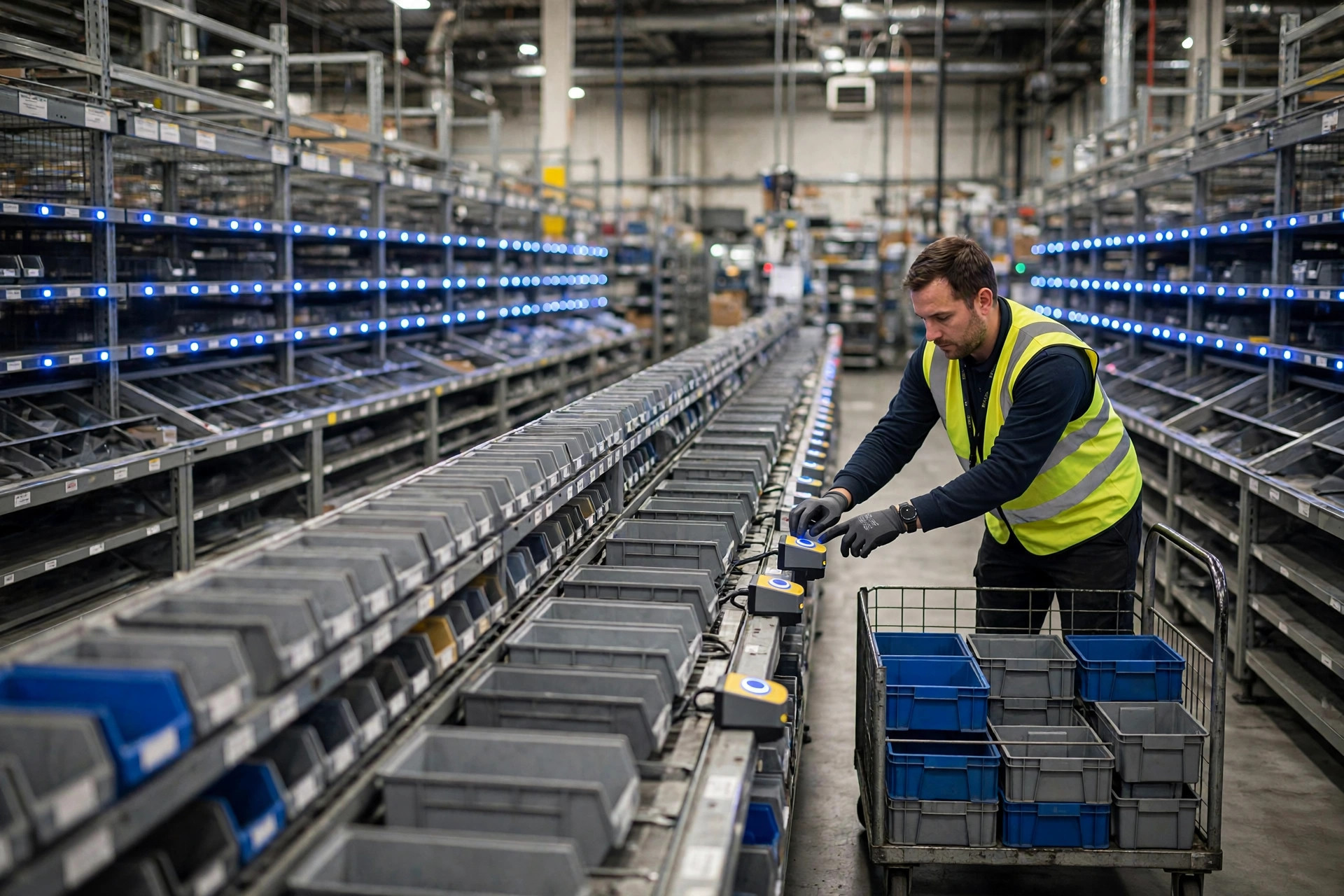
In the Western vocabulary, DPS is the umbrella term: any setup where electronic tags (a light, a quantity display, a confirm button) direct manual picking counts as a digital picking system. PTL — pick-to-light — is just one implementation: lights mounted on the rack, the picker takes from wherever glows. Alongside it sit put-to-light (lights on order slots; you "sow" goods into the right order), pack-to-light, and pick-to-display.
In the Japanese vocabulary, though, DPS means pick-style electronic-tag picking specifically, while sow-style gets its own name, DAS (Digital Assorting System). So when one proposal says "DPS" and another says "PTL plus a put wall," they may describe the same hardware in different dialects. My advice: read the topology diagram, not the title. Whether the lights sit on storage locations or on order slots determines whether you are buying pick-style or sow-style.
The working principle itself is simple: each location gets a tag module, the WMS releases a wave, every location with a pick lights up showing the quantity, the picker takes the units, taps the confirm button, the light dies, and the picker moves to the next glowing location. Information flows WMS → controller → tag; confirmation flows back the other way.
What the lights actually change: numbers with published sources
The directional finding first: lights delete "search" time, not "travel" time. The numbers below all have public sources.
According to a published case in Modern Materials Handling, Australian supplements distributor Symbion consolidated six warehouses and deployed mobile pick carts fitted with electronic tag modules. Picker headcount fell from 23 to nine, throughput beat the pre-move baseline within a week of go-live, and the error rate dropped from roughly one order in five to roughly one in fifty — and was still falling.
According to public figures reported by Material Handling & Logistics, US food distributor SimonDelivers runs pick-style electronic tags in its cooler and freezer at 99.8% accuracy, and sow-style tags in dry goods at 99.93%. The dry side runs slightly hotter partly because items like bananas carry no barcode — a reminder that no light, however bright, fixes goods that cannot be scanned.
Then a controlled experiment: a 2025 study in Sensors (MDPI) put 71 subjects through paper, pick-by-light, and pick-by-point picking. Pick-by-light was the fastest of the three and the fastest for newcomers to learn; pick-by-point, with its scan-to-confirm step, was the most error-proof. The authors' attribution was blunt: the light eliminates the cognitive load of read-list, memorize-location, walk-back, double-check.
Finally, a modeled number from an Abel Womack white paper: cutting the mispick rate from 1% to 0.1% cuts total mispick cost by about 90% (modeled at $100 per mispick). The value of that figure is order-of-magnitude, not precision — the bulk of a mispick's cost was never the item, it was the customer service, the return, the rework labor.
The attribution is now clear: a digital picking system converts "human finds goods" into "light finds human." It deletes not a single step of walking — only the finding and the confirming. So its ROI ceiling is set by one variable: what share of your pick time is currently spent finding.
Who should buy: read your order profile first, then this table
When I judge whether a warehouse fits DPS, I ask three questions. First, do orders routinely exceed 10 lines — the fewer the lines, the less the light is worth, because there was never much "finding" to delete. Second, how stable is your slotting — DPS tags are bolted to locations, and a warehouse with heavy SKU churn and constant re-slotting will watch the maintenance of tag moves and remapping eat the gains. Third, in your error mix, which dominates: wrong slot, or wrong look-alike SKU? The light only fixes the first; look-alikes (resistors that differ by one band, part numbers one letter apart) still need scan verification.
| Approach | Good at | Afraid of | Cost scale |
|---|---|---|---|
| Paper / RF scan (baseline) | Everything, flexible | High lines per order, many rookies, 10k+ SKUs | Low |
| DPS, pick-style electronic tags | 10+ lines per order, thousands to tens of thousands of SKUs, stable pick faces | Frequent re-slotting, many look-alike SKUs | Medium: tag hardware + controller + WMS integration |
| Put wall (put-to-light) | Many orders in parallel, small e-commerce orders, returns re-sorting | Bulky items, few orders per wave | Medium-high |
| Voice picking | Full-case / full-pallet, freezer work with gloves | Noisy environments, huge SKU counts straining the voice catalog | Low: no physical infrastructure |
Illustrative math, not a quote: a 400-tag pick zone running 8,000 lines a day, modeled at the publicly cited ~25% productivity uplift, frees roughly two picker-equivalents per day. On errors, the "1% to 0.1% mispick at $100 per mispick" framework puts annual savings in the hundreds of thousands of dollars — though that figure is highly sensitive to local labor cost. On the cost side, the ranking usually runs: WMS integration ≥ tag hardware > controllers and wiring. Most budgets count the hardware and forget the integration, which is the most common modeling error I see.
The profile, in one sentence: many lines per order, thousands to tens of thousands of SKUs, hundreds to low thousands of orders a day, a reasonably stable pick zone — auto parts, electronics components, pharma distribution, MRO spares. That is the digital picking system's home turf.
The counterintuitive part: it was never a cure for walking
Here is the counterintuitive judgment, worth stating plainly: a digital picking system saves cognition, not distance. If your pickers spend 60% of the day walking — a big building, scattered slotting, no waving — the walking will eat most of the return. In that situation, ABC zoning, pulling fast movers into the golden zone, and wave consolidation cost an order of magnitude less and may return more. The light solves "standing at the rack, not knowing which one"; it does nothing for "still 200 meters from the rack."
Three pitfalls, ranked by how underestimated they are. First, tags are living things. SKU additions and removals and slot changes mean moving tags, remapping, and syncing WMS master data — and in high-churn warehouses that maintenance labor is routinely budgeted at zero. Second, the integration. The DPS controller must handshake with the WMS in real time — wave release, confirmation callback, exception holds. Where the WMS has no standard interface, integration becomes the second-biggest cost after hardware, and the most common source of schedule slip. Third, the confirmation-button illusion. Tapping the button proves you visited the right slot; it does not prove you grabbed the right item. Look-alike SKUs sharing a slot are invisible to the light. Warehouses heavy on look-alikes need light-plus-scan as standard; light alone is flying blind.
On trend: per integrator observations cited by Modern Materials Handling, large greenfield pick-to-light projects have thinned out in recent years, with growth shifting to put walls and goods-to-person — the driver being e-commerce, which made multi-order parallelism the dominant order profile. That does not make DPS obsolete: for the small warehouse it may be the only reachable "first semi-automation," an order of magnitude cheaper to retrofit than AMRs or shuttles.
So I will leave the open question: if goods-to-person pricing falls within small-warehouse reach in five years, are today's tags a bridge asset or a sunk cost? My call depends on the timeline: if your SKU structure stays largely stable for five years, the tags are an asset — they standardize the pick process, and standardization is the precondition of all automation. If half your SKUs turn over every year, they are closer to sunk cost, and the maintenance will drag you down first. The answer is not in the spec sheet. It is in your SKU lifecycle.
By Dr. Chen, Supply Chain Researcher


