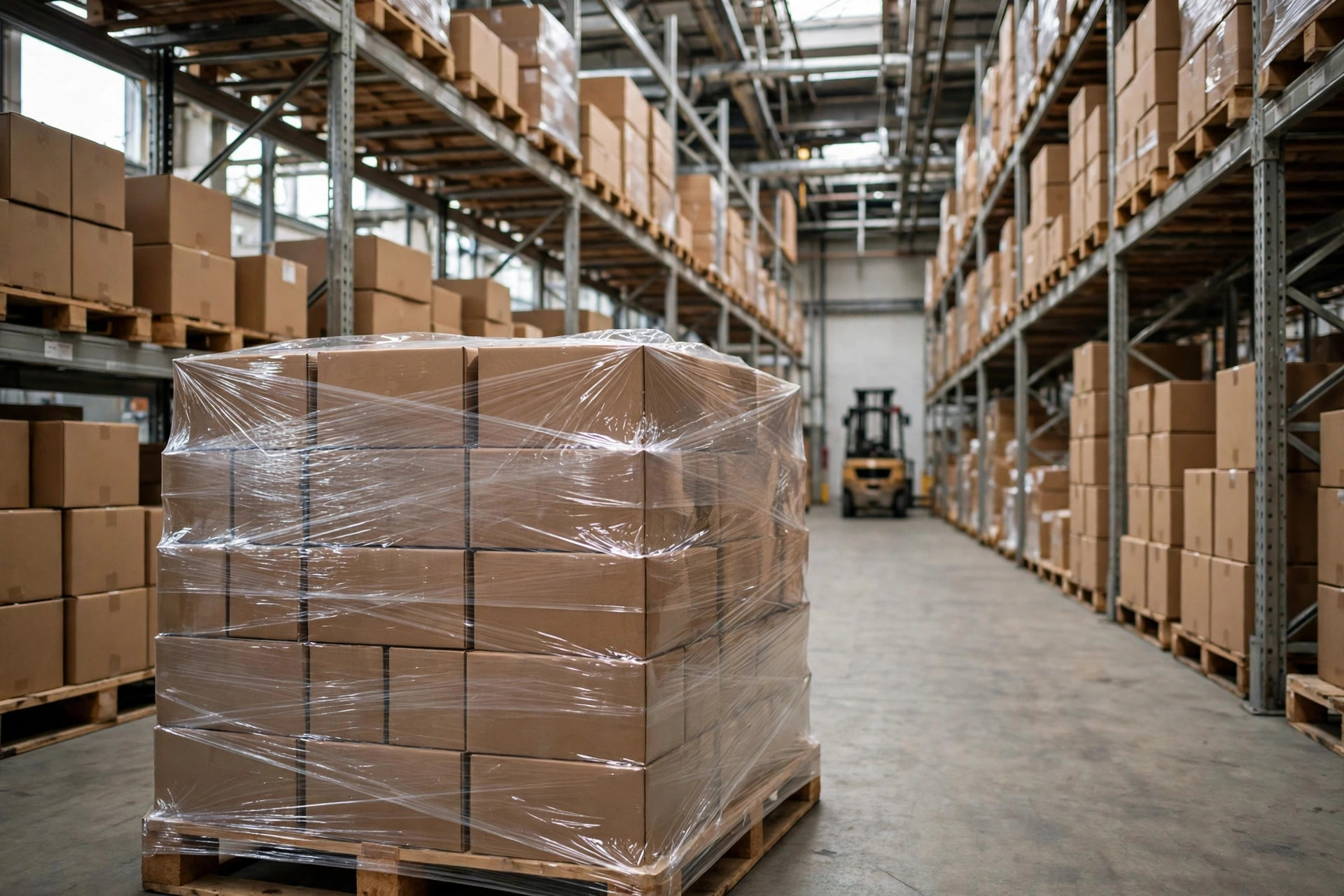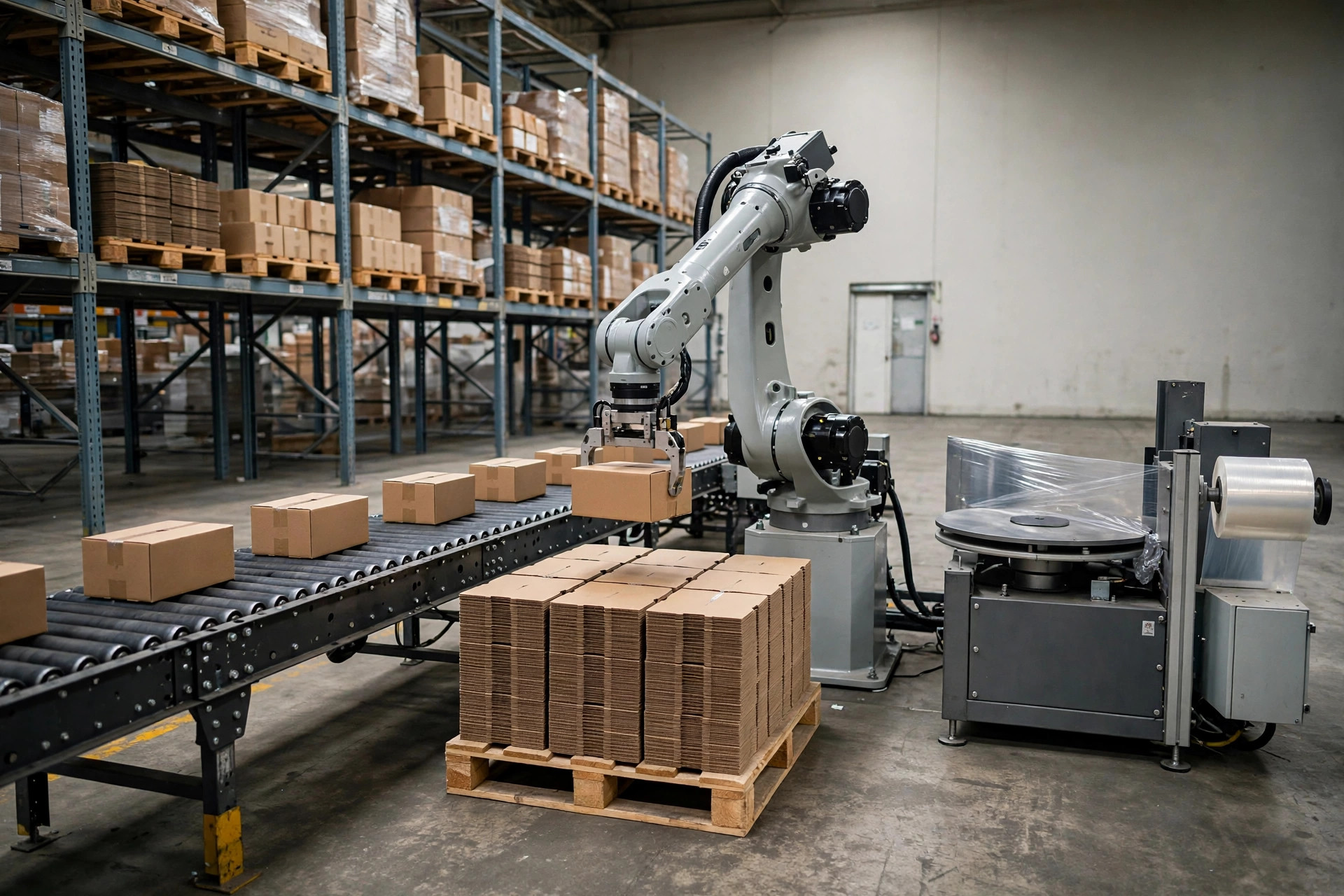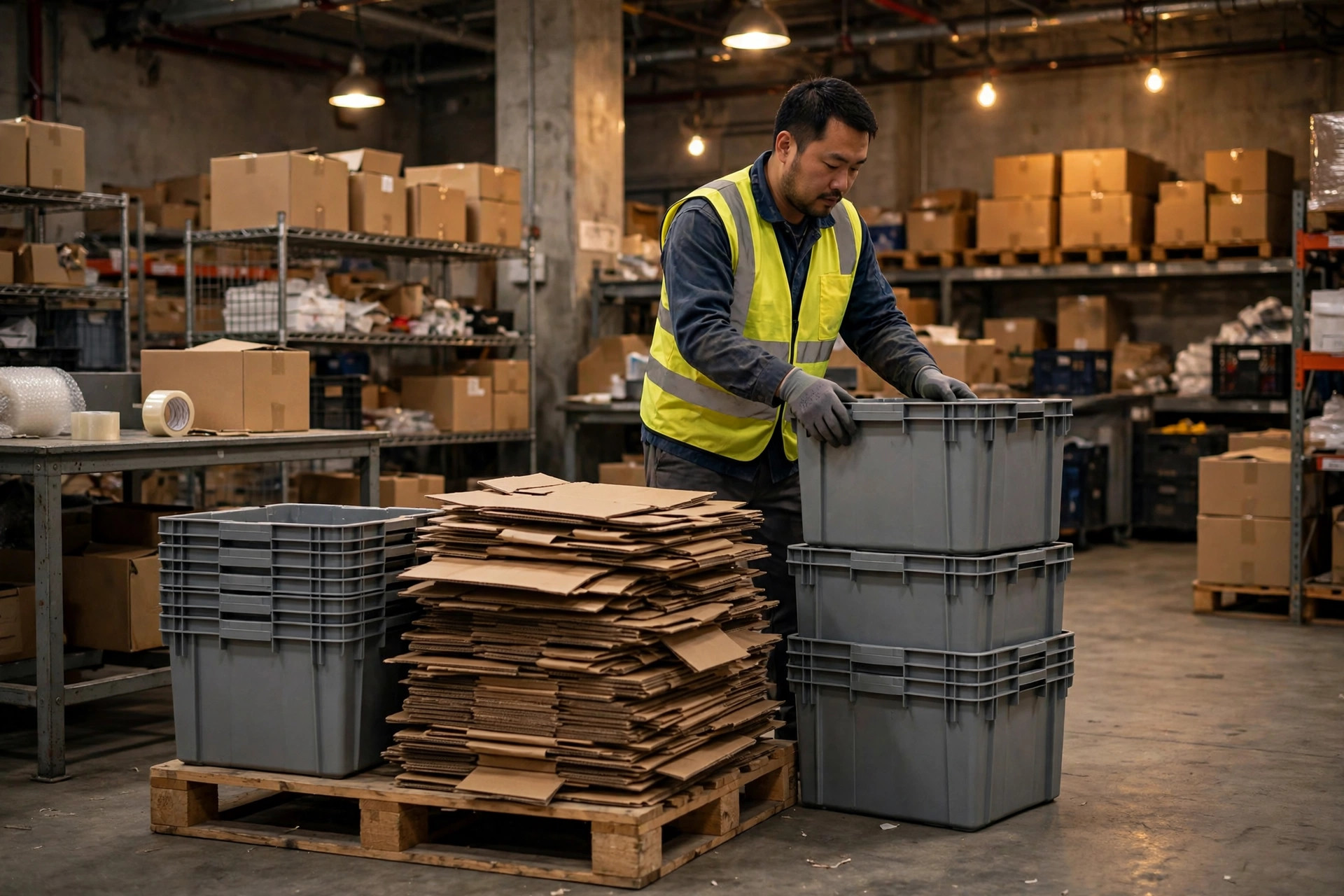
Our warehouse is 3,000 square meters with nine people on the floor, and every dollar in the books has a name on it. Last year I did something my peers thought was "not for small warehouses": I replaced single-use cardboard in our internal handling with reusable plastic totes. The cardboard salesman stopped calling after he heard.
To be clear, I did not touch outbound shipping cartons. Customers open those, inspect, and judge us by them — that box is marketing, not waste. What I replaced was everything that never leaves our four walls: receiving putaway, picking circulation, and returns inspection. Those boxes were just traveling in circles inside my building. Throwing them away after one loop was painful.
The Monthly Cardboard Bill That Hurt
We do e-commerce fulfillment and returns processing, and cardboard is our single biggest consumable. We run three main carton sizes at roughly $0.17, $0.27, and $0.40 a piece. Looks like nothing — until you burn through about 9,000 cartons a month. Boxes alone run us around $2,300, and with tape, void fill, and packing labor, the monthly damage is close to $3,400.
Returns made it worse. Our return rate sits between 8% and 12% most months. Every return gets unboxed, inspected, and repacked. One carton surviving the full "ship, return, reship" loop is basically dead afterward — so the same item eats two cartons' worth of cost.
I looked at the big-company playbook too: smart totes with RFID, trackable, scannable, demo videos that look like science fiction. Then I asked for the price and gave up on the spot. We small warehouses can't burn money like that. One smart tote costs what a whole pallet of cardboard costs. That math was written for someone else, not us.
200 Secondhand Totes: Starting With the Returns Loop
My cheap-and-cheerful plan had three steps, each one pinching pennies.
Step one: don't buy new, buy used. In local logistics groups and secondhand marketplaces, decent used totes go for about $2.50 each. New ones run $6 to $8. I bought 200 used ones for $500 — tuition money. If it flopped, I wouldn't lose sleep.
Step two: only replace internal loops. Receiving-to-putaway and returns-to-inspection never leave the building, so totes don't get lost or beaten up there. Perfect pilot zone. I left outbound picking alone for later — too big a step, and you pull something.
Step three: do the math properly. Most operators never actually run these numbers, so here is my table:
| Cardboard boxes | Used plastic totes | |
|---|---|---|
| Cost per unit | $0.25 avg | $2.50 |
| Cost per use | $0.25 (dead after 1–2 uses) | ~$0.07 |
| Lifespan | 1–2 cycles | ~100 cycles |
| Monthly cost (9,000 cycles) | ~$2,300 | ~$630 |
The $0.07 per use breaks down like this: $2.50 spread over 100 cycles is $0.025, washing costs about $0.04 per cycle (pressure washer, two people, half a day per batch — water and power), plus a little loss allowance. Break-even is simple: $2.50 ÷ ($0.25 − $0.07) ≈ 14 cycles. At our circulation speed, payback took about two months. Everything after that is profit.
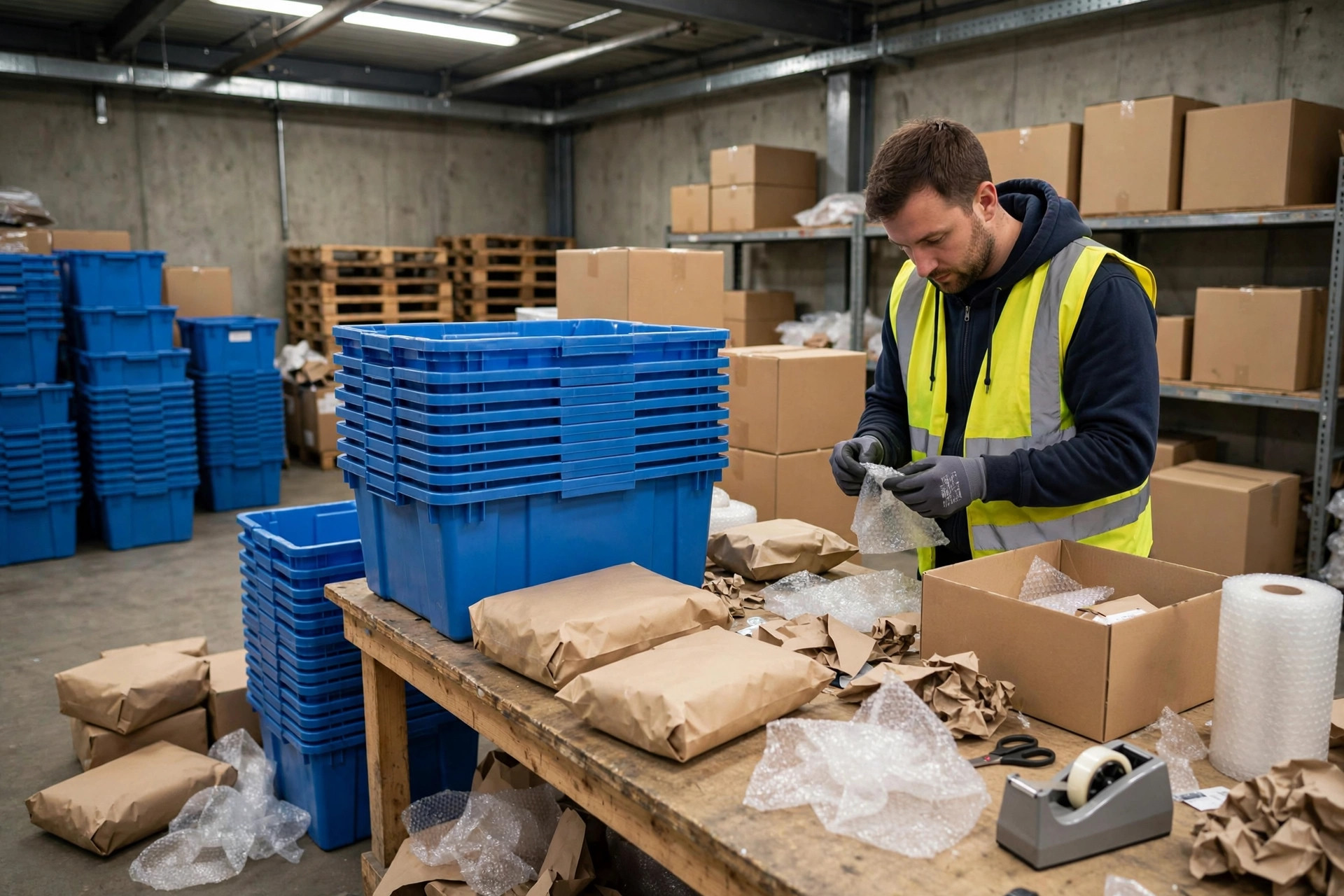
The biggest win was actually the reverse loop. During the November 2025 peak, returns were coming in by the hundreds daily. They went straight into totes, and anything passing inspection went right back to the shelf — no unboxing, no hunting for a fresh carton, no repacking. End of December, we counted: 11 totes missing out of 200. Drivers "borrowed" a few, one client's warehouse kept some. A 5.5% loss rate stung for about three seconds, but the math still worked, so we kept going.
There is also a hidden saving I left out of the table: labor. Folding, taping, and labeling a carton takes time — a skilled packer does maybe 25 to 30 an hour. A tote just needs its lid snapped shut, and the same person clears 40 to 50. I didn't put it in the table because it's hard to measure precisely, but during peak season we didn't hire a single temp. That was the totes doing the work.
The Counterintuitive Bit: The Best Tote Is the One You Can Afford to Lose
I'm going to bold this one mentally. A lot of small operators start by buying the expensive, heavy-duty, lidded "good" totes. Then what? Losing one expensive tote hurts for three days. Staff get scared to use them, hide them, hoard them. Utilization tanks, and you might as well have burned the money.
Our buying standard has exactly three rules: cheap, sturdy, and painless to lose. Every tote gets spray-painted with our mark. Lost one? That's tuition. I ran the numbers: anything under an 8% annual loss rate keeps the math positive. If you're losing more than 10%, that's not a tote problem, that's a management problem — check the people, not the plastic.
Here's another street-smart move: negotiate the loop with your clients. Two of our big clients now run a "tote loop agreement" with us. We ship to them in totes, they stack the empties, and our driver grabs them on the next delivery run. We give them $0.15 back per returned tote. They grumbled about the hassle at first, until we converted our cardboard savings into a 2% warehousing discount for them. Suddenly the empties were stacked neatly by the dock. Funny how that works — share a slice of the savings and the loop runs itself.
Four Tips for Warehouses Like Ours
First, start with internal loops, never with outbound cartons. Outbound touches the customer experience — don't touch it. Internal boxes are your own turf; mess around all you want.
Second, pilot with 100 to 200 totes, not thousands. Run it for two months. Learn your real loss rate, your real wash cost, and whether your crew actually cooperates before you scale.
Third, budget the loss rate at 10% upfront. When you negotiate loop agreements and rebates with clients, build that number in, so year-end reconciliation doesn't surprise you.
Fourth, don't outsource washing. A pressure washer and two people can blast through two or three hundred totes in half a day. The cost is water and power. Wash vendors quote $0.15 to $0.30 per tote — at that price you might as well keep buying cardboard.
This playbook isn't sexy. No RFID, no dashboards, just people hosing down plastic boxes in a warehouse. But it saves me over $1,600 a month — nearly $20,000 a year. That's one more hire, or a new forklift. Big companies have their playbook. Small warehouses have their own way of surviving.
By Xiao Ma, Small Warehouse Owner