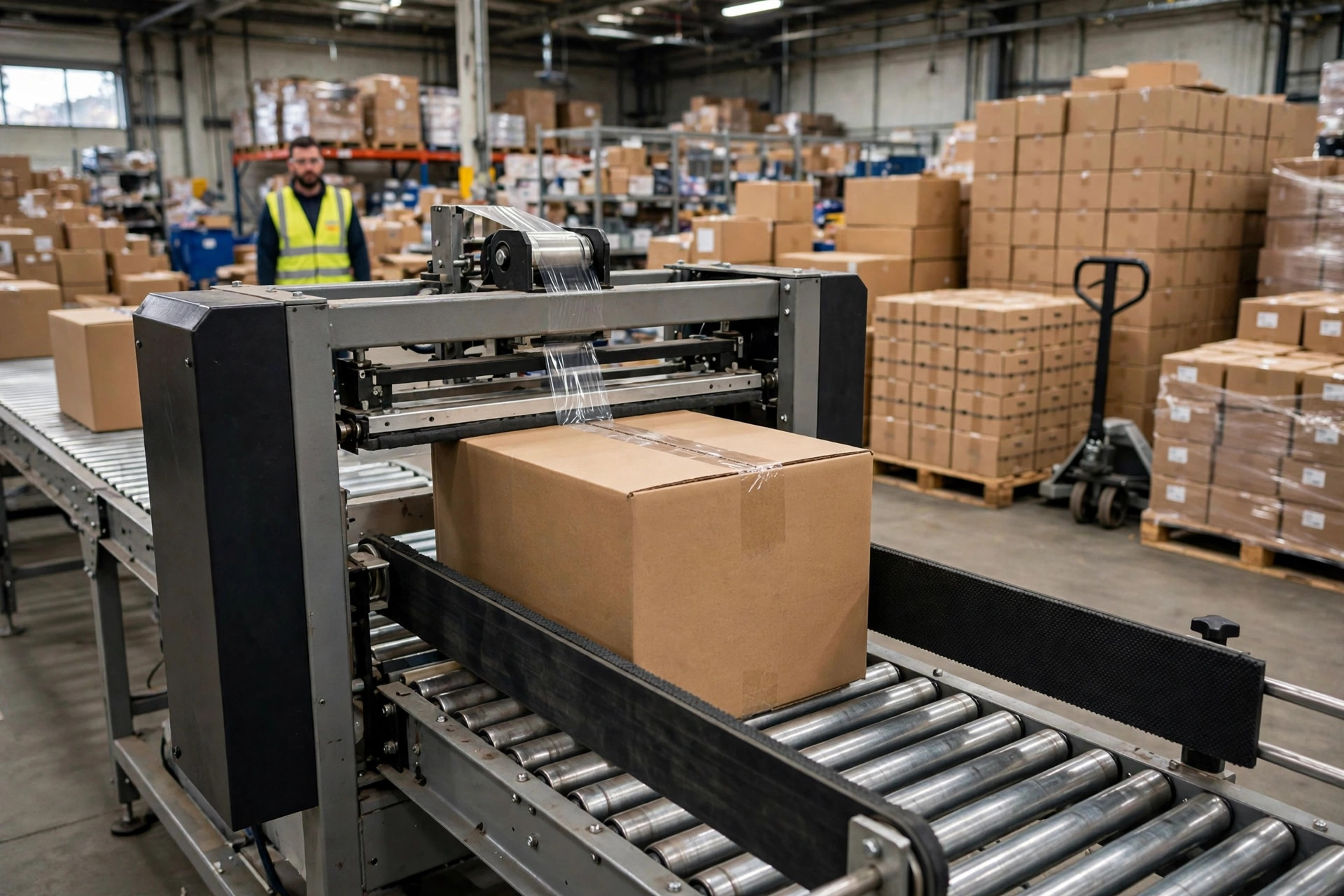
Our case sealer jammed at 8 a.m. the week before Black Friday, with 300-plus orders still untaped and the carrier rolling in at 9:30. A service call starts at a couple hundred bucks before the tech even opens the toolbox — money we small warehouses just can't burn. So I built myself a case sealer jam troubleshooting chain: carton size, belt tension, blade. In that order, no skipping. Nine times out of ten, the fix costs me nothing but twenty minutes and a little dignity.
Nine Times Out of Ten, It's Not the Machine
Our little semi-automatic sealer has been with me six years and jammed maybe fifteen, sixteen times. When I finally sat down and did the post-mortem, only two were actual machine failures. The rest were the same three culprits on rotation: out-of-spec cartons, loose belts, dull blades.
The big-company playbook is a service contract — jam happens, you call the vendor, done. We can't play that game. One year of a maintenance contract costs me half a month of payroll. So my chain runs cheapest-first: check the cartons (free), check the belts (ten minutes), and only then touch the blade (which means replacing a part). Start with what's free. That's small-warehouse survival rule number one.
The Chain: Cartons First, Belts Second, Blade Last
Link one: the cartons — the most wrongly accused suspect. November 18, 2025, the week before Black Friday, 8:10 in the morning, third jam of the day. I crawled in and found a box wedged sideways in the guide rails, stuck both ways. Caliper out: the new batch of cartons ran 6 millimeters wider than the last one. Six millimeters sounds like nothing until you realize the guides were set for the old size, and the box jammed halfway through.
I called the carton supplier. "Die wear, within tolerance," they said. I said your tolerance is plus-or-minus 3 millimeters and you're double that. Three seconds of silence, then: "We'll reship the batch." Those 300-plus orders got hand-taped by four of us until noon, and the driver waited an extra two and a half hours.
Lesson learned the hard way: every incoming carton batch, I now pull five boxes at random and caliper the length, width, and height. Anything beyond plus-or-minus 3 millimeters gets photographed and sent back. A caliper costs pocket change and has blocked more than half of our jams since.
Here's the counterintuitive call: when a case sealer jams, blame the box before you blame the machine. My first instinct — everyone's first instinct — used to be "the machine is getting old, time to replace it." Then you spend real money on a new sealer, feed it the same out-of-spec cartons, and it jams exactly the same. And a quick trade-off worth knowing: in a pinch you can widen the guide rails a couple of millimeters to force the batch through, but the tape lands crooked — off by three to five millimeters. Fine during peak when you're chasing the clock; dial it back in the slow season, or the sloppy seals will cost you more in returns than the downtime ever did.
Link two: belt tension — too loose it slips, too tight it strangles. Cartons check out? Move to the belts. June 2026, the heat arrived, and our side belts started slipping. The symptom is unmistakable: boxes go in crooked and come out with tape wide on one side and narrow on the other, like the box got slapped.
Belts are born stretchy and only get looser. The fix is embarrassingly low-tech: one tension screw on each side of the machine, half a turn clockwise, run one box. Still slipping? Another half turn. My field gauge is my finger — press down mid-belt, and if it gives about a knuckle (roughly one centimeter), with no slipping and no strangling, that's the sweet spot. An old tech taught me that; beats the manual. While you're there, glance at the inside of the belt — fraying or cracking means it's done, no amount of tightening will save it, replace it.

When there's genuinely no time to adjust — peak season, trucks waiting — there's a wilder trick: belt dressing spray, two squirts on the inside of the belt, buys you one to two weeks. A can runs about ten bucks online. But that's a painkiller, not a cure; reset the tension properly in the slow season. And fair warning: over-spray attracts dust, which makes slipping worse. Even wild tricks have side effects — don't get greedy.
Link three: the blade — the cheapest part, the most expensive lesson. A dull blade is also easy to spot: the tape won't cut clean, it drags a little tail, or the cut edge looks ragged. Most people — me included, once — go adjust the belts and the guides first, burn half an hour, and only then discover it's the blade. What tuition taught me: the duller the blade, the more convinced you'll be that something else is broken.
Blades are consumables; don't get sentimental. A few bucks apiece, two minutes to swap. But small warehouses have their own kind of thrift: some blades are double-edged — flip one over and it fights on for another month or two. And if you're truly out of spares, a few gentle strokes of fine sandpaper along the edge will get you through the day. Along the edge, mind you — scrubbing back and forth rolls the edge over and makes it duller.
The Cheap-Fix Shelf: What We Keep Next to the Machine
| Spare | When to replace | How long the hack lasts |
|---|---|---|
| Blade | Tape won't cut clean, drags a tail | Flip it: another 1–2 months; sandpaper: one emergency day |
| Side belts | Still slipping after tightening | Belt dressing spray: 1–2 weeks |
| Tension springs | Springs tired, belts keep loosening | No hack for this one — just replace |
| Packing tape | Cheap thin tape with high stretch — switch early | Move to 2mil-plus tape, cuts tape breaks roughly in half |
This table is taped to the side of the machine; whoever's on shift can do the swap. We're three to five people — "wait for the tech" isn't a plan, everyone's the maintenance crew. One more word on tape: the bargain-bin thin stuff stretches, snaps mid-seal, and a snapped tape is a jam. The few extra cents for thicker tape are cheaper than any repair bill.
The Math: When to Replace the Machine
Machines, like people, have a lifespan. Ours is six years old, and I've set myself three tripwires — hit any one and we replace:
| Signal | How I do the math |
|---|---|
| Annual repair spend tops 30% of a new machine's price | One service visit is a couple hundred bucks; three or four visits a year and you're over the line |
| Jam rate won't come down | After the full chain tune-up, still jamming 2–3 times per 100 boxes and it's holding up outbound |
| Parts lead time over two weeks | Old machine discontinued, parts made to order — we can't wait that long |
How much is a new one? Check the manufacturer's latest pricing — brands and semi-auto versus full-auto span a wide range. But the formula doesn't change: when fixing costs more than a third of replacing, stop fixing. Big companies run TCO models and depreciation schedules; we small warehouses run one rule: fixed it three times and it's still acting up, put the fourth repair's money toward a new machine.
And one more anti-big-company call: don't fall for full-auto. A salesman told me full-auto is "set it and forget it." I ran the numbers: we do two to three thousand orders a day, one person can mind a semi-auto just fine. Full-auto costs multiples more, every breakdown idles bigger money, and repairs wait on the factory. The small-warehouse way: good enough, easy to fix, cheap parts.
Last month the carton supplier sent another out-of-spec batch. Photo, caliper, return — ten minutes, done. We went from seven or eight jams a day in peak season to barely one a week. So tomorrow morning, before the shift starts: measure five cartons, press the belt with a finger, glance at the blade. Do those three things and jamming season is basically over for you. Small warehouses have their own way of surviving — and this time, "spend where it cuts" is literal.
By Xiao Ma, Small Warehouse Owner