Last summer, a small-appliance client called me in a panic. A shipment had just arrived at his customer's warehouse. Three pallets had toppled in transit, cartons crushed, product damaged inside. The customer refused the load. Freight, damage, and rework all landed on my client. I asked whether he had tested the pallet build before it shipped. "We wrapped it in film. It looked solid." Looking solid is the least reliable stability test there is. A pallet load stability test — tilting the pallet a little at a time and watching the angle where it starts to slide and where it tips — is what actually answers the question. Angles, not feelings.
Why Pallets Fall: The Physics in Plain Terms
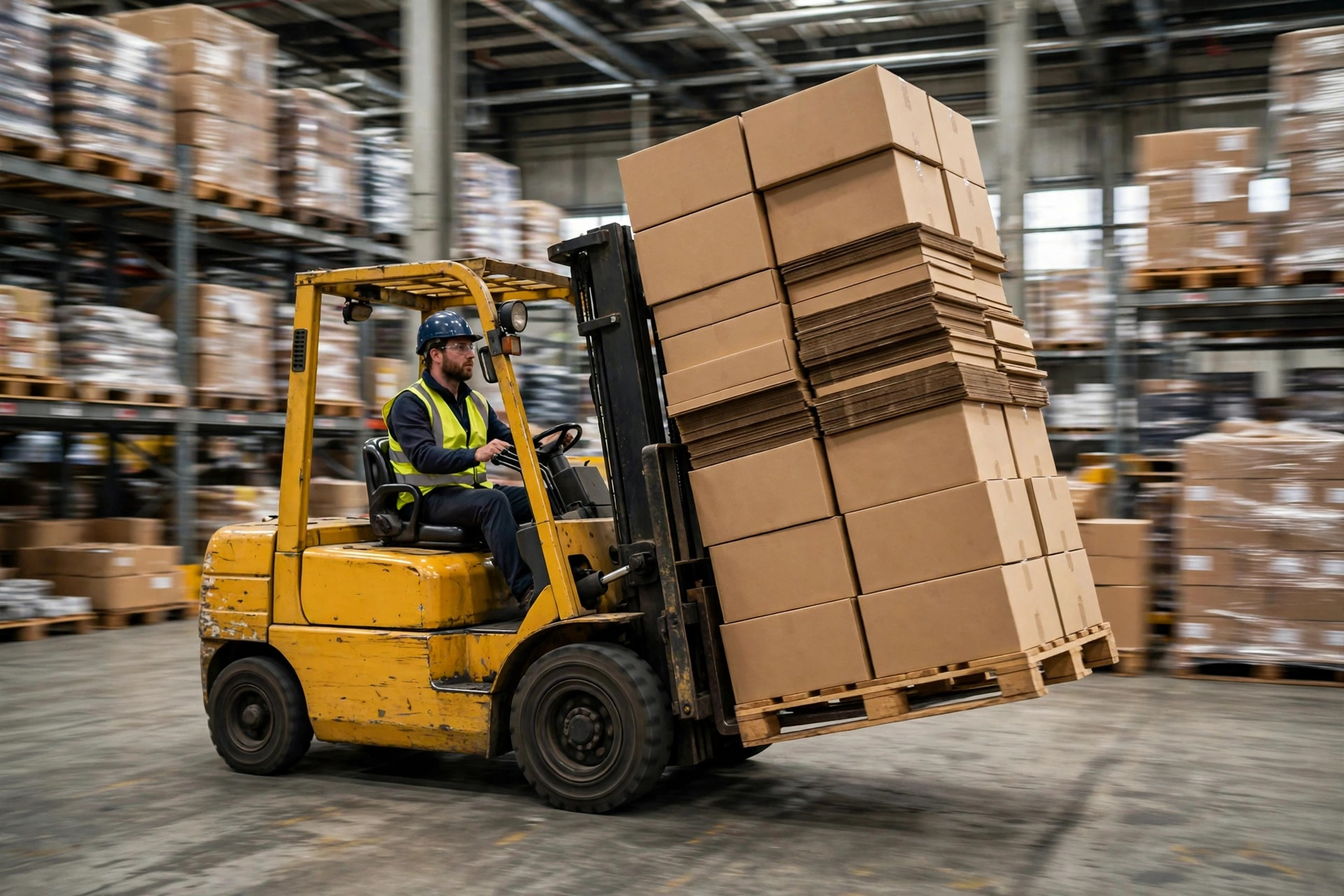
A toppling pallet is three forces fighting: gravity, friction, and transport acceleration. Think of it as a block tower on a slope. The higher the center of gravity, the easier it tips. The slicker the layer-to-layer contact, the easier the whole load slides. Every hard brake, sharp turn, and pothole is someone shoving the tower from the side. Stack all three past a threshold, and the load goes over.
Here is the counterintuitive part: most topples are not caused by "stacked too high." They are caused by "the bottom slid." The upper layers stay intact, the lower layer shifts sideways as a sheet, the center of gravity moves off the base, and the whole pallet follows. I have seen short pallets of slick-surfaced cartons slide on one hard brake, and tall pallets with anti-slip sheets between layers ride perfectly fine. Height matters. Layer-to-layer friction is the factor people keep forgetting.
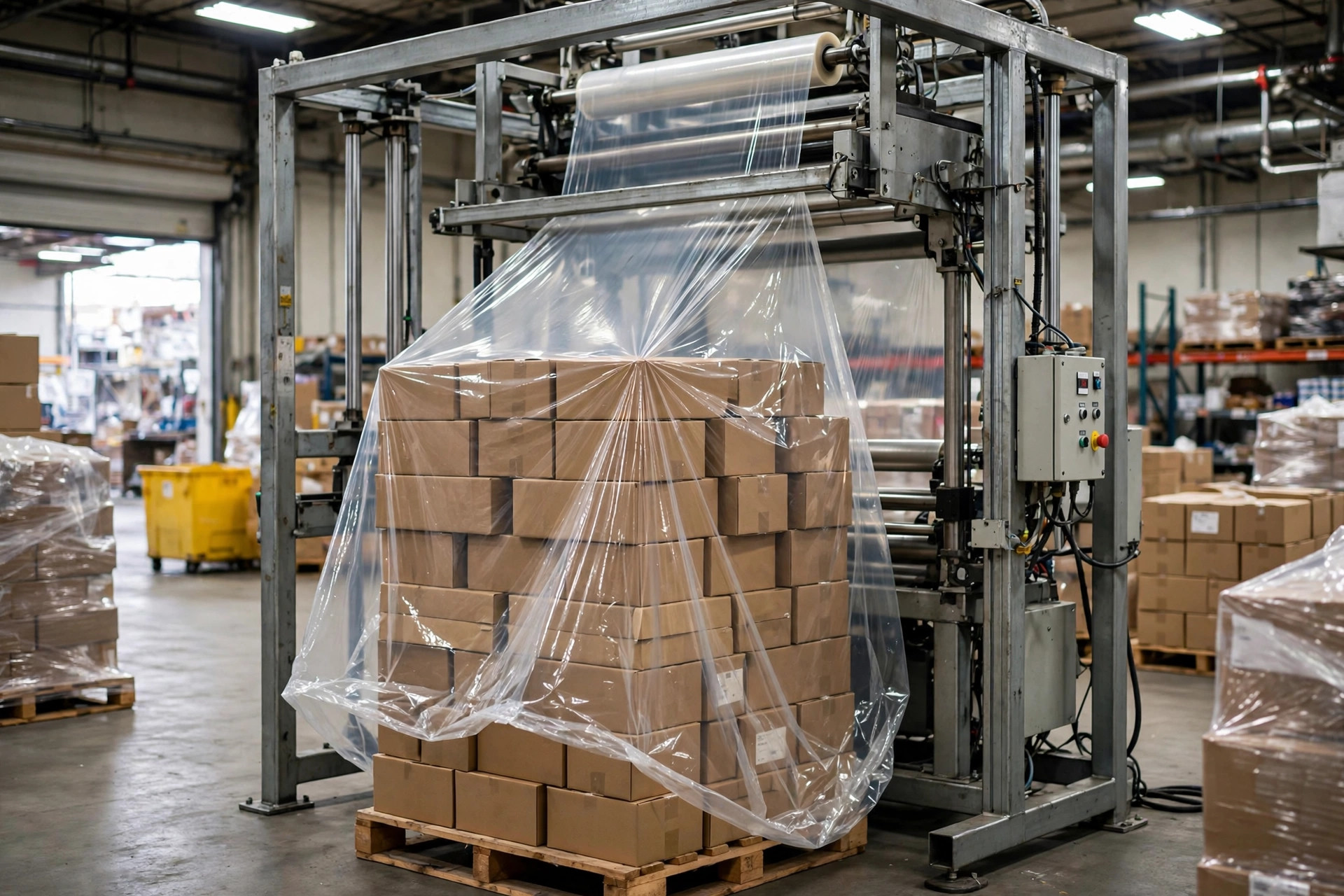
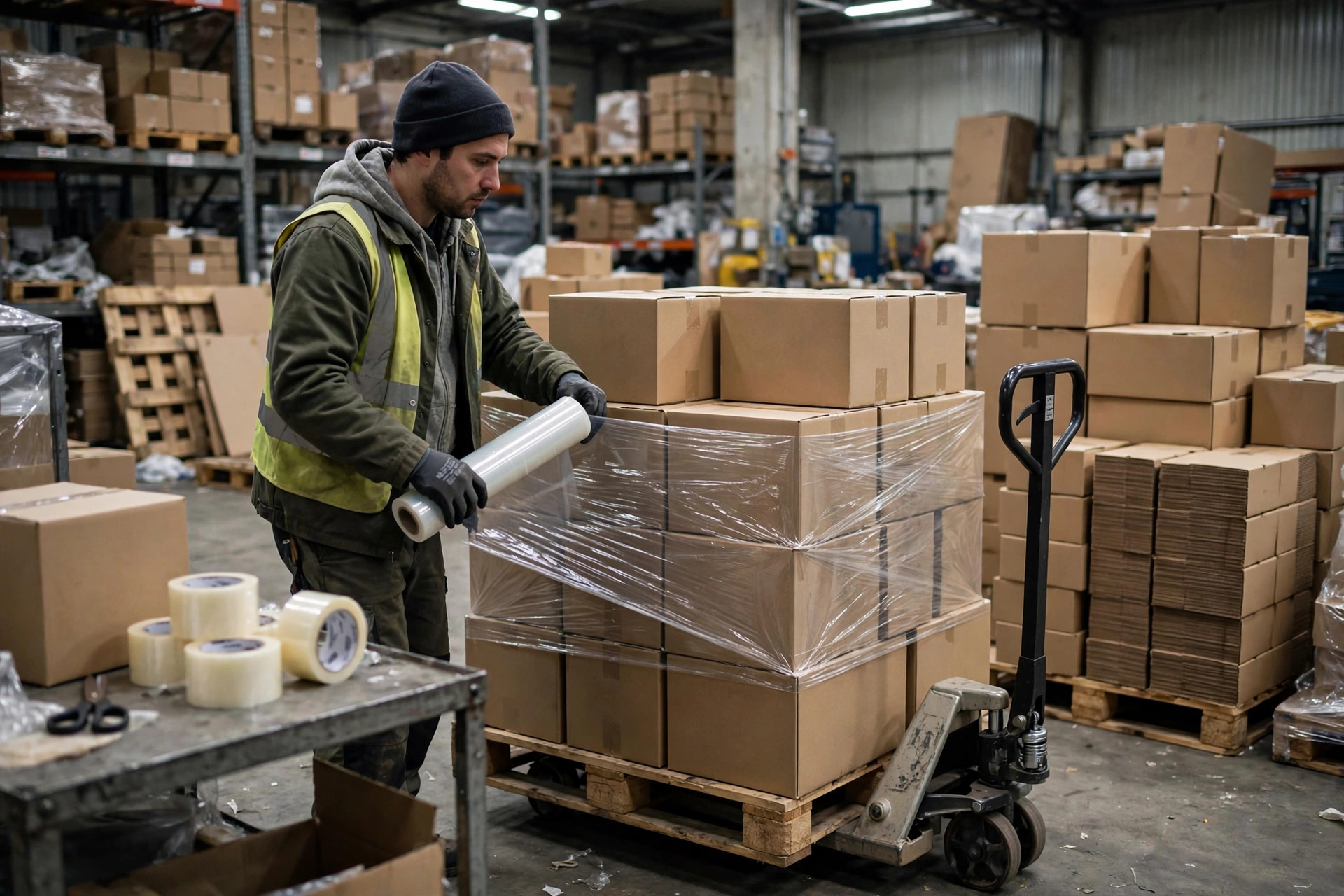
The other thing people get wrong: stretch film is not "wrap it and forget it." If the pre-stretch ratio is too low, the film goes on loose — like a jacket a size too big. The load rattles inside it under braking. You can add more wraps, but if the pre-stretch is off, the containment force is imaginary. Think of it like a seatbelt: buckled but not tensioned, it still lets you fly forward.
Pallet Load Stability Test: The DIY Tilt Test
A lab has tilt tables and vibration rigs, but daily outbound checks don't need a lab. A DIY tilt test is enough. The method is simple. The discipline is in doing it slowly and writing it down:
Step 1. Find flat, hard ground. Place the test pallet as-is, in its normal outbound condition. Don't build a special "exam version" for the test.
Step 2. With a forklift tine or a simple tilt frame, raise one side of the pallet a little at a time. Go slow. A sudden jerk adds inertia and corrupts the result.
Step 3. Watch for two angles and record both. The first is the slip angle — the point where one layer visibly shifts relative to the layer below. That is your early warning. The second is the tip angle — where the whole pallet starts to go over. That is your floor.
Step 4. Test at least three pallets of the same pack-out and take the worst result as your verdict. Passing one pallet and calling it good is like tasting one spoonful and declaring the whole pot fine.
Step 5. Photograph it. One shot at the slip angle, one at the tip angle, plus date, pack-out description, and operator name in a simple log. When something goes wrong later, that log is your evidence with the customer and the carrier.
What angle counts as passing? There is no universal number — it depends on what transport the load will see. Short local delivery on flat roads can live with a lower bar. Long-haul linehaul over speed bumps and mountain roads needs a much stricter one. The value of the DIY test is not a universal standard. It is a comparable number: test before the pack-out change, test after, and if the angle went up, the improvement is real.
Four Fixes, Compared on One Table
Once you know why pallets fall, the fixes are straightforward. There are four common ones. Here they are by cost, effect, and the trap each one hides:
| Fix | How it works | Cost | The trap |
|---|---|---|---|
| Stretch film, correct pre-stretch | Tensioned film shrinks back and clamps the load into one unit | Film + equipment wear | Pre-stretch ratio never adjusted; film goes on loose; top and bottom under-wrapped |
| Anti-slip sheets between layers | Raises layer-to-layer friction, stops whole-layer sliding | A few sheets per pallet | Only one or two layers sheeted; sheet smaller than the carton footprint |
| Corner boards + strapping | Boards spread pressure, straps cinch vertically | Straps + boards + labor | Strap cuts into cartons and deforms them; only one strap used |
| Interlocked stacking pattern | Layers offset like brickwork, locking each other in | Zero, just a different stacking pattern | Mixed carton sizes break the interlock; pattern sacrifices cube utilization |
These are not either-or choices. They are usually a combination. That small-appliance client is the case in point: originally they relied on film alone, and the pre-stretch ratio had never been adjusted. After the incident we made three changes: pre-stretch set to the machine manual's recommended value, an anti-slip sheet every two layers, and a corner board plus one strap on top. Re-tested, the slip angle came up several degrees. Three months of outbound shipments after that, zero toppling complaints. What the fix cost per pallet was a rounding error next to what one lost load had cost.
The selection rule: the heavier the load, the taller the stack, and the longer the haul, the more you lean toward the full combination — film plus sheets plus strapping. Light load, short stack, short local run, and well-tensioned film alone may be enough. Don't default to the full kit for everything, and don't try to save money with two lazy wraps.
Pallet Load Stability Test: When to Pay for the Lab
This is the question clients ask me most. My dividing line is three conditions. If any one applies, pay for professional testing:
One, high load value. If one toppled pallet costs more than years of testing fees, don't economize here.
Two, a customer with hard requirements. Some big customers and export orders write stability requirements into the contract, or carry aggressive claims clauses. DIY numbers don't carry much weight in those negotiations. A professional report does.
Three, brutal transport conditions. Export ocean freight means container handling and ship roll. Long-haul intermodal means repeated handling and transfers. The accelerations and vibration in those scenarios can't be simulated by a DIY tilt test — that is where a professional pallet load stability test earns its fee, reproducing the trip on a lab vibration table with an acceleration profile.
Everything else — daily outbound checks, before-and-after comparisons after a pack-out tweak, internal quality patrols — the DIY tilt test covers fine. Professional testing buys evidence for outsiders. The DIY test buys improvement data for yourself. They don't conflict.
The Maintenance Trap: Where Film Machines Quietly Cheat You
Finally, the maintenance trap. A pack-out design is only the starting point. When equipment drifts, the best design goes with it. The film wrapper is the usual suspect: pre-stretch rollers wear down, the real pre-stretch ratio quietly drops, and the film goes on looser and looser. Turntable speed gets uneven, top and bottom wraps come up short, and the load loosens at both ends first. The operator goes by feel and says "looks about right," while the containment force has already fallen off a cliff.
My routine: pull one pallet a month for a tilt test and compare it against last month's log. Angle trending down is the signal that equipment or handling is drifting — check the pre-stretch rollers and the film roll first, then check whether operators have slipped back into the "save film" wrapping style. Same for sheets and straps: are sheets being skipped, is strapping down to one band? Spot checks beat retraining.
One more trap: changing the carton without changing the pack-out. A client switches carton suppliers, the new carton surface is smoother, layer friction drops with it, the old pack-out stays in place, the tilt angle falls, and toppling follows. Carton type, carton surface, stacking pattern, film — change any one of them and the tilt test has to be redone. That is not busywork. It is ten minutes spent preventing one lost load.
Is this money well spent? Look at one number: the extra cost per pallet after the pack-out change, against the cost of one toppled pallet — product damage plus freight plus the customer's claim. Once that number is on the table, nobody needs to decide by gut feel anymore.
By Da Liu, Automation Engineer