Our little warehouse can't afford to burn money like that. That's the first thought in my head every time I shop for equipment.
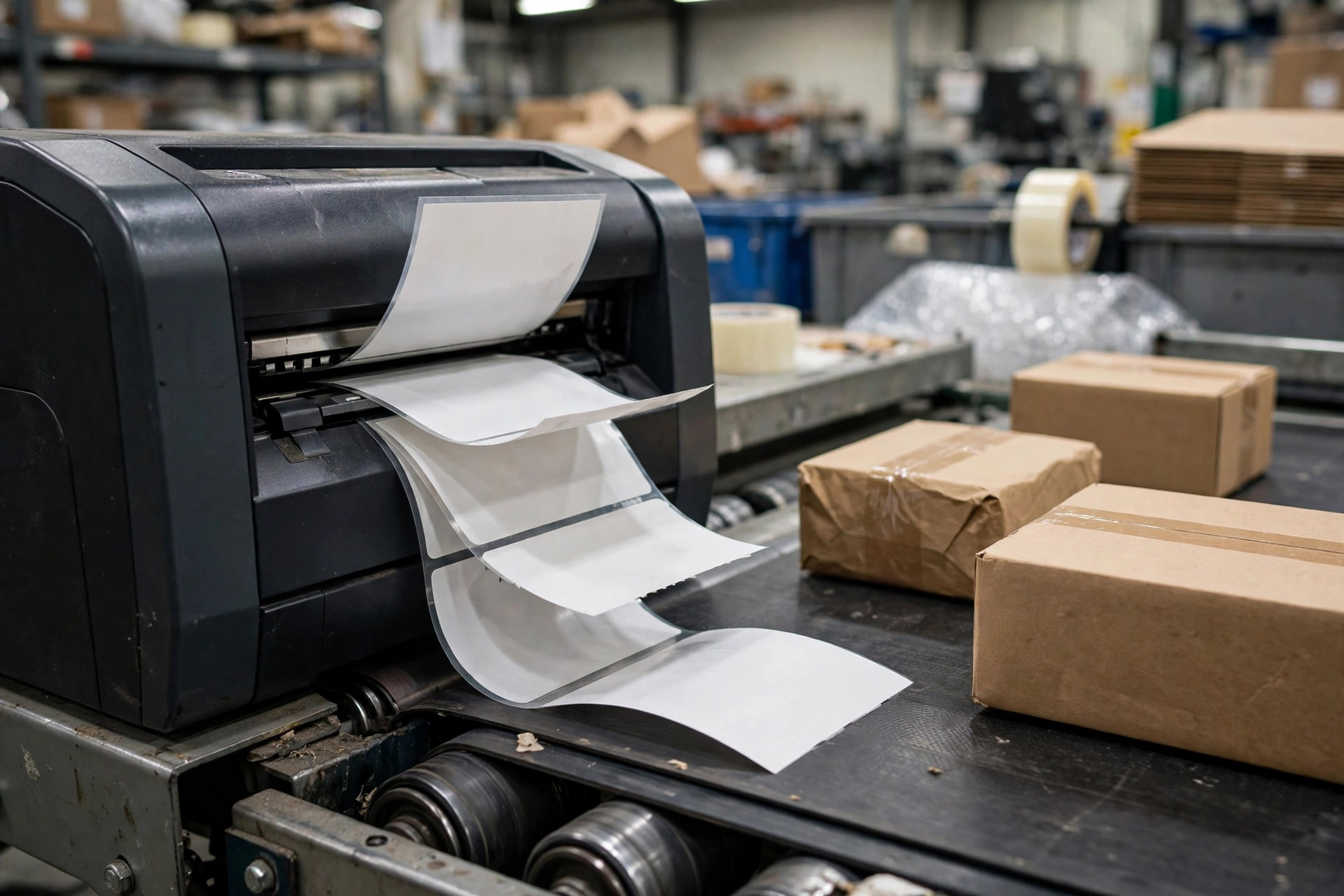
Don't laugh — in our first year, the "label printer" on our packing table was a secondhand A4 laser printer. Shipping labels came out on A4 sheets, we cut them into strips with a paper cutter, then wrapped them around boxes with packing tape, round and round. At 200 orders a day, two packers spent half their shift just sticking labels on boxes. The boxes looked like mummies. We even got customer complaints about peeling labels that couriers couldn't scan. Back then I swore: the moment volume picks up, a real label printer is priority number one.
When we hit 500-plus orders a day, I finally went printer shopping — and discovered there are two kinds, direct thermal and thermal transfer, with prices several times apart and salespeople swearing by opposite ones. Fine. I did the math myself. Turns out it's not that complicated.
Direct Thermal vs Thermal Transfer, in Human Words
Here's the one-sentence version of how each works:
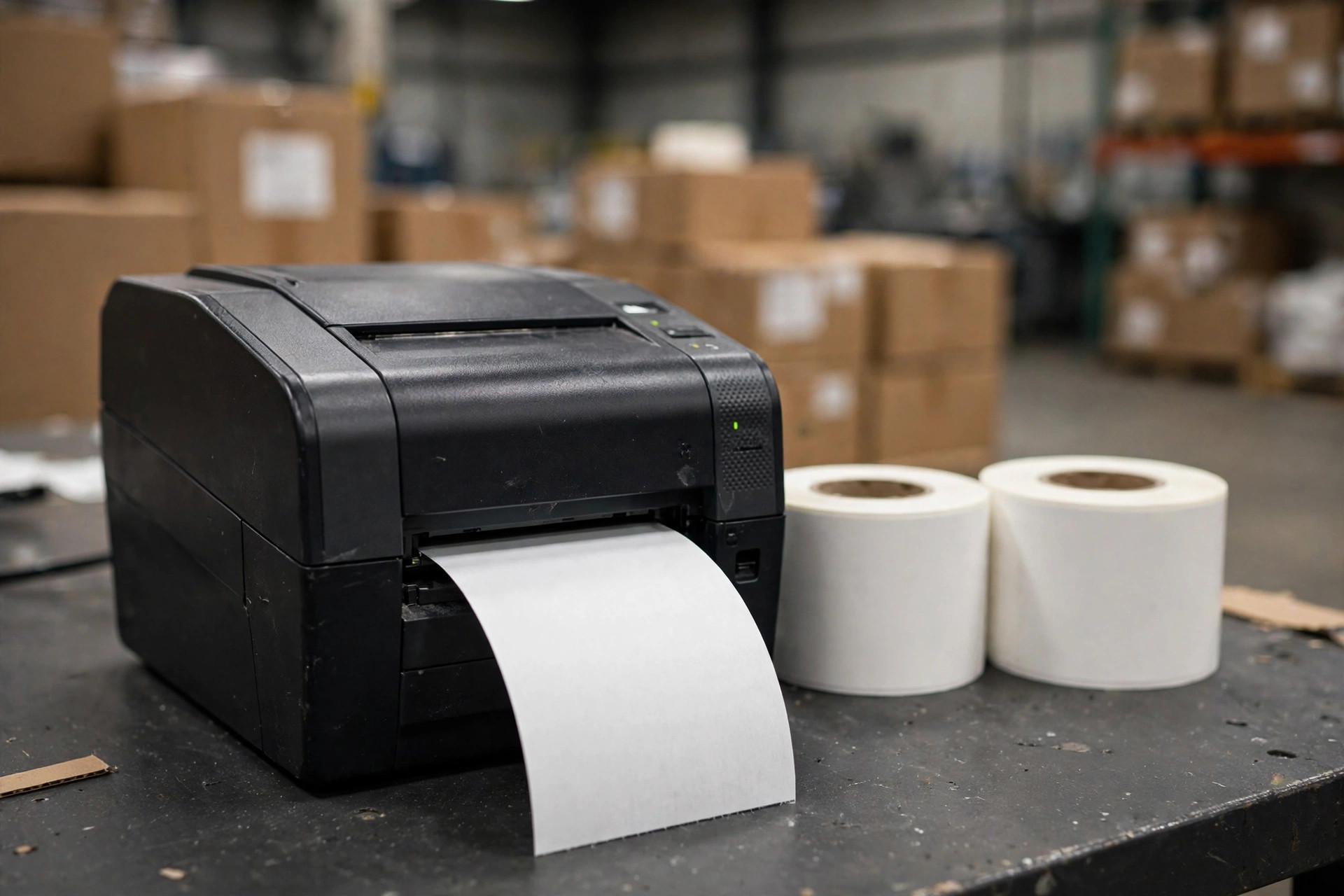
Direct thermal: the print head heats up, and the label paper darkens on its own. The only consumable is the label paper — no ink, no ribbon. Cheap, simple, just swap the roll. The catch: it hates heat, sunlight, and friction. The print fades over a few months.
Thermal transfer: heat melts ink off a ribbon onto the label. Consumables are labels plus ribbon. The machine costs more, swapping ribbons is a hassle, but the print lasts for years — shrugs off grease and water.
Do the Math: What Labels Really Cost a Small Warehouse
| Direct thermal | Thermal transfer | |
|---|---|---|
| Machine | A few hundred bucks | One to two thousand |
| Consumables | Label rolls only — a roll costs tens of dollars and prints thousands of labels | Labels plus ribbon — a ribbon roll also costs tens of dollars |
| Cost per label | A few cents | Over ten cents |
| Maintenance | Basically zero, just change the roll | Ribbon swaps, pressure adjustments, more fiddly |
At 800 orders a day, thermal transfer consumables run you a few thousand dollars more per year than direct thermal. For a small warehouse like ours, that's a month of rent and utilities. Why spend it if you don't have to?
But money is only half the question. The other half is lifespan — the label's lifespan, I mean.
The Counterintuitive Part: A Shipping Label Lives for Days
This is the key insight it took me a while to reach: a shipping label lives from the moment you print it until the courier scans it at intake — a week, tops. Its job is done the moment the package arrives. Paying for "won't fade for three years" is pure waste — like buying a thermos lid for a paper cup.
So for the vast majority of small warehouses, direct thermal is enough for shipping labels. Afraid of heat and sunlight? Your label isn't sunbathing for three months. Print it, stick it, ship it the same day. Nothing to fear.
Does that make thermal transfer a scam? No. It's made for labels with long lives:
My neighbor Lao Wang sells apparel, and he learned this the hard way in 2023. He printed return labels with direct thermal and stuck them on hang tags. Winter passed, spring came, customers started returning items — and the labels had faded to blank. Returns couldn't be matched to SKUs. A whole batch sat in his warehouse for two days while his team sorted it out by hand, and he ate thousands in extra freight and labor. Ever since, all his return labels are thermal transfer — a return label lives on the product for months, so that money has to be spent. Same goes for bin location labels, cold-storage labels, and compliance labels for chemicals or food: they live for months or years, and direct thermal can't survive that.
Three Questions That Settle It
Ignore the sales pitch. Ask yourself three questions:
Question 1: How long does this label need to live? Days to a week — direct thermal. Months to years — thermal transfer.
Question 2: Where does it go? On a carton in a room-temperature warehouse — direct thermal. Outdoors, in a freezer, in a greasy workshop — thermal transfer.
Question 3: What's the budget? Just starting out, modest volume — grab a direct thermal printer first, a few hundred bucks, no heartbreak. When volume grows and you have more label types, add a thermal transfer later. Don't buy the expensive one on day one. The big-company "buy once, buy right" playbook doesn't apply to small warehouses.
Let me share a mistake we made: our first thermal printer was a cheap unit that could only print small labels — our actual shipping labels didn't fit, and returns weren't accepted, so we resold it at half price. Measure your label size before ordering and confirm the printer's max print width. And check the ports — skip anything with only a serial port; USB is the minimum, and a network port is even better for sharing across computers.
One more overlooked money saver: the print head. It's the most expensive part on both types of printers — replacing a worn one costs as much as several rolls of labels. Maintenance is dead simple: wipe the print head with an alcohol swab once a week, thirty seconds, and it'll last dramatically longer. We do it every Friday before closing; two years in, our print heads are still going strong. Also, don't stack label rolls by a sunny window or in a damp corner — store them cool, dry, and out of direct light, and your print quality will thank you.
Two street-smart money savers before I go. First, don't worship OEM label rolls — decent third-party rolls run about 30% cheaper. But don't buy the absolute cheapest either: low-grade paper sheds dust that grinds down the print head in half a year, and one replacement print head costs as much as ten rolls of paper. Penny wise, pound foolish. Second, the secondhand printer market is a minefield — the print head is a consumable, so buying used means inheriting someone else's worn-out head. If you must buy used, ask whether the print head has been replaced.
Our packing table now holds two printers: direct thermal for shipping labels, thermal transfer for return and bin labels. Clear division of labor, nobody stepping on anyone's toes. Eight hundred-plus orders a day, and labels cost us next to nothing all year.
Small warehouses have their own way of surviving. Equipment that's good enough, easy to use, and cheap enough not to hurt — that's the small-warehouse buying philosophy.
By Xiao Ma, Small Warehouse Owner