Let me start with the numbers. A 100,000-square-foot retrofit warehouse project comes in with a quoted budget of 2.8 million dollars and settles at 4.1 million. Of the 1.3 million overrun, 900,000 dollars sits on lines that were never in the budget at all. This is not one warehouse's bad luck. It is the normal shape of a brownfield retrofit. Budgets don't fail because the quotes are wrong. They fail because nobody knew how many bills were hiding inside the old building.
A retrofit warehouse budget breaks into three accounts: reuse, build-out, and downtime. Each has its own traps. Add them up and you get the real price.
Account One: Reuse, the Easiest Number to Get Wrong in a Retrofit Warehouse Budget
Start with the conclusion: reuse is not free. Before you use an old asset, you pay to prove it still works.
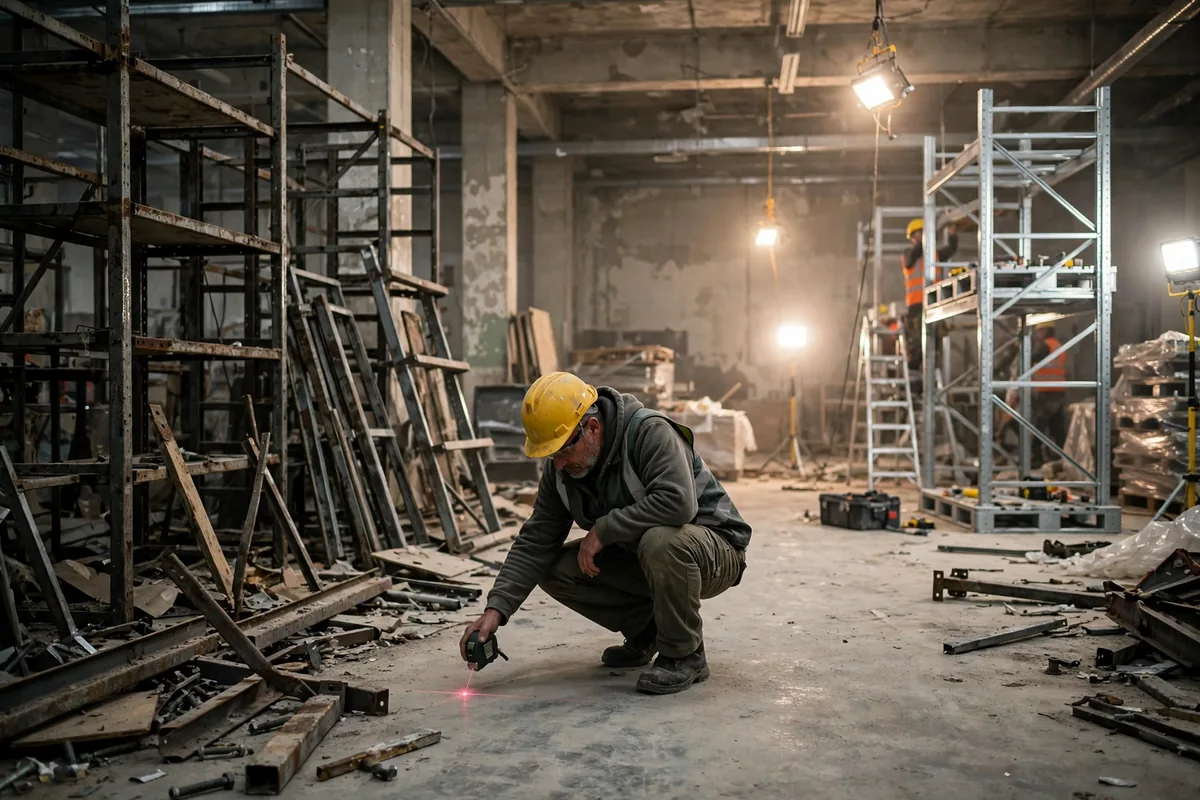
In 2023, a third-party logistics operator in Columbus, Ohio, leased a warehouse built in 1998 — 120,000 square feet, 26-foot clear height. The previous tenant left behind two rows of heavy-duty racking and a conveyor line that looked almost new. The owner booked that used equipment at zero cost, and the retrofit budget listed only new purchases. After move-in inspection, the truth came out: 17 rack uprights were bent from impacts, a third of the beam safety pins were missing, and two conveyor motors had burned out before. Inspection, straightening, parts, and re-certification of load capacity cost 110,000 dollars. Worse, the old racking's hole spacing didn't match the new beams, so a third of it had to be torn out and bought new anyway. That 110,000 dollars appeared in no version of the budget, because nobody had inspected the used equipment before the project started.
The correct formula for reuse is: residual value of the old asset, minus inspection, minus repair, minus adaptation, minus certification. What is left is what you actually saved. For racking, forklifts, and conveyors, budget inspection at 3 to 8 percent of the equipment's original value. Steel structures older than 15 years need third-party load certification, listed as its own line, not buried under "miscellaneous." My experience is that once the reuse rate passes 40 percent, inspection and adaptation eat more than a third of the reuse savings. More reuse is not always better. Past a point, old equipment is a liability.
There is one more line people forget: demolition. Old racking you don't want, old partitions, old cabling — taking them down, hauling them out, and disposing of them all costs money. For a 100,000-square-foot building, budget 80,000 to 150,000 dollars for demolition and removal at market rates. If that line is not on the quote, it will be on the final invoice.
Account Two: Build-Out Costs in a Retrofit Warehouse
Build-out is the least predictable of the three accounts, because an old building's problems only show up once the crew is inside.
The floor comes first. Warehouses built around 1998 typically have 6-inch concrete slabs, designed for manual forklifts. Put in automation and heavy racking, and the slab is too thin and too uneven: rack anchors don't hold, and automated guided vehicles rattle and throw errors. Partial reinforcement and a full re-pour can differ in price by three times. A core sample test of the slab costs a few thousand dollars before the project starts, and it is far cheaper than stopping work mid-project to redo the floor.
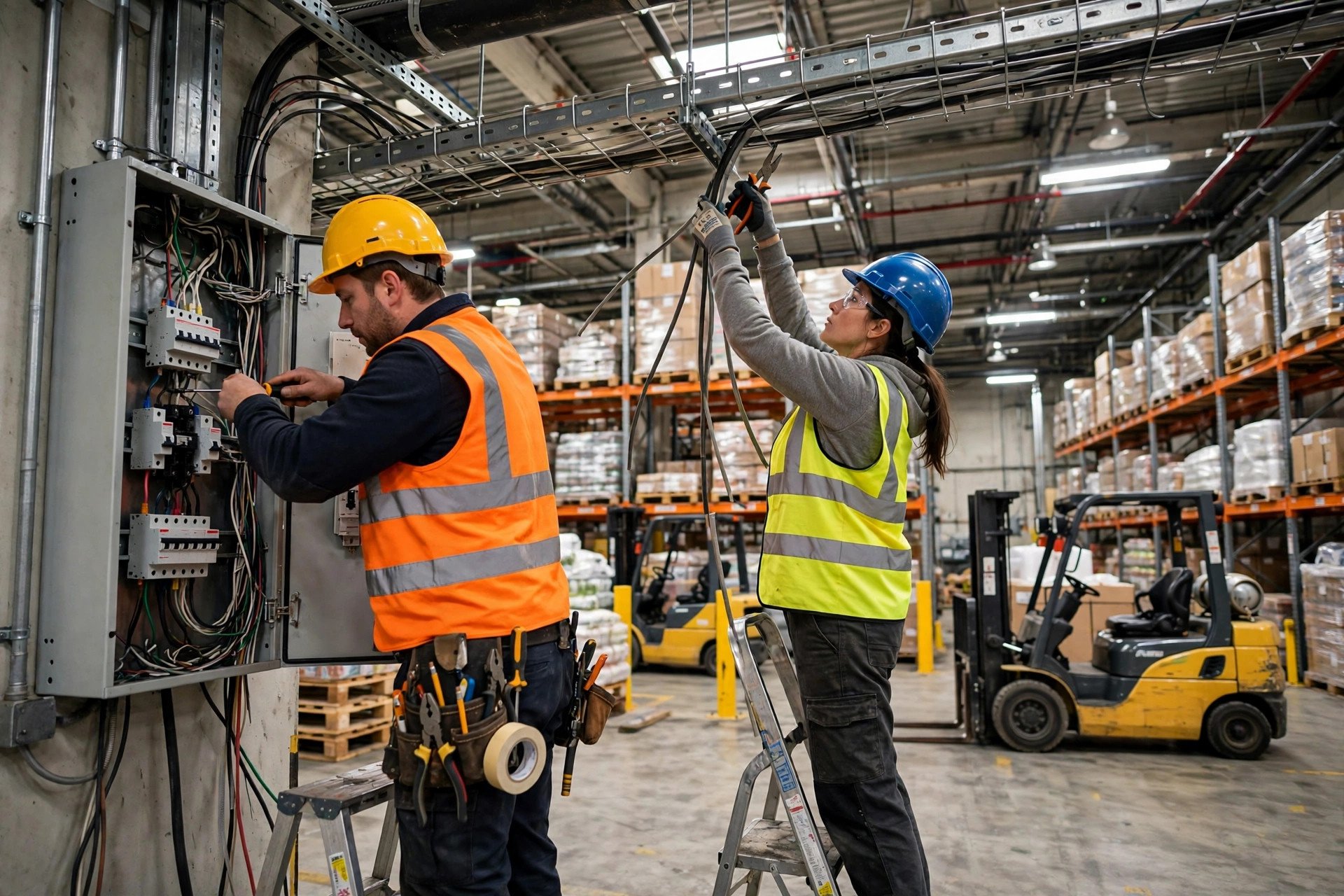
Second is power. Old buildings sized their transformers for lighting and a few forklift chargers. Automation arrives and capacity runs out immediately. The upgrade cost is not just the transformer — it is the utility's approval process and the queue time, and both the money and the time belong in the budget. Fire protection is third: published US contractor pricing puts a sprinkler retrofit in an existing warehouse at roughly 4 to 12 dollars per square foot, so 400,000 to 1.2 million dollars on 100,000 square feet. The range is that wide because some buildings only need new heads and others need new mains and a fire pump. Budgeting at the low end and paying at the high end is the most common way a brownfield project dies.
The roof is fourth, and the easiest to be fooled by because it "looks fine." On a building over twenty years old, the waterproofing membrane is at the end of its life. More important is load capacity: new ductwork, fire mains, and lighting trusses all hang from the roof structure, and old purlins may not carry them. Roof inspection and local reinforcement, left out of the budget, get billed by the day while workers stand on the roof waiting for your approval. That is the most wasteful money in the whole project.
An industry cost guide published in 2025 gives a useful reference range: a full automation-ready retrofit runs about 42 to 58 dollars per square foot in hard costs. On 100,000 square feet, that puts the all-in hard cost — build-out, equipment, electrical, fire protection — at 4.2 to 5.8 million dollars. That number is not a quote. It is a ruler to check quotes against. If your total budget is half that range, ask yourself which lines you left out before you celebrate the good price.
| Cost item | Worked example (100,000 sq ft brownfield) | Note |
|---|---|---|
| Reuse inspection and repair | $80,000–$150,000 | Includes rack certification, excludes demolition |
| Demolition and removal | $80,000–$150,000 | Old racking, partitions, cabling |
| Floor reinforcement or re-pour | $250,000–$600,000 | Scope set after core sampling |
| Power capacity upgrade | $150,000–$400,000 | Includes utility approval lead time |
| Sprinkler retrofit | $400,000–$1,200,000 | At $4–$12 per sq ft |
| New equipment and installation | $1,200,000–$2,200,000 | Varies with automation level |
| Downtime loss | See next section | Separate line, not mixed into construction |
The table above is a stated example to show the structure, not any real warehouse's quotation. Every range is wide, because old buildings differ from each other far more than new ones do.
Account Three: Downtime, the Most Expensive Line on the Budget
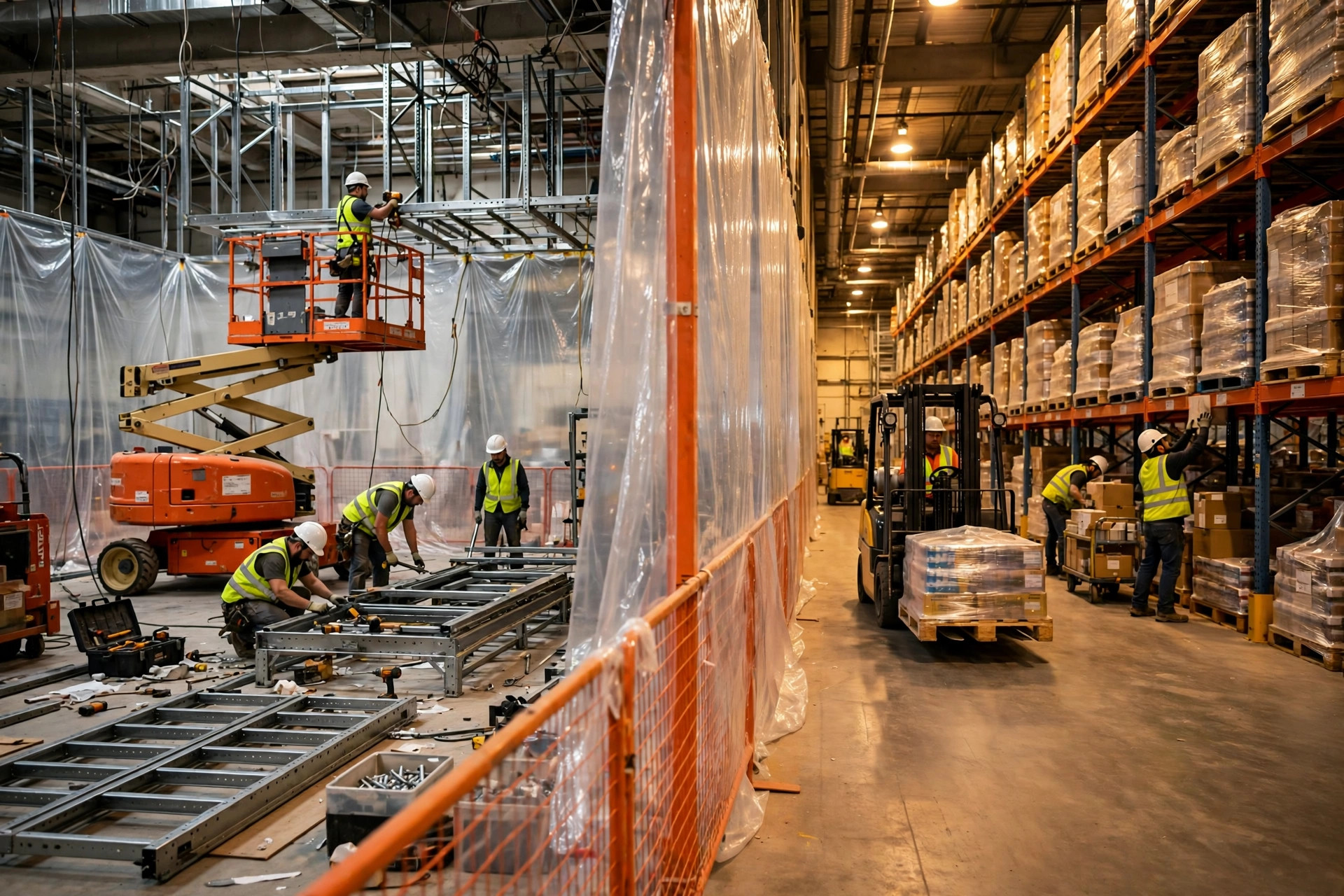
This is the line most often left out, and the most expensive. While the retrofit runs, the warehouse cannot operate at full capacity, and every order not shipped is real money. The formula is simple: days of downtime multiplied by daily gross profit. Whether you calculate daily gross profit on peak-season or off-season volume changes the answer by a factor of two or more.
Take a 3PL shipping 400,000 orders a year at 3 dollars of gross profit per order: about 1,100 orders a day, so one day of downtime costs roughly 3,300 dollars in gross profit, and ten days costs 33,000. That is only the direct loss, before customer attrition and rush outsourcing. Put downtime on its own line in the budget total so decision-makers can see the whole picture. How to shrink the number of downtime days is a scheduling question, not a budgeting one — for the overall approach to a brownfield conversion, see the brownfield warehouse automation retrofit guide. That piece covers how the retrofit itself is done; this one only settles what it costs.
Here is the counterintuitive judgment: the cheapest brownfield retrofit is often the smallest one. Not every old building deserves to be brought up to automation-ready standard. A warehouse with 26-foot clear height that needs its roof raised for high-bay racking will spend enough on the roof to lease a new building for three years. A warehouse with a 6-inch slab forced into heavy automation will spend enough on the floor to buy two sets of equipment. The first principle of retrofit budgeting is that a building's bones set its ceiling, and every dollar spent above that ceiling is wasted money. Calculate the ceiling first, then talk about the plan — never the other way around.
One more lever: split the budget into "must-do" and "want-to-do." Fire protection, power, and floor load capacity are must-do — without them, work cannot start. A new conveyor line or an automated sorter is want-to-do, and can wait for next fiscal year. Split the two lists and the budget becomes clear by half. In most overruns I have seen, the overrun is not in the must-do work. It is the want-to-do work quietly growing during construction.
Here is a conclusion you can calculate: divide the total budget by the additional annual gross profit the retrofit creates, and you get the simple payback in years. A payback over five years means cut the want-to-do list first. Over seven years, seriously consider leasing a newer building instead. Whether a retrofit warehouse budget is sound has nothing to do with how thick the quotation is. It comes down to whether any of the three accounts has an empty line.
By Lao Zhou, Logistics Cost Analyst