Let me start with the money, because that is where every site decision is actually made. Take 100,000 square feet in Columbus, Ohio. The national average asking rent for warehouse and distribution space in Q3 2026 was $10.06 per square foot per year, triple-net, according to Cushman & Wakefield. That is $1.006 million a year in base rent alone. In Columbus, market guides put industrial rents roughly in the $5 to $9 range. Call it $7 at the midpoint and the same 100,000 square feet costs $700,000 a year. That is a $300,000 annual gap before you touch anything else — before operating expenses, before labor, before the fact that Ohio charges no tax on inventory sitting in a warehouse. The Columbus Ohio warehouse market logistics story is usually told as a geography story. Geography is the pitch. Rent is the math.
Columbus Ohio Warehouse Market Rents: The Biggest Line Item First
Rent is the largest fixed cost of a distribution hub, and also the easiest to get wrong. People compare asking rents to signed rents, or gross rents to triple-net rents, and the whole comparison falls apart. Get the basis right first: U.S. industrial leases are usually quoted triple-net, so on top of base rent you pay your share of property taxes, insurance, and maintenance — typically another $1 to $3 per square foot per year. Small spaces cost more. Warehouses under 50,000 square feet typically run 15% to 35% more per square foot than larger buildings in the same city.
| Market | Warehouse/distribution asking rent ($/sq ft/yr) | Basis |
|---|---|---|
| U.S. average | $10.06 | Q3 2026, Cushman & Wakefield |
| Columbus | ~$5–$9 | Range across market guides |
| Los Angeles | ~$15.86 | Same-period market data |
| Memphis | ~$4.12 | Same-period market data, cheapest tier |
Two things fall out of that table. First, Columbus is cheap, but it is not the cheapest in the country — Memphis undercuts it. Second, cheap has a price: Columbus industrial vacancy tightened to 7.2% at the end of 2025, down from 9.7% a year earlier, and the market posted 8.8 million square feet of positive absorption in 2025, among the top five in the country. The good buildings are not sitting empty waiting for you. My advice: never decide on a published range. Get three real quotes, put free-rent periods and escalation clauses on the same sheet, and compare total cost over the full term.
The One-Day Drive: How the Columbus Ohio Logistics Math Works
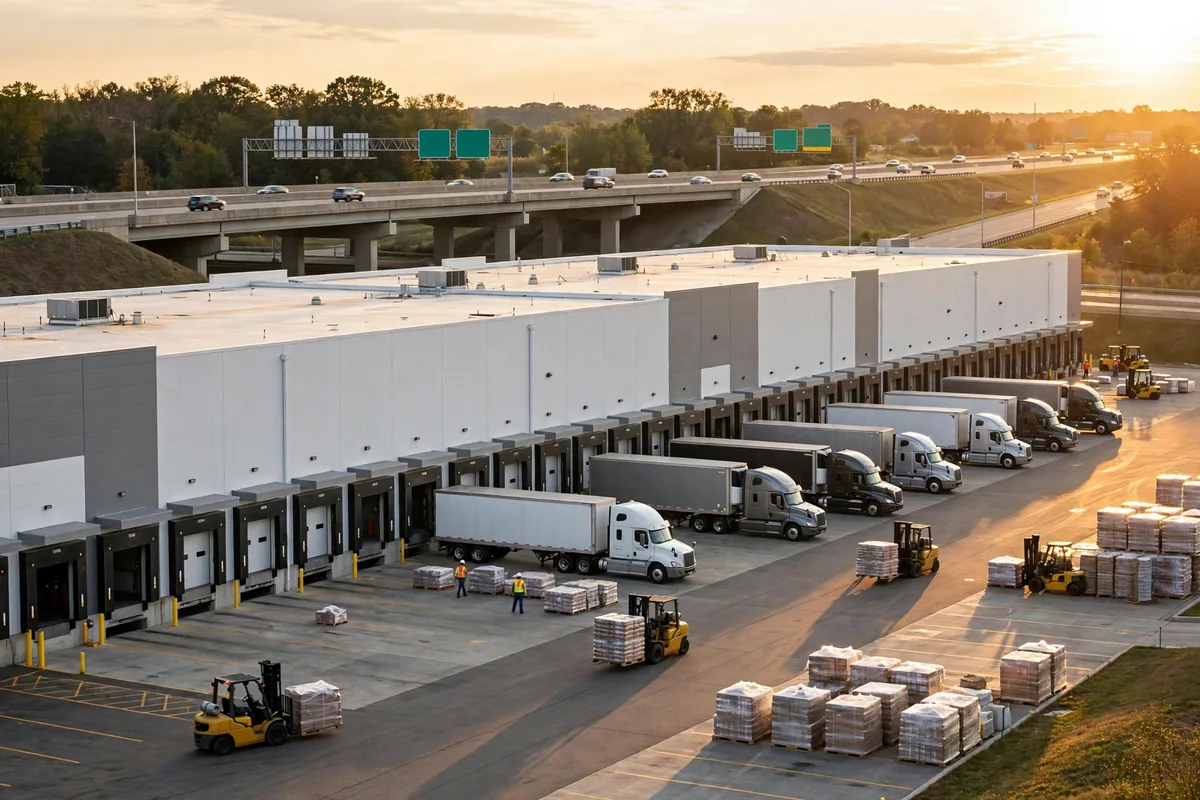
The location math holds up better than most location pitches. Several market sources agree: a one-day truck drive out of Columbus reaches roughly 45% to 50% of the U.S. population. Widen the lens to Ohio as a whole and it is about 60%, roughly 185 million consumers. Interstates 70 and 71 cross here, the I-270 outerbelt ties the logistics parks together, and ground shipments reach New York, Chicago, and Atlanta in one to two days.
But population coverage is not the number that decides anything. Order geography is. In 2024 I ran the numbers for a DTC home-goods brand weighing a move from New Jersey to the Groveport area (figures below are an illustrative example). The brand shipped about 40,000 orders a month: 68% of deliveries east of the Mississippi, 22% to the West Coast, 10% in between. In New Jersey, rent plus labor plus linehaul came to $6.80 per order all-in. In Columbus, East Coast delivery times barely moved, West Coast orders took one extra day, and all-in cost per order fell to $5.90. That is roughly $430,000 a year on 40,000 orders a month. The cost was real too: West Coast transit went from three days to four, and nobody could say for three months whether the return rate would move.
The lesson is not "Columbus always wins." It is "your West Coast share decides." My rule of thumb: if West Coast orders are under 30% of volume, a single Columbus hub is probably your cheapest national option. Over 35%, run the two-warehouse math seriously. The delivery speed and returns you save have to cover a second safety stock and a second crew, and you only learn that from real order data, not from a map.
Rickenbacker Inland Port: Columbus Logistics' Second Card
What separates Columbus from other inland hubs is a genuine cargo airport. Rickenbacker International Airport (LCK) sits about 10 miles south of downtown Columbus, one of the few cargo-focused airports in the country, with two 12,000-foot runways, a Norfolk Southern intermodal terminal next door, and a foreign trade zone covering the whole complex. FedEx, UPS, Cargolux, Emirates, and Etihad all run scheduled freighters there.
That card is worth the most to air-dependent freight: high-value electronics, auto parts, pharmaceutical cold chain. During the pandemic in 2021, Rickenbacker handled a record month of 120 international freighter arrivals, mostly emergency medical cargo. Nobody talks about that in a normal year. The moment supply chains break, it is the only thing that matters. Two more details worth writing down: Ohio phased out its tangible personal property tax years ago, so inventory in the warehouse is not taxed; and UPS Worldport in Louisville is about three hours away, which buys later cutoff times for overnight parcels.
Here is the contrarian part: a great airport does not rescue the wrong freight. If air cargo is 5% of your volume, choosing a site for it is backwards. The airport is a bonus, never the deciding factor. The deciding factors are always the order map and the rent math.
What Belongs in a Columbus Distribution Hub: A Four-Way Decision Framework
| Freight type | Columbus fit | Why |
|---|---|---|
| National e-commerce, home goods, general consumer products | Good fit | Orders spread nationwide; one-day reach covers nearly half the population at the lowest single-hub cost |
| Auto parts, high-value electronics | Good fit | Uses the Rickenbacker air and intermodal advantage; transit time is protected |
| Fresh food, short-shelf-life cold chain | Proceed with care | Columbus is a linehaul hub, not a consumption center; last-mile cold chain costs run high |
| West Coast-heavy freight, oversized furniture | Poor fit | West Coast transit and return costs eat everything the rent saves |
One hidden condition sits behind that framework: small space is hard to find in Columbus. Listings average around 43,000 square feet, and almost nothing is offered under 1,200 square feet. A small seller wanting a few thousand square feet will generally need shared warehousing or a 3PL's allocated space. That is not unique to Columbus, but you should know it before signing a letter of intent, not after.
Labor belongs in the same calculation. The Columbus metro has about 2.25 million residents, and warehousing is a pillar industry there — the Rickenbacker, Groveport, and Obetz corridors hold a deep concentration of distribution centers, so hiring is manageable. But the national average hourly wage for warehousing and storage workers reached $26.74 in August 2026, according to preliminary Bureau of Labor Statistics data, and peak-season overtime and temp premiums sit on top. I budget labor at the hourly wage times 1.35; the extra 35% covers payroll taxes, insurance, recruiting, and turnover. On that basis, a 50-person warehouse costs nearly a third more per year than a straight hourly-wage calculation suggests.
So here is a conclusion you can actually compute. Pull your last 12 months of orders and build a table by destination state. West Coast share under 30%, and a single-site requirement above 20,000 square feet: Columbus is probably your lowest-cost national single hub. West Coast share over 35%, or volume concentrated in one coastal city: run the two-warehouse model before signing a five-year Columbus lease. The $300,000 in rent savings is real money. The return rate on West Coast customers waiting one extra day is the line item most people leave out of the spreadsheet.
By Lao Zhou, Logistics Cost Analyst