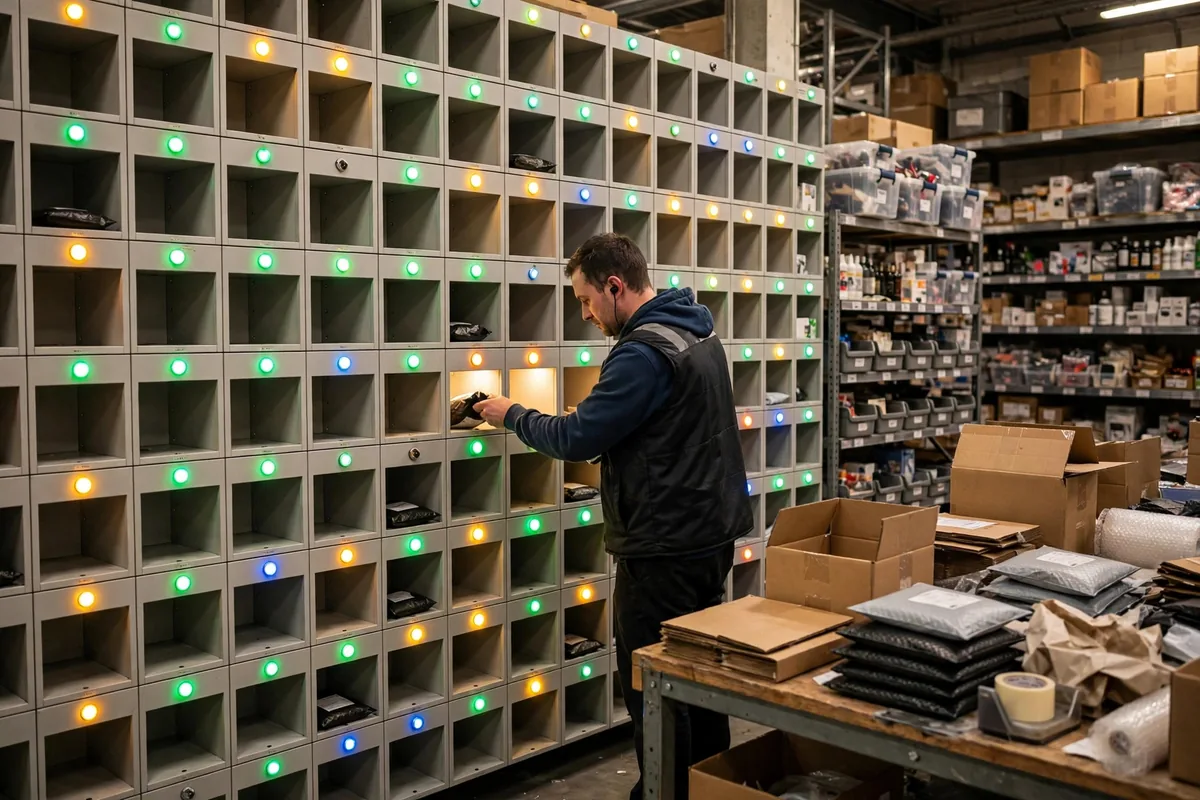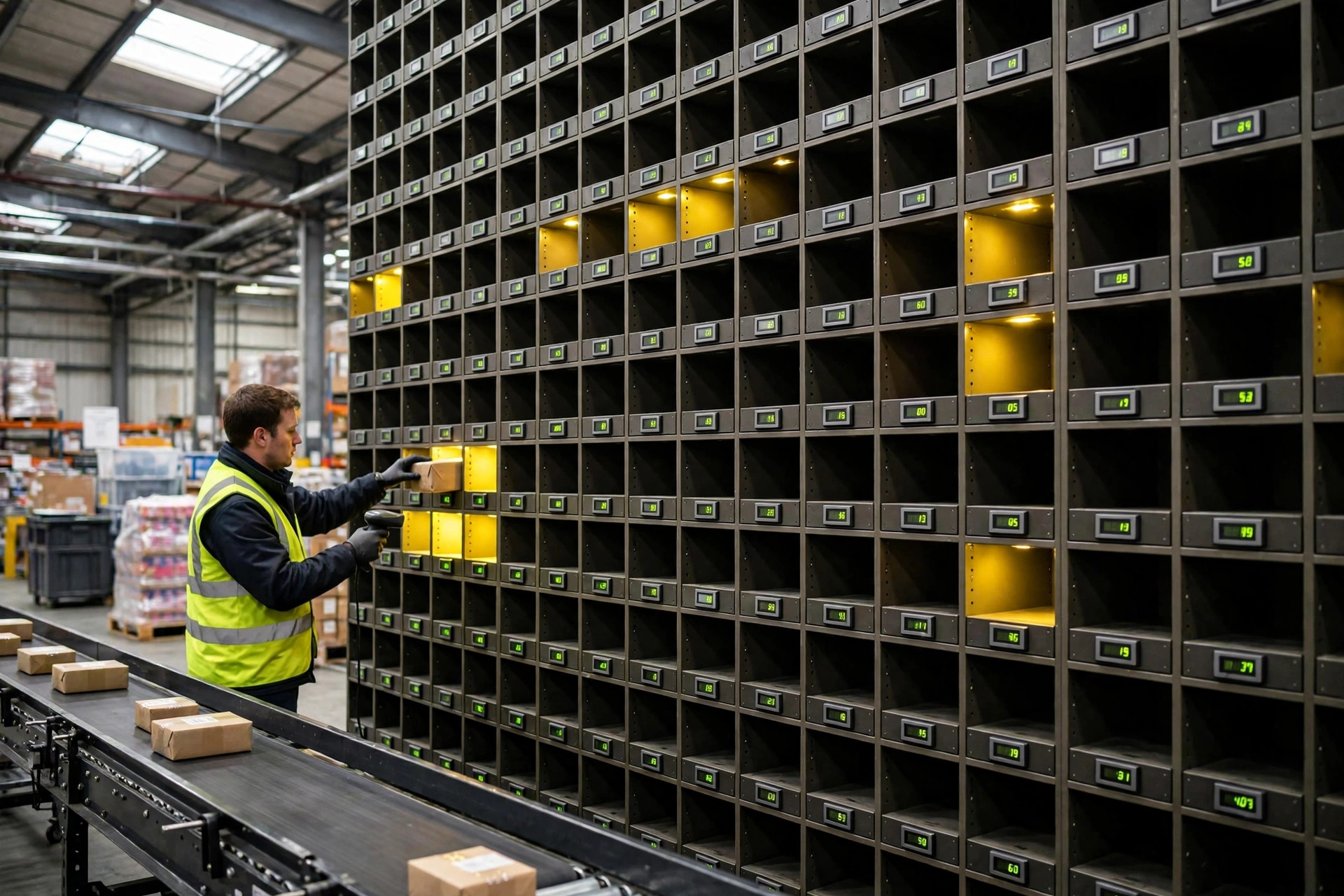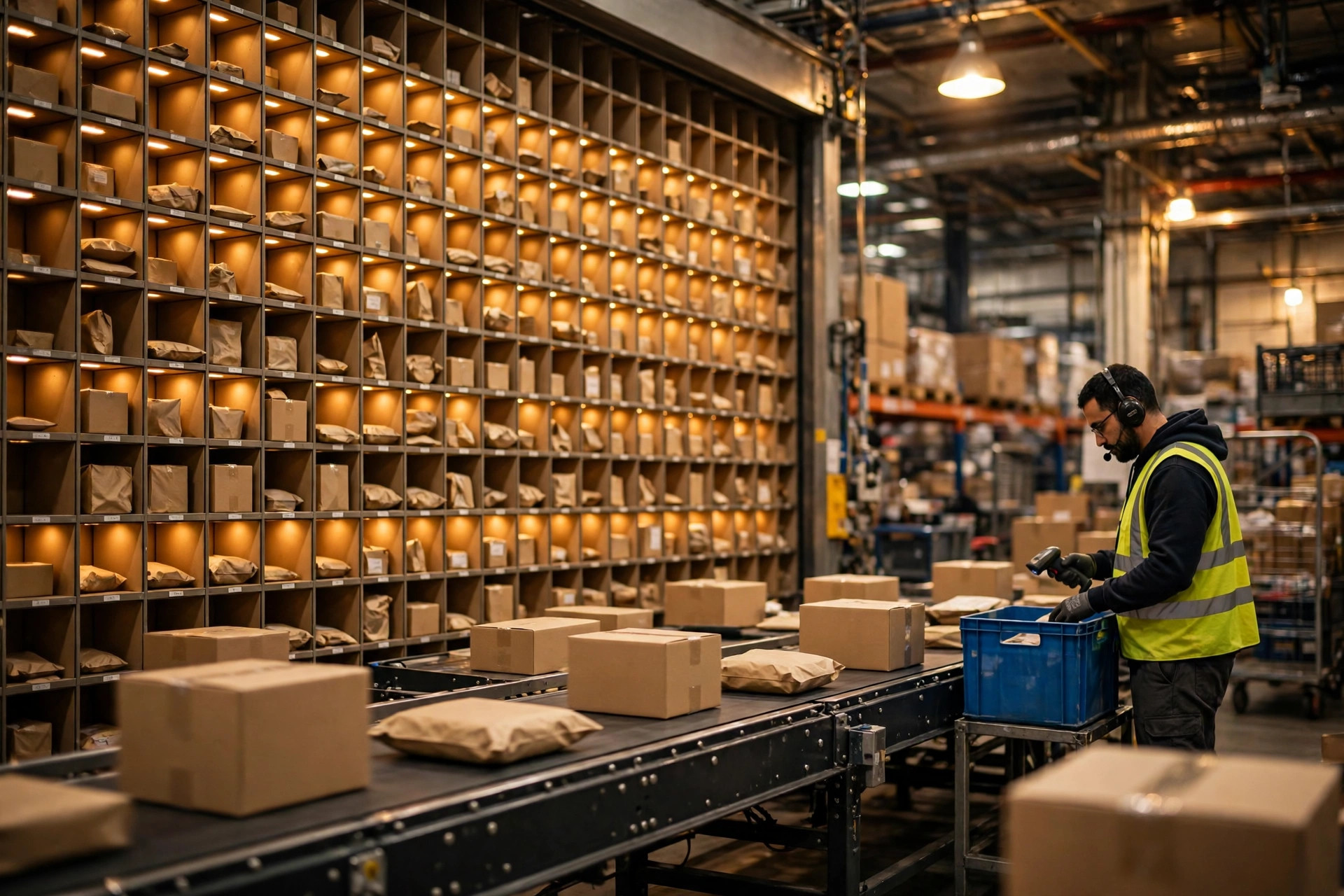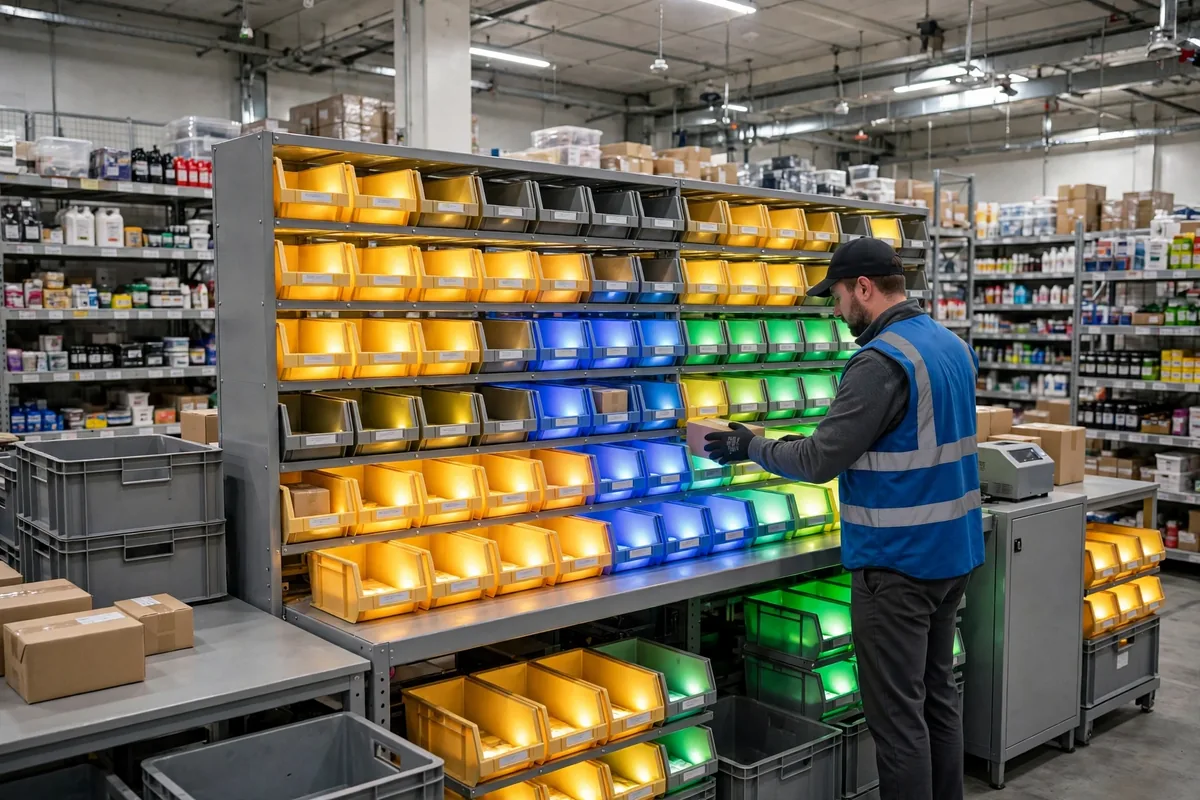
A put to light system for ecommerce sounds like a big-warehouse toy, but in plain terms it is a lamp on every pick location. The system tells you which location to go to and how many units to take. The light comes on, you grab the goods, you press the button, the light goes out. Think of it like a traffic light at an intersection: you do not memorize the route, you just follow the lights. For a small e-commerce seller, the question is never whether the technology works. The question is whether your order volume earns the investment.
Let me get the principle straight before talking money. Put to light does two jobs: guiding picks from locations to orders, and guiding sorts from bulk picks into order slots. Small sellers usually meet the second one, paired with a sort wall: a wave of orders comes in, and the lights tell you which slot each item belongs in. The most common setup is a light-guided sort wall, and how a put-to-light sort wall works in e-commerce fulfillment covers how the wall is laid out and how slots are assigned. This article does not repeat that. It does the math for a small seller.
How a Put to Light System Works: A Traffic Light on Every Location
You can think of it this way: put to light moves the job of "finding the goods" out of the worker's head and onto the wall. In manual picking, the worker reads the order, finds the location, and checks the product name. Three steps, all depending on one person, and errors creep in at all three. With put to light, the worker keeps only one job: moving their hands. Where to go and how many to take are decided by the light. The fewer decisions a person makes, the fewer chances to get one wrong.
The hardware itself is not mysterious: a lamp module, a small display showing the quantity, a confirm button, and a controller wired into your order system. The hard part was never the lamp. It is the integration. The lights need to understand your orders, and the system needs to know which lights are on and which picks are done. Think of it as a nervous system for the warehouse. The lamps are the nerve endings. The real work happens in the software layer in the middle.
[Illustrative scenario — figures are hypothetical.] I have seen a small home-goods seller running about 800 orders a day with fewer than 300 SKUs, picking by memory with two people. On a promotion day, volume tripled. The temporary workers they brought in could not even recognize the locations, mis-ships spiked, and customer service spent three days drowning in return tickets. That was not a people problem. It was a process that could not absorb volatility. Put to light fixes exactly this: volume can surge, but the process no longer depends on any one person's memory.
When Order Volume Justifies Put to Light: Three Dividing Lines
Here is the conclusion first: a put to light system for ecommerce is not divided by company size. It is divided by order structure. If you cross two of these three lines, it is time to talk seriously.
First, volume. A sustained daily volume above 1,000 orders is a common starting line. Below that, the cost of the lights spread across each order is too heavy, and manual picking plus scan verification is the better buy. Second, wave density. Do your orders arrive in concentrated waves? A few orders trickling in all day gives the lights almost nothing to do. Two or three fixed waves of several hundred orders each, and the lights pay off immediately. Third, the cost of a mis-ship. If your goods are high-value, returns are expensive, or the platform penalizes mis-ships, the money the lights save on errors can exceed what they save on labor.
| Daily orders (hypothetical reference) | Recommendation | Why |
|---|---|---|
| Under 500 | Manual picking plus scan verification | The lights cost too much per order; get scan verification right first |
| 500 to 1,500 | Decide on waves and mis-ship cost | Concentrated waves and expensive errors justify a quote; otherwise wait |
| Above 1,500 | Evaluate put to light seriously | Volume supports the investment; focus on the payback period |
Note that the volume bands in this table are hypothetical reference points, not a promise from any vendor. SKU counts, order profiles, and labor costs differ from one warehouse to the next, so the dividing lines move. Equipment and consumable prices vary widely between vendors, so treat any specific price as subject to the vendor's latest quotation, and never apply someone else's quote to your own warehouse.
Put to Light vs Manual Picking vs Scan Verification
I have no patience for false needs, so let me say this plainly: what many small sellers actually lack is not lights, it is verification. Manual picking plus a scan-verification step cuts mis-ships dramatically at a fraction of the cost of a light system. If your errors come from grabbing the wrong item, scan verification solves it. If your errors come from sorting right items into the wrong order slots, that is where put to light earns its keep. Figure out where you go wrong before you decide what to buy.
The cost structure has four parts: the equipment itself, installation and system integration, consumables and spares, and day-to-day maintenance. Equipment and installation are the one-time bulk. Consumables and maintenance are the small recurring bills. Many sellers only ask about the equipment price and never ask about integration, then discover integration ate more than 30% of the total budget. Ask for all four parts together. Any quote missing one of them is a trap.
[Hypothetical example.] Do not calculate payback as a percentage efficiency gain. Calculate it as money stopped leaking every month. Suppose you currently mis-ship 200 orders a month, and each one costs an average of $50 in returns and compensation. That is $10,000 a month in mis-ship cost. Suppose put to light cuts that to 40 orders a month, saving $8,000. Suppose the system costs $5,000 a month in amortization plus maintenance. Then you net $3,000 a month, and the payback period is the total investment divided by $3,000. Every number in that example is hypothetical. Plug in your own real numbers and run it again before you believe the conclusion.
Three Things That Go Wrong After Go-Live
First, lights that no longer match locations. Locations were rearranged before go-live, but the lights still follow the old map, and new workers follow the lights and pick the wrong goods. My rule: the light map and the location map must be the same data. Move a location, update the lights the same day, and spot-check ten lamps before the shift starts.
Second, a promotion wave that overwhelms the pace. A wave of 300 orders runs fine on a normal day, then a promotion pushes one wave to 900 orders, the sort wall runs out of slots, the lights are on with nowhere to put the goods, and the floor jams. The fix is to calculate the peak wave size in advance and split the wave when slots run short. Lights will not conjure extra slots for you.
Third, nobody owns maintenance. A lamp dies, nobody repairs it, half the wall goes dark, workers slowly stop looking at the lights, and the system might as well not exist. Maintaining put to light is not hard, but someone has to own it: a weekly check, spares stocked at about 5% of installed lamp modules (a hypothetical reference, adjust to the vendor's recommendation), and no excuses. No MTBF rating survives neglect.
[Illustrative scenario — figures are hypothetical.] One cosmetics seller I know ran more than 2,000 orders a day. Six months after installing lights, mis-ships were genuinely down. But to save effort, they ran the light system and the old manual sort side by side on the same waves: half the orders went through the lights, half by hand. When something went wrong, nobody could say whose error it was. My view is blunt: either run everything through the lights or do not install them. Half a system is messier than no system.
So is the money worth it? It comes down to one number: what you currently lose to mis-ships each month, divided by the total monthly cost of a put to light system for ecommerce. Above one, it is worth a serious conversation. Below one, get scan verification right first.
By Da Liu, Automation Engineer